Ian Brodie

Ian Brodie


Navigation
Searchtime
Featured

Mindset

Is it better to be Truthful, or Interesting?

Posted on February 13th, 2010.

I've just had a rather heated argument with someone on a Linkedin discussion group that's had the side benefit for me of clarifying what I feel is the “right” way for professionals to promote their businesses.

I'll summarise the background briefly:

The person in question posts regular articles on a Linkedin group I'm a member of. His posts are pretty much “best practice” from a copywriting perspective. The headlines are always controversial and intriguing – they always make you want to read the article. And the articles are well written, opinionated and again, controversial.

Essentially, he's differentiating himself through his writing. He's not bland – he has clear points of view that I'm sure attract a lot of readers.

Last week, however, he posted on a subject I know something about. The business value of Twitter.

In a post entitled “Twitter is for Twits” he opined on how Twitter was a complete waste of time for businesses.

This is where it became intriguing for me. His headline was effective – it got people to read the article. The article was well written and got across a clear point of view.

The trouble was, I know a lot about using Twitter to get new clients. Both from my own experience and from others who I've talked to in depth about how they've used twitter to win new business. And my experience was very different.

His position massively oversimplified reality. In my experience, Twitter can work well for some people, in some circumstances, and used in certain ways. It's not a simple black or white, good or bad situation. Just like any other business development or lead generation channel, it requires careful thought to figure out if it will work in your circumstances, and to figure out how best to use it.

I wasn't the first person to answer the post – someone else posted a really thoughtful reply full of examples of how twitter could bring value. I posted my experience. I explained that I had 50,000 followers so I had some experience in the matter – and I went on to describe both how I had won (at least) a couple of clients via twitter and how others had done so with rather fewer followers but using a strategy of building deep relationships with a small number of people.

A few days later I received a Linkedin direct message from the person saying he was going to make a second post effectively using me as an example of how twitter was a waste of time because I had only won two clients despite having 50,000 followers.

I replied saying that that would be misinterpreting the facts. I use twitter for 10-15 minutes per day – and not every day. Getting two clients (and probably more, as I can't track all the clients who initially found me via twitter) and a bunch of other side benefits for 10-15 minutes per day in my spare time when there's not much else I can do for business development is actually a pretty good ROI in my point of view. Especially since I'm really, really expensive so those clients are very high value.

I also explained that whether twitter would be a valuable investment for people was not a simple question and required thorough analysis, not a blanket answer. And that I typically advised clients not to try to build large followings, but to use twitter to help build deeper relationships with a small number of potential clients.

Today I noticed he had gone ahead and made a new post on the Linkedin group exactly as he'd said. He'd completely ignored all the information and explanation I'd sent him.

Instead he made up a spurious calculation of how many people I must have touched with tweets over a year and claimed that only getting two clients from that “captive audience” viewing my tweets was an awful ROI.

Now measuring success with twitter in terms of new clients per tweet is like measuring success in advertising in terms of new customers per reader of the publication you've advertised in. Never mind that the one customer you got spent $1m and the advertising was free. Apparently it must have been a bad ROI because number of new customers per reader was low!

What he did was in many ways good copywriting. He continued to have compelling headlines and interesting, controversial and well-written material in his post.

But it was bad, bad advice. Worse, he deliberately gave that bad advice despite knowing better.

I can forgive him the initial post. We all sometimes write on a subject we're not experts on but which we feel passionate about. And sometimes we're wrong.

But I gave him detailed information which he then ignored when writing the second post.

Knowingly writing misleading information just to make an impact is wrong.

It may attract more viewers. It may build your reputation. it may make you more popular with people who share similar viewpoints.

But it's wrong.

People reading it will make bad decisions as a result that will cost them significant time and money – or worse.

And that brings me to my point.

As someone who writes a lot, I'll admit to trying to construct intriguing or controversial headlines to get more clicks to my site or readers to my articles. I've even constructed headlines to try to help my ranking in google.

But as professionals our primary duty is to our clients. We must give them the very best advice we can – not just say what best promotes ourselves.

Now sure, I may not be right all the time. And my passion may get the better of me and cause me to write or say something when I'm not in full possession of the facts.

But it is our absolute duty as professionals not to twist or ignore information to best serve our own interests.

So it's most definitely best to be truthful.

Interesting gets more readers and more traffic. But truthful is the right thing to do.

And it allows me to sleep at night.

And I like to think that in the long term, it wins loyalty and trust.

Featured

Strategy

How to Use Linkedin to win new business: poll results

Posted on January 28th, 2010.

My latest tips on building a Client Winning Profile for Linkedin are now on a free, short video – click here to watch it.

As you might know, as (apparently!) a Linkedin Expert, I've been asked by Cisco Webex and Linkedin to do occasional blog posts related to the European Business Awards they're running.

One thing I was interested in finding out was how people were using Linkedin to win new business. Many people, myself included (in this article on Linkedin tips for professionals), have written on the topic and given ideas and recommendations based on our own experiences and private research.

But I wanted to know how this was playing out in practice.

Never mind the theory, how are people actually winning business via Linkedin in the real world?

Webex were kind enough to run a poll for me in the Business Awards group asking people what they'd found to be the best way of winning new business via Linkedin.

We had 256 respondents. Of course, the results have an inbuilt bias as they're not from the full Linkedin population, but from those who have participated in the Business Awards group. But they certainly give a good picture of the different ways people are actually using Linkedin effectively.

The Results: Just How Are People Using Linkedin to Win New Business?

The poll question asked was “What has been the best way you've found to win new business using Linkedin?”. Like all Linkedin polls, respondents were allowed to pick one answer only.

First up: Overall results from all respondents

Overall Business Development Poll Results

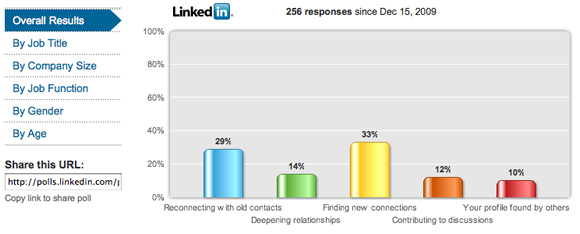
That “Finding new connections” came out in 1st place is no surprise. The way Linkedin works makes it ideal for connecting with friends of friends. And that's been the main focus of most of the advice given about how to get new clients through Linkedin: using search and asking other to refer you.

But what was a surprise for me was that “Reconnecting with old contacts” was only just a few percentage points behind it in 2nd place. Remember, the question wasn't just about how you use Linkedin generally or for fun – it asked respondents about the best way they'd found to win new business. And nearly 30% of respondents were primarily getting new business from reaching out to old contacts they'd lost touch with.

When you think about it, this makes sense. Our old contacts (in the main) already know and trust us – whereas new connections don't. And the obvious initial question “what are you doing now?” can lead to interesting follow-ups: “oh really, funny you should say that, we were looking for someone to…” or “actually, I know someone who is on the lookout for…”. Although this is not something that's happened to me personally, a number of people I've spoken to have said this has worked well for them. the contacts they've reconnected with have often been in a position to pass on work to them.

Linkedin's pretty good at recommending names to reconnect with. And the more old contacts you connect with, the more it seems to recommend other, similar contacts.

So perhaps my biggest recommendation emerging from this survey is that if you want to use Linkedin to win new business, don't just focus on trying to find new connections: look at re-establishing contact with some of your old colleagues and clients.

Results by Company Size

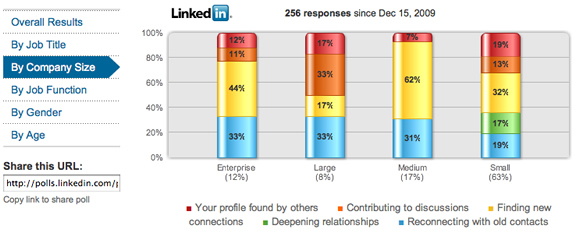
There weren't really many differences between responses of different levels of seniority of respondents. But where there was an interesting difference was when you look at the results by company size.

Linkedin Business Development Poll Results By Company Size
You can see here a clear difference in the response of medium sized firms.

There were a significant number of responses from these firms (44), yet none of them found either contributing to discussions or deepending relationships to be good uses of Linkedin to win new business.

It's difficult to make a lot of sense of these results. Perhaps medium firms are less specialist than small ones – and hence don't get value from sharing their expertise in discussions. But then why would large firms and corporates firms see value in it?

Without knowing the answer, what is clear is that few medium sized firms have found value in this. Yet it's often a strategy recommended by experts in Linkedin.

My own experience is that I'd be wary of investing a lot of time in using Linkedin discussions (either in groups or the Q&A section) to try to win new business. Yes, you can establish yourself as an expert. But I've known many people invest a lot of time into building this expert status who've yet to see any work as a result from it. Not that no one has – but it does seem very hit and miss and difficult to predict in advance if it's going to pay off.

Results by Gender of Respondent: Stereotypes confirmed?

This is another area with markedly different results by group.

Linkedin Business Development Poll results by gender

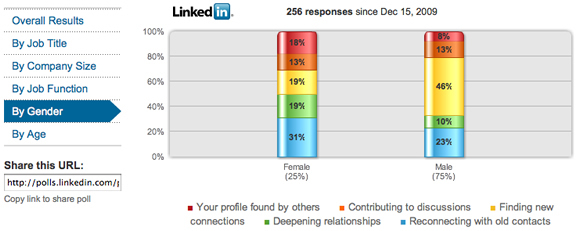
Firstly, there were a lot more men answering the poll than women: 192 to 64.

But more interestingly, the big difference is that for men, the strategy they report as being the most effective at winning new business by far is finding new contacts. For women it's a much more balanced picture. They get new business by reconnecting with old contacts more than men. They get business by deeping relationship with existing contacts more than men. And they get business by having their profile found more than men. In short, it plays right in to the stereotype of men as aggressive hunter gatherers – going out and looking for new business. While women spend more time nurturing old and existing relationships to win business.

Now this may be because we're playing to our stereotypes and if we tried alternative approaches we'd have success. Or it may be that women really are better at ‘relationship stuff” than men (I'm sure a woman wouldn't call it “relationship stuff” either). Either way, it's worth testing further.

What Does it Mean?

The main thing I've learned from this is to challenge my own assumptions. I've written quite a bit on Linkedin, discussed experiences with many people, and read widely. But it was still a surprise to me to find out how many people were using the “reconnection” strategy so effectively, or the differences between medium sized businesses and others, or the differences between the experiences of men and women.

In future I'm going to be a little more wary of assuming that because a certain strategy has worked well for me that it's the best one for others.

And, of course, I'm going to start reconnecting…

So that's my interpretation of the results? What do you think? Hit the Comments below to share – it's much appreciated.

Featured

Selling

What David Maister can teach us about Twitter

Posted on December 27th, 2009.

David MaisterTwitter is a bit of an enigma for most professionals. Can it be used successfully for business development? Is it an effective use of time, or a huge white elephant?

And while many commentators are pointing to the tailing off of Twitter’s previously phenomenal growth rates and the low usage amongst client decision-makers; some professionals are quietly going about their business using Twitter to win new clients.

One of the most common criticisms of Twitter is that “it’s just inane chatter”. People tweeting about what they had for breakfast, how much they enjoyed the latest episode of their favourite soap, or a joke they’ve just heard. And in all honesty, that was my initial reaction to Twitter when I was first encouraged to use it a couple of years ago.

The most common riposte to this criticism is to point out that many people don’t just tweet inanities. They tweet useful commentary or links to resources, articles and blog posts. “People are tweeting sensible stuff” they say, you just need to follow the right people.

But both sides are missing the point to some degree.

The fact is that most adult conversation is “just inane chatter” too. When we’re with our friends down the pub, talking to clients over coffee or colleagues by the water cooler we’re rarely sharing valuable business insights. Most of the time we’re talking about what we saw on TV, our plans for the weekend, what Bill in accounts is doing with Jane in HR.

We don’t build relationships with clients and colleagues by “talking shop” all the time. We do it in the gaps between business conversations. We open up a little and talk about what interests us, our views on the news, what annoys us and what makes us laugh. We talk about our family, our football team, and the funny thing we saw while on the way in to work.

David Maister (who as far as I'm aware isn't on Twitter himself) sums this up brilliantly when he says “The key to being a good communicator is talking when there's nothing to talk about”. Whether it's in your personal or business life, if the only time you talk is when there's an issue to talk about, then you're not going to build a relationship. You can see David on video expanding on this and on how to be a good listener here. (By the way, for any readers not familiar with Maister's work, bookmark this page, head on over to davidmaister.com, and take in the wealth of articles, video and podcasts. I'll see you back here when you're done – perhaps in a month or so…)

And it's exactly the same on Twitter.

Yes, it's great to post useful tips. You'll build your credibility no end by sending out links to great articles and blog posts in your niche, including some of your own.

But you won't build relationships.

Relationships are built by engaging at a human level with the other party. That means two-way communication, not just one-way broadcasting – no matter how great the material you're broadcasting is.

And two-way communication will inevitably include idle chit-chat. if you're genuinely interested in the other person then you'll be interested in their views on the news, what they're planning for the weekend, and perhaps even what they had for breakfast.

Case in point: a few weeks ago I engaged in a short twitter exchange with a professional I know reasonably well about karaoke tunes. A couple of other folks he knew joined in. We made fun of each other's selections, and suggested putting a karaoke band together. Nothing of any “value” was tweeted. No great insights or anything business related. But we all got to know each other a little better. We now have a shared experience: something to make a little joke about next time we meet online or in the real world. We know a little more about each other's personalities (and our taste in music). Pretty much the same as if we'd been introduced at a party or other casual encounter.

In fact, in some ways, Twitter can provide a real shortcut to building relationships. In the face to face world, it often takes some time to get beyond the “what do you do?” stage of conversation when you first meet someone. But on Twitter, most people seem quite willing to share their thoughts and ideas on a whole range of more personal topics. It's often possible to get a real insight into someone's personality, likes and dislikes quite quickly on Twitter – something that would take many meetings, often over months with face-to-face networking.

And because Twitter is still a fairly new channel, many users share a sense of being part of an “early adopter community”. They're much more willing to interact and respond to messages than they would be on other more established media.

So next time you hear someone complain about how all people tweet is nonsense, just smile and agree. And take note of David Maister's wisdom: it's that nonsense which actually builds relationships.

Featured

Mindset

The Business Development Drumbeat

Posted on December 9th, 2009.

The Business Development DrumbeatBack in the days when I was managing major business transformation projects, almost the first thing I did on every engagement was to instil a regular project management “drumbeat”.

Not that I particularly viewed myself as a Roman galley slave master. But the metaphor was clear. By establishing a regular cycle of project management reviews we ensured that the whole programme progressed forward in-sync.

Now of course, most consultants hate “bureaucracy”. They like to be self-managing and independent. But in practice, the regular drumbeat reviews always picked up things each team wasn't doing, or areas where they could integrate or work better with other teams. And they simply kept the pace moving. Knowing the reviews were coming up, each team leader managed the progress of their area better.

Not surprisingly, the same process works incredibly well for business development too.

Now whether you do them as part of a big team or you do them just for yourself, you need to take time out on a regular basis to look at your pipeline and identify actions you can take to improve its position.

A typical agenda for a business development drumbeat review might be:

  1. Review progress executing your Lead Generation tactics:
    • Reviewing progress vs your marketing action plans – i.e. are you successfully carrying out the activities
    • Reviewing the outcome of the tactics – e.g. how many short term leads (usually sales meetings) did you generate? How many long term leads (contacts passed into lead nurturing) did you generate?
    • Reviewing the progress of your Lead Nurturing activities – e.g. How many contacts did you make with your A/B/C clients and prospects vs plan?. How many prospects do you have in each phase of your nurture funnel (if you use one) and how is this progressing? What was the feedback from the contacts with A priority prospects and clients? How many nurtured leads converted into sales opportunities (i.e. a sales focused meeting for a live piece of work)?
  2. Reviewing the progress of your sales activities
    • What does each stage of your sales process/pipeline look like vs target and how is this progressing over time?
    • What was the outcome of your key sales meetings this period: lost sale, “treading water”, progress or sale?
    • What business did you close this period?
  3. Agreeing the critical activities your business needs to focus on in the
    next period

    • Are there shortfalls in the early stage pipeline?
    • Do you need to focus on Lead Generation?
    • Are some potential sales “stuck” and need senior effort to help progress?
    • What support is needed for each professional or business developer to help them progress and close their key opportunities in the upcoming period?
    • Are there any consistently weak areas in the process that need addressing?
    • Are any individuals consistently under-performing? Do they need coaching, support or reassignment?
    • Do we need more or different resources focused on lead generation or sales?

A simple review like this typically takes between 90 minutes to 2 hours and it's best done weekly (certainly for the first few iterations) or fortnightly.

At first it'll feel uncomfortable and bureaucratic. But persevere – the results will be well worth it.

Featured

Terms of Use

Posted on December 3rd, 2009.

PLEASE READ THESE TERMS OF USE CAREFULLY BEFORE USING THIS SITE.

By using the ianbrodie.com World Wide Web site, you agree to follow and be bound by these terms of use and agree to comply with all applicable laws and regulations. If you do not agree to these terms of use, please do not use this Site. I may revise these terms of use at any time without notice to you. If you have any questions about these terms of use, please contact me by email.

Please also refer to my privacy policy, cookie policy and disclosure policy which I refer to in this policy. And apologies in advance for all the legal lingo, apparently it’s necessary.

Introduction

These terms and conditions apply between you, the User of this Website (including any sub-domains, unless expressly excluded by their own terms and conditions), and Learningcloud Limited, the owner and operator of this Website. Please read these terms and conditions carefully, as they affect your legal rights. Your agreement to comply with and be bound by these terms and conditions is deemed to occur upon your first use of the Website. If you do not agree to be bound by these terms and conditions, you should stop using the Website immediately.

In these terms and conditions, User or Users means any third party that accesses the Website and is not either (i) employed by Learningcloud Limited and acting in the course of their employment or (ii) engaged as a consultant or otherwise providing services to Learningcloud Limited and accessing the Website in connection with the provision of such services.

You must be at least 18 years of age to use this Website. By using the Website and agreeing to these terms and conditions, you represent and warrant that you are at least 18 years of age.

Intellectual property and acceptable use

  1. All Content included on the Website, unless uploaded by Users, is the property of Learningcloud Limited, our affiliates or other relevant third parties. In these terms and conditions, Content means any text, graphics, images, audio, video, software, data compilations, page layout, underlying code and software and any other form of information capable of being stored in a computer that appears on or forms part of this Website, including any such content uploaded by Users. By continuing to use the Website you acknowledge that such Content is protected by copyright, trademarks, database rights and other intellectual property rights. Nothing on this site shall be construed as granting, by implication, estoppel, or otherwise, any license or right to use any trademark, logo or service mark displayed on the site without the owner’s prior written permission
  2. You may, for your own personal, non-commercial use only, do the following:
    1. retrieve, display and view the Content on a computer screen
  3. You must not otherwise reproduce, modify, copy, distribute or use for commercial purposes any Content without the written permission of Learningcloud Limited.

Prohibited use

  1. You may not use the Website for any of the following purposes:
    1. in any way which causes, or may cause, damage to the Website or interferes with any other person’s use or enjoyment of the Website;
    2. in any way which is harmful, unlawful, illegal, abusive, harassing, threatening or otherwise objectionable or in breach of any applicable law, regulation, governmental order;
    3. making, transmitting or storing electronic copies of Content protected by copyright without the permission of the owner.

Links to other websites

  1. This Website may contain links to other sites. Unless expressly stated, these sites are not under the control of Learningcloud Limited or that of our affiliates.
  2. We assume no responsibility for the content of such Websites and disclaim liability for any and all forms of loss or damage arising out of the use of them.
  3. The inclusion of a link to another site on this Website does not imply any endorsement of the sites themselves or of those in control of them.

Privacy and Cookie Policy

  1. Use of the Website is also governed by our Privacy and Cookie Policy, which are incorporated into these terms and conditions by this reference. To view the Privacy Policy and Cookies Policy, please click on the following: https://www.ianbrodie.com/privacy-policy and https://www.ianbrodie.com/cookie-policy

Availability of the Website and disclaimers

  1. Any online facilities, tools, services or information that Learningcloud Limited makes available through the Website (the Service) is provided “as is” and on an “as available” basis. We give no warranty that the Service will be free of defects and/or faults. To the maximum extent permitted by the law, we provide no warranties (express or implied) of fitness for a particular purpose, accuracy of information, compatibility and satisfactory quality. Learningcloud Limited is under no obligation to update information on the Website.
  2. Whilst Learningcloud Limited uses reasonable endeavours to ensure that the Website is secure and free of errors, viruses and other malware, we give no warranty or guaranty in that regard and all Users take responsibility for their own security, that of their personal details and their computers.
  3. Learningcloud Limited accepts no liability for any disruption or non-availability of the Website.
  4. Learningcloud Limited reserves the right to alter, suspend or discontinue any part (or the whole of) the Website including, but not limited to, any products and/or services available. These terms and conditions shall continue to apply to any modified version of the Website unless it is expressly stated otherwise.

Limitation of liability

  1. Nothing in these terms and conditions will: (a) limit or exclude our or your liability for death or personal injury resulting from our or your negligence, as applicable; (b) limit or exclude our or your liability for fraud or fraudulent misrepresentation; or (c) limit or exclude any of our or your liabilities in any way that is not permitted under applicable law.
  2. We will not be liable to you in respect of any losses arising out of events beyond our reasonable control.
  3. To the maximum extent permitted by law, Learningcloud Limitedaccepts no liability for any of the following:
    1. any business losses, such as loss of profits, income, revenue, anticipated savings, business, contracts, goodwill or commercial opportunities;
    2. loss or corruption of any data, database or software;
    3. any special, indirect or consequential loss or damage.

General

  1. You may not transfer any of your rights under these terms and conditions to any other person. We may transfer our rights under these terms and conditions where we reasonably believe your rights will not be affected.
  2. These terms and conditions may be varied by us from time to time. Such revised terms will apply to the Website from the date of publication. Users should check the terms and conditions regularly to ensure familiarity with the then current version.
  3. These terms and conditions together with the Privacy Policy and Cookies Policy contain the whole agreement between the parties relating to its subject matter and supersede all prior discussions, arrangements or agreements that might have taken place in relation to the terms and conditions.
  4. The Contracts (Rights of Third Parties) Act 1999 shall not apply to these terms and conditions and no third party will have any right to enforce or rely on any provision of these terms and conditions.
  5. If any court or competent authority finds that any provision of these terms and conditions (or part of any provision) is invalid, illegal or unenforceable, that provision or part-provision will, to the extent required, be deemed to be deleted, and the validity and enforceability of the other provisions of these terms and conditions will not be affected.
  6. Unless otherwise agreed, no delay, act or omission by a party in exercising any right or remedy will be deemed a waiver of that, or any other, right or remedy.
  7. This Agreement shall be governed by and interpreted according to the law of England and Wales and all disputes arising under the Agreement (including non-contractual disputes or claims) shall be subject to the exclusive jurisdiction of the English and Welsh courts.

Learningcloud Limited details

  1. Learningcloud Limitedis a company incorporated in England and Wales with registered number 06372487 whose registered address is 29 Dean Road, Handforth, Wilmslow, Cheshire, SK9 3AH and it operates the Website www.ianbrodie.com. The registered VAT number is 922389218.

You can contact Learningcloud Limited by email on contact@ianbrodie.com.

Attribution

These terms and conditions were created using a document from Rocket Lawyer (https://www.rocketlawyer.co.uk)

Featured

Privacy Notice

Posted on December 3rd, 2009.

This policy was last updated on 24th May 2018

1. INTRODUCTION

This privacy notice provides you with details of how we collect and process your personal data through your use of our site www.ianbrodie.com

By providing us with your data, you warrant to us that you are over 13 years of age.

Learningcloud Limited. is the data controller and we are responsible for your personal data (referred to as “we”, “us” or “our” in this privacy notice).

We have appointed a Data Protection Officer who is in charge of privacy-related matters for us. If you have any questions about this privacy notice, please contact the Data Protection Officer using the details set out below.

Contact Details

Our full details are:

Full name of legal entity: Learningcloud Limited. Company Number 06372487. VAT Number 922 3892 18.

Data Protection Officer: Ian Brodie

Email address: support(at)ianbrodie.com

Postal address: 29 Dean Road, Handforth, Wilmslow, Cheshire, SK9 3AH, United Kingdom.

Telephone number: 01625 326 989

It is very important that the information we hold about you is accurate and up to date. Please let us know if at any time your personal information changes by emailing us at support(at)ianbrodie.com.

2. WHAT DATA DO WE COLLECT ABOUT YOU, FOR WHAT PURPOSE AND ON WHAT GROUND WE PROCESS IT

Personal data means any information capable of identifying an individual. It does not include anonymised data.

We may process the following categories of personal data about you:

  • Communication Data that includes any communication that you send to us whether that be through the contact form on our website, through email, text, social media messaging, social media posting or any other communication that you send us. We process this data for the purposes of communicating with you, for record keeping and for the establishment, pursuance or defence of legal claims. Our lawful ground for this processing is our legitimate interests which in this case are to reply to communications sent to us, to keep records and to establish, pursue or defend legal claims.
  • Customer Data that includes data relating to any purchases of goods and/or services such as your name, title, billing address, delivery address email address, phone number, contact details, purchase details and your card details. We process this data to supply the goods and/or services you have purchased and to keep records of such transactions. Our lawful ground for this processing is the performance of a contract between you and us and/or taking steps at your request to enter into such a contract.
  • User Data that includes data about how you use our website and any online services together with any data that you post for publication on our website or through other online services. We process this data to operate our website and ensure relevant content is provided to you, to ensure the security of our website, to maintain backups of our website and/or databases and to enable publication and administration of our website, other online services and business. Our lawful ground for this processing is our legitimate interests which in this case are to enable us to properly administer our website and our business.
  • Technical Data that includes data about your use of our website and online services such as your IP address, your login data, details about your browser, length of visit to pages on our website, page views and navigation paths, details about the number of times you use our website, time zone settings and other technology on the devices you use to access our website. The source of this data is from our analytics tracking system. We process this data to analyse your use of our website and other online services, to administer and protect our business and website, to deliver relevant content and advertisements to you through the website, email and other media and to understand the effectiveness of our advertising. Our lawful ground for this processing is our legitimate interests which in this case are to enable us to properly administer our website and our business and to grow our business and to decide our marketing strategy.
  • Marketing Data that includes data about your preferences in receiving marketing from us and our third parties and your communication preferences. We process this data to enable you to partake in any promotions we may run such as competitions, prize draws and free give-aways, to deliver relevant content and advertisements to you through the website, email and other media and measure or understand the effectiveness of this advertising. Our lawful ground for this processing is our legitimate interests which in this case are to study how customers use our products/services, to develop them, to grow our business and to decide our marketing strategy.
  • We may use Customer Data, User Data, Technical Data and Marketing Data to deliver relevant content and advertisements to you through the website, email and other media (including Facebook adverts or other display advertisements) and to measure or understand the effectiveness of the advertising we serve you. Our lawful ground for this processing is legitimate interests which is to grow our business. We may also use such data to send other marketing communications to you. Our lawful ground for this processing is either consent or legitimate interests (namely to grow our business).

Sensitive Data

We do not collect any Sensitive Data about you. Sensitive data refers to data that includes details about your race or ethnicity, religious or philosophical beliefs, sex life, sexual orientation, political opinions, trade union membership, information about your health and genetic and biometric data. We do not collect any information about criminal convictions and offences.

Where we are required to collect personal data by law, or under the terms of the contract between us and you do not provide us with that data when requested, we may not be able to perform the contract (for example, to deliver goods or services to you). If you don’t provide us with the requested data, we may have to cancel a product or service you have ordered but if we do, we will notify you at the time.

We will only use your personal data for a purpose it was collected for or a reasonably compatible purpose if necessary. For more information on this please email us at support(at)ianbrodie.com In case we need to use your details for an unrelated new purpose we will let you know and explain the legal grounds for processing.

We may process your personal data without your knowledge or consent where this is required or permitted by law.

We do not carry out automated decision making or any type of automated profiling.

3. HOW WE COLLECT YOUR PERSONAL DATA

We may collect data about you by you providing the data directly to us (for example by filling in forms on our site or by sending us emails). We may automatically collect certain data from you as you use our website by using cookies and similar technologies. Please see our cookie policy for more details about this https://www.ianbrodie.com/cookie-policy.

We may receive data from third parties such as analytics providers such as Google based outside the EU, advertising networks such as Facebook based outside the EU, search information providers such as Google based outside the EU, providers of technical, payment and delivery services, such as data brokers or aggregators.

We may also receive data from publicly available sources such as Companies House and the Electoral Register based inside the EU.

4. MARKETING COMMUNICATIONS

Our lawful ground of processing your personal data to send you marketing communications is either your consent or our legitimate interests (namely to grow our business).

Under the Privacy and Electronic Communications Regulations, we may send you marketing communications from us if (i) you made a purchase or asked for information from us about our goods or services or (ii) you agreed to receive marketing communications and in each case you have not opted out of receiving such communications since. Under these regulations, if you are a limited company, we may send you marketing emails without your consent. However, you can still opt out of receiving marketing emails from us at any time.

Before we share your personal data with any third party for their own marketing purposes we will get your express consent.

You can ask to stop sending you marketing messages at any by following the opt-out links on any marketing message sent to you or by emailing us at support(at)ianbrodie.com at any time.

If you opt out of receiving marketing communications this opt-out does not apply to personal data provided as a result of other transactions, such as purchases, warranty registrations etc.

5. DISCLOSURES OF YOUR PERSONAL DATA

We may have to share your personal data with the parties set out below:

  • Service providers who provide IT and system administration services.
  • Professional advisers including lawyers, bankers, auditors and insurers
  • Government bodies that require us to report processing activities.
  • Third parties to whom, in future, we may sell, transfer, or merge parts of our business or our assets.

We require all third parties to whom we transfer your data to respect the security of your personal data and to treat it in accordance with the law. We only allow such third parties to process your personal data for specified purposes and in accordance with our instructions.

Since service providers can change frequently we haven’t listed each individually. Should you require we can provide a list of current service providers on request.

6. INTERNATIONAL TRANSFERS

We are subject to the provisions of the General Data Protection Regulations that protect your personal data. Where we transfer your data to third parties outside of the EEA, we will ensure that certain safeguards are in place to ensure a similar degree of security for your personal data. As such:

  • We may transfer your personal data to countries that the European Commission have approved as providing an adequate level of protection for personal data by; or
  • If we use US-based providers that are part of EU-US Privacy Shield, we may transfer data to them, as they have equivalent safeguards in place; or
  • Where we use certain service providers who are established outside of the EEA, we may use specific contracts or codes of conduct or certification mechanisms approved by the European Commission which give personal data the same protection it has in Europe.

If none of the above safeguards is available, we may request your explicit consent to the specific transfer. You will have the right to withdraw this consent at any time.

7. DATA SECURITY

We have put in place security measures to prevent your personal data from being accidentally lost, used, altered, disclosed, or accessed without authorisation. We also allow access to your personal data only to those employees and partners who have a business need to know such data. They will only process your personal data on our instructions and they must keep it confidential.

We have procedures in place to deal with any suspected personal data breach and will notify you and any applicable regulator of a breach if we are legally required to.

8. DATA RETENTION

We will only retain your personal data for as long as necessary to fulfil the purposes we collected it for, including for the purposes of satisfying any legal, accounting, or reporting requirements.

When deciding what the correct time is to keep the data for we look at its amount, nature and sensitivity, potential risk of harm from unauthorised use or disclosure, the processing purposes, if these can be achieved by other means and legal requirements.

For tax purposes the law requires us to keep basic information about our customers (including Contact, Identity, Financial and Transaction Data) for six years after they stop being customers.

In some circumstances, we may anonymise your personal data for research or statistical purposes in which case we may use this information indefinitely without further notice to you.

9. YOUR LEGAL RIGHTS

Under data protection laws you have rights in relation to your personal data that include the right to request access, correction, erasure, restriction, transfer, to object to processing, to portability of data and (where the lawful ground of processing is consent) to withdraw consent.

You can see more about these rights at:

https://ico.org.uk/for-organisations/guide-to-the-general-data-protection-regulation-gdpr/individual-rights/

If you wish to exercise any of the rights set out above, please email us at support(at)ianbrodie.com.

You will not have to pay a fee to access your personal data (or to exercise any of the other rights). However, we may charge a reasonable fee if your request is clearly unfounded, repetitive or excessive or refuse to comply with your request in these circumstances.

We may need to request specific information from you to help us confirm your identity and ensure your right to access your personal data (or to exercise any of your other rights). This is a security measure to ensure that personal data is not disclosed to any person who has no right to receive it. We may also contact you to ask you for further information in relation to your request to speed up our response.

We try to respond to all legitimate requests within one month. Occasionally it may take us longer than a month if your request is particularly complex or you have made a number of requests. In this case, we will notify you.

If you are not happy with any aspect of how we collect and use your data, you have the right to complain to the Information Commissioner’s Office (ICO), the UK supervisory authority for data protection issues (www.ico.org.uk). We should be grateful if you would contact us first if you do have a complaint so that we can try to resolve it for you.

10. THIRD-PARTY LINKS

This website may include links to third-party websites, plug-ins and applications. Clicking on those links or enabling those connections may allow third parties to collect or share data about you. We do not control these third-party websites and are not responsible for their privacy statements. When you leave our website, we encourage you to read the privacy notice of every website you visit.

11. COOKIES

You can set your browser to refuse all or some browser cookies, or to alert you when websites set or access cookies. If you disable or refuse cookies, please note that some parts of this website may become inaccessible or not function properly. For more information about the cookies we use, please see https://www.ianbrodie.com/cookie-policy.

Featured

News

Linkedin News and Leadership Poll

Posted on November 18th, 2009.

Regular readers will know I'm a big fan of Linkedin as a business development tool for professionals (see 10 Linkedin Tips for Professionals for my guide to the best ways to use it).

I'll be doing quite a few more Linkedin posts in the upcoming weeks. Some of them will be further ideas on using Linkedin for business development. But some will be more news oriented.

The reason for that is I've been asked to blog about and comment on the upcoming Linkedin European Business Awards 2010.

As you may have seen in the press, Linkedin and Cisco WebEx are sponsoring these awards and are running a large poll over at www.linkedinbusinessawards.com to get votes for the Start Up, Leader, Business Innovation and Rising Star of the Year.

The judges for the Grand Prize are Pierre-Yves Gerbeau (of Millenium Dome rescue fame), Reid Hoffman (Executive Chairman of Linkedin) and James Campanini (Director of Cisco WebEx for EMEA and LATAM).

During the run-up to the awards, they'll be holding a variety of discussion events and polls. As a blogging partner for the event I'll be getting exclusive access to these and will also be able to pose questions to the judges. I'll be posting the results up here.

The first thing I've got a sneak preview of is a poll they've been running on leadership.

I don't claim to be a great expert on leadership, but I've run and analysed quite a few surveys in my time.

The basic question they asked was What do you think is the most important factor in Leadership?

The possible answers were:

  • Character
  • Knowledge
  • Communication
  • Vision
  • Drive

Very surprisingly, despite the dominant stress on Vision, Drive and Character in the literature on Leadership, the overwhelming choice of the 608 respondents (so far) was Communication:

What do you think is the most important factor in Leadership?
Overall Results

Overall Results: Communication rated most important factor in leadership

Does this really mean that communication is the most important factor in leadership?

Not really – after all, a poll is only telling you the opinion of people – it's not measuring which factor has the most impact in practice. But it does highlight something I believe is rather important.

In my experience, what polls like this actually measure is the most pressing related issue at the top of the minds of the participants right now. If you ask us what the most important factor in leadership is, or teamwork, or business development excellence; we never really give our objective, dispassionate view of the absolute importance of the factors. What we give is our view on what we are most missing out on right now.

In this case, the poll is highlighting that most participants see a problem with the level and quality of communication of their leaders (or they see it as their main challenge if they're a leader themselves). It's impossible for anyone to know for sure, objectively whether communication is more important than vision. But they answer with their gut feeling. And if currently they feel they're not being communicated well enough with, then that's what they'll answer.

The results were pretty consistent across gender, and also across the different sizes of companies respondents worked for. With the exception that communication was (understandably) viewed as even more of an important factor in very large enterprises.

Results across job role were similar too – with the interesting discrepancies that engineers don't seem to care about their leaders having character, IT people not seeming to care about them having a vision, and sales people not seeming to care if they had drive.

What do you think is the most important factor in Leadership?
By Job Function

Leadership poll: Engineers don't care about character!

Perhaps the most interesting result was the variety in responses across age groups:

What do you think is the most important factor in Leadership?
By Age Group

Leadership poll: 25-34s worry more about communication
There's a big difference between the scores of the different age groups here (discounting the 55+ group which is obviously a very small sample size).

It seems that as young people enter the workforce, they have a fairly balanced view of what is needed from leadership. However, those in their mid 20s to mid 30s are focused much more than anything else on the importance of communication with leadership (or the lack of it). Then those from 35 upwards are less concerned with communication and again have a more balanced perspective on leadership issues.

The results could be read 2 different ways.

On the one hand, you could interpret this as meaning that the 35+ group are more senior and closer to their firm's leadership – and so are being communicated effectively with, whereas the younger cohort of up and coming staff aren't.

On the other hand you could view it as a demographic shift. Those of us of a slightly older generation don't expect so much communication and interaction with our leaders. But 20 somethings are used to being able to connect closely with their idols through the media or directly via twitter, and follow their exploits and outpourings on blogs, comment columns and gossip sheets. It could well be that this generation needs to be communicated with more, and in different ways.

I don't have the answers to this, of course. But it's interesting food for thought.

I'll be doing another Linkedin post shortly with a quick hint on using status updates. And I may well have some news about another interesting poll that's being run.

Disclosure: I'm not being paid or given anything to support this event. I'm a big user and fan of Linkedin, but I've never used WebEx at all so can't comment on it's effectiveness as a business tool (although I might give it a whirl sometime in the next few months)

Featured

Marketing

Meet: Lawyers – great idea

Posted on November 13th, 2009.

Over on my (small but very friendly) Rainmaker Network Linkedin group we've been discussing using Linkedin for business development in professional services.

One idea I'd not heard before came from Julian Johnstone. He's set up a group called Meet: Lawyers where lawyers who are travelling can set up “meetings for coffee” with other lawyers in the cities they're visiting.

One of the best sources of referrals for many professionals is other professionals in the same field. This might either be in complementary or non-competing specialisms (a lawyer in a corporate practice referring to a divorce lawyer in a family law practice for example) or even from direct competitors (a divorce lawyer recommending a “competitor” as they clearly can't represent both sides in a case).

Sometimes professionals are asked to recommend people in other locations – and small firms are at a disadvantage here as they often don't have good contacts outside the town they practice in.

The Meet: Lawyers idea really helps with this. And for a lawyer alone in a different city, provides a bit of social contact too (hey, someone's got to feel sorry for lawyers).

Check out Julian's group here

Featured

Selling

Dealing with a "Stonewall"

Posted on November 9th, 2009.

Stonewall reactionOne of the situations I've always found it difficult to handle in business development is when a potential client you meet “stonewalls” you.

In other words, they don't respond or react to what you're saying.

I rarely get this reaction nowadays – for reasons we'll come on to later. But early on in my career when I first started taking on consulting sales roles rather than just delivery roles it was something I encountered a number of times. It's worth taking a look at some of the reasons why you might get this reaction from potential clients, and what you can do about it.

The first reason you might get a stonewall reaction is if the client is not expecting a sales meeting. In particular they're not expecting to be asked about or to talk about their own business or challenges.

This can often happen if you've been referred in to the client, or if your firm already has a relationship with the client and you're brought in to cross-sell other services.

Often the way the meeting has been set up in these cases can leave something to be desired. The potential client is often just told that you'll be there to share information, or present some new ideas or techniques.

The referrer or person in your firm who holds the relationship with the client feels they're being helpful by inviting you in – but doesn't want to go as far as saying to the potential client “I think you need help in this area, and this meeting is about seeing if that's the case”.

So part of the solution here is to be very clear about when to call you in, and how best to position it with the client. You should only be brought in if your colleague or referrer thinks the potential client really could need your help – preferably with a specific problem. And it's best to agree that with the client up front. Even if it's only to say “he'll talk about some of the best practices we've seen, and ask you a few questions about your business to see if they might apply to you”.

They have to create the expectation that you will be probing and asking questions about their business to identify a fit – not just presenting some material for their education.

If that pre-positioning hasn't been done, then it's imperative that you at least know about it. Then at the start of the meeting you can clarify what you'll be doing and that you'll be asking them questions and looking to see if there might a fit. You may want to consider not holding the meeting if it hasn't been set up correctly.

The second reason why the client might stonewall is if you don't really give them the chance to interact.

In my early days I tended to present at potential clients rather than discussing things with them. I was an engaging enough presenter, and I'm sure they learnt a lot from the presentations and it might even have worked to establish my credibility.

But the style I used didn't work to get them interacting with me.

It's something that's difficult to describe in words, but there are ways of presenting – the tone of your voice, the way you make eye contact, pauses you put into the material – that invite discussion. You can use almost the same words, but be much more likely to generate a reaction or response.

In the early days, the way I was presenting was sending out the signal “you're here to listen”. The potential client was placed into a passive mode where they sat and listened – but didn't talk about how what they were hearing might relate to their own business.

The third cause of stonewalling is the client's own reluctance or fear of engaging.

This can be for many reasons. they may fear you're going to try to “hard sell” them – and so don't want to open up. Or they don't perhaps want to admit to having problems in their business – they may be embarrassed, or not want to appear “weak”.

Getting over this fear has a lot to do with how you handle yourself in the meeting and the impression you create. You need to build rapport quickly, and to demonstrate that you're someone safe to open up to. You're not going to push product at them, and you're going to be understanding and empathise if they share their challenges with you.

Doing this isn't about using tricks and techniques. It's not about mirroring body language or using “hypnotic” words that magically make people like you.

It's about genuinely being interested in, and caring about the other person. It's about actively listening and trying to understand rather than just listening for gaps to come in with your own clever statements.

It's also about recognising when you need to challenge the other person. Today, if a potential client who has asked me in to talk to them doesn't really open up or answer questions then I now have the confidence and courage to pick them up on it.

I'll sometimes ask a very straight question: “Look, you don't really seem interested in the examples I'm giving, and you don't seem to have any problems in this area it's worth talking about. Yet you were interested enough to invite me in to talk to you today – so there must be a reason or something you want to discuss. Rather than dancing around – is there something specific we should be talking about that would be helpful for you?”

It doesn't always work – but it's a lot more likely to work than constantly talking at a stone wall.

Featured

Mindset

Make Business Development a Habit

Posted on October 27th, 2009.

Busy, Busy, BusyA couple of weeks ago I got a phone call from a friend which got me thinking about this particular topic.

The friend in question is David Lomas, who runs M3 Publishing – but more importantly, is the kind of guy who always has a dozen projects on the boil and has a huge network of connections.

David called me as he was driving home one Friday evening “just to keep in touch”. We spent the next 20 minutes or so just shooting the breeze, exchanging stories and brainstorming a little about a couple of projects we are working on.

Here's the point: 95% of people – when driving home on a Friday – would be listening to music, thinking about their weekend, or grumbling about the traffic.

But in David's case, the thing that came most naturally to him was to phone up his contacts to see how they were getting on.

The rest of us either wouldn't bother, or we'd be thinking “I don't want to intrude”, “I don't have a good reason to call” or “Why would he want to speak to me on a Friday afternoon?”.

We talk ourselves out of keeping in touch. Perhaps because we fear that 1 in 10 call where the person really doesn't want to hear from us. Or perhaps we just don't enjoy these part social, part business calls.

Now maybe David and others for whom business development seems to come naturally go through the same self-chatter like this. Or maybe they don't. But either way – it doesn't stand in their way. When they have a few spare moments they don't turn inward – they reach out to contacts and clients to stay in touch.

Another example: Steve Head.

Steve is one of the UK's top professional speakers. He's got that rare ability to entertain, inform and inspire.

Steve has an unusual business development approach – one I've not seen anyone else use: he keeps in touch with clients via text messages.

When I saw him at the Professional Speakers Association in Manchester, he talked about how he checked his phone after an evening away from home before a client seminar and was astounded to see that he'd sent 125 texts to clients the previous evening.

When I quizzed Steve about it he highlighted that every one of those 125 messages was personal and sincere. In other words, it's his way of keeping in touch with people he cares about – who also happen to be his clients. It's absolutely not a cold, calculated “what can I get in return” business development methodology. Nor is David's habit of phoning up his contacts.

Nonetheless, the habit shared by Steve and David is a healthy one from a business development perspective. By keeping in touch, they keep top of mind with clients. And because they both really care about their clients: every interaction they have deepens their relationships.

So do you have a business development habit? A way you keep in touch and deepen client relationships on “autopilot” without having to think, plan and prepare every time.

In reality – most of us don't do this naturally.

Personally, given a few moments spare, my first thought is to read a book or article – to expand my knowledge. I don't instantly think of getting in touch with current & prospective clients.

In order to get good at business development I've had to create habits which “force” me to do the right things. For example, keeping a list of my priority client and prospective client relationships and reviewing it weekly to brainstorm what I can do to help them this week.

It's not like I find keeping in touch with clients painful or difficult. It's simply that, unlike David or Steve, given a few spare moments, it's not my first thought.

And that's the thing. The world of the professional isn't filled with empty hours where we can start from scratch, plan how to keep in touch with clients, and carefully execute the plan. We're busy. Really, really busy.

We don't get hours spare at our desks. We get a few minutes here and there. Or we get an hour driving home or on the train.

If we have to think, plan and prepare our keep-in-touch activities, the reality is that they just won't happen.

So for people like me who aren't naturals at business development – we need to have already done our homework by the time our free moments arrive. If we're going to call people up (or even text them) we need to have thought through already who we're going to call and what we're going to say. Because if we leave it to our free moments, by the time we've figured out what to do the moment will be gone.

Most importantly, we need to get ourselves into the habit of staying in touch. Initially we have to force ourselves to do it with reminders and rituals. Over time, we'll come to do it automatically without having to force ourselves. We may even come to enjoy it.

And then we'll be indistinguishable from those natural business developers we all get so envious about.