Ian Brodie

Ian Brodie


Navigation
Searchtime
Featured

Marketing

Vertical Differentiation

Posted on April 19th, 2010.

You can't turn a corner these days without bumping into a marketing consultant banging on about the importance of a Unique Selling Proposition (USP) and differentiation.

I've written on the topic before – and in my view, for most service businesses it's actually far more important to focus on creating compelling client value than it is to worry about being unique or differentiating yourself.

However, it's a topic I keep coming back to and thinking about. For while clients buy based on the value you can bring, they may well initially notice you, and remember you based on your uniqueness or differentiation.

So there's a challenge here: being different helps you get noticed and get remembered. But if you're different in a way that doesn't add value to a client then you won't get hired.

Now you can try to find ways of being unique and different that are also valuable to clients – but it's difficult. Competition being what it is, if something is valuable to clients, other people will notice and create and provide that service too. Unless you're very, very smart or a great reader of early trends – the chances are if you spot something that no other professional in your field is doing – it's because clients don't value it.

But there is another way to think about differentiation.

Too often, when we think about differentiating ourselves we think of what I call “horizontal differentiation”. We want to be viewed as doing something different to our competitors. As not occupying the same space in our niche.

But think of some of the most successful professional service firms. Do they really do something different to their competitors?

Is McKinsey the only firm that does Strategy? No.

Do Skadden, Arps, Slate, Meagher & Flom* or other top law firms really do law differently? No.

Do AECOM design different buildings from the rest of the profession? Again, no.

What sets these firms apart is not that they are differentiated horizontally. They don't really do anything different to the other firms in their niche.

They do things better.

They're “vertically differentiated”. Clients perceive them to be in the same horizontal space as their competitors – but above them.

That's the perfect positioning for a professional service firm. Delivering the same services as their competitors (because they're the services clients need). But delivering them better.

How do you differentiate vertically?

Well to some degree, the perception of superiority comes from delivering great results.

But all professional firms have a truckload of testimonials and happy clients. It's difficult to differentiate on that.

What allows these firms to stand head and shoulders above their competitors is perceived authority.

Being a consultant, McKinsey is the firm I know best (in my career, I've had to come in after McKinsey projects and pick up the pieces on more than one occasion – yet their reputation is immaculate).

I've asked McKinsey clients about why they perceive them as being better than their competitors. And I consistently get two answers.

It's the quality and depth of their thought leadership – and the insights their partners share when they meet with them.

Clearly these two are related. Face to face insights come from personal experience – but also from the thought leadership the firm produces. Thought leadership is usually grounded in the personal experience of the team.

But perceived authority isn't the exclusive domain of global giants. At a local level, there are consultants, accountants, lawyers, many professionals who are viewed as authorities in their field.

They're the ones who “really know their stuff”. Who get invited to speak at events, and who are the first to get the call when there's a tricky or out-of-the-ordinary issue.

They get the best work, and they charge the highest prices.

So next time you're thinking about differentiation: think about up rather than sideways.

____

* I could have named a different law firm – but blimey, I love that name!

Featured

Mindset

The Top 10 Ways to Screw Up a Client Relationship

Posted on April 15th, 2010.

I don't often do top 10 lists, but most of this one came to me in a dream (which is a pretty sad admission in itself) and it kind of amused me.

In reverse order:

10. Bad mouthing a client. We all have clients that we dearly love, but who drive us wild. There's a terrible temptation to moan and bitch about them to colleagues, business partners and friends. Don't. Delivered with affection by you, you might get away with it. Repeated second hand you certainly won't.

9. Courting a competitor. It doesn't often happen (but it happened once to me). Sometimes clients can get upset if we approach or start working with one of their competitors – especially if it's a particularly direct or aggressive competitor. Even though you know you won't be sharing anything confidential and you're probably working in a different area, it can raise big concerns. Best to avoid it, or check with your current client first.

8. Being too salesy. Clients don't like being sold to all the time – especially not when they're paying you to be there. Developing client relationships and winning extension work, expansion work and referrals which currently being employed by them is subtle art you have to learn.

7. Making a mistake. We all make mistakes. Clients are usually very forgiving of small mistakes – but sometimes not. Make quality control a priority. Far more serious than making a mistake though, is:

6. Covering up a mistake. You might be able to cover up a mistake and get away with it, or fix it before the client notices. It's surprising how often they find out though. And if they do, they now know that you prioritise your interests above theirs. It's difficult to come back from that.

5. Overpromising. Even if you do a brilliant job, if you've promised the earth and you only give them the moon, they'll be disappointed. And they'll know not to trust your word in future.

4. Surprises. Clients hate being surprised. Even more so if they find out about it from their colleagues, their customers or their bosses rather than you. Make sure you warn them in advance of potential risks, and you keep them regularly informed. Even surprisingly good news can be embarrasing if you're the last to hear about it.

3. Taking key decisions without involving them. Even if clients have hired you because you're the expert not them, it can be a big loss of face for them if you take key decisions without consulting with them and reviewing the options. Agree very early in your engagement how you will take decisions and who will be involved. And stick to it.

2. Not being open. Touch feely stuff this – but important. Any close relationship will go through high points and low points. There'll be moments when the relationship is tested. As your relationship develops, it needs to move beyond the factual and rational into the emotional. But many professionals feel uncomfortable sharing their feelings. If a workshop or meeting or event didn't go as well as planned, instead of being open about their disappointment and how they feel, they put on their “game face”. They hide their feelings and call it professionalism. They never develop really strong relationships with clients because they never let them in.

1. Indifference. This doesn't sound like a big crime – but it's #1 because it's the cause of more broken relationships than anything else. When you've stopped working for a client (or even when you still are but you're really focused on delivery) it's so easy to stop communicating. All those great corridor chats they found so valuable suddenly go away. You don't seem to care any more. The truth is that you still love them, but you're just so darn busy. But to them, it feels like you don't care – and that the only reason you had a relationship with them was because they were paying you at the time.

That's my top 10 – comments on some of the things you've seen that screw up client relationships would be much appreciated – just drop them in the box below.

Featured

Selling

Selling Consulting Services: The Myth of "Killer Closing Techniques"

Posted on April 8th, 2010.

Mike Schultz's excellent free report “Selling Consulting Services: Forget Everything You Know About Sales and Begin to Sell Without Selling” has a great section in it on closing techniques.

At first I approached this chapter with trepidation. In my professional career I've never found closing techniques worked for me. Not only did they feel uncomfortably manipulative – the complete opposite of the relationship I was trying to build up – but clients didn't seem to respond to them as well as all the books suggested.

Maybe it was just me, I thought.

After all, all these sales gurus can't be wrong.

But as I grew in confidence and experience, I learned it wasn't just me.

The truth is that despite all the books you can buy and courses you can go on to learn “killer closing techniques”, when it comes to selling high value consulting and other professional services, they're actually counter productive. If people aren't yet convinced that they really need a service, and they're not sure that your particular one is right for them; then using closing techniques like asking if they'd like you to start on Tuesday or Thursday will push them further away.

So how do I recommend closing if it's not with techniques?

In my experience, closing is a three stage process which begins early on in your discussions with the client.

Initially, you set the stage for a positive close through the whole sales process by:

  • Confirming agreements through the discussion.
  • Addressing client concerns as they arise rather than “steamrollering” through to the next point.
  • Ensuring you drill for impact – it's understanding the full implications of the issue which will motivate the client to buy.

Next, close at the Concept level (i.e. first get agreement on what the client wants to achieve):

  • Summarise the client's priority needs, the impact of the issue and the outline of what they are looking for.
  • Check for any outstanding concerns – and genuinely address them if there are any.
  • Propose the next step – usually to move on to agreeing the practical details.

Finally, close at the Practical level (i.e. get agreement on what you will actually do together). This may need a second meeting and some further work from you to prepare an outline plan. But it's crucial that you and your potential client work together to finalise the scope and plan, for example:

  • Jointly discussing and designing the approach to the project/engagement (while remembering that you are the expert).
  • Checking for any final concerns – and addressing them.
  • Proposing moving forward together.

The idea of being able to use a magic technique to increase your sales is a very alluring one. But in the case of selling consulting or other professional services, it's a misguided one. Clients will only buy when they feel comfortable they're getting what they need from someone who's capable and who they can work with. You establish this in the way you engage with them throughout the selling process – not by using some clever technique at the end.

So how did my approach fare vs Mike's recommendations?

It turns out we're in agreement (which shouldn't have really been a surprise given I know Mike quite well). As Mike says in the report:

Selling consulting is about trust, not tricks

I couldn't have put it better myself.

—————
You can download a free copy of the Selling Consulting Services report here.

The reason Mike's giving away such a valuable report for free is simple: it's a bribe!

He and the team at Raintoday.com have just launched a new online training program on selling consulting services which they'd like you to try out: hence the “bribe” of the free report.

I chatted to Mike on the phone last week about the program and the content looks excellent. There are 6 modules, teleseminars, expert forums, and over 25 individual training sessions covering everything from developing your value proposition to starting sales conversations with rapport to getting in front of the economic buyer to crafting winning solutions to closing the deal.

Next to having your own personal business development coach or mentor, it's absolutely the best way to boost your selling skills.

They're limiting enrolment to the first 200 members who sign up and they're closing the doors on April 16.

This initial “Charter Membership” will be at only $97 per month. When they reopen the program the price will be at least double.

And as an added bonus, all Charter Members will get a free copy of the $345 “How Clients Buy Professional Services Benchmark Report” absolutely free. (As many of you know, I've been quoting the report and using it to guide a lot of my work over the last year).

You can find out more about the course here.

You should know, the Raintoday.com team have offered to pay me a small commission if any of my readers sign up for their course. I hope you know me well enough by now to know this has in no way influenced my recommendation. If you've been a reader of the blog for any time you'll know I've been a long-term supporter of Mike and the team and really respect the quality of their training.

Featured

Selling

How a Simple Piece of Paper can Transform Your Success at Selling

Posted on March 25th, 2010.

Tick tock, tick tock.

You're standing outside the boardroom waiting to meet the Senior VP of Operations for your #1 target client.

Tick tock, tick tock.

It's a vital meeting, crucial to your firm's success this year, and even more so for your own career.

Tick tock, tick tock.

The butterflies inside your stomach are bouncing around like competitors on ‘So You Think You Can Dance'. But you're well prepared. You know what questions you're going to ask. You know your “best realistic objective” and how you're going to close. You've rehearsed the objections you might face and gone over your case study anecdotes time and time again.

“Mr Jones will see you now”.

Great. Time for action. The adrenaline begins to pump as you head into the room.

You're ready. This is going to be great.

But it isn't.

Somehow, you get taken off track. He starts asking questions about your methodology. You spend too long talking about a potential issue that turns out not to be relevant.

And then your time is up. He has to leave 5 minutes early to get to his next meeting. You haven't asked half the questions you needed to – let alone achieved your objective.

“Very interesting” he says, “we'll give you a call if we need help in your area”.

And that's it. It's over. You're never going to hear from him again. You blew it.

It's not that you said anything stupid. It's just that in the heat of the moment and under pressure, you lost where you were.

It happens to all of us. And the more important the meeting, the more likely it is that you'll forget something. You won't ask about the decision-making process, or whether he's used consultants before, or how this impacts his overseas plants, or whatever critical questions you were going to ask.

And that's where the simple piece of paper comes in.

This is trivially simple. But it works. You'll probably read it and think “I don't need that”. But you do. I've been selling for over a decade and I still do this. It's got me out of a number of holes.

All you do is take out the notebook you're going to use to make notes and turn to a clean double page.

On the right hand page. Write what you normally write when you're about to have a meeting. Maybe the name of the person you're meeting, the date and an outline agenda. As normal, leave plenty of space for notes.

But on the left hand side, list all the questions you're going to ask and the things you need to remember. You can use my sales meeting planning guide to figure out what these questions are.

And since it's on the left hand page, it's not going to get in the way of your note taking. In fact, the person you're meeting with won't even know you've got a crib sheet – it'll look like the remains of a previous meeting.

See? I told you you'd think “I don't need that”. You're probably mumbling “I can remember a few simple questions” right now.

But you can't. In the heat of battle, under pressure, you will forget something vital. The more vital the meeting, the more under pressure you'll feel, and the more likely to forget you are.

It won't feel like it at the time. You probably won't go blank. But you will get distracted and sidetracked. You'll lose the flow, and you'll skip something vital. You'll only notice it afterwards, and then you'll kick yourself.

So try it out. It can't hurt, and it may well do you a load of good.

Featured

Marketing

Are You Exploiting This Key Strategy To Get More Clients?

Posted on March 23rd, 2010.

Campaign PlanWe've all heard multiple versions of the “it takes 6 touches before a customer will buy from you” saying. But how true is it?
In my experience it's very true.

But it's also very misleading.

You see, it kind of gives the impression that all you need to do to win a client is communicate with them in some way 6 times.

But if you got the same advertising flyer from someone 6 times would it make you more likely to buy? Or if you met the same person at a networking event 6 times, but your conversation never got beyond what they did?

To make an real impact on a client, rather than 6 (or more) random, unplanned or ad-hoc communications, you need a planned sequence of communications with each one furthering your relationship with them.

You need a campaign.

You can only really run campaigns for your highest potential clients. They require detailed thought, planning and preparation. You must think through what your clients need to know and feel about you before they'll feel comfortable hiring you (or initially meeting with you if that's the goal of your campaign). They you need to deliver a series of communications which focus on addressing each of these “know and feels”.

A classic example would be a direct mail campaign.

Imagine you have a prospect list which includes ten really high value potential clients. Winning work with any of those ten could start a relationship which could set you up for life.

Unfortunately, you don't know any of them. You've searched, but you can't find anyone you know who could refer you in to them. So you're considering writing or calling them directly.

Rather than a one-off letter which has a small chance of being read and acted upon (even with great copywriting) you should instead create a tailored campaign for each of the key clients.

Create a sequence of letters – each demonstrating something you need them to know before they'll be comfortable meeting with you. And each adding value.

For example, in your first letter you could send them a recent whitepaper you've written highlighting your expertise in an area you believe they need to focus on.

The next could include some case studies – each one providing useful information while showing you've done this before and are a safe pair of hands.

The next could be a link to an online video where you talk about how to make results from improvements in the area actually stick. Here they'll get a sense of your personality and a feeling for whether they'll be able to work with you.

The next could be some research you've done, a selection of related articles, etc.

Each letter includes something of high value to the potential client. But each item of value also doubles as a proof point that you're an expert in your field, that you get results, that you'd be great to work with – whatever it is you want them to know.

Now using a campaign like this is relatively high cost. Not exorbitant, and you should have a lot of material you can reuse for it. But it does require thought and planning.

But for your very high potential clients, the ideal ones you really want to work with, it's well worth it. If you were on the receiving end of such a campaign, would you be more likely to respond to it than a series of random sales-oriented letters or cold calls? I'm sure you would – and so will your clients.

Featured

Selling

Have You Forgotten How To Listen?

Posted on March 16th, 2010.

We're sorry, we've decided to go with someone else.

Aargh. The worst words any professional wants to hear.

You did a great job, it's just we decided to go with a training solution rather than the coaching you proposed.

But hang on, I do training. In fact I'm great at it. Let me tell you about the training I do…

But it's too late.

Has that ever happened to you?

The chances are it's because you weren't really listening to your potential client. Or more accurately, you didn't ask the right questions and you made too many assumptions about what they wanted.

Listening is Sales 101. It's one of the basics. The stuff they teach in your first few days in a role with business development responsibilities.

Listening allows you to properly understand what the client really needs and how to position your services to show they meet those needs. And clients need to feel listened to. If they feel you're not paying attention to them they'll assume you'll be like that to work with and they'll decide it won't be a pleasant or successful experience.

So why do so many of us do it so badly?

Well, there are two types of people who struggle with listening: The enthusiast and the expert.

Enthusiasts are often business owners or the ideas person behind a particular service. They're passionate about their services, they truly believe in them and they're convinced that their potential clients will benefit from them tremendously.

Passion's great when you're selling. In fact it's essential. If you don't believe in your services, how can you expect your clients to?

But sometimes passion can get in the way of selling. Passion can turn into evangelising, into a one way monologue rather than a dialogue where you do most of the listening.

Experts struggle because they assume they know what the client needs without asking. The minute a client mentions the first symptom of their problem they'll jump straight to the solution. They've heard it all before and they think they don't need to know anything more for their diagnosis.

The trouble is, they're often wrong. And even if they're right, the client doesn't feel as if they've really understood the issue. And the clients themselves, because they haven't been involved in a process of mutual discovery about the issue, don't feel any ownership of the solution.

Unfortunately for us professionals – especially those of us who run our own businesses – we're often both enthusiasts and experts. It can be a deadly combination.

After experiencing a number of “I'm sorry we're going with someone else” incidents many years ago I learned to bite my tongue. I learned to pay full attention to what the client was saying, not to focus on the next clever thing I was going to say. I learned to probe their problems fully and to explore the impacts. I still make mistakes and I'm far from perfect – but it works.

In short, by learning to listen, I learned to sell.

Make sure you do too.

Featured

Strategy

How to Escape Marketing Overwhelm

Posted on March 11th, 2010.

Do you ever feel overwhelmed when you look at your pipeline and think about what you need to do to fill it?

You’re not alone.

I think it’s the curse of business owners and executives these days. You look at how many new clients you need to bring in to hit your targets and then you try to think about how you’re going to do it.

But it’s so difficult to know where to start. What will actually work?

Back in the day, you pretty much had the choice of networking, direct mail, telemarketing or advertising when it came to marketing. Each with their own established best practices and rules.

Today we’ve got organic and paid search, social media, social media ads, video marketing, email marketing. And it all seems to be changing all the time.

I’ve lost count of the number of “next big thing” emails I’ve had trying to convince me to buy the latest and greatest method for getting a so-called flood of clients with some newfangled technique.

And that’s just Facebook!

When you’re just starting out – or even if you’re fairly well established – it can all be so overwhelming. So difficult to know what to do.

It was a big issue for me when I set out on my own. In some ways because I focus on marketing and sales it’s worse – because I deliberately keep tabs on all the newest approaches.

Every time I tried to think of what I should do I couldn’t get a clear picture in my mind. And all the stories of other people succeeding with this method or that method just confused me further.

So how on earth do we figure out what to do without spending every waking hour networking, phoning, tweeting or blogging?

Well, what follows is an approach I evolved that worked for me to clear the fog of uncertainty and give me some clarity on what to do.

I can’t promise it will work for you – but give it a try – it’s been helpful to a number of people I’ve shown it to.

The key to is to break down your marketing into manageable chunks. Ones you can think about sensibly. Too often, when we think about how we’re going to get new clients we lump all our potential clients into one amorphous blob.

And you know what? You can’t market to an amorphous blob.

So I found it helpful to split my clients into Top Clients and Others. For me, Top Clients are the top 10 clients I’d really love to win over the next 6 months. Clients who – if I got to do business with just one or two of them – could set me up for the year. For you it might be a top 5 or a top 20. But essentially it’s a small number of ideal clients you can think about individually.

You could go more sophisticated and split into A/B/C or suchlike. But let’s keep things simple for now.

The “others” are clients I’m not going identify specifically or do a specific plan for – too many of them. But I do aim to win a number of them via more general marketing.

Then I split my marketing into short term and long term.

Long term marketing is all about building “gravity”. Doing the things that will attract clients to you so you don’t have to actively seek them out. Thought leadership, stuff with your website and the like.

But long term marketing takes time before it pays off. So you also need some short term activities to try to bring in clients right now. The kind of stuff that pays the bills while you work on the long term side.

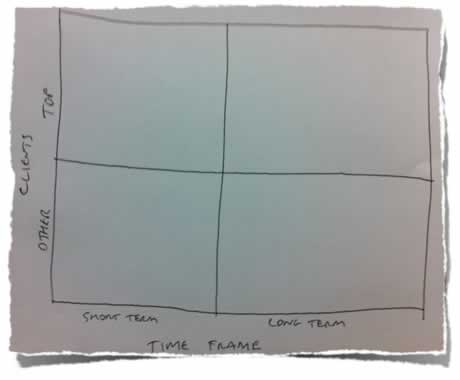
Then – because I’m a consultant and it’s part of the union rules – I draw a little 2 x 2 matrix to represent this. Client types on one axis and time frame on the other. Rather like this:

Client Categorisation Matrix

Then I think through what marketing activities would be the most appropriate in each box for each client type/time frame combination.

Splitting it up like this makes it much easier. Instead of struggling to see what marketing will magically work for all clients in all circumstances, I can take a “horses for courses” approach. It’s much easier to see what marketing will work in the short term for my top 10 clients, or to nurture relationships with the thousands of “other” prospects who visit my website for example.

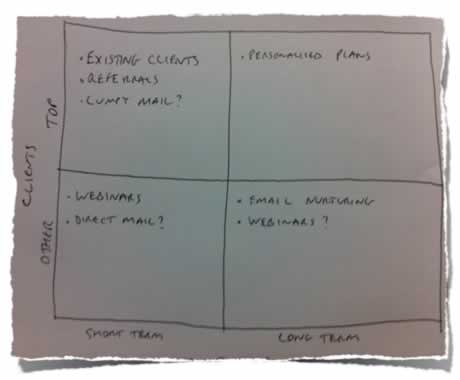
Usually, I end up thinking about referrals and extending existing client relationships for my top clients in the short term. And I develop unique, personalised nurture plans to build my relationship with my top prospects in the long term.

For the broader set of target clients, I’ll may pencil in approaches like webinars or direct mail in the short term – and I’ll focus on using email marketing nurture campaigns in the long term. Here’s an example of what the matrix might look like for a typical client:

Client Categorisation Matrix Example

Of course, your matrix will look different depending on your analysis of what marketing approaches will work for your specific clients – and what you’re good at.

But the key is that by breaking it up into this matrix rather than trying to eat the elephant all in one go, you zap the overwhelm.

As I say, I can’t promise it’ll work for you – but it’s worked for me and many others – I suggest you give it a go.

Featured

Marketing

Are Traditional Websites Dead?

Posted on March 4th, 2010.

Are Traditional Websites Dead?I recently recorded a podcast interview with Raintoday.com entitled “Is the Traditional Website Dead?” (You can listen to it free here).

The focus was specifically on websites for professional service firms – and reflected my experience with the success of my own site over the last 9 months. Despite being a rather small outfit (and determined to stay that way) – my site attracts more traffic than the sites of some of the top 30 consulting firms globally.

Why is this?

The primary reason, in my view, is that my site focuses almost completely on content. If you come to the home page, what you see is the latest of my articles or videos – and not a pitch for my services.

This helps me in two ways.

Firstly, it means I have lots of content indexed by google, with lots of keywords that potential clients may be searching on. And it's much easier for related sites in my field to link to a resource site like mine or specific articles on it than it would be to link to a corporate website that focused on pitching it's services. Sure, I do a lot of Search Engine Optimisation work and have a little bit of “secret sauce” I sprinkle around, but none of this would work without having a content rich site.

Secondly, once visitors arrive at my site, they're much more likely to stay than with a traditional site.

If you think about most professional services, the reality is that our clients don't need our services all the time. No one redoes their strategy every week, takes over a company every month, gets divorced every fortnight or changes their accountant daily. They use our services intermittently.

And if you think about the buying cycle for our services, our clients rarely wake up with a sudden need for our services that they weren't aware of before. The problems or opportunities that trigger the need for them to hire us usually start off small. They're a minor irritation or perhaps a glint of an idea.

Then, over time, the irritation gets bigger or the idea begins to firm up. They start looking around to find out more and to see what can be done. Years ago, they'd speak to colleagues and friends – maybe even dip into a book. Today, of course, they search the web.

So the first time a potential client visits my site (or any professional service firm's site) the chances are that they're not in buying mode. They're looking for useful information. And if they don't see useful information on the first page they come to, they're going to click away pretty quick.

Even if you have a blog or articles page just one click away from your home page, it's too far. You're not going to catch the attention of most visitors.

The BBC's website is always a good place to look for best practices. What do they have on their home page? Lots and lots of content. In the BBC's case it's primarily clickable headlines linking through to news, sports, business, entertainment or other stories. But the main point is that it has useful information rather than just a list of the BBC's services. You're encouraged to dig further and engage with the site.

So it should be with professional services websites. 90% of the time, your visitors will be early in their buying cycle. You need them to engage with you, get value from your site – and in the process discover that you know what you're talking about and you could be someone they could work with.

What's needed for this is not a traditional website with clever copy showcasing your services. it's a content-rich website that puts value for the visitor front and centre of its approach. Faced with this sort of website, your potential client is much more likely to engage with you and to keep coming back for more value.

Then when their initial irritation turns into an unbearable pain they need a solution to – you'll be the first on their list to contact. You may not win every time, but you'll be in pole position.

Featured

Selling

Downselling

Posted on February 23rd, 2010.

In the latest version of the Outside In newsletter I discuss a number of things that professional services can learn from internet marketers. Each of the strategies is something I've adopted myself or seen results from with clients.

To subscribe to the Outside In newsletter to read the article click here.

One strategy which internet marketers use a lot is the “downsell” – it's something I've rarely seen professional service firms use.

Downselling in Internet Marketing

We're all familiar with upselling and cross-selling. The downsell as used by internet marketers is where someone has declined your product or service offer (sometimes by simply clicking the close button on the web page) and you offer them an alternative product at a lower price.

The advantage of a downsell is that even if a customer doesn't buy the product you'd ideally like them to buy, they are at least buying something. That means you get some return for your sales effort. And since they're now a customer they will hopefully have a good experience with you and be much more likely to buy higher priced items in the future.

The problem with downsells is twofold.

  • First, they can be annoying. If you've pondered over a purchase and decided not to buy, it can be rather annoying to be held up and made another offer. And it might even seem desperate.
  • Secondly, they can encourage bad buying behaviour in future. If a customer comes to believe they will be made a “better offer” simply by saying no to the original offer, then they will always say no.

To counter the annoyance issue you need to make the downsell relatively pain free. Some marketers might argue that if you're going to lose a customer anyway, who cares about whether you annoy them. But in reality they may still be potential customers for the future, and they may also create bad publicity if they find the process very annoying.

To avoid encouraging bad buying behaviour, the downsell must not simply be a cheaper version of the original offer. It must be significantly different in some way which justifies the lower price.

For example, a common offer in internet marketing is a free DVD with training material on it. A downsell could be for cheaper, downloadable versions with no physical DVD.

Or it could be for less advanced training material that may be a better fit for the potential customer.

A good way to decide what the downsell should be is to survey customers to find out why they didn't by – what their main objections were. Was it price? Was the offer too simple? Or too complex? Are they actually more interested in a different area? Once you know the main objection you can offer a downsell which addresses it.

Downselling applied to Professional Services

In professional services we have the advantage that we're selling face to face – so there shouldn't really be a mismatch between what the client is looking for, and what we're offering.

But no one is perfect. Sometimes we offer a service that's more than the client was looking for. Sometimes it's just not quite focused in the right area.  Sometimes they realise they just don't have the money to afford the service we're offering. And sometimes they're just not quite convinced we're right for them – they haven't seen us in action yet.

In these cases a downsell can sometimes help.

For example, if you've been discussing a consulting project with a client, and they decided not to go ahead – perhaps a downsell to a training course in the same area for some of their team would get them to bite. After doing a brilliant job with the training course, the  consulting project may get put back on the agenda.

Perhaps you've proposed a major lead-time reduction programme across all the clients major factories – and it felt like too much to them. You might be able to downsell to a pilot in one factory.

When to Downsell

A downsell is most appropriate when you realise a client is not going to buy what you're currently offering. Don't introduce it too early – it may be you just need to work through some objections to confirm the original sale.

But if you know a client is not buying, then a downsell can work. It's best to visibly rewind the discussions. “John, it sounds like what I'm proposing doesn't fit well with what you're looking for. Do you mind if we backtrack a little and go back to some of the things you were saying about the problems you were having with your lead times?”. Then rework the problem and solution and introduce the downsell.

A downsell can also be introduced later. For example: if you ran a campaign to sell a 10 day analysis project to a qualified list of companies, try contacting the ones who turned you down a week later with an offer of a couple of places at a half day workshop you're running on the subject. It could be they were hoping to work with you – but just weren't yet convinced enough to justify the 10 day project. A half day workshop is much easier to buy – and may give them the confidence to hire you for the big piece.

In this case you must be careful and have a logical reason why you're proposing something new which you didn't throw into the original proposal.

For example, “John, we've had a number of clients express an interest in a half-day workshop on lead time reduction. It wasn't the right time to start up the analysis work together – but would you like to come along to the workshop?”

Creating downsells like this can reopen the dialogue with a client who may not have been ready to buy – but who may have been pretty close. Certainly closer to buying than a completely unqualified lead that you might be working on instead.

What's your experience?

Professional service firms often downscope an engagement if it's just too much for the client to buy. But wider downselling – particularly coming back later with a different offer – is a tactic I've not seen many firms use.

What's your experience been? Have you had successes or failures in this area. Please share in the comments below.

To read more about what professional service firms can learn from internet marketers (and get a free copy of my Referral Masterclass ebook), subscribe to the Outside In newsletter. Click here.

Featured

Disclosure Policy

Posted on February 22nd, 2010.

On this site I write articles and produce audio and video content about marketing and business development for consultants, coaches and other professionals. The material (unless marked as guest posts) is my original work – although they may have been inspired by the writing of, or discussions with others. Where this is the case it will be clearly stated.

I rarely review or endorse products. Where I do so I will have used (or read/watched in the case of a book or training course) the product myself and will be speaking from experience. I may provide a link to books or other products (e.g. on Amazon) via an affiliate link where I will get a commission. Whether I receive a commission or not, my review will not be biased in any way by any commission I might make. My reputation is too important to me.

I maintain a list of the products I currently use and recommend here.

I am occasionally provided with free copies of books to review. This does not guarantee a positive review. In fact it doesn’t even guarantee a review: I have many books currently in my in-tray waiting to be reviewed and it probably won’t happen anytime soon.

At the moment I don’t accept advertisements on the site and have no plans to do so. And I will certainly never accept those “disguised text link” adverts so please don’t contact me to ask about them. If I do place any adverts on the site they will be clearly marked as such.

Sometimes I will promote the training courses of other authors, consultants or trainers who I recommend and occasionally I will be provided with a commission if purchases of their courses are made. If this is the case I will clearly identify when I have been offered a commission. As with books and products I only recommend courses I have taken myself or have reviewed but advise all potential buyers to do their own due diligence too.

Finally, occasionally kind people just send me gifts. I fully encourage this, chocolate is good!

If you have any questions or concerns with this policy, please don’t hesitate to contact me via my contact form. I’d be happy to talk about any concerns you might have.

Ian Brodie Signature