Ian Brodie

Ian Brodie


Navigation
AuthorIan Brodie
Ian Brodie

Ian Brodie

https://www.ianbrodie.com

Ian Brodie is the best-selling author of Email Persuasion and the creator of Unsnooze Your Inbox - *the* guide to crafting engaging emails and newsletters that captivate your audience, build authority and generate more sales.

Featured

More Clients Memorandum

What you do says more than what you say

Posted on August 3rd, 2014.

I have many memories from back when Kathy and I first started going out in the 80s.

But one that stands out is from when we were students with very little cash between us and watching her spend her last 50p to buy a cornish pasty to give to a homeless guy at the Piccadilly Gardens bus stop in Manchester.

I knew then this was the person I wanted to spend the rest of my life with.

We're all prone to making great promises. Telling our clients (and our loved ones) about all the great things we're going to do.

But actions really do speak louder than words.

What actions have you taken recently to show your clients you care? And your prospects?

And most important of all, your loved ones?

Maybe a task for this morning?

Featured

More Clients Memorandum

What’s your “learning infrastructure”

Posted on July 27th, 2014.

That's a bit of a jargony phrase isn't it? But I couldn't think of anything better.

I've been swapping notes this week with an online entrepreneur who's run nearly 300 product launches in the last year for a wide variety of businesses.

Fascinating stuff. With that amount of data she was able to know with a good degree of certainty what's really working these days and what's not. And “what's not” includes a lot of stuff you'll see recommended by well known experts.

We actually met in a Facebook group. Contributing to common discussions led to direct messages for more in depth sharing.

Weirdly, I'm finding Facebook groups are better places to learn new things these days than Linkedin. Maybe because your profile is personal people seem less likely to try to use the groups to market themselves as unfortunately seems to be the case on Linkedin these days.

My experience with groups generally is that you get more out of them if you see them as opportunities to learn rather than opportunities to market yourself. There is so much real-world insight out there being shared freely.

Same goes “offline” too. I wonder how much more people would get out of networking events if they went with the mindset “what can I learn?” rather than “what can I sell?”.

What's your “learning infrastructure”?

What groups are you a member of you learn from? What are your top sources of reliable information? Who do you turn to for new ideas?

The more experienced I get at business, the more I've come to believe that it's not “survival of the fittest”, it's “survival of the fastest learner”.

Featured

More Clients Podcast

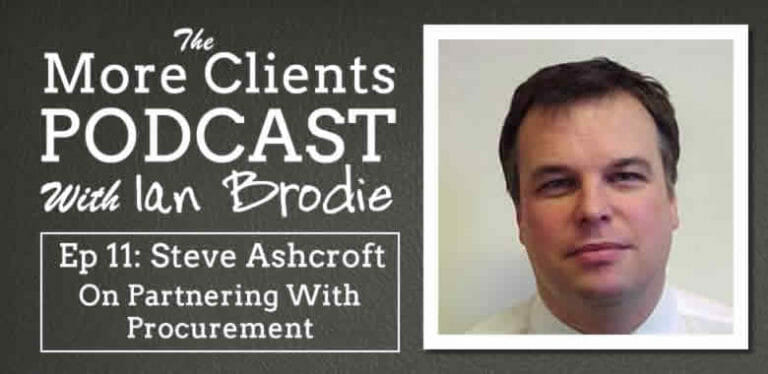
How to Partner with Procurement to Win More Clients

Posted on July 23rd, 2014.

If you're selling your services to corporates or even mid-sized companies, chances are you'll bump into procurement.

You may need to submit proposals, take part in formal tender processes, get onto the approved supplier list, or just have them OK your letter of engagement.

And you've probably discovered that sometimes working with client's procurement teams isn't easy.

Sometimes it feels like their only goal is to drive down your price. Or keep small suppliers like you out of the equation.

In this podcast I interview procurement expert Stephen Ashcroft. Steve's worked with procurement teams in 33 of the UK's largest private companies and some of the biggest public sector organisations to help them improve the way they buy. And he's increasingly working with professional service firms to help them improve their relationships with clients' procurement teams.

In the interview Steve shares what procurement are really focused on, how small firms can differentiate themselves against larger competitors, and the best ways of working with procurement to make sure you “stay in the game”.

Click here to listen to the interview »

Featured

More Clients Memorandum

Win more clients through, er, trial and error

Posted on July 20th, 2014.

I've just watched an excellent TED video from “Undercover Economist” Tim Harford.

In the video Harford tells the story of Archie Cochrane, a Scottish doctor, who while being held in a prisoner of war camp managed to figure out how to cure the prisoners of a mystery ailment (which he was suffering from himself) using a makeshift “split test”.

Later on after the war he challenged the medical establishment over the most effective post-operative treatment for heart patients. Again, using a simple test of the two different approaches to prove his case.

Harford uses the example (and others) to warn us against overconfidence in our ability to engineer solutions to complex problems and show that trial and error is most often the best route to a successful answer. You can watch the video here for more details.

The exact same thing is true in winning clients.

It's nice to think that someone out there can just hand us the answers to make our marketing work perfectly. But the truth is that what works in one business may well not work in another. Even if on the surface they look very similar.

So you need to use “best practices” as sources of inspiration to then test out, rather than taking them as the definitive answer to what your business needs.

I recently ran a test on my signup forms that resulted in a 59.3% improvement in optin rates. In other words for the same amount of traffic to my home page I'm now getting nearly 60% more optins.

And you can test things in the “real world” too, not just online.

Many people seem to be in a constant search for the perfect “elevator pitch” or introduction. They read one piece of advice and change their own introduction. Then they read another recommendation or “magic formula” and change it again.

But until they test it, they'll never know which format really works best or whether it makes any difference at all.

What they could do is try introducing themselves in one way at one set of events and another way at another. And keeping track of who got which introduction. Then measure how many follow-up calls or meetings they got from each introduction.

Not 100% scientific as there are many other variables. But do it enough times and keep good records and you'll begin to develop a decent picture of what works best for you.

Not all your tests will work, of course. I'm currently testing different text on the button on my website forms. The one I thought would perform best is currently getting 74.8% fewer optins than the control. But at least I now know not to switch to it, which I would have done if I'd just listened to others and gone based on my instinct.

What are you testing right now in your business. If you're not testing, you're not improving.

Featured

Get Clients Online

How I Grew My Email Sign Up Rate By 91% With One Simple Technique

Posted on July 18th, 2014.

I'm going to assume that if you're reading this, you already know two things:

  1. Building an email list is the most powerful, most certain method of getting clients and growing your business online (hey, I have to say that, I wrote the #1 book on email marketing on Amazon after all ;) 
  2. Building an email list isn't easy. The vast majority of visitors to your website will leave without signing up.

Click here to read how to double your sign up rate »

Featured

More Clients Memorandum

Work hard once

Posted on July 6th, 2014.

You've probably heard the “only handle it once” principle in productivity where you should strive to only handle paperwork or emails one time and deal with them fully rather than keep returning to them and doing a crappy job each time.

I've found a similar principle to apply to a lot of marketing too. I like to call it the “Work Hard Once” principle (a phrase I first heard from Taki Moore).

I was reminded of the principle when I ran a webinar for recently on follow-up systems. Follow-up is a great example of “Work Hard Once”.

What normally happens with follow-up is we meet someone (or we send them a proposal or they become a client or any number of situations then need follow-up). We know we should be following up. After all, the majority of sales takes multiple contacts before your potential client will be ready to buy.

But more often than not we try to “wing it” with follow-up.

We have the meeting and the next day we think “what should I do to follow-up?”. And we shoot off an email or something.

Then if we're lucky, a couple of weeks later we remember the meeting and realise we've not heard back. So we try to think of something else we can do to keep in touch. If we're pushed for time, we often end up with another email saying “just checking up” or “have you made a decision yet?”.

Hardly the kind of inspiring follow-up that will build credibility and strengthen our relationship.

The problem is that we're trying to do important stuff like this on the fly when we're busy. So we do a half-arsed job of it.

It's inevitable when we're under pressure. No one does their best creative thinking when they're pushed for time.

What we need to do is have the strength to take time out every now and then to do our important thinking. To “work hard once” on creating a template or process that we can then tweak and re-use again and again later.

In this case we should brainstorm the different situations where we're likely to need to follow-up and then create some decent templates (emails, ideas for phone calls or letters or other things to do) that we can reuse with minor tailoring every time we get into those situations.

Work hard once to come up with a great template, then use it time and time again. Rather than reinventing the wheel (badly) every time.

What are the marketing tasks you do again and again that would benefit from taking time out and creating templates for so that you do them brilliantly every time without having to constantly rethink everything?

Work hard once on these and you'll be repaid many times over.

Featured

Marketing

The Right and Wrong Way to Use Controversy in Subject Lines

Posted on July 1st, 2014.

A couple of years ago a load of emails dropped in my inbox proclaiming “Social Media Doesn't Work”.

It was one of those big product launches. You know the ones where a bunch of gurus cross-promote each other's products in turn to create the sense that everyone is talking about the product and that this is the one you must buy (until the next one comes along).

This one was being promoted with the line that “social media doesn't work” and a link to a video that would explain why.

So, of course, I clicked. Who could resist a controversial subject line and topic like that?

What was the great revelation about social media not working?

Click here to find out »

Featured

More Clients Memorandum

Take your own medicine

Posted on June 29th, 2014.

We're most of us in the business of change.

Maybe you're a coach or consultant who works directly with clients helping them change and improve. Or maybe you provide advice or services to clients that they then use to make a change themselves.

Either way, like me, you probably spend a bunch of time advising your clients to change (and lamenting it if they don't). After all, it's the only way they'll make improvements and achieve their goals.

Of course, when it comes to ourselves it's a different story.

We set ourselves ambitious goals, but often we don't change the “system” we use to get them.

For us, our “system” is what we're doing day-in, day-out, week-in, week-out.

If we do the same things we did last year, our results will be a lot like last year. And the year before.

If we want different results, we've got to do different things.

For the first few years of running my own business I got better results simply by getting better at what I did and doing more of the same. But eventually you hit a plateau. It felt to me for a year or so like I was just spinning my wheels.

So for the last few years I've been making significant changes every year.

I started focusing more on my online courses to get more scale. I put the prices of my 1-1 work up. And I started emailing more frequently.

Some of that was uncomfortable. Some of it required me to learn new skills so I invested in courses and spent some time talking to people I thought had mastered what I wanted to learn.

And some of it required some late nights working on course material and content long after everyone else was tucked up in bed or watching TV.

I must admit, I went down a couple of blind alleys with some of the things I tried. But most of it worked. And it worked well enough to make a significant difference to my business.

We all advise our clients to change. So how much are you prepared to change yourself? How much are you prepared to invest in your own future?

I can't guarantee that what you try will work 100%. But I can guarantee that if you don't do anything different, you won't get any different results.

Featured

Get Clients Online

3 Simple Mistakes Which Stop People Reading Your Emails

Posted on June 23rd, 2014.

A lot of focus gets put in Email Marketing on subject lines.

After all, if no one opens your email, no one is going to take action or buy.

But after opening it, if they then don't read it or they scan it and just close it without properly reading; it's the same end result. No action and no sales.

And frankly, making your emails readable is something even marketing experts screw up regularly as we'll see in a few moments.

Click here to discover the 3 big mistakes and how to fix them »

Featured

More Clients Memorandum

Harness this “underdog’s advantage”

Posted on June 22nd, 2014.

I'm guessing that if you signed up to get these emails from me, you're probably not the CEO of a big global megacorporation with an army of minions working for you.

Like me, you're probably an underdog. A small or solo business who gets great results for your clients, but has to do most of the marketing for your business yourself.

Often we underdogs find ourselves up against superior forces. Bigger marketing budgets. Dedicated business development teams. Long-standing relationships and the old-boy network.

And the truth is that we can't beat big firms if we try to take them on head-to-head. We can't out-spend or out-schmooze them.

But underdogs have an advantage. A big advantage.

We can play to our strengths.

Big firms need loads of clients. We just need a few. That means we can focus on being the perfect match for our ideal clients. They have to be “all things to all men” to a much wider set of needs.

I reckon I'm a pretty decent marketing coach. I could help lots of different sorts of businesses. But probably not that much better than a bunch of other marketing coaches.

But when it comes to helping consultants and coaches, there are very, very few others with my experience and track record. Especially when it comes to online marketing.

Playing to your strengths doesn't just mean focusing on a specific niche, it can also mean the type of marketing you do.

I focus pretty much only on online marketing. I can't reach anywhere near all my potential clients that way. But I can easily reach enough, and that's all that matters. Your big competitors can't afford to focus like that – they need to reach everyone. So they spread themselves thinly and don't get world class at anything.

And as an underdog you can harness the one thing that's genuinely unique: yourself. You can be the face of your business. You can let people see who you really are.

I'm sure the videos I do turn away as many people as they attract. But they attract enough people strongly enough to want to do business with me.

And as a result, I end up working with people looking for something different. Big firms tend to attract clients who want safety and security. You don't learn or grow much from working with those clients.

So what are your strengths that you can harness?

Make a quick mental list. Rule out all the generic stuff that everyone says like “great customer service” or “we really get results”.

If you haven't got much, that's a hint that you may want to focus on building some. Otherwise you're going to be competing head to head with a bigger army.

And that's a losing battle.