Ian Brodie

Ian Brodie


Navigation
AuthorIan Brodie
Ian Brodie

Ian Brodie

https://www.ianbrodie.com

Ian Brodie is the best-selling author of Email Persuasion and the creator of Unsnooze Your Inbox - *the* guide to crafting engaging emails and newsletters that captivate your audience, build authority and generate more sales.

Featured

More Clients Podcast

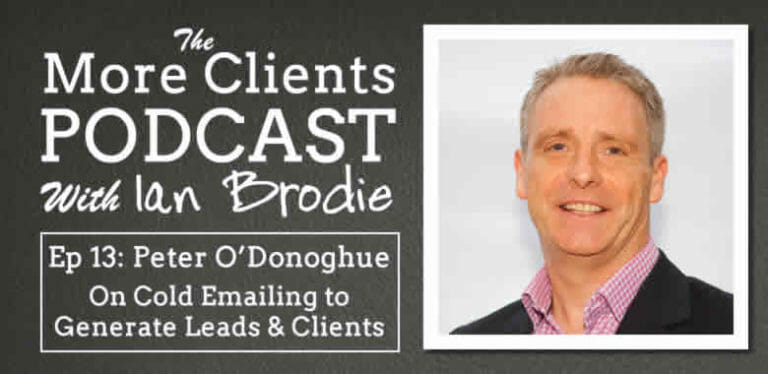
Cold Emailing to Generate Leads and Win Clients

Posted on September 30th, 2014.

Have you ever had one of those awful emails out of the blue, usually from a company offering SEO or website services, where they just pitch at you and don't seem to have paid the slightest attention to your website or business?

That's bad cold emailing at work. No better than spamming.

On the other hand have you had a very targeted, charming email from someone you don't know where the writer has done their homework and opens up a useful conversation with you that leads to something mutually beneficial?

That's good cold emailing.

I've had much more of the former than the latter. But when cold emailing is done well it can greatly benefit both sender and receiver.

In fact, when you're trying to get work with larger organisations where executives don't go out to events and you don't have any connections to get referrals from, a highly-targeted, well-researched short email can be your best way of making an initial connection.

In this interview I speak to the UK's leading expert on cold emailing done right, Peter O'Donoghue and find out from him how to make cold emailing work.

It's my biggest interview to date – 100 minutes in total so you might want to listen in a few chunks – and Peter doesn't hold back. He reveals how to find the right people to email, the different types of email to send in different circumstances, and how to write your emails to maximise your chance of getting a response.

He also reveals why a lot of the tips on cold emailing you'll see on the web only work in very specific circumstances – and how to find the right approach for your situation.
Click here to listen to the interview »

Featured

More Clients Memorandum

Sherlock vs Sherlock

Posted on September 28th, 2014.

My wife Kathy is a huge Sherlock Holmes fan.

She's got all the books, we've been to 221b Baker Street (more than once) and we watch any TV show or film with a vague reference to the great detective.

So a few years ago when both CBS and the BBC launched new series featuring Holmes we started watching both eagerly.

Initially, we thought the BBC's Sherlock with Benedict Cumberbatch and Martin Freeman was much the better show. Better, more satisfying, more intricate plots. Elementary with Jonny Lee Miller and Lucy Lui was good, but just not at the same level.

A few years later, after three series of Sherlock and a series and a half of Elementary, we sat down again to watch Jonny and Lucy do their stuff.

And at that moment I realised that while I still thought that Sherlock was a better show, I had warmer feelings for Elementary. It felt like inviting old friends back into my house.

It's not that the characters are more appealing. Lee Miller's Sherlock is just as abrasive as Cumberbatch's.

It's just familiarity.

There had been only 9 episodes of Sherlock in nearly 4 years. We'd watched 34 episodes of Elementary in just 18 months.

The regular, consistent good of Elementary had overtaken the infrequent brilliance of Sherlock.

I think marketing works like that too. If you look at email marketing, for example, too many people try to get by with a monthly newsletter. Meaning that if they want to be remembered, they have to make a huge impact each time.

Meanwhile, people like me are mailing much more regularly. Just drip, drip, dripping into our subscribers' consciousness.

Regular consistent good beats infrequent brilliance.

Bear that in mind next time you're working on your marketing.

Featured

More Clients Memorandum

Knowing is not the same as doing

Posted on September 21st, 2014.

A few years ago I spoke to someone about an Email Marketing course I had available at the time.

“It's not for me”, she said. “I know all that stuff”.

I checked out her website shortly afterwards and she'd implemented pretty much none of the strategies she'd told me she knew.

By contrast, I got a message yesterday from someone who'd bought Email Persuasion recently.

He'd put what he learned in the first couple of chapters straight into action and had gone from averaging 100-120 optins a month to 225 the first month after making the changes. And that was in what had historically been his worst month.

The lesson's fairly simple. But it's one many of us ignore – me included.

Knowing is not doing.

Often we ignore information because we already know it. Or because it doesn't seem like something new.

But the key question to ask isn't “do I know this?”. It's “am I doing this?”.

Knowing is not doing. And it's doing that brings results.

Featured

More Clients Memorandum

Do your marketing materials have to be “ultra professional”

Posted on September 14th, 2014.

Lots of people wrote back to me after last Sunday's email to say they'd be implementing the interview strategy.

I hope you're considering it too – it's a great way of quickly creating valuable content you can share with potential clients.

One of the reasons it works well – and that means you can do it quickly – is that you don't need it to be ultra-professionally produced.

There's a subtle psychology going on here.

If you were doing a “to camera” video, for example, then subconsciously your viewers would be comparing your video with all the other “to camera” videos they've seen. Usually newsreaders and chat show hosts.

Chances are your video won't look so great into comparison.

But if you're being interviewed – on audio or video – then subconsciously they'll be comparing it with other people they've seen being interviewed.

Two things will happen. One is they'll position you in the same bracket as other people who get interviewed: experts. And secondly, they won't expect perfect production values. People who get interviewed aren't word perfect. They aren't perfectly lit and made up in TV studios. And the audio isn't always brilliantly crisp and clear.

To my mind, that's a bit of a win. Because it means you don't have to wait to get everything perfect to do it.

Featured

More Clients Podcast

How To Use Website Analytics To Get More Sales And Grow Your Business

Posted on September 11th, 2014.

When it comes to websites and online marketing, analytics is probably the last great unexplored frontier.

Most people have a fair idea about their website and they know they should be using email marketing and doing stuff on social media. But when it comes to analytics, few people get much further than glancing at basic Google Analytics data every now and then.

The truth is though that there's a wealth of information available about what your website visitors and potential clients are doing on your site. And if you use it right, you can get tremendous insights from that information and use it to improve your site and your offers and get a whole load more clients and sales.

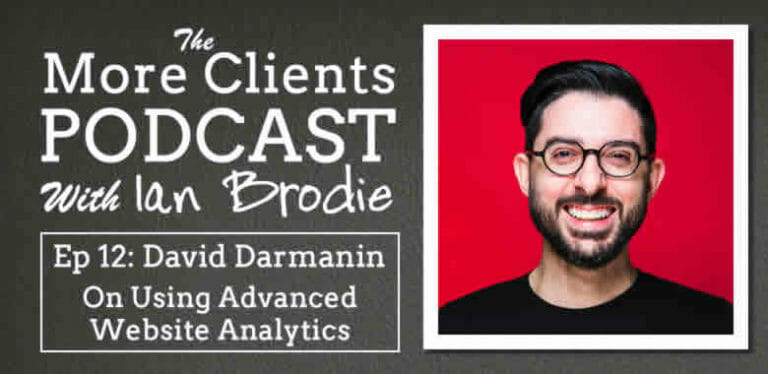
On this podcast I talk to Dr David Darmanin, the CEO and Founder of Hotjar.com – a new startup that's created a combined analytics tool now in beta test.

David shares details of how to use tools like heatmaps, visitor playback, funnel analysis, surveys and feedback polls to get insight on your web visitors to drive improvements in your conversions and sales.

And he lays out a simple process for systematically improving your site (rather than the haphazard “copy what some other people are doing” strategy that most people use).

Click here to listen to the interview »

Featured

More Clients Memorandum

Have you been interviewed yet?

Posted on September 7th, 2014.

I spent some time on the phone recently being interviewed for an upcoming podcast.

Took about an hour including the chit-chat before and afterwards. took me about 20 minutes to prep my answers to the questions beforehand.

The podcast will probably reach a few thousand people. Maybe more, maybe less.

More importantly, I get a copy of the audio and can use it however I want. I can pop it on my website and send a link to it to selected contacts. It'll give them some useful information and will raise my credibility with them.

If you get the chance, I thoroughly recommend being interviewed like this. It only takes a little time and you can use the material as a great credibility booster.

But what if you don't get the chance? What if no one asks you to be interviewed for their podcast or radio show?

Do it anyway. Don't wait to be asked.

Write down 6 questions that you can answer in your field of expertise that will be valuable for your potential clients to know (valuable to them I mean, of course – not just you).

Then get a friend to ask you the questions as an interview and record the conversation. Either on Skype, a teleconference service or with an audio recorder.

Post the interview on your website. Send it to potential clients with a “thought you might find this useful” cover note.

Value + Credibility.

Whatever you do, don't think “sounds like a good idea but…I bet it won't sound professional enough”.

Wait for “professional” and it'll never get done.

Wait for “professional” and your potential clients will already be working with your competitors who sent them useful information with “amateur” production values.

If you think your clients value professional production values more than the quality of the content you're either underestimating them, or you're working with the wrong clients.

Don't wait to be asked. Don't wait for professional.

Make something good quick and get it into the hands of people who will value it.

Featured

Selling

The REAL Secrets of Networking

Posted on September 2nd, 2014.

There's lots of great training available about the skills of networking.

Crafting a compelling “elevator pitch”, learning how to break in to groups, hold conversations, ask for referrals.

All good stuff. But in a way, all very tactical. Personally I've found there are much more powerful principles that make a huge difference to your success at winning clients. Principles that most networkers tend to ignore.

Get these principles right and even if you're a networking newbie you'll do well. Get them wrong and no amount of skill will save you.

Click here to discover the principles »

Featured

More Clients Memorandum

Fast = done

Posted on August 31st, 2014.

Something interesting happened when I first developed a training module on Facebook Advertising for Momentum Club.

This was quite a few years ago, so at the time I was pretty sceptical. Do the kind of business clients that you and I target really hang out on Facebook? And do they click on adverts?

I'd done a couple of minor experiments a little earlier. Enough to know that there was potential. But I wasn't sure.

I'd been holding back doing a full test because I wanted to create something just right for Facebook. A new lead magnet. A new opt-in page. A new follow-up sequence.

Then it dawned on me: trying to get everything perfect was stopping me doing anything.

So I quickly changed tack and created a simple newsfeed ad that fed into my existing landing page for one of my free reports.

I switched on the ads, targeting people who liked pages similar to mine and boom – the traffic started hitting my landing page. I started getting optin after optin, with the ads costing me less than a pound for each new subscriber.

That's actually cheaper than I'd managed to get to with a ton of optimisation on Google Adwords.

Within days I'd even had a few new Momentum Club subscribers already, so the ads paid for themselves.

So my experiment showed that Facebook has plenty of the sort of business clients that I (and perhaps you) target. That's pretty old news these days.

But more importantly, it showed the power of speed.

I could have spent ages trying to get a perfect ad, a perfect landing page, perfect new lead magnet and a perfect follow-up sequence. All to find out it didn't work.

Instead, I went fast with something I already had. And once I knew it worked I could start improving it.

Going fast with something less than perfect can often get you to your desired outcome much quicker than trying to get it right first time.

Are you holding back from implementing something because you want to get it perfect? Maybe you can go faster with something good, then make it perfect later once you know you're on the right track.

Featured

More Clients Memorandum

What your prospects already know is the key to how they buy

Posted on August 24th, 2014.

K – bit of a tongue-twister of a title. But it's pretty darned important, so here's what it means…

Basically at any given point in time your potential clients have a certain amount of awareness of your products and services and what they do.

Initially, they may not even be aware of the problem that your product or service addresses. Before Sony created the Walkman how many of us were aware we needed a portable music player?

At some point in time, they get aware of the problem, but don't know about any solutions. Then they become aware that solutions exist, but don't know the specifics of different products.

Then as the market matures, people become aware of specific products and the differences between them.

Why is this important?

Because you need to market to potential clients by talking about things they care about.

Trying to sell someone on the benefits of coaching vs training to address leadership issues is pretty pointless if they don't realise they have any leadership problems at all.

Conversely, if an HR director has hired dozens of coaches before for her organisation she doesn't need to hear the talk about what a coach is and why coaching works.

You need to match the messages in your marketing to the level of awareness of your potential clients. Both in general, and then tailored to the specific people you're talking to.

If they're not aware they have any problems you can help with, talk to them about their business in general and ask questions that allow them to discover the issues.

If they know they have problems, begin your sales letter, web page or introduction talking about those problems and then lead on to how you help with them.

If they're already experienced buyers of your type of service, focus on what differentiates you from your competitors and how that will deliver them the most benefit.

Talking the basics to an experienced buyer can feel condescending, or they can assume you just deal with “beginners”. Talking about the subtle differences when someone doesn't even know what the real issue is or how it could be solved just confuses them.

So it's a vital step in preparing any marketing to focus on the people you most want to reach and to think through what their current understanding, awareness and beliefs about their problems and your services are. It'll help you get the right message for them.

For more details on “Prospect Awareness” you can watch this short video I did recently which lays out the model in a bit more details:

Prospect Awareness Model >>

But most importantly, set a little time aside whenever you're about to communicate with potential clients to think about what their level of Prospect Awareness is. It'll pay dividends, I promise.

Featured

More Clients Memorandum

What I’ll never forget about my first clients

Posted on August 10th, 2014.

The very first client I got for my own business came through my website. A marketing workshop for a small firm of surveyors: three women in a largely male-dominated profession.

It was a bit of a fluke. I hadn't really figured out online marketing then. But I was lucky enough that what I said on my site exactly matched with what they were looking for.

We spent a day together figuring out how to take their business forwards.

It was there that I realised that most people don't want to get brilliant at marketing. And certainly not at selling.

After a while doing marketing I kind of fell in love with it. That's why I'm constantly trying out new approaches and techniques. I love figuring out “what works”.

But most people don't love marketing or selling. They just want to be able to do it well enough, or have it done for them, so that they can focus on the thing they do love.

I've never forgotten that learning.

That's why, for most people, keeping your marketing simple is crucial.

There's a saying in marketing that it's easier to find 100 ways of getting one client than it is to find one way that gets you 100.

That's nonsense. Possibly the worst advice I've ever heard.

For most of us the best thing to do is find one, two or three methods that reliably bring us in a steady stream of new leads. Get good at just one or two ways of nurturing relationships and converting those relationships into paying clients.

Don't try to become the master of every type of marketing. And try not to be tempted by the latest scheme promoted by a whole bunch of gurus saying you can get a bunch of new clients overnight with very little effort. If it was that easy they'd be doing it themselves.

Winning clients is hard work. So focus on a few proven techniques and get them to work for you.