Ian Brodie

Ian Brodie


Navigation
Archive Archive for 2012
Featured

Selling

Stop Focusing on Problems – Start Focusing on Growth

Posted on July 31st, 2012.

Problem HoleI was chatting last night to a smart marketer who was asking me about an effective sales process for high value services.

He was experienced, and he'd done his homework and studied and tested some of the classic approaches. The steps he outlined to me that he was following were rock solid.

Where he was struggling was “finding the pain”.

You know: the step in every sales process where you drill in to the problems the client has and ask about the impact. And ask some more. And some more.

“Twist the knife”, so to speak, so that the client is fully aware of the situation they're in, how much it's costing them, the impact on their business or life.

He just didn't feel comfortable with that part.

And I don't blame him.

Almost all sales techniques focus on finding the pain. For good reason too. Without a big motivation to change, clients just won't buy.

You can find the pain ethically. Help the client see the reality of their situation for their own good.

Or you can do it unethically. Exaggerate all the negatives to scare them so you make the sale. I've even seen some sales training teach people to ask about the impact of the business issue on the potential client's personal life, their husband or wife, their kids. Yuck.

Here's the thing.

Finding the pain works. But it has a downside.

If you're constantly looking for pain, that means your focus is on clients with problems.

Remedial work. Fixing issues.

And typically that means you'll end up working on the same basic stuff again and again.

Like a plumber fixing leaks or a mechanic changing tyres or replacing alternators.

Not necessarily the most rewarding work. Or the highest paid.

If you're an engineer at the top of your game you probably want to be designing cars, not just fixing them.

If you're an expert business coach you probably want to work with clients who are doing well and are keen to grow, rather than those who are struggling to survive.

There's less desperation. but there's more upside. More joy and more enjoyment. Higher fees (and they're much better placed to pay you too).

If you look at a lot of marketing you can see that it's geared at the desperate. It agitates the pain and makes exaggerated claims. Who else but a desperate person would believe you can make thousands of dollars a day with just a few hours work. Or get 306 clients from a teleseminar?

So I believe my friend was right to feel uncomfortable finding the pain.

Yes, you and your client need to understand the gap between where they are today and where they need to be.

But isn't it so much better if that gap is about upside and growth?

And won't working on those growth challenges build your capabilities much more than just fixing the same old problems?

Isn't there much less competition at the top? Aren't car designers better paid than garage mechanics?

Next time you revisit your marketing strategy, take a look at who you see as your ideal client. Who you target with direct mail or who you focus your website content on.

(In fact, as I write this my stomach has just turned as I realise the pay-per-click campaign I've been testing is focused on pain rather than gain. Time to fix that).

Look at your marketing. What sort of client would be attracted by your headlines, your tweets, your sales letters?

A struggling client, or a growing client?

Who do you really want to work with?


Featured

More Clients Podcast

Sales Growth Tips from Jon Vander Ark

Posted on July 17th, 2012.

Co-lead of McKinsey's Sales Growth practice and co-author of the book Sales Growth, Jon Vander Ark reveals what industry leaders are doing to transform their sales practices.

The recently published book from McKinsey and Company, Sales Growth is based on their extensive research with successful sales leaders on what's working today to drive sales growth.

In this podcast interview, co-author of the book Jon Vander Ark shares his perspective on the main lessons from the book – and what businesses can do to put those lessons into practice.

We cover tips on “digging for gold” in your client base, integrating online strategies, and make more impact with face to face selling.

Subscribe To The More Clients Podcast

Jon is a partner with McKinsey and Company and co-leads their Sales growth Practice.

You can grab a copy of Sales Growth from Amazon.com by clicking here: Sales Growth Book and find out more about the book and McKinsey's work in this area at: Sales Growth at McKinsey

Featured

Marketing

Good Marketing, Bad Marketing

Posted on July 13th, 2012.

It's not often you see really good and really bad examples of marketing from the same company in the same week – but Giffgaff here in the UK have done just that.

Giffgaff are a sim only mobile phone company. You buy their sim, stick it in your own phone, and you get an absolutely tremendous deal: £10 a month for 250 minutes, unlimited texts and unlimited data is their core deal.

So since they're offering what looks like the very best deal on the market, you'd think their advertising would focus on this benefit.

No, of course not.

Giffgaff has sponsored a bunch of TV shows, including The Big Bang Theory which is where I first came across them. Yeah, I admit it, I watch geek comedy.

Their great idea for their sponsorship was to show a little image before the show and during every ad break that says…wait for it..”Giffgaff – the mobile phone network that's run by you”.

Whaaat?

No mention of them having the best tariffs out there, with unlimited data.

Just that their network is apparently run by me and you.

I'm not even sure what that means. But it doesn't sound that good. I don't want to run a mobile network – feels like hard work. I just want a great deal.

Apparently, the “run by you” thing is because they do a lot of their customer support through user forums where subscribers help each other out. So overheads are lower, and so they can afford to give you better deals.

OK. So that makes sense. But I couldn't possibly have guessed that from the 10 seconds of “The mobile phone network that's run by you”.

They've fallen into classic bad marketing. They've tried to be clever instead of effective. They've focused on the feature, not the benefit. And they've made me work too hard to figure out what I'd be getting.

After months of me watching these promos and doing nothing, I actually ended up switching to them. Not because of the ad – but because of word of mouth. Someone told me what their actual tariffs were and said they'd had a great experience with them.

So I checked it out, switched. And then saw an example of great marketing from them.

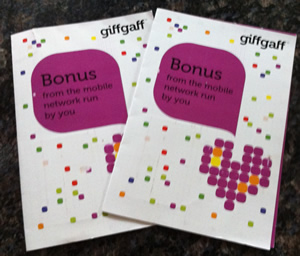
About a week or so after joining, I got these through the post.Giffgaff sim cards

They're Giffgaff sim cards I can give to my friends. When they activate them, they get £5 of free credit and I get £5 of credit on my number too.

It's a brilliant example of referral marketing done well.

They got the timing right: a couple of weeks in, I've had enough time to be sure the network performs well and I get good reception. I can recommend them with confidence. But it's not so long that the novelty and delight at the savings has worn off.

They got the incentive right: they recognised that we're not all purely “what's in it for me” motivated. We like to do good things for our friends. The incentive is £5 for me – but more importantly, £5 free calls for the person I give the sim to. So I don't feel all sleazy for recommending something where only I get the benefit. The person I recommend it to benefits too.

And they made it easy for me to make the recommendation. I don't have to go to a website to order an extra sim. Or fill in all sorts of details. Or wait for it to be delivered. It's there in my hand right now. I just have to give it to the person I'm recommending it to. Easy. And quick.

I just wonder who gets paid the most in Giffgaff. The genius who came up with the referral giveaway. Or the idiot “creative” who came up with the clever-but-useless advert? Sadly, I suspect the latter.

More importantly – what can you learn?

Firstly, when it comes to advertising: don't forget the basics. Focus on benefits not features. And don't fall into the “cleverness” trap.

And for referrals, make it easy for someone to refer you – don't make them do all the hard work. Use Linkedin to identify exactly who you'd like a referral to rather than having them figure it out. Ask for a referral when they're confident in your capabilities and are feeling the benefits of what you've done for them.

And harness altruism, not just self interest. Help them see how the person they'll be referring you to will benefit. Create a free report or gift of some sort they can give from you to the person they refer
you to that will make them feel like they're doing the person a favour, not just recommending someone to them.

And keep an eye out yourself for good and bad marketing to learn from!

Featured

Strategy

How to Become a Trusted Advisor

Posted on July 5th, 2012.

Exclusive Bonus: the very best way to establish yourself as a trusted advisor to your senior clients is using a Value-Based Marketing strategy. To download your free step-by-step blueprint to implementing Value-Based Marketing and get FREE access to the Fast Start videos that will get you up and running and generating leads and clients fast, click here.

It's the holy grail of Professional Services – to become a trusted business advisor to your senior clients. To be viewed – and sought out – as a source of valued advice and support.

The benefits are crystal clear: if you're the first port of call for a client with a critical business problem then you're in a tremendous position to help shape that client's thinking, to build a deep understanding of the situation, and to establish strong credibility through the discussions.

In other words, you'll be in pole position to win any related work.

And if you’ve established a position of being able to help and offer good advice across a broad range of issues – not just in your own specialism – then you become an indispensable partner – not just a supplier.

But becoming a trusted advisor doesn’t happen overnight.

The position’s got to be earned – and that takes time and it takes consistent action.

How To Become a Trusted Advisor

The clues to what to focus on are in the name – trusted advisor.

You must establish both a trust-based relationship with your client; and you must be viewed as a source of valuable advice.

Building trust comes from demonstrating and proving trustworthiness over time to your clients.

That means repeatedly demonstrating that you understand them, you have their best interests at heart, and you'll deal with them with candour: always being honest about what you can and cannot do, and taking a long term perspective rather than seeing them as a short-term sales prospect.

And that starts even before they become clients. How you treat them when they're prospects sends a strong message about how you'll treat them when they're a client.

When the Huthwaite Group studied client’s perceptions of professional service salespeople, they found that of the key elements of trust (in their words: candour, competence and concern) it was the area of showing concern and empathy for their clients where professionals performed the worst.

Much worse that their counterparts in product sales.

Accountants, lawyers and consultants are trained “to be professional”. To be objective, fact-driven and solution focused. We've been conditioned into feeling we must constantly demonstrate our cleverness and expertise in order to be credible.

But all of this mitigates against showing genuine human concern for clients and their challenges.

It’s not that we don’t care about our clients – far from it. But we've got to learn to express this concern in ways which clients can appreciate.

Using our listening skills, for example, not to gather ammunition for our next verbal gem – but to build genuine and deep understanding of a client’s situation.

And when it comes to demonstrating that you can provide valuable advice, again you've got to do this consistently over time. Every interaction with your senior clients is a chance to either advance their perception of you as a source of valuable insight…or not.

Now that doesn't mean that a junior consultant or lawyer should try to jump right in and spout their “wisdom” to senior clients on day 1.

You've got to “earn your spurs” first.  You have to earn the basic right to be listened to by your senior clients.

You do this by demonstrating competence in the areas you've been hired for. Until you've done this, any attempts to advise on wider areas are going to fall on deaf ears. You need to prove your basic capabilities first.

Or as a grey-haired consultant told me on one of my early projects when I was trying far too hard to “add value” on a whole bunch of topics: “Ian, you've got to get your own sh*t sorted first”.

So that's your starting point.

But unfortunately, many professionals stop there.

They limit their interactions with clients to talking about the work at hand and the specialism they focus on.

Over time, this causes them to be pigeon-holed as just being technical specialists. People who can be relied on to deal with specific topics – but not a trusted advisor who can help with more challenging problems.

To establish your trusted advisor status you've got to demonstrate you can give valuable advice outside your specialism. You need to show you have broader knowledge of business in general, and of the client’s business and industry specifically.

That means you've got to do your homework.

As a professional you need to know the key issues of the day. In business and industry generally. In your client’s industry more specifically. And if you can, in your client’s company.

As you get closer and closer to your client, they’ll also begin to share issues that are personal to them and their role. But at the start, it’s the more general industry and company issues you should focus on.

Always make sure you’re up to date with industry news – and ask the client about their opinions. Put out tentative hypotheses to gently establish the fact that you’ve been thinking about their industry and their company. Highlight a recent move a competitor made and ask them how effective they feel it was – and be prepared to give your views too.

Use the smalltalk at the start and end of meetings to cover these relationship-building topics rather than jumping straight in to talk about the job at hand.

Or invite your client out for a coffee next time you do a progress update. A change of scenery to a more casual environment often helps clients open up more broadly about the things on their mind.

Don’t push this too far, too early though.

I’ve seen many junior consultants and aspiring partners rush far too fast into trying to “coach” senior clients long before they've earned the right.

Instead, recognise where you are in your relationship.

  • Have I established my basic competence?
  • Have I created an impression of strong general business knowledge?
  • Have I demonstrated useful insights into key business problems?

Look at the development of your relationship as a ladder you climb step-by-step. And hand-in-hand with your client at every step of the way.

In the early days, ask about issues just a bit wider in their organisation. Or things that are big news and everyone is talking about.

As your relationship develops you can move on to broader and bigger topics. But always do your homework so you have an interesting point of view to share.

Do this and you will set yourself well apart from the vast majority of consultants and other professionals.

Do it really well, and you’ll find that the clients you develop your trusted advisor roles with will support you for many, many years.
Download the Value-Based Marketing Blueprint

Featured

Authority Marketing Podcast

Authority Marketing Interview: Geoff Ramm

Posted on July 4th, 2012.

Geoff RammGeoff Ramm is the UK's leading speaker on Marketing. He's been travelling the world blending observational humour with sharp marketing insights for a decade now. And he stopped off to chat to me about how he built his reputation.

Unlike many Authorities, Geoff didn't build his expert status based on a book or articles or a big study. He got out on the road and showcased his ideas in front of paying audiences week in, week out.

It's a route to Authority that can be highly effective – especially if you're a great presenter.

In this interview Geoff talks about what got him started, how he began to build his name, his big break and how it happened, and what he believes are the key success factors for building a successful business through public speaking.

Oh, and he reveals his #secretsauce too (check the audio so see what that means!)

Subscribe to the Authority Marketting PodcastClick here to subscribe to the Authority Marketing podcasts in iTunes.

To find out more about Geoff and watch some of his videos (highly recommended) check out:

www.geofframm.com

Featured

Marketing

My Worst Performing Email EVER (And How To Avoid Making The Same Mistake Yourself)

Posted on June 24th, 2012.

Email PerformanceLast week I sent out an email that had the worst open rate I've had for an email ever.

The email got 20% fewer opens than normal. For a business like mine that has email marketing at its core, that's a disaster.

And for someone like me who's studied email marketing in depth, bought pretty much every training course there is on email marketing, and who's been interviewed on email marketing best practices on more than one occasion it's a little embarrassing.

So what went wrong?

Well, the truth is, I fell into a trap that very many people do with their marketing. I got too clever.

Here's the offending email subject line:

“Spooked By Shadows”

You can probably see what's wrong with it straight away. There's no real motivation for people to open it.

The email itself is a good one. All about the importance of not being scared in your marketing by what your competitors might be doing.

So the subject line “Spooked By Shadows” is a clever one. Alliterative too, and reads nicely.

Clever. But not effective.

Many years ago John Caples studied the most effective headlines for adverts – and identified that the three types of headline that work well are:

  • Benefits: the headline indicates the benefit you'll get by reading on (or buying the product)
  • News: the headline refers to something in the news that people already want to hear about
  • Curiosity: the headline invokes curiosity – the prospect reads on to find out what the headline means

The same principles apply to email subject lines.

Benefit headlines are often the strongest. Subject lines like “How to find your ideal niche” work because they promise to reveal how to do something your readers (or in this case my readers) really want to know.

And you can often combine types. “5 ways of winning clients with mobile apps” is a benefit headline (winning clients) combined with news (mobile apps are hot at the moment) and it's also curiosity (“I wonder what those 5 ways are…”).

And my email contained…none of them.

Well maybe a bit of curiosity. Perhaps someone wondered what I meant by “Spooked By Shadows”.

I fell into the trap that so many do of trying to be clever and funny with my marketing.

But I really should have stuck to being effective.

If you're writing emails, adverts or sales pages you should stick to being effective too. Follow Caples' advice and stick to benefits, news or curiosity.

If you'd like more in-depth tips on email marketing – completely free – you can sign up for my series of Email Marketing Power Tips here:

Email Marketing Power Tips >>.

Featured

More Clients Memorandum

Spooked by Shadows

Posted on June 17th, 2012.

A while ago I did a “strategy workout” with one of my clients. An intense day blasting through all the key factors to build them a powerful marketing strategy and action plan.

One of the areas we looked at was their approach to large clients. And creating a strategy for one of their “gold star” clients in particular

The firm has a huge contract with them, one they can't afford to lose when it comes up for renewal.

One of the advantages her firm had over the majority of their competitors is that they have locations and staff all over the country, matching this client's locations and able to deliver training courses to them locally.

“But”, said my client, “one of our big competitors could say that too”.

She was right.

But here's the thing: just because they could say that, doesn't mean they will.

When you're planning your strategy you can't back away from talking about something that's of real value to your client just because someone else might be able to say the same.

The chances are, they won't.

(And even if they do, you're still better off than if they talk about it and you don't).

Sometimes we overthink things. We end up being spooked by shadows. Imagining that our competitors are super-marketers able to respond to our every move.

And so we end up being paralysed. Searching for the perfect strategy.

But we're much better off taking action on a good strategy.

Look at Dominos for example. Often lauded as an example of a brilliant Unique Selling Proposition (USP).

But really, just how unique is “fresh, hot pizza delivered to your door in 30 minutes…or it's free”?

Pretty much any pizza delivery company could make that promise.

It's a strategy that's almost trivial to copy.

Yet back when they came up with it, no one did copy them.

Dominos' real secret was that they were bold. They spotted something that was valuable to customers (fast delivery) and they marketed the heck out of it.

They stuck a guarantee behind it. They made sure everyone knew about it. They infused everything they did with that positioning.

What they didn't do was sit around worrying about whether anyone might copy them. Trying to come up with something that was so unique to them that no one could ever get near it.

They spotted something clients valued. They focused on it and took action.

And that's what we should do too.

Featured

Strategy

Why We Need More Experts, Not Fewer

Posted on June 12th, 2012.

More ExpertsExpert.

It's an overused term for sure.

Over on Danny Brown's blog, Ryan Hanley recently railed against The Commoditization of Expertise.

His argument was twofold. Partly that so many people now call themselves a “guru”, “expert” or “thought leader” that the term's become meaningless.

And partly that most of these folks were just regurgitating what others have already said. They weren't creating new insights themselves.

Well, I'd certainly agree with the first sentiment. If you have to call yourself a guru, or “the king of so-and-so” or “the queen of wotsit” you probably aren't. And you're being embarassing. Stop it.

But I'm going to disagree with the second point.

There's a great need for people who are “local experts”. Only Rosser Reeves invented the USP – but the world needs plenty of experts in it to help businesses create one (if they do it right, of course – most don't).

There was only one Peter Drucker – but millons of organisations needed help in management by objectives, customer focus, decentralisation and all the other stuff he pioneered.

There's only one Michael Porter, but…well, you get the picture.

Ironically, Ryan illustrated his point by saying “..in his book Outliers, Malcom Gladwell theorizes that it takes a person 10,000 hours of practice to master a task”.

Of course, the 10,000 hour principle doesn't come from Gladwell. It comes from Professor Anders Ericsson via Geoff Colvin and a bunch of others. Thus perfectly illustrating the point: Gladwell's not an ideas guy. He's a populariser. He's a type of expert in his own right – he finds out the new and interesting stuff that scientists and other “deep experts” are coming up with and makes it accessible to a broad public.

And similarly, a small business in Norwich doesn't need (and can't afford) Seth Godin to come over to show them how to make their business remarkable. But they can hire a local guy who's expert enough in Godin's ideas (and others) to put them into practice.

Now the local expert isn't going to earn quite as much as Seth Godin. But the world needs him too. And he'll be much better rewarded than the local guy who's not so expert.

So whether they're completely original or they're popularisers, or their local implementors – the world needs plenty of experts.

Featured

More Clients Memorandum

What’s your “trigger”?

Posted on June 10th, 2012.

I talk a lot about the need to nurture client relationships: to build credibility and trust over time – you may well have noticed ;)

But if you're anything like me, every now and then you've probably found yourself thinking “great, but isn't there a shortcut? I need clients now”.

Well, there is – sometimes.

Normally, so-called shortcuts don't work. They usually involve you getting more aggressive with your marketing and pushing your stuff at people when they're not ready.

Exactly the opposite of what I advocate. And frankly, it rarely works.

But there is an approach to getting clients fast that can work for some people.

It's dependent on the sort of business you're in. But if it works for you it can help you bypass a ton of time and effort and get straight through to clients open to talking to you and open to hiring you.

The approach is to look for “trigger events”.

A trigger event is something that happens to a business or individual that precedes them needing your help.

So, for example, after two businesses have merged, they often need support from HR consultants, change management consultants and IT specialists to make the merger work.

In this case the news of the merger is a trigger event for the people who supply those sorts of services. Businesses undergoing a merger are far more likely to need their support than typical businesses.

By focusing their marketing on businesses undergoing a merger, they're far more likely to hit people who are interested than if they try to market to everyone.

And those people are going to be closer to a buying decision (and with a real motivation to buy) than people who are just interested generally.

Now the strategy doesn't work for everyone. In the merger case, by the time the merger is announced it's too late for consultants, lawyers and financiers who work on the deal itself to get involved – that'll already be sorted out.

But for people like HR, change and IT consultants who get involved downstream it's a great time to approach a business.

So what are the trigger events for clients getting interested in hiring someone like you?

It could be news about the business (overseas expansion, rapid growth, a profit warning, a new facility being built). Or it could be news about individuals (a promotion, a new senior hire, a new project being taken on).

Make sure you're watching for the relevant news. Set up google alerts for your target clients. Watch Linkedin profile changes and status updates. Keep up to date with the trade news in your sector and stay in touch with the grapevine.

And have something useful to share for when the event happens. Don't just contact a merging business to say “hey, we can help you with your IT”. Have an executive briefing on the “5 big pitfalls of IT systems that can derail mergers – and how to avoid them”.

Offer them the briefing as a way of building your credibility and starting a relationship quickly.

Trigger events can be a real shortcut to finding high potential clients – make sure you're watching out for them.

Featured

More Clients Memorandum

Overcoming marketing paralysis

Posted on June 3rd, 2012.

In my last couple of Sunday emails I've been looking at the barriers that hold us back from taking effective action with our marketing.

The final one I'd like to cover is being overwhelmed.

A number of my clients, when we first meet, talk about feeling paralysed. Not able to do anything with their marketing because they're just not sure what will work.

There just seems to be so many different options.

And the more advice they hear from different sources, the more confused they get and the less able they feel to confidently take action.

Often what I find when I dig beneath the surface is that the reason they can't decide what to do is that they don't really understand their clients at a deep enough level.

That might sound a bit harsh – but it's true.

When I say “deep understanding” I don't mean knowing your potential client's favourite football team or whether they're a wine afficionado.

There's nothing wrong with the sort of trivia most professionals gather about their potential clients. But it doesn't really help you sell.

What's important to know are their real challenges: their problems and issues, goals and aspirations. And what's going to motivate them to hire someone (like you) to help them.

When you have a picture of this – way beyond the superficial level – then your marketing becomes clear.

You know what messages will resonate, what services to offer. What channels to use to reach your ideal clients.

But it requires a bit of thought. Client's don't tell you these things. Often they're not consciously aware of them.

Over the last few years I've refined a technique for taking your knowledge of your clients and potential clients and mapping it out in a way that gives you Actionable Insights into their needs.

Stuff you can do something with in your marketing.

If you'd like to try out the process, the video is completely free to watch. Just head over to:

Customer Insight Mapping Video >>

And press play.