Ian Brodie

Ian Brodie


Navigation
Searchtime
Featured

Strategy

One-To-Many Or One-To-Few?

Posted on December 27th, 2012.

CrowdThere's a fundamental principle of business that's equally as vital online as offline. And yet I've rarely heard it articulated.

It's the principle of understanding whether you're in a one-to-many or one-to-few business.

Understanding this is much more important than labelling yourself “business to business” or “business to consumer” because it fundamentally impacts the type of marketing that will work best for you.

Read more about how the one to many/one to few concepts can impact your business

Featured

Mindset

Break Your Scarcity Mindset

Posted on December 6th, 2012.

Scarcity MindsetYour scarcity mindset is hurting your sales.

No, not that scarcity mindset. Not the one that I'm sure you've heard lots about and shifted away from years ago.

Not the “there's not enough to go around, I need to hold tight to what's mine” mindset. I'm sure you're more into abundance than that sort of scarcity.

But there's another scarcity mindset many of us have. And it's far more insidious.

Click here to find out how to defeat this treacherous mindset >>

Featured

More Clients TV

Guest Blogging: A Shortcut For Finding High Quality Sites For Your Guest Blog Posts

Posted on November 9th, 2012.

Guest blogging is one of the hottest strategies to boost your website up the search engine rankings. But it can be a hugely time consuming task to find high quality, high traffic sites willing to accept your guest blog posts.

In this video I show you a great little tool that will do all the hard work for you – freeing you up to focus on your content.


Here's the link to the Link Prospector software mentioned in the video:

linkprospector.citationlabs.com >>

If you've got any questions about this strategy or observations on how you've put it into place yourself – just pop them in the comments below and I'll answer as soon as I can.

Continue to Comments

Featured

Welcome To More Clients TV

Posted on October 25th, 2012.

Thanks for signing up to get notification of new More Clients TV episodes and my regular client winning tips by email.

I hope you find my emails and videos useful.

If so, why not drop me an email to say so? And tell me what you'd like to see more of (and less of too).​

In the meantime, you can see the archive of previous 5 Minute Marketing Tips and More Clients TV videos here: 

Speak Soon!

Featured

Marketing

Do you pass the "Tapping Game" test?

Posted on September 29th, 2012.

TappingWhen what we do is complex and intangible we rely on our communications skills to get our message across to our clients.

They can't touch, kick or properly test drive what we do. So the largest part of what they think of us and whether think they want to hire us is driven by how well we're able to get across our message.

Only it turns out that getting our message across is a lot more difficult than we think.

Here's an example.

In their book, “Made to Stick”, Chip and Dan Heath tell the story of Elizabeth Newton and her research at Stanford in 1990.

Newton created a simple game where she assigned people to one of two roles: ‘tappers’ or ‘listeners’. Tappers received a list of 25 well-known songs, such as “Happy Birthday to You”. Each tapper was asked to pick a song and tap out the rhythm to a listener by knocking on a table. The listener’s job was to guess the song, based on the rhythm being tapped.

In the test, tappers tapped out 120 songs. And listeners only managed to guess 3 of them.

But that wasn't the point of the test. The real purpose of the test was to see how well tappers thought they'd do.

And the tappers predicted that the listeners would guess right 50% of the time.

50% vs their actual score of 2.5%. Huge difference.

Turns out the problem is what's known as “The Curse of Knowledge”.

Once the tappers knew the tune they could hear it in their head. It was obvious to them that the taps sounded like the tune. They couldn't understand how anyone wouldn't be able to pick it up.

But to the listeners it was just random taps. They rarely had a clue what it was.

The same thing applies to our communications. Once we have an idea in our head we're staggered that everyone else doesn't “hear it”. That they don't understand what we understand.

As a result, our communications far too often assume a level of knowledge and familiarity that just isn't warranted.

If we want our ideas to get across then we need to turn them from the abstract to the concrete. Something our listeners can picture for themselves. Something it's easy for them to grasp.

The Tapping Game story is a great example itself. I could have just talked about how it's easy to make assumptions and about how much other people understand. But that's an abstract concept. Illustrating it with a story brings it to life. Makes it memorable.

Or as the Heath brothers put it – it makes it “sticky”.

So how do you score on the Tapping Game? how many of your messages about your business get through?

50%, or nearer 2.5%

Worth thinking about.

———-
Image by Brian Auer

Featured

Selling

Get Unstuck and Shorten Your Sales Cycle

Posted on September 11th, 2012.

Today's blog post is a guest article from Michael Zipursky. A good friend and real expert in marketing and sales for consultants and other professionals. Take a special look at the “Clear A Path” section – simple to do but an area where most people go wrong.

Get Unstuck and Shorten Your Sales Cycle

For SaleIt's not uncommon for consultants and independent professionals to find their pipeline full of leads and prospective business, though not enough of that business is being closed.

Imagine a funnel being filled with small marbles from the wide end at the top. Each one represents a potential client and project. You know that the majority of these should be coming out the bottom in the form of a sale…yet nothing is moving.

When you find yourself in this situation, it's important to sit back and analyze the situation. Often one or more issues are at play. Once you deal with the issues it's like you've greased up all the marbles and they start coming out the bottom at a quick rate.

So how do you identify the problem in your sales cycle to fix it and grow your business?

Here are several strategies to help you get started…

Houston, We Have A Problem

In fact, maybe you have more than one. The problem I'm talking about however is not a problem with YOUR business. I’m referring to the problem your prospective client is facing. Once you've identified the real issue they are having, you can ensure that you focus your language and communications so that you're addressing it. To uncover what's really going on and how big of a problem the issue is, consultant and author Andrew Sobel suggests asking questions like: ” “What is this costing you right now?”; “If you don’t fix this problem, what will the consequences be?”; “What do you think this opportunity is worth to your organization?”; “What other issues is this causing for you?”; and “Would you say this is one of your top two or three priorities?” As soon as you've discovered the real issue and what it is worth to your prospective client you will be well on your way to moving the sales cycle along.

Clear A Path

Neglecting to outline the steps involved in the sales process clearly for the client is a mistake many consultants make. At the end of every meeting you need to inform the client what the next step is and when it will happen. In addition, you'll find it valuable to walk them through a step-by-step of what your sales process is. That may be starting with an Analysis, and then on to a Review Meeting, then a Recommendation Session with Discussion on Investment and so on. The better your prospective client understands your process the more likely they will be to move along it.

You are THE Authority

Another common challenge you may face is questions around your authority. If a prospective client doesn't have full trust in you, they will find it very difficult to engage you. In fact, this is one of the key reasons sales cycles can take so long. If the client is not convinced that you clearly are the best option for them, they will put off making a purchase. In this situation you need to do all that you can to educate and provide value to your prospective client to prove to them that you are an authority, that you get results and that they can trust you. Think case studies, testimonials, reports, demonstrations.

Shrink The Table

If you've ever sat a boardroom table and had a feeling that too many people are present you know what I'm hinting at with this point. When you are moving a prospective client through the sales cycle, it's critical that you are speaking directly with the decision maker. Anyone that doesn't need to be there ideally shouldn't be. If they can add value to the conversation and process, then value their input and attendance. If not, focus your energy on speaking directly with the decision maker. You will find that as soon as you talk to the right person and get on the same page with them, the whole sales cycle will speed up.

Eliminate Objections

Sometimes asking a simple question can provide you with extremely powerful information. For example, “What would we need to have ready in order for us to start this project at the beginning of next month?” The goal here is to figure out what your prospective client's real objections are. You can then figure out how to remove those objections and create a clear route to win the project.

Why Rush?

It's a great question, right? If there is no scarcity involved then your prospective client has no reason to move quickly. Scarcity doesn't have to be a ‘limited-time offer'. It can be something as simple as “We can only accept 2 new projects next month so if you want to do this soon it would be best to get moving quickly…” Or scarcity can be focused more on the company. “How much is this issue costing your company each day it is not dealt with?” If it's a big problem, finding a solution and having it implemented ASAP becomes valuable.

By looking at your current sales cycle and your prospective client and referencing each of these points you'll be able to uncover the current roadblocks in your path, remove them, and be well on your way to closing more sales.

Michael ZipurskyMichael Zipursky is a strategy and lead-generation consultant, author, and founder of Consulting Success, a leading resource to help you become a consultant, and FreshGigs.ca, a jobsite for marketing and creative professionals in Canada.

Featured

Selling

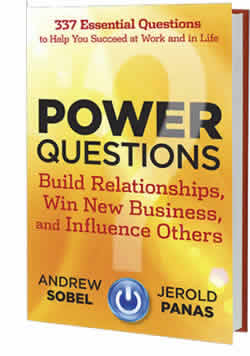
Book Review: Power Questions by Andrew Sobel and Jerold Panas

Posted on September 2nd, 2012.

Power QuestionsMy first love, way before I got into marketing (even before I met Kathy) was magic. Particularly sleight of hand, close up magic.

I devoted hour after hour to practising techniques and tricks. I devoured every latest book and video and every clever new move.

But over time I learnt an eternal truth. Your level of performance isn't dependent on learning a host of tricky new techniques. It's based on how well you do the “basics”.

All the great masters, David Roth with coins, Juan Tamariz with cards, Dai Vernon with pretty much anything. All of them know (or knew) the clever techniques. But what makes their performances so sublime and their magic so, well, magical, is their mastery of the basics.

The first thing you learn in coin magic is how to palm a coin. David Roth doesn't palm a coin any differently to me. He just does it better. He does it so well and so naturally that even if you know all about palming, you still don't get an inkling that he's doing it.

Growing your skills in any field isn't primarily about learning new things. It's about learning to do the “classics”, the important core skills, at a higher level of performance.

In business development, the first thing you learn is that asking good questions is the key to winning sales.

Watch a master rainmaker at work and of course they'll be doing some subtle things that you're not. But the most important thing they do, the thing that makes the difference, is they ask better questions.

More insightful. Better chosen. More suited to the situation. Braver.

And that's what Power Questions, the new book by Andrew Sobel and Jerold Panas is all about.

You won't find any fancy new techniques you won't have heard about in it. Just detailed descriptions of how to ask insightful, thought provoking questions that will get your potential clients engaged and opening up.

If you've ever wanted a replacement for the corny old “what keeps you up at night” question, you'll find a bunch of much better alternatives here.

There are questions that will get clients to open up and tell you what they really care about. Questions to find out what they're looking to see from you. Questions that help you recover from bad starts. Questions to ask yourself to make sure you're on track.

Each chapter focuses on a specific type of question with an explanatory story, details of how to ask, and alternative phrasings and follow-up questions.

If you're looking for a book full of new approaches to marketing and selling you've never heard of, you'll be disappointed.

But if you want a book that'll help you progress to the higher levels of skill that mark out the true masters – then this is a book you'll want to have in your library. And it's one you'll keep coming back to.

As one of Andrew's clients in the book, the CEO of a $12-billion company, explains: “I can always tell how experienced and insightful a prospective consultant, banker or lawyer is by the quality of their questions and how intently they listen. That's how simple it is.”

This book will help ensure you're one of the ones that CEO rates as insightful and experienced.

You can find out more about the book and watch Andrew talking about some of the content by clicking here:

>> Power Questions

Disclosure: Andrew sent me a free copy of the book for review.

Featured

Marketing

More Leads Than You Think

Posted on August 31st, 2012.

SearchingAsk most professionals and business owners what their biggest marketing challenge is and the answer you'll hear more than any other is “lead generation”.
Ask what they mean by a “lead” and the answer is always “contact with someone who needs my services” or something similar.

Dig a little deeper and ask over what timeframe, and the answer is always “now” or “soon”.

And that's the problem.

The reason we don't have many leads is that we focus on trying to connect with people who are ready to buy right now.

There just aren't that many of those people.

Go through this thought experiment. If you think of all the businesses or individuals in your market who are a great fit for you. Right size of company, right geography, right sector, right attitude. Whatever defines your ideal client.

Out of those people – what percentage will believe they have a need for your services or those of someone like you right now or in the next couple of weeks?

For most people it's a small percentage. 1%. 5%. 10% at most.

Then think of those same businesses or individuals – what percentage of them will come to believe they need your sort of services in the next year? The next 2 or 3 years?

The number rises dramatically. Maybe to 30%. 50%. 80%

So in other words, when you first connect with a potential client. Be it at a networking event, via a sales letter, or them coming to your website. The chances are very slim that they need your services soon – that they're a “lead” in the commonly used sense.

But the chances are very high that they'll need your services in the next 3 months, 6 months, 1 year or 3 years.

What's the difference between the two? Time. You'd ideally like to be talking to that person in 3, 6 12 or 18 months time when the time is right and they're ready to buy.

What's the best way of of getting to speak to them then?

Keep talking to them. You've made your initial connection – now build a relationship. Demonstrate your credibility so they call you when the time is right.

What do we actually do?

We ignore them. We focus our energy on finding people who are ready right now. Trying to find the needle in the haystack rather than nurturing relationships with potential clients for the future.

Lead generation is tough if you only see leads as people ready to buy right now.

If you switch your mindset to leads being people who will buy in the future, there are many, many more of them. Orders of magnitude more.

Nurture those relationships and you'll have a ton more leads when the time is right for them.

———-
Image by rightee

Featured

Marketing

A Decades Old Marketing Tip That's Just As Powerful Today

Posted on August 14th, 2012.

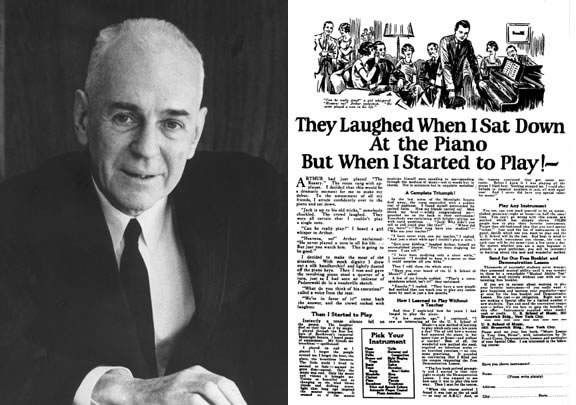
John Caples

It was John Caples who created the terrifyingly beautiful guidance for marketers:

“First you need to enter the conversation going on in your prospect's mind”.

That's him in the picture above by the way, along with one of his most famous advertising pieces – written when he was just a rookie at Ruthrauff and Ryan in 1925.

First you need to enter the conversation going on in your prospect's mind. It's one of those maxims that gets more profound the more you think about it.

Have a think for a few seconds yourself – what does it mean for you?

In its original context of advertising it told copywriters that if they wanted to get the attention of their prospects they couldn't force their message on them. They had to start by keying in to things the prospect was already thinking about.

Things they were worried about. Or dreamt of. Or were excited about. Or just interested in.

That's why the most effective headlines for ads (or subject lines for emails and blog posts) focus on the benefits the prospect will receive, or on something in the news right now, or work by eliciting that ever present human emotion: curiosity.

By starting where your prospect already is you can gently move them to where you'd like them to be.

It's marketing judo rather than a full frontal attack.

And it works. Really well.

But the “conversation already going on…” strategy works in many more situations than just advertising.

Having an initial sales meeting with a potential client. You need to start from where they are. Do they trust you or are they wary? If so you'll need to address that before you move on.

Using testimonials on your website? Don't just use the standard “Ian's great, we loved working with him” type. Think through what remaining concerns about working with you might someone have at the time when they check out your testimonials. Then make sure the testimonials address those concerns. (For a great set of questions to ask to do that, see this article by Sean D'Souza).

Asking for a referral? Think what's going on in the mind of the person you'll be asking. What will they be worried about? What might they see ask the risk of referring you?

At almost any time when you need to be persuasive, always start from where your potential client already is. Enter the conversation going on in their mind.

Featured

Selling

Stop Focusing on Problems – Start Focusing on Growth

Posted on July 31st, 2012.

Problem HoleI was chatting last night to a smart marketer who was asking me about an effective sales process for high value services.

He was experienced, and he'd done his homework and studied and tested some of the classic approaches. The steps he outlined to me that he was following were rock solid.

Where he was struggling was “finding the pain”.

You know: the step in every sales process where you drill in to the problems the client has and ask about the impact. And ask some more. And some more.

“Twist the knife”, so to speak, so that the client is fully aware of the situation they're in, how much it's costing them, the impact on their business or life.

He just didn't feel comfortable with that part.

And I don't blame him.

Almost all sales techniques focus on finding the pain. For good reason too. Without a big motivation to change, clients just won't buy.

You can find the pain ethically. Help the client see the reality of their situation for their own good.

Or you can do it unethically. Exaggerate all the negatives to scare them so you make the sale. I've even seen some sales training teach people to ask about the impact of the business issue on the potential client's personal life, their husband or wife, their kids. Yuck.

Here's the thing.

Finding the pain works. But it has a downside.

If you're constantly looking for pain, that means your focus is on clients with problems.

Remedial work. Fixing issues.

And typically that means you'll end up working on the same basic stuff again and again.

Like a plumber fixing leaks or a mechanic changing tyres or replacing alternators.

Not necessarily the most rewarding work. Or the highest paid.

If you're an engineer at the top of your game you probably want to be designing cars, not just fixing them.

If you're an expert business coach you probably want to work with clients who are doing well and are keen to grow, rather than those who are struggling to survive.

There's less desperation. but there's more upside. More joy and more enjoyment. Higher fees (and they're much better placed to pay you too).

If you look at a lot of marketing you can see that it's geared at the desperate. It agitates the pain and makes exaggerated claims. Who else but a desperate person would believe you can make thousands of dollars a day with just a few hours work. Or get 306 clients from a teleseminar?

So I believe my friend was right to feel uncomfortable finding the pain.

Yes, you and your client need to understand the gap between where they are today and where they need to be.

But isn't it so much better if that gap is about upside and growth?

And won't working on those growth challenges build your capabilities much more than just fixing the same old problems?

Isn't there much less competition at the top? Aren't car designers better paid than garage mechanics?

Next time you revisit your marketing strategy, take a look at who you see as your ideal client. Who you target with direct mail or who you focus your website content on.

(In fact, as I write this my stomach has just turned as I realise the pay-per-click campaign I've been testing is focused on pain rather than gain. Time to fix that).

Look at your marketing. What sort of client would be attracted by your headlines, your tweets, your sales letters?

A struggling client, or a growing client?

Who do you really want to work with?