Ian Brodie

Ian Brodie


Navigation
Searchtime
Featured

Marketing

Good Marketing, Bad Marketing

Posted on July 13th, 2012.

It's not often you see really good and really bad examples of marketing from the same company in the same week – but Giffgaff here in the UK have done just that.

Giffgaff are a sim only mobile phone company. You buy their sim, stick it in your own phone, and you get an absolutely tremendous deal: £10 a month for 250 minutes, unlimited texts and unlimited data is their core deal.

So since they're offering what looks like the very best deal on the market, you'd think their advertising would focus on this benefit.

No, of course not.

Giffgaff has sponsored a bunch of TV shows, including The Big Bang Theory which is where I first came across them. Yeah, I admit it, I watch geek comedy.

Their great idea for their sponsorship was to show a little image before the show and during every ad break that says…wait for it..”Giffgaff – the mobile phone network that's run by you”.

Whaaat?

No mention of them having the best tariffs out there, with unlimited data.

Just that their network is apparently run by me and you.

I'm not even sure what that means. But it doesn't sound that good. I don't want to run a mobile network – feels like hard work. I just want a great deal.

Apparently, the “run by you” thing is because they do a lot of their customer support through user forums where subscribers help each other out. So overheads are lower, and so they can afford to give you better deals.

OK. So that makes sense. But I couldn't possibly have guessed that from the 10 seconds of “The mobile phone network that's run by you”.

They've fallen into classic bad marketing. They've tried to be clever instead of effective. They've focused on the feature, not the benefit. And they've made me work too hard to figure out what I'd be getting.

After months of me watching these promos and doing nothing, I actually ended up switching to them. Not because of the ad – but because of word of mouth. Someone told me what their actual tariffs were and said they'd had a great experience with them.

So I checked it out, switched. And then saw an example of great marketing from them.

About a week or so after joining, I got these through the post.Giffgaff sim cards
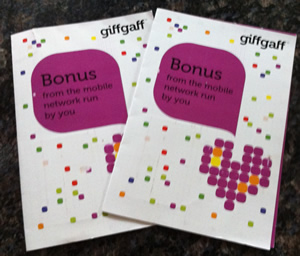
They're Giffgaff sim cards I can give to my friends. When they activate them, they get £5 of free credit and I get £5 of credit on my number too.

It's a brilliant example of referral marketing done well.

They got the timing right: a couple of weeks in, I've had enough time to be sure the network performs well and I get good reception. I can recommend them with confidence. But it's not so long that the novelty and delight at the savings has worn off.

They got the incentive right: they recognised that we're not all purely “what's in it for me” motivated. We like to do good things for our friends. The incentive is £5 for me – but more importantly, £5 free calls for the person I give the sim to. So I don't feel all sleazy for recommending something where only I get the benefit. The person I recommend it to benefits too.

And they made it easy for me to make the recommendation. I don't have to go to a website to order an extra sim. Or fill in all sorts of details. Or wait for it to be delivered. It's there in my hand right now. I just have to give it to the person I'm recommending it to. Easy. And quick.

I just wonder who gets paid the most in Giffgaff. The genius who came up with the referral giveaway. Or the idiot “creative” who came up with the clever-but-useless advert? Sadly, I suspect the latter.

More importantly – what can you learn?

Firstly, when it comes to advertising: don't forget the basics. Focus on benefits not features. And don't fall into the “cleverness” trap.

And for referrals, make it easy for someone to refer you – don't make them do all the hard work. Use Linkedin to identify exactly who you'd like a referral to rather than having them figure it out. Ask for a referral when they're confident in your capabilities and are feeling the benefits of what you've done for them.

And harness altruism, not just self interest. Help them see how the person they'll be referring you to will benefit. Create a free report or gift of some sort they can give from you to the person they refer
you to that will make them feel like they're doing the person a favour, not just recommending someone to them.

And keep an eye out yourself for good and bad marketing to learn from!

Featured

Strategy

How to Become a Trusted Advisor

Posted on July 5th, 2012.

Exclusive Bonus: the very best way to establish yourself as a trusted advisor to your senior clients is using a Value-Based Marketing strategy. To download your free step-by-step blueprint to implementing Value-Based Marketing and get FREE access to the Fast Start videos that will get you up and running and generating leads and clients fast, click here.

It's the holy grail of Professional Services – to become a trusted business advisor to your senior clients. To be viewed – and sought out – as a source of valued advice and support.

The benefits are crystal clear: if you're the first port of call for a client with a critical business problem then you're in a tremendous position to help shape that client's thinking, to build a deep understanding of the situation, and to establish strong credibility through the discussions.

In other words, you'll be in pole position to win any related work.

And if you’ve established a position of being able to help and offer good advice across a broad range of issues – not just in your own specialism – then you become an indispensable partner – not just a supplier.

But becoming a trusted advisor doesn’t happen overnight.

The position’s got to be earned – and that takes time and it takes consistent action.

How To Become a Trusted Advisor

The clues to what to focus on are in the name – trusted advisor.

You must establish both a trust-based relationship with your client; and you must be viewed as a source of valuable advice.

Building trust comes from demonstrating and proving trustworthiness over time to your clients.

That means repeatedly demonstrating that you understand them, you have their best interests at heart, and you'll deal with them with candour: always being honest about what you can and cannot do, and taking a long term perspective rather than seeing them as a short-term sales prospect.

And that starts even before they become clients. How you treat them when they're prospects sends a strong message about how you'll treat them when they're a client.

When the Huthwaite Group studied client’s perceptions of professional service salespeople, they found that of the key elements of trust (in their words: candour, competence and concern) it was the area of showing concern and empathy for their clients where professionals performed the worst.

Much worse that their counterparts in product sales.

Accountants, lawyers and consultants are trained “to be professional”. To be objective, fact-driven and solution focused. We've been conditioned into feeling we must constantly demonstrate our cleverness and expertise in order to be credible.

But all of this mitigates against showing genuine human concern for clients and their challenges.

It’s not that we don’t care about our clients – far from it. But we've got to learn to express this concern in ways which clients can appreciate.

Using our listening skills, for example, not to gather ammunition for our next verbal gem – but to build genuine and deep understanding of a client’s situation.

And when it comes to demonstrating that you can provide valuable advice, again you've got to do this consistently over time. Every interaction with your senior clients is a chance to either advance their perception of you as a source of valuable insight…or not.

Now that doesn't mean that a junior consultant or lawyer should try to jump right in and spout their “wisdom” to senior clients on day 1.

You've got to “earn your spurs” first.  You have to earn the basic right to be listened to by your senior clients.

You do this by demonstrating competence in the areas you've been hired for. Until you've done this, any attempts to advise on wider areas are going to fall on deaf ears. You need to prove your basic capabilities first.

Or as a grey-haired consultant told me on one of my early projects when I was trying far too hard to “add value” on a whole bunch of topics: “Ian, you've got to get your own sh*t sorted first”.

So that's your starting point.

But unfortunately, many professionals stop there.

They limit their interactions with clients to talking about the work at hand and the specialism they focus on.

Over time, this causes them to be pigeon-holed as just being technical specialists. People who can be relied on to deal with specific topics – but not a trusted advisor who can help with more challenging problems.

To establish your trusted advisor status you've got to demonstrate you can give valuable advice outside your specialism. You need to show you have broader knowledge of business in general, and of the client’s business and industry specifically.

That means you've got to do your homework.

As a professional you need to know the key issues of the day. In business and industry generally. In your client’s industry more specifically. And if you can, in your client’s company.

As you get closer and closer to your client, they’ll also begin to share issues that are personal to them and their role. But at the start, it’s the more general industry and company issues you should focus on.

Always make sure you’re up to date with industry news – and ask the client about their opinions. Put out tentative hypotheses to gently establish the fact that you’ve been thinking about their industry and their company. Highlight a recent move a competitor made and ask them how effective they feel it was – and be prepared to give your views too.

Use the smalltalk at the start and end of meetings to cover these relationship-building topics rather than jumping straight in to talk about the job at hand.

Or invite your client out for a coffee next time you do a progress update. A change of scenery to a more casual environment often helps clients open up more broadly about the things on their mind.

Don’t push this too far, too early though.

I’ve seen many junior consultants and aspiring partners rush far too fast into trying to “coach” senior clients long before they've earned the right.

Instead, recognise where you are in your relationship.

  • Have I established my basic competence?
  • Have I created an impression of strong general business knowledge?
  • Have I demonstrated useful insights into key business problems?

Look at the development of your relationship as a ladder you climb step-by-step. And hand-in-hand with your client at every step of the way.

In the early days, ask about issues just a bit wider in their organisation. Or things that are big news and everyone is talking about.

As your relationship develops you can move on to broader and bigger topics. But always do your homework so you have an interesting point of view to share.

Do this and you will set yourself well apart from the vast majority of consultants and other professionals.

Do it really well, and you’ll find that the clients you develop your trusted advisor roles with will support you for many, many years.
Download the Value-Based Marketing Blueprint

Featured

More Clients Memorandum

Spooked by Shadows

Posted on June 17th, 2012.

A while ago I did a “strategy workout” with one of my clients. An intense day blasting through all the key factors to build them a powerful marketing strategy and action plan.

One of the areas we looked at was their approach to large clients. And creating a strategy for one of their “gold star” clients in particular

The firm has a huge contract with them, one they can't afford to lose when it comes up for renewal.

One of the advantages her firm had over the majority of their competitors is that they have locations and staff all over the country, matching this client's locations and able to deliver training courses to them locally.

“But”, said my client, “one of our big competitors could say that too”.

She was right.

But here's the thing: just because they could say that, doesn't mean they will.

When you're planning your strategy you can't back away from talking about something that's of real value to your client just because someone else might be able to say the same.

The chances are, they won't.

(And even if they do, you're still better off than if they talk about it and you don't).

Sometimes we overthink things. We end up being spooked by shadows. Imagining that our competitors are super-marketers able to respond to our every move.

And so we end up being paralysed. Searching for the perfect strategy.

But we're much better off taking action on a good strategy.

Look at Dominos for example. Often lauded as an example of a brilliant Unique Selling Proposition (USP).

But really, just how unique is “fresh, hot pizza delivered to your door in 30 minutes…or it's free”?

Pretty much any pizza delivery company could make that promise.

It's a strategy that's almost trivial to copy.

Yet back when they came up with it, no one did copy them.

Dominos' real secret was that they were bold. They spotted something that was valuable to customers (fast delivery) and they marketed the heck out of it.

They stuck a guarantee behind it. They made sure everyone knew about it. They infused everything they did with that positioning.

What they didn't do was sit around worrying about whether anyone might copy them. Trying to come up with something that was so unique to them that no one could ever get near it.

They spotted something clients valued. They focused on it and took action.

And that's what we should do too.

Featured

Strategy

Why We Need More Experts, Not Fewer

Posted on June 12th, 2012.

More ExpertsExpert.

It's an overused term for sure.

Over on Danny Brown's blog, Ryan Hanley recently railed against The Commoditization of Expertise.

His argument was twofold. Partly that so many people now call themselves a “guru”, “expert” or “thought leader” that the term's become meaningless.

And partly that most of these folks were just regurgitating what others have already said. They weren't creating new insights themselves.

Well, I'd certainly agree with the first sentiment. If you have to call yourself a guru, or “the king of so-and-so” or “the queen of wotsit” you probably aren't. And you're being embarassing. Stop it.

But I'm going to disagree with the second point.

There's a great need for people who are “local experts”. Only Rosser Reeves invented the USP – but the world needs plenty of experts in it to help businesses create one (if they do it right, of course – most don't).

There was only one Peter Drucker – but millons of organisations needed help in management by objectives, customer focus, decentralisation and all the other stuff he pioneered.

There's only one Michael Porter, but…well, you get the picture.

Ironically, Ryan illustrated his point by saying “..in his book Outliers, Malcom Gladwell theorizes that it takes a person 10,000 hours of practice to master a task”.

Of course, the 10,000 hour principle doesn't come from Gladwell. It comes from Professor Anders Ericsson via Geoff Colvin and a bunch of others. Thus perfectly illustrating the point: Gladwell's not an ideas guy. He's a populariser. He's a type of expert in his own right – he finds out the new and interesting stuff that scientists and other “deep experts” are coming up with and makes it accessible to a broad public.

And similarly, a small business in Norwich doesn't need (and can't afford) Seth Godin to come over to show them how to make their business remarkable. But they can hire a local guy who's expert enough in Godin's ideas (and others) to put them into practice.

Now the local expert isn't going to earn quite as much as Seth Godin. But the world needs him too. And he'll be much better rewarded than the local guy who's not so expert.

So whether they're completely original or they're popularisers, or their local implementors – the world needs plenty of experts.

Featured

More Clients Memorandum

What’s your “trigger”?

Posted on June 10th, 2012.

I talk a lot about the need to nurture client relationships: to build credibility and trust over time – you may well have noticed ;)

But if you're anything like me, every now and then you've probably found yourself thinking “great, but isn't there a shortcut? I need clients now”.

Well, there is – sometimes.

Normally, so-called shortcuts don't work. They usually involve you getting more aggressive with your marketing and pushing your stuff at people when they're not ready.

Exactly the opposite of what I advocate. And frankly, it rarely works.

But there is an approach to getting clients fast that can work for some people.

It's dependent on the sort of business you're in. But if it works for you it can help you bypass a ton of time and effort and get straight through to clients open to talking to you and open to hiring you.

The approach is to look for “trigger events”.

A trigger event is something that happens to a business or individual that precedes them needing your help.

So, for example, after two businesses have merged, they often need support from HR consultants, change management consultants and IT specialists to make the merger work.

In this case the news of the merger is a trigger event for the people who supply those sorts of services. Businesses undergoing a merger are far more likely to need their support than typical businesses.

By focusing their marketing on businesses undergoing a merger, they're far more likely to hit people who are interested than if they try to market to everyone.

And those people are going to be closer to a buying decision (and with a real motivation to buy) than people who are just interested generally.

Now the strategy doesn't work for everyone. In the merger case, by the time the merger is announced it's too late for consultants, lawyers and financiers who work on the deal itself to get involved – that'll already be sorted out.

But for people like HR, change and IT consultants who get involved downstream it's a great time to approach a business.

So what are the trigger events for clients getting interested in hiring someone like you?

It could be news about the business (overseas expansion, rapid growth, a profit warning, a new facility being built). Or it could be news about individuals (a promotion, a new senior hire, a new project being taken on).

Make sure you're watching for the relevant news. Set up google alerts for your target clients. Watch Linkedin profile changes and status updates. Keep up to date with the trade news in your sector and stay in touch with the grapevine.

And have something useful to share for when the event happens. Don't just contact a merging business to say “hey, we can help you with your IT”. Have an executive briefing on the “5 big pitfalls of IT systems that can derail mergers – and how to avoid them”.

Offer them the briefing as a way of building your credibility and starting a relationship quickly.

Trigger events can be a real shortcut to finding high potential clients – make sure you're watching out for them.

Featured

Selling

Using the "Point of View" Meeting to Win Clients

Posted on May 31st, 2012.

EinsteinIn this month's Momentum Club Marketing Masterclass webinar we worked on strategies for effective face to face sales meetings.

One strategy we covered was on how to use a “Point of View” meeting to win clients.

A Point of View meeting is a meeting with a potential client where the primary purpose isn't for you to talk about your services, or to discuss a client's problems – it's for you to share valuable information with them.

It might be the results of a benchmarking study you've done. Or some case studies. Or the summary of a report you've written.

Essentially it's you sharing your point of view on a useful topic for your potential client.

Point of View meetings are important for two reasons.

Firstly because they're a great way of building your credibility with potential clients.

Secondly because it's an awful lot easier to get a client to agree to have a meeting with you where you share useful information with them than it is to have a meeting where you explain your services to them or “find out what they need”.

So they're ideally placed to help you sell.

The trouble is, they're handled incredibly badly most times.

The first mistake people make is to just go in, share the information and leave without any exploration with the client that might lead to working with them.

It's a huge opportunity missed.

But worse is the second mistake: “sugging”. Selling under the guise of sharing information. Promising you'll share useful information but actually just treating the session like a sales meeting.

Not only do you get no sale, you lose your relationship.

So how should you handle Point of View meetings?

The secret's in the structure. And in what I call “the flip”.

You need to structure the meeting so that rather than you just talking for an hour, you interact with them.

And you do this by asking about their priorities.

Do a summary of your point of view (or research or benchmarking or case studies) first.

Then ask them “so I can go into more details on the areas that will be the most valuable for you – out of all those topics, which are the most relevant for you based on where you are now? Which ones would be your priorities?”.

When they tell you, you need to “flip” the discussion. You need to move from you talking to them talking.

Ask them to expand – why are those the priorities? What exactly is happening right now in those areas that they want to change? What's the impact?

Then expand on your Point of View in those areas. Give them the meat.

What's happened now is that instead of you just rabbiting on for the duration of the meeting about what you think is important, you've found out from them what's important to them.

And you've turned the meeting from “show and tell” into an interactive, advisory discussion. You're giving them valuable information on areas that are priorities for them.

And you now know what those priorities are, what the issues are in those areas, what their impact is, etc.

Pretty much all the information you need to build an effective case for them hiring you.

But you've done it while building your credibility and giving value to the client.

Next, you close by summarising the main points.

“We discussed the importance of X, Y and Z (the main points in your point of view)…and the big priorities for you were A, B and C”.

(In real life, of course, your summary would be rather more detailed).

And then you need to ask for the follow up. This is critical.

“Would it be useful for you for me to come back and talk in a bit more detail about A, B and C…share some thoughts on some of the things you could do to address them?”

Here you're basically asking permission to come back and have a traditional sales meeting where you discuss their specific problems and propose how you could work with them.

Why a separate meeting? Why not have that discussion at the end of the Point of View meeting?

Well partly because you probably don't have the time to fully discuss the issues.

But mainly because your potential client will be in the wrong psychological state.

They've come to the meeting to hear and discuss your point of view (or case studies or whatever).

Even though they'll be happy to answer questions to help with that discussion – they didn't come in “buying mode”. They didn't come expecting to end up with you proposing something to them.

And I've found that's a big switch. For many clients, it just doesn't feel comfortable to find themselves in a sales meeting when they weren't expecting it. So the chances of them buying are slim.

Sure, if things go brilliantly and the client starts asking you questions that naturally lead on to talking about how you might help them, then go with the flow.

But more often than not, you'll get better results by coming back another day for an explicit sales meeting.

But in that follow up meeting, you'll be talking to someone you've already established your credibility with, and who you already know really needs what you'll be discussing.

So your chances of ending up with a new client are pretty darn good.

By the way, if you join Momentum Club, not only do you get to participate in upcoming Marketing Masterclass webinars and get your specific questions answered in depth – you'll also get access to all the webinar archives, including this recent one on effective sales meetings.

Featured

Marketing

How A Long Dead Genius From The 60s Can Make Your Marketing More Effective And Less Painful

Posted on May 30th, 2012.

Eugene SchwartzAs the TV show Mad Men demonstrates, the world of advertising in the 60s was a pretty interesting place to be. And one of the most interesting guys in the field was Eugene Schwartz.

He was one of the highest paid copywriters in the business, and billed himself as the hardest working.

Decades before anyone else was getting into it, Schwartz was using techniques learned from Zen Masters to enhance his output. He used a method uncannily similar to the recently published Pomodoro Technique for productivity. And his method for fueling his creativity matches up to techniques taught today.

He used those techniques to get very rich working only 3 hours a day, 5 days a week, and spending the rest of his time collecting art (and giving much of it away to museums).

And in his book Breakthrough Advertising, published in 1967 (and which sold for up to $900 until it was recently republished) he wrote some deeply profound words about marketing.

Here's one quote I keep coming back to:

Let’s get to the heart of the matter. The power, the force, the overwhelming urge to own that makes advertising work, comes from the market itself, and not from the copy.

Copy cannot create desire for a product. It can only take the hopes, dreams, fears and desires that already exists in the hearts of millions of people, and focus those already existing desires onto a particular product.

Schwartz was talking about advertising, but what he says applies to all marketing.

And it explains why most of us find marketing and selling so painful.

Most of us imagine that our job in marketing is to persuade. To convince a potential client that they want what we've got. To create a desire for our services.

And we feel bad about that because it feels manipulative. We're trying to push them from where they are to where we are.

But Schwartz says that doesn't work. We can't create desire. Instead we need to channel the desires they already have.

Instead of pushing them from where they are to where we are, we go to where they already are. We show them how what we've got satisfies that desire.

We don't push. We uncover.

And, of course, if what we've got doesn't satisfy their desire, we move on. Because there's no point trying to persuade them that actually they should want what we've got. We can only channel what they aready want.

So in a nutshell, Schwartz has given us the clue not only to marketing that isn't painful and salesy. But to marketing that actually works.

And it turns out they're one and the same.

Featured

More Clients Memorandum

Your very best source of new business…

Posted on May 20th, 2012.

…is of course, your current and previous clients.

The people who already know and trust you. Who know what a great job you do.

But you're not quite sure how to broach the subject with them. You don't want to seem all salesy.

And you've probably dropped out of contact with many of your ex-clients. It happens to all of us – other priorities take over.

So it's embarassing to get back in touch. Tricky to figure out what to say. Again, you don't want to seem salesy or needy.

Here's the trick: invest a little time in creating something of value for them. Some useful information that they'll find helpful and that'll demonstrate your credibility in an area they might be able to hire you in.

It doesn't have to be a giant “war and peace” tome. A couple of pages summarising some insights from the last 5 clients you've worked with. Or a short presentation on “what's working now” or “5 critical trends” in your field. Or even something you've learnt personally.

Anything that will be genuinely valuable to your contacts.

Because then you can get back in touch with confidence and say:

“Hey, we haven't spoken for a while but I've just written this short executive summary on XYZ and thought you might be interested in a copy. Would you like me to email a copy over?”

You can feel good about getting back in touch rather than feeling like you're being salesy or needy.

It'll remind them of how good you are at what you do. It'll trigger conversations. And it'll give you a good reason to follow up to see what they thought, find out what's going on with them, and start a business conversation.

Featured

Hope Is Not A Strategy

Posted on May 18th, 2012.

Hope Is Not A Strategy

Press the Play button to watch this short (3m 36s) video.

Video Transcript


Ian Brodie


I’d like to share with you probably the biggest lesson I ever learned in business.

If you've read my story on my website, you'll know that when I first started out in business development I discovered I was far from a natural.

I really struggled early on. It took a lot of support and mentoring from some genuine experts and a lot of work on my behalf before eventually things clicked in to place.

But I still remember those early days well. The fear of not knowing what to do, what would work and what wouldn't. Yet also knowing I absolutely needed to make it work.

I went through something similar when I first set up in business on my own.

All of a sudden, the marketing approaches I'd used when I had the backing of a big team and a brand name just didn't work so well.

Marketing for the small firm or solo professional is a different world.

At first I did OK - in fact pretty well. I got passed a lot of business from people who knew me from the corporate consulting world and knew what I could do.

So referrals and recommendations fed my pipeline and I hit six figures in my first year of business.

But then things began to dry up. I'd pretty much exhausted the work that I could get from my "inner circle". I was making progress with local networking and referrals - but slowly.

And for quite a while I let it drift. I kept thinking something would drop in from my network, or that the local referrals and networking would begin to pay off.

But, of course, it didn't. Not enough of it anyway.

Hope is not a strategy.

Eventually I figured out I needed to be a lot more pro-active. I couldn't rely on people passing work to me.

I needed to take control.

So I took a step back and really thought about who my ideal clients were and the value I could bring to them.

I narrowed my client focus. And I picked a small handful of pain-free marketing tactics I could work on and excel at.

And most importantly of all, I got much more systematic. I set targets for each of the marketing tactics and translated them into weekly goals.

And then week in, week out I implemented those tactics.

Of course, some weeks I lapsed. You can probably track back my blog posts and spot where some other priority got in the way of my blogging strategy, for example.

But 9 times out of 10 I stuck to my plan. And it turns out that's about 8 times out of 10 more than most people.

You know the rest of the story. The planning and the action really paid off for me.

Today my business is much more on autopilot. I know the strategy works so I get on with implementing the plan.

But the start of it all was that day when I took a step back and chose action over hope.

If you ever find yourself in that position of thinking "something will turn up, it always does". Or "once the recovery kicks in we'll be all right". Take a step back and remember hope is not a strategy.

Do something.

Start by choosing to take control.

Start by putting yourself in your clients' shoes and figuring out what they really want.

Start by finding ways to get yourself in front of your ideal clients more often and in ways that add value to them.

Start by thinking about how to nurture your valuable relationships with clients and prospects.

Start by learning how to have pain-free sales discussions with clients.

Then do it.

If you do, you'll be way, way ahead of most people. And you'll have the satisfaction of knowing you're in control of your own destiny.

If you'd like to learn the most effective ways of marketing to take control and take powerful action, then check out my Momentum Club private membership site where I deliver advanced marketing training, regular webinars, and specific projects designed to help you get more clients.

Right now I'm running a trial offer of $1 for 14 days access to the program. You can take a look at what's inside by clicking here and take it for a test drive by clicking here.

If you do think it's something that can help you, I'd love to see you inside. If not, I hope you found this video useful.

Best Wishes,


Transcript

I’d like to share with you probably the biggest lesson I ever learned in business

If you’ve read my story on my website, you’ll know that when I first started out in business development I discovered I was far from a natural.

I really struggled early on. It took a lot of support and mentoring from some genuine experts and a lot of work on my behalf before eventually things clicked in to place.

But I still remember those early days well. The fear of not knowing what to do, what would work and what wouldn’t Yet also knowing I absolutely needed to make it work.

I went through something similar when I first set up in business on my own.

All of a sudden, the marketing approaches I’d used when I had the backing of a big team and a brand name just didn’t work so well.

Marketing for the small firm or solo professional is a different world.

At first I did OK – in fact pretty well. I got passed a lot of business from people who knew me from the corporate consulting world and knew what I could do.

So referrals and recommendations fed my pipeline and I hit six figures in my first year of business.

But then things began to dry up.

I’d pretty much exhausted the work that I could get from my “inner circle”. I was making progress with local networking and referrals – but slowly.

And for quite a while I let it drift. I kept thinking something would drop in from my network, or that the local referrals and networking would begin to pay off.

But, of course, it didn’t. Not enough of it anyway.

Hope is not a strategy.

Eventually I figured out I needed to be a lot more pro-active. I couldn’t rely on people passing work to me.

I needed to take control.

So I took a step back and really thought about who my ideal clients were and the value I could bring to them.

I narrowed my client focus. And I picked a small handful of pain-free marketing tactics I could work on and excel at.

And most importantly of all, I got much more systematic. I set targets for each of the marketing tactics and translated them into weekly goals.

And then week in, week out I implemented those tactics.

Of course, some weeks I lapsed. You can probably track back my blog posts and spot where some other priority got in the way of my blogging strategy, for example.

But 9 times out of 10 I stuck to my plan. And it turns out that’s about 8 times out of 10 more than most people.

You know the rest of the story. The planning and the action really paid off for me.

Today my business is much more on autopilot. I know the strategy works so I get on with implementing the plan.

But the start of it all was that day when I took a step back and chose action over hope.

If you ever find yourself in that position of thinking “something will turn up, it always does”. Or “once the recovery kicks in we’ll be all right”. Take a step back and remember hope is not a strategy.

Do something.

Start by choosing to take control.

Start by putting yourself in your clients’ shoes and figuring out what they really want.

Start by finding ways to get yourself in front of your ideal clients more often and in ways that add value to them.

Start by thinking about how to nurture your valuable relationships with clients and prospects.

Start by learning how to have pain-free sales discussions with clients.

Then do it.

If you do, you’ll be way, way ahead of most people. And you’ll have the satisfaction of knowing you’re in control of your own destiny.

If you’d like to learn the most effective ways of marketing to take control and take powerful action, then check out my Momentum Club private membership site where I deliver advanced marketing training, regular webinars, and specific projects designed to help you get more clients.

Right now I’m running a trial offer of $1 for 14 days access to the program. You can take a look at what’s inside by clicking here and take it for a test drive by clicking here.

Take a $1 Test Drive of Momentum Club ».

If you do think it’s something that can help you, I’d love to see you inside. If not, I hope you found this video useful.

Best wishes

ian-dash

Featured

Marketing

Google’s "Zero Moment Of Truth": Why They’re Right And Why They’re Wrong

Posted on May 10th, 2012.

Zero Moment Of Truth BookA few weeks ago Google launched their first business book, ZMOT: Zero Moment Of Truth. You can download a pdf for free at the ZMOT site.

The concept of the book is simple. Google have taken the model of shopping popularised by P&G and added a step to reflect the way we actually buy today.

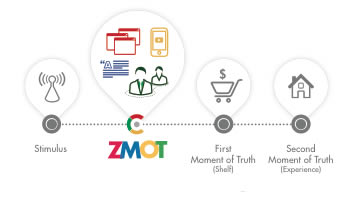
The traditional model starts with a stimulus – an advert on TV for an iPad perhaps. Then we have our First Moment Of Truth – our first experience of the product on the store shelf. Then our Second Moment Of Truth is our actual experience of the product when we've bought it.

In essence, consumer marketing has been build around this model for years. Stimulate an interest, impress at the store, deliver a great post-purchase experience.

Google's ZMOT model adds a fourth step. The Zero Moment Of Truth.

Zero Moment Of Truth Model

In this model, after the stimulus, the Zero Moment Of Truth step comes next where the potential buyer researches their options – usually online. They google the product. Check out reviews. Ask for opinions on facebook and twitter. Look up more details and alternatives.

Only after that do they take a look “on the shelf” for the product in the real world.

Makes sense?

Absolutely. It's not really a new model – more a neat way of summarising what's become a commonly accepted picture of how buying now works.

And you could argue that consulting, coaching and other professional services have always had the Zero Moment Of Truth step – long before online was an option.

When you're buying a complex, costly and intangible service there is no “shelf” to inspect the product on. So you have to rely on previous experience, referrals, testimonials, what other people say about their service and its provider. Or on the value the service provider gives you in advance of the purchase that “proves” his capabilities.

And these days that process is now much richer with the huge increase in information available online and easy access to people willing to give their opinion.

If fact, Google's book has some very illuminating “heat maps” showing, for example that the biggest wave of research activity when buying groceries happens a few hours before the purchase – but for a car it's 4-6 months in advance.

So yes, Google are right. There are some hugely important things going on before the first contact with the product or service. And the web has increased the importance of that phase.

But here's where Google is wrong. It's not a “moment” of truth. It's a series of moments. It's a relationship.

People don't research their car 5 months in advance and then do nothing until the day of the purchase. They continue to build their knowledge of their potential purchase and the people they might be buying it from. Over time, their confidence grows until they feel ready to make that big outlay.

And it's the same with professional services. Even more so in fact.

That Zero Moment Of Truth is really an extended courtship between the potential client and the service provider. With much of it happening without any direct involvement from the service provider themselves. The client is finding out more about them, checking if they really know their stuff and can deliver results. Getting a feel for what it would be like to work with them.

They're using the web. They're talking to others they know.

And by the time you first talk to them, their mind is almost made up.

So what are you doing to make sure that weird kind of courtship that's happening with your website and all your other marketing channels before a client contacts you is working effectively? How are you managing your Zero Moment Of Truth?