Ian Brodie

Ian Brodie


Navigation
Searchtime
Featured

Follow Up Strategies for Corporate Clients

Posted on November 29th, 2020.

How To Get Corporate Clients: The Ultimate Guide

Follow-Up Techniques to Win More Corporate Clients


CONTENTS

Introduction to Winning Corporate Clients

Critical Success Factors for Winning Corporate Clients

How to Target the Best and Most Valuable Corporate Clients for You

4 Powerful Lead Generation Strategies for Corporate Clients

Follow-Up Techniques to Win More Corporate Clients

Selling to Corporates: the Best Approaches for Enrolling Clients

Resources for Winning Corporate Clients


The vast majority of leads you generate with corporate clients won't be ready to buy when you initially make contact. Either because the timing isn't right and they're still in the early stages of their buying process. Or because you just haven't built up enough credibility and trust yet.

Add in the fact that you have to do this with multiple decision-makers in a corporate environment and that those decision makers have to reach agreement on what they actually want, and it's clear why sales cycles to corporate clients are long and complex.

That means that following up after your initial contact is absolutely crucial.

The ideal scenario is that you make contact with key influencers in the client organisation early on as they're discovering or exploring the challenge they'll later hire someone to help with. Then over time you build credibility and trust while helping to inform and shape their thinking.

So by the time it comes to hiring someone, you're in pole position.

Following up in this context means doing it in ways that add value and help your potential clients make progress. It doesn't mean chasing them, nagging them or otherwise trying to get something from them.

If your only follow up is to ask them if they're ready to look at an opportunity,  or to progress with a proposal or any other form of nagging then pretty soon they'll come to dread your calls and emails. They'll screen you out and try to avoid you.

That means that with the vast majority of your follow-up communications you're going to be sending useful, valuable information to them. Or connecting them with people they'll find helpful, or inviting them to events they'll find useful, or sharing industry news.

But to do that, you need to know what it is they're actually going to value. Which means that follow-up actually starts with your first interaction.

The role of your first contact in follow-up

If you're going to follow up effectively you need to know what kind of things your potential clients actually care about. Because, of course, those are the topics that they'll pay attention to if you use them in your follow-up.

For example, if you're a sales trainer, you might find out that your potential client's main issue is getting more business from their existing clients. In that case you're going to have more success following up by sharing useful insights into account based marketing or cross-selling than you are sending them information about cold calling or networking.

Knowing what their big goals, aspirations, problems and challenges are helps you know what would be a useful follow-up communication for them.


You can also add in non-work related topics to the mix. Perhaps they're a huge fan of their local sports team. Or of opera, or a certain genre of fiction. All these give you more topics you can keep in contact with them about (provided you share that interest, of course).


The business topics they care about are the core of your follow-up. But the non-work topics can build your relationship too.


How do you find out what they care about?


By asking questions.


If you're using one of the lead generation methods we've already talked about then you should have a good idea of the main business issues they're facing. But you can deepen and broaden your knowledge and give yourself more topics to follow up on by asking smart questions.


And if you've met the potential client by another method - at an event or via a more casual introduction for example, then these questions will be vital to give you something to follow-up on.


The exact questions you ask will depend on the circumstances and what you know already about your prospect. But questions that have worked well for me in the past include:

“What are the big challenges you see in your industry right now?” (substitute the name of their industry or sector)

“The big issues many of my clients are focusing on right now are X, Y and Z - are those things you're seeing, or is something else a priority for you?” (substitute the names of the most common problems or challenges your clients typically face)

“Are you working on anything interesting right now?”

“Do you have any big goals or ambitions for your business/unit/team/role over the next year or so?”

Note: you don't want to make your questions too threatening. In a first meeting, most people will feel they don't know you well enough to tell you their deepest, darkest fears and problems in their business.


So notice in the first two questions I ask them about the challenges they see in their industry generally, rather than in their specific business. That doesn't come across as threatening. But nine times out of ten, they'll answer by telling you about their own specific challenges – because those are the ones they know the most about.


In the other questions I ask them about their ambitions or the interesting things they're working on. It's much less threatening to talk about an ambition or a goal than a problem. But if you do have a problem that's top of mind, often you'll mention your ambition or goal to solve it. So this kind of “phrasing on the upside” of questions can elicit responses about their problems if they want to reveal them, without it feeling like you're being too intrusive early on.


And obviously, you don't launch straight into detailed questioning as the first thing you say to them. You generally engage in smalltalk first: talking about the speaker if you met at an event for example, or how they met the person who introduced you.


Don't overlook the role of this gentle questioning in initial contacts. You might feel pressure to talk about yourself and make a good impression. But unless you find out about them, you'll have very little to follow up about.

Now let's talk about how you manage follow up on an ongoing basis. And for that, it's useful to differentiate between your Perfect 10 and Dream 100 prospects.

Follow Up with your Perfect 10 Corporate Clients

Your Perfect 10 prospects are your very highest potential clients. And as such, they're worthy of investing significantly in follow-up.

I recommend you build a 2-weekly review into your schedule where you spend a little time looking at each of your Perfect 10 clients organisations and the individuals within them and thinking about how you can follow up in a way that's valuable for both you and them.

Use the information you gleaned from your initial contact plus any additional research you do - e.g. from their Linkedin profile, company website, google searches, information from common contacts, etc.
Based on what this tells you about what they might find valuable, think through what you might be able to do for follow up in the next few weeks.

You won't be able to think of something every review. But by reviewing every 2 weeks you'll probably be able to think of something every month or two months. And going through the thought process means you'll be more attuned to the potential for valuable follow up in the intervening period between reviews.

Examples of the types of follow up you could do include:
  • Sending an article (ideally, one you've written yourself) – either via email or printed
  • Sending a copy of a book you recommend
  • Introducing them to a useful business contact
  • Inviting them to an event you think they'd find useful
  • Recommending a tool, service, piece of software, etc.
  • Sharing some industry news or gossip
  • Just calling for a more casual chat if you've established a good relationship with them
This kind of personalised follow up is often time consuming - that's why you reserve it for your Perfect 10. But it can also really set you apart from competitors taking a more standardised and mechanical approach to follow up.

Follow Up with your Dream 100 Corporate Clients

For your Dream 100 where each individual client doesn't have so much potential, you're going to follow up in a more standardised way.

So rather than reviewing each individual client and following up with something specific for them, you're going to do the same follow up for each client in the Dream 100 group (with potentially a small degree of tailoring or deciding that a particular follow up isn't right for a client and just not doing it).
In this case you may look at doing something every month, two months or quarterly. You can use many of the same follow-up steps as with your Perfect 10 - for example, sending an article, a copy of a book, sharing industry news, etc.  The difference is you'll send the same article or book or news to everyone in your Dream 100 rather than selecting something specific for them.

Depending on how they react, or new information you might find out about them,  you may "promote" them to your Perfect 10 if they show potential, or remove them from your Dream 100 if they don't show any interest. 

Turning your Corporate Client Follow Up into a System

The key to follow up is that you have to actually do it.

And that means that the more you can turn your follow up into a repeatable system that you can use without having to re-invent the wheel every time, the more success you're going to have with it.

The first step is to schedule regular time into your agenda for your follow up activities - not to try to fit them in when you can.
Next is to set up repeatable "nurture campaigns" and a database of nurture activities you can use again and again for different potential clients (with some tailoring for each one).

For example, a sales trainer might have a series of articles, videos and other resources related to lead generation, another set related to sales meetings and another set related to negotiations. Depending on the interests of a potential client they meet, they can select the appropriate set and start using them in their follow up rather than creating completely unique activities each time. 

You can build up your campaigns over time - you don't need to set them all up in advance. Whenever you follow up with a new potential clients just check to see whether the activity you've just done can be turned into a new campaign or added into an existing one.

Of course, you don't just mindlessly do the same thing with each potential client. You check first to see if the particular nurture activities are appropriate to that client. And depending on how they respond, you then act accordingly.

But by turning follow up into a system you can save a lot of time - and most importantly, you can make sure it actually gets done

Next step

Selling to Corporate Clients

Learn how to convert your relationships with corporate clients into paying clients:

  • High Value Briefings
  • Sales Meetings
  • Requests for Proposals and Competitive Tenders

Learn more about  Selling to Corporates

Featured

Lead Generation for Corporate Clients

Posted on November 27th, 2020.

How To Get Corporate Clients: The Ultimate Guide

4 Powerful Lead Generation Strategies for Corporate Clients


CONTENTS

Introduction to Winning Corporate Clients

Critical Success Factors for Winning Corporate Clients

How to Target the Best and Most Valuable Corporate Clients for You

4 Powerful Lead Generation Strategies for Corporate Clients

Follow-Up Techniques to Win More Corporate Clients

Selling to Corporates: the Best Approaches for Enrolling Clients

Resources for Winning Corporate Clients


Once you've identified which corporate clients to target and the individuals within those clients to focus on, your next step is to make initial contact with them or otherwise get on their radar screen. In marketing circles this is commonly known as lead generation.

In this article we'll review four of the most effective yet underused methods for generating corporate leads.

For corporate clients, your lead generation goal should be to get a meeting or call with a potential client.

Getting your name known is fine. Getting them on an email list is great. But for corporate clients, a meeting or call is where the work really begins.
 
And if you want to speak directly to corporate clients you have to ask your self the question "why would this person want to meet with me?"

Why would this person want to meet with me?

Back when I first started working with corporate clients in the 90s it was common practice for buyers to have meetings with potential suppliers to learn about their capabilities and to get updates on "what's new" in the marketplace.

These days that rarely happens.

According to a 2019 Gartner study, business-to-business buyers spend only 17% of their time talking to potential suppliers compared to 45% of their time doing their own independent research.
Which means that today, you need a much stronger reason before a potential corporate client will be willing to meet with you.

Offering to meet up to "discuss how we might be able to help you" or to "explore your problems and challenges" is just not a compelling use of time for busy executives in large organisations. You need to offer something they'll get immediate value from if you want to get on their agenda.

And that's especially true given that the vast majority of time, they're not actively looking for help. 

By the time they're well advanced into their buying process when they finally need to speak to potential suppliers it's often too late to make a big impression or build the relationships needed for them to feel comfortable working with you.

Most often the project ends up being awarded to someone who they already know: either because they're an incumbent, or because that person started talking to them when they were still in the early phases of discovering and exploring their problem or goal.

So if you want to position yourself for success, you need to be talking to potential clients in that early phase too. And that means you need a compelling reason for them to meet with you before they're looking to hire someone.


That means you need to offer them some kind of meeting or call that they'll get tremendous value from and will be helpful to them in those early stages where they're still exploring their problem and potential solutions. Or perhaps even before they’ve identified a specific problem to focus on.


Typically, corporate clients always value hearing more about:

  • What their customers are thinking and doing
  • What their competitors are thinking and doing (e.g. best practices/benchmarking)
  • Big external trends that will affect them (e.g. technology, legal, economic, societal, etc).
The key is that you have to be perceived as being able to provide valuable new insight and information in these areas that they can't easily find elsewhere. So it needs to be different to information they can easily find online, from your competitors, or from their own research.

And the more that information is perceived as objective rather than just your opinions and ideas, the more attractive it will be to them. For example, the results from a benchmarking study you did into customer service best practices in their sector. Or a survey you did with their target market.

That's why perhaps the most powerful approach to lead generation is to do an Authority Research Project.

Lead Generation for Corporate Clients: Authority Research Projects

An Authority Research Project is a custom piece of research you carry out with the twin goals of creating valuable content that will position you as an expert in your field, and introducing you to potential clients.

In essence, it's a smaller scale version of the approach that made people like Tom Peters and Jim Collins famous (and some of the highest paid and most sought after experts in their fields).

It's a significant investment of your time - but it comes with a huge payoff.

An authority research project serves double-duty in terms of lead generation:
  • It generates unique insights that your competitors can't match and that corporate clients will value and be willing to meet you to discover.
  • The process of doing the research gets you talking to potential clients in a context that positions you as an expert. 
One of the most powerful aspects of an authority research project is the way it can get you in front of potential clients relatively easily.

Most corporate clients are reluctant to meet potential suppliers for what they might perceive as a sales meeting. But they're very happy to participate in a research project with the potential to give them valuable new insights.

You mustn't abuse the opportunity by turning a research interview into a sales pitch. It won't take long for that to destroy your reputation. But what you'll find is that by asking smart questions as part of your research you'll begin to build your credibility and your interactions with potential clients will start a personal relationship. I've often had clients turn to me at the end of interviews and ask me how I could help them. 

Your main opportunity, of course, comes when you present your research results back to potential clients.

Not only will you be sharing valuable new ideas and insights, you'll get the opportunity to ask potential clients about their biggest problems in the areas of your research and to talk about their options for making progress.

So at worst, you'll have found out where their biggest issues are and established yourself as an expert in those areas while building your relationship by delivering tremendous value to them.

And at best, they'll ask you directly how you could help them in those areas.

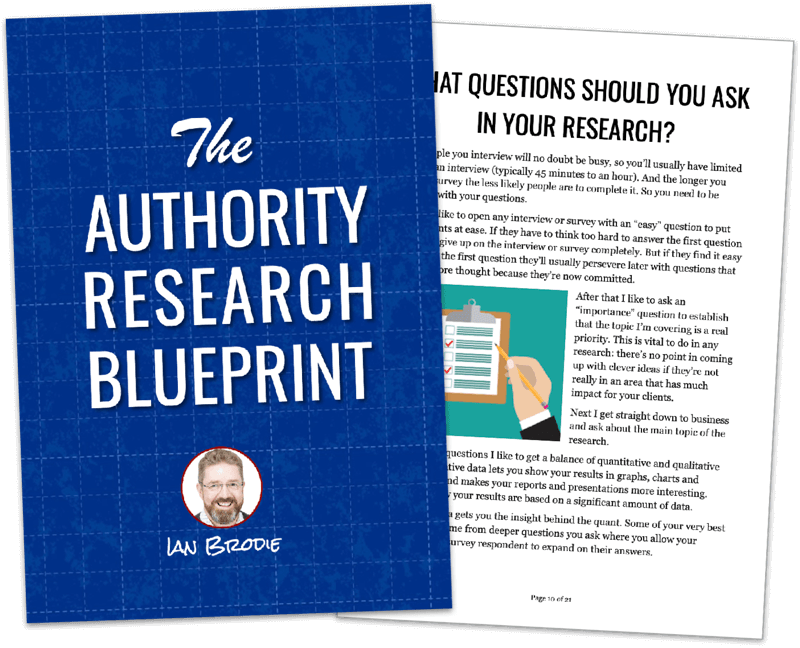
You can download a detailed guide to running an authority research project by clicking here or on the image below. The guide will walk you through all the steps, including:
  • Choosing the right research topic
  • Finding potential clients to interview and getting them to participate
  • Which questions to ask in your research project
  • How to execute the project
  • The best ways to analyse the results
  • How to present back the results and use them in your marketing
  • An example interview

Lead Generation for Corporate Clients: Referrals

Corporate decision-makers may not take your call or cold email – but they will pay attention if you've been recommended by someone they trust.

Your best step here is to make sure you're connected on Linkedin to your best contacts (e.g. ex-clients and clients) who you're confident would recommend you, and to then look at their contact base or use the Linkedin search to find people who you'd like introductions to. 
If you search for your ideal clients on Linkedin it'll show you who your common contacts are, and if you know them well enough you can ask them for a referral.

Don't use Linkedin itself to ask for the referral. Reach out in person to your contact, either on the phone or email. Explain who you'd like an introduction to and why.

And rather than asking for an introduction for a meeting to introduce yourself, tell them about the valuable insight you'd like to share with that person (e.g. the results of your authority research project or other source of new ideas).

Your contact should be able to see that this will be incredibly valuable to the person you're asking for an introduction to, and so they're much more likely to make that introduction than if they think they're setting up their contact for a sales pitch.

For more details on this strategy of using valuable insight and ideas to increase referrals, see this short video on How to Motivate People to Refer You.

Lead Generation for Corporate Clients: Presentations and Seminars

Nothing gives you a better opportunity to prove your capabilities than to make a presentation in front of an audience of potential clients.

If you're targeting corporates, you'll have to work to find out which events their senior decision-makers attend. It's far more likely to be a high-end industry conference than it is to be a local chamber event, for example.
Or, armed with new insights from your authority research project, you could organise your own small-scale seminar and invite your ideal corporate clients.

You goal in a lead generation presentation isn't to sell, it's to raise awareness of issues and solutions with your potential clients, and to build your credibility.

Ideally you want attendees at your presentation to "raise their hands" for some form of follow-up with you. That could be relatively light touch: a discussion after the presentation and an agreement to touch base in a few weeks time. Or it could be to set up a follow-up 1-1 meeting to go into some of the areas you discussed in more detail.

My experience with lead generation presentations is that "new" works better than "how to".

A "how to" presentation may get great feedback. But ultimately it doesn't lead the attendees to think that they can only get this information from you. You become just one of many who knows how to implement.

"New" information that triggers a lightbulb moment for them will not only motivate them to find out more, it will set you apart as being to only person with this valuable insight. Combine that with a compelling narrative and the stage is set for a presentation that generates high quality leads interested in working with you.

Lead Generation for Corporate Clients: Direct Mail

In these days where we're overwhelmed with email, good old direct mail is making a comeback.

Not flyers and adverts – but well-written letters that offer something of value rather than pitching. And hand addressed.
Even better: send “lumpy mail”: a package with a relevant object accompanying the letter.  Like a message in a bottle if you offer communications consultancy, or a squeezy stress toy if you offer risk management consultancy.

After all, who doesn't open packages addressed to them with a sense of anticipation?

As with the other lead generation methods we've mentioned, your offer in the letter should be for some kind of high-value 1-1 call or presentation where you offer to share new and useful insights on an important issue for your potential clients.

With your Perfect 10 prospects you can tailor the letter and/or lumpy mail object to the specific client. With your Dream 100 you'll take a more standardised approach sending the same letter and object to everyone.

Direct mail is something of a numbers game. You can reach many more potential clients than using referrals or presentations. But you chance of converting each one o a call or meeting is relatively low. To up your chance, consider sending a sequence of mailings - usually three is enough to prompt a response from those who your offer clicks with.  

Next step

Follow-Up Strategies for Corporate Clients

Learn how to follow up while adding value to build your relationship with corporate clients and get into pole position for when they're ready to buy:

  • The Personal Touch
  • Systematising your Follow Up
  • Valuable, Interesting Follow Up that builds Credibility and Trust

Featured

How to Target Corporate Clients and Individuals in Corporates

Posted on November 26th, 2020.

How To Get Corporate Clients: The Ultimate Guide

How to Target the Best and Most Valuable Corporate Clients for You


CONTENTS

Introduction to Winning Corporate Clients

Critical Success Factors for Winning Corporate Clients

How to Target the Best and Most Valuable Corporate Clients for You

4 Powerful Lead Generation Strategies for Corporate Clients

Follow-Up Techniques to Win More Corporate Clients

Selling to Corporates: the Best Approaches for Enrolling Clients

Resources for Winning Corporate Clients


Because winning work with corporates requires you to focus your efforts on a small number of potential clients, it's vital that you target the right organisations and the right individuals within those organisations to invest your time into.
 
If you're targeting small businesses or individuals you'd normally try to find a profitable niche to focus on.

Focusing on a niche accomplishes two primary tasks:
  1. 1
    It makes it easier to find and reach potential clients in that niche. For example clients in a niche may go to specific conferences or events, read certain magazines, visit certain websites or be identifiable on advertising platforms.
  2. 2
    By focusing on the niche you can tailor your expertise  to offer a better service and they'll feel you're more attuned to their needs and can offer a better solution for their issues.
When you're targeting corporate clients, the first factor is less important. 

Because you'll be focusing on a small handful of potential clients, you'll be able to target them individually. You'll know the specific organisation and the key people in it. And you'll make tailored plans for how to establish contact with them rather than relying on a "one size fits all" approach to a whole niche.

The second factor, however, is still vital. 

By focusing on a specific type of client - perhaps an industry sector or job function or a particular business challenge - you'll be much more in-tune with your potential client's concerns and much better able to communicate clearly and with empathy. 

You'll use the right language. You'll be intimately aware of their goals and challenges. And your potential clients will feel you're better able to use that knowledge and your experience to help them. 

So even if you only target half a dozen potential clients at a time, you'll have more success if you focus on those in a specific niche with a common factor between them.

Identify your "Perfect 10" and "Dream 100"

Once you've identified your target niche, your next step is to draw up lists of potential corporate clients you'll try to win.

You can do this based on your existing knowledge of the market or research on Linkedin, Google, or via industry reports.

I advise starting with a small list of organisations each of which could  be a brilliant client for you - potentially bringing you a large amount of the type of work you love to do. I call this your "Perfect 10".

It doesn't have to be exactly 10 organisations, but it's that order of magnitude because you're going to create a personalised plan to win that client and use "high touch" marketing approaches like  referrals and personal outreach.
Next, create a longer "Dream 100" list of your next best potential clients. These are organisations you'll use more standardised marketing approaches to contact such as direct mail, conference presentations or email.

Credit for the Dream 100 concept goes to Chet Holmes from his book The Ultimate Sales Machine. Well worth a read if you haven't done so already. The Perfect 10 is my enhancement for a smaller number of higher value corporate clients.

Find the Right People to Contact within your Target Client Lists

Starting with your Perfect 10 organisations, research who the right people to contact within those organisations are.

Who are the right people?

Ultimately, you want to be speaking to two groups of people:
  • People in the client organisation who feel the pain of the problems you solve (or whose goals are enabled by the solutions you provide) and so are motivated to want their organisation to hire you.
  • People with the power and financial support to authorise hiring you.
However, these people can be difficult to reach. Either because you don’t know who they are, or they're unwilling to talk to you because you're an unknown quantity.

So initially your best bet may well be to contact someone who won't directly become a client or decision-maker, but who can help you meet those who are.

This might be because you already know them or they're a friend of a friend and will be willing to help you out. Or they may just be the sort of person who's keen to introduce new ideas into their organisation and is open to meeting people who could provide them.

Again, use your existing knowledge, Linkedin, Google or just "asking around" to identify "problem owners", "decision makers" and "coaches" in your Perfect 10 organisations.

Initially your contact base may be very sparse. But as you start talking to people within the client organisation you'll be able to add new contacts to your list - or figure out that perhaps this isn't an ideal client after all. 

Build a Strategic Plan for your Perfect 10

Over time you'll want to build a detailed strategic plan for each of your Perfect 10 potential clients including:
  • A profile of the client's organisation (e.g. size, revenue, products, key locations, structure, management team, etc.) 
  • Your history and relationships with the client (if any)
  •  An analysis of the client's business (customer, competitors, key trends in their markets etc.)
  • An analysis of the client's strengths, weaknesses, opportunities and threats
  • Insight into their key priorities and initiatives
  • An assessment of how you can help them - tied to their priorities and/or SWOT
  •  An analysis of key individuals in the client organisation and their role in buying decisions
  • Your goals for working with the client (e.g. target revenue, type of projects, etc.)
  • An action plan of what you're going to do deliver on those goals - including building the key relationships needed to secure sales
Of course, initially you'll largely be working with publicly available information like annual reports, news stories, or what you can glean from asking around. So your plan will have lots of gaps.

Usually your first actions in a plan for a new Perfect 10 prospects are simply to gather information and identify a potential coach you can speak to to get insight and introductions.

Once you've established contact you can refine the plan as you gather more information and build more relationships.

Build a Plan for your Dream 100

For your Dream 100 your plan will be much simpler.

Since each potential client on the Dream 100 list won't have as much potential (at least as far as you know so far) as those on the Perfect 10 list, you won't be making personalised plans for each one.

Instead you'll be planning standardised marketing campaigns you can run to the whole group. For example a direct mail campaign or a request for referrals to anyone you know with contacts in your Dream 100 organisations.

Your first step is to decide which type of campaign to run to make initial contact and we cover a short list of the most effective approaches in the next section on Lead Generation for Corporate Clients.

Once you've decided, you'll need to list who that campaign is going to be focused on.

Usually with a Dream 100 campaign you focus on "problem owners" and "decision makers" rather than trying to find a coach to introduce you to the right people. It's a lower probability approach, but you're hitting 10x as many potential clients as with the Perfect 10 so you're playing the probabilities. 

Next step

Lead Generation for Corporate Clients

Learn which lead generation approaches work best to make initial contact with corporate clients:

  • Authority Research Projects
  • Referrals
  • Presentations and Seminars
  • Direct Mail

Featured

Critical Success Factors for Winning Corporate Clients

Posted on November 26th, 2020.

How To Get Corporate Clients: The Ultimate Guide

3 Critical Success Factors that Set You Up for Success in Winning Corporate Clients


CONTENTS

Introduction to Winning Corporate Clients

3 Critical Success Factors that Set You Up for Success in Winning Corporate Clients

How to Target the Best and Most Valuable Corporate Clients for You

4 Powerful Lead Generation Strategies for Corporate Clients

Follow-Up Techniques to Win More Corporate Clients

Selling to Corporates: the Best Approaches for Enrolling Clients

Resources for Winning Corporate Clients


When it comes to winning corporate clients, it's vital to remember that Principles are more important than Tactics.

Tactics are still important of course. But get the principles right and any solid marketing tactics executed well can work for you.

If you're serious about winning corporate clients you'll focus on these principles first, rather than joining the crowds obsessing over whether they should be using Google Adwords vs Facebook Ads or polishing up their Linkedin profile.

What are these principles - or critical success factors?

Here are the 3 that I've found make a huge difference when it comes to winning corporate clients:

Critical Success Factor 1: Ruthless Focus

Although large organisations dominate the business press, the truth is that that aren’t actually very many of them.

In the UK and US for example, less than 0.3% of all businesses have 500 employees or more. And the numbers are similarly small everywhere around the world.

The implications of this are twofold:

Firstly, it means that competition is fierce. Every consultant, coach or service provider hoping to win corporate business is going for the same tiny pool of clients as you are.
Secondly, it means you can be very targeted in your approach. You don't need to "spray and pray" a message out hoping it will hit a potential client. You can identify exactly who your best ideal clients are and work out a specific plan to win them.

Winning corporate clients is a game of high investment for high return.

Projects can be much bigger and longer-term. Expansion opportunities into other parts of the client's business are much greater. Fee rates can be significantly higher. The prestige and potential referrals from working with a corporate can be much higher too.

But in order to win those clients, you're going to have to do more.

You'll face more competition. Bigger hurdles to justify the bigger spend. More people involved in decision-making. More formalised purchasing processes with more criteria.

If you combine that with that fact that as a small provider you'll have limited time available for marketing then it implies that you need to be ruthlessly focused.

It's much more effective to focus your resources on a small number of opportunities and do a brilliant job at each one than it is to spread yourself thinly and fail to make an impression on any of them.
My advice is to segment your potential clients into 3 groups:
  • Your Perfect 10: A small number of very high potential clients who you're going create personalised marketing campaigns for and invest in nurturing personally.
  • Your Dream 100: A longer list of great potential clients you'll target with standard campaigns, tailored to the individual client where you can.
  • A Wider Audience: Who'll you'll aim to reach more reactively via your website, general social media campaigns and any other general marketing you do they might see.
Of course, the numbers aren't going to be exactly 10 and 100. Depending on the size of our business, the time you have available for marketing and the size of project you typically work on with clients you'll have more or less in each group. But the order of magnitude is correct: a small handful of potential clients you invest in marketing to personally to maximise your chances of winning and a larger number you take a more standardised approach to.

With your Perfect 10 you'll create dedicated account plans. You'll study their specific business and the key decision-makers within it, looking at their overall and individual goals and aspirations, problems and challenges. You'll aim to build relationships with multiple people within the client organisation using a variety of different marketing approaches and you'll look to keep in touch with your contacts and follow-up at least monthly if you can.

With your Dream 100 you're more likely to start with the problems and goals of your ideal client persona as a base and tailor if you know more information about the Dream 100 Potential client. But you won't do in-depth research on each one. You'll also run standard marketing campaigns to the clients at this level and follow-up on a less frequent (e.g. quarterly) basis.

With your Wider Audience you're generating awareness and building authority generally, and reacting to any interest shown. For example, someone might visit your website and make an enquiry and based on who they are, you might then elevate them to the Dream 100 or Perfect 10 and upgrade your marketing to them accordingly.

Critical Success Factor 2: Lead with Value

If you've read my guide to Value-Based Marketing you'll know that I recommend that all businesses lead with value to attract potential clients, demonstrate their credibility and build relationships.

But it's particularly important when you're trying to win corporate clients.

With small business clients – especially those active on the networking circuit – you can often get meetings with them to discuss “how your businesses might help each other out”.
With corporate clients, that almost never happens. They're inundated with potential suppliers wanting to get meetings. And they have no need to meet you to find out what you do.

The best way to get them to say yes to a meeting with you is if they believe they'll get something of value in the meeting itself.

By this, I don't mean you talk about the value they'll get if they hire you. I mean they get value from the meeting itself. New information, new ideas, new insights.

You've probably heard of the use of a “lead magnet” to get leads online. It's a report or video that's so useful that potential clients willingly sign up to get hold of it and get your follow-up emails in the process.

In the corporate world, rather than a report or video or checklist or other impersonal tool, you're better off offering a “High-Value Briefing”.

This is an in-person lead magnet where you share and discuss targeted, hugely valuable information to them.

It might be the results of a benchmarking study you recently carried out where they can learn about best practices in their industry and what their competitors are doing. Or a survey you did that sheds insight into the needs of their clients.

Or case studies about how other similar organisations made the kind of improvements they're looking to make. Or an analysis of the major trends impacting their industry. Or new techniques you've seen in a different industry or situation applied to their business. Or perhaps you host an event for leaders in their industry where you facilitate experience sharing.

A High-Value Briefing takes time and work to create: but it's an example of the “high investment, high returns” strategy you need to adopt to win corporate clients. It's the kind of thing senior clients are willing to schedule time in their diary for because they can see in advance that they'll get value from it, irrespective of whether they end up hiring you or not.

And, of course, from your perspective, it means you get an in-person discussion with a potential client about an issue that's important to them where you're an expert and have unique knowledge. If you do a good job in the briefing there's a very good chance it'll turn into a discussion about how you can help them.

And worst case: you've established credibility and built a relationship in an area they care about that you can harness later, even if they don't go ahead today.

Critical Success Factor 3: Nurture Relationships for Long Term Success

Corporate decision-making processes are long and sometimes arduous.

And while you can  occasionally short-cut them and win work quickly, it's the exception rather than the rule.

If you're selling something of high value, it's going to take time for the client to be able to decide to go ahead. They're going to have to trust you can deliver.
And it's inevitably going to need many people to buy into the decision. According to the Conference Executive Board in 2018, the average number of customer stakeholders involved in a business to business purchasing decision was 6.8.

That means it's going to take time to build a strong enough relationship with the key influencers of buying decisions in your area. And it's why the ability to nurture relationships is one of the key success factors for winning corporate clients.

Your Perfect 10 and Dream 100 segmentation is the best guide to doing this.

With your Perfect 10 you should already have analysed the organisation and the key individuals. Follow them on social media. Set alerts so that you pick up emerging news quickly. Follow their industry and competitors. Read their annual report, analysts reports and any internal documents you can get hold of.

That, along with your knowledge of their specific problems, challenges, goals and aspirations should give you plenty of ideas to keep in touch on a regular basis in ways that add value.

I suggest setting aside at least 30 minutes to an hour every week to review your Perfect 10 and think to yourself “based on what I know about them and what they care about, is there anything I can do this week to build my relationship with them?”

You won't be able to identify something every week. But even the act of doing the review makes you more alert during the week for things that might help you with relationship building.

For your Dream 100 do a monthly review to identify anything you can use to communicate to multiple prospects in the Dream 100 that would be useful to them. For example, if you've written a new blog post or had something published in a magazine, you could send it to all your relevant contacts in your Dream 100 who would find it useful.

For your Wider Audience, your nurturing will be done on autopilot if they've signed up to get regular emails from you, or if they follow you on social media.

Since we're talking about corporate clients where you'll need to speak to them before they'll buy, make sure you encourage interaction in your emails and social posts and then follow-up with the people who interact who it looks like could be potential clients. As you interact more online and you get to know more about them you may eventually elevate them up to the Dream 100 or Perfect 10.

Next step

How to Target Corporate Clients and Individuals

Learn which organisations to target for maximum impact - and who to focus on within each corporate client:

  • Finding your Niche
  • The Targeting Pyramid
  • Corporate Decision Making Networks
  • Choosing your Entry Strategy

Featured

Unsnooze Your Inbox – Finally Start Winning with Email & Newsletters

Posted on November 26th, 2020.

 I've Retired!

A HUGE thank you to all the friends, clients, colleagues and subscribers I've met along the way. 

You all allowed me to do fun, interesting work while earning a great living. You made Email Persuasion a best-seller and helped me win a bunch of accolades and awards for marketing which I really didn't deserve but appreciated anyway!

Now I'm taking time off to travel more, relax more, watch football more...and maybe play around with some fun side-projects too.

If you're interested, you can see all my recent posts about newsletters and emails on Substack by clicking the button below. I just re-read a whole bunch of them recently and I'm really rather proud of them:

You can also read my older articles on marketing, consulting and relationship building here.

Ian Brodie

Here's what I used to say...it still makes sense...

Email is Without Doubt the most powerful marketing tool for Small and Solo Businesses

I'm sure you've heard that a million times before.

And I'm sure you've read about the 43:1 return on investment with email marketing.

Or that a regular newsletter allows you to build credibility and trust directly with your audience without being hostage to the whims and algorithms of social media giants, search engines and their capricious billionaire owners.

It's true.

But, of course, there's a catch...

there's a Huge Problem with almost all the advice you get on email and newsletters

If you've ever read one of those articles about how you should copy the methods Joe Blow used to grow his email list to 27 million, or that you need to learn advanced "ninja" copywriting techniques or implement yet another complex technology tool then you'll know all about this problem.

Almost none of the advice on email and newsletters deals with the actual challenges real people have.

Real people have problems like getting started. Or knowing what to write about. Or managing to send emails out regularly rather than once in a blue moon. Or getting more than a few dozen subscribers.

Learning about fancy automations or how some influencer with a huge social media following grew their email list doesn't help the rest of us. 

And frankly, we just don't have the time to learn any of it, let alone implement it. We have businesses to run. Clients to help. Lives to lead.

All that well-meaning advice does more harm than good because it doesn't focus on the actual day-to-day problems most of us have with newsletters and email marketing.

And it doesn't help with the one thing that above all else leads to success with email for "normal people".

 Consistency

Sending a valuable, interesting email week in, week out that cements your credibility and builds a personal relationship with your subscribers while helping them succeed.

And you can only be consistent with email (or anything) if it's simple, easy and enjoyable.

You can get my free advice on how to succeed with email and newsletters in a way that's simple, easy and enjoyable by reading my Unsnooze Your Inbox Newsletter.

You'll learn simple techniques that anyone can implement to come up with great ideas, write engaging fun emails your readers will find hugely valuable and then turn those engaged subscribers into paying clients.

Highlights from
 Unsnooze Your Inbox

Magic should feel like this...

-> so should your emails

Every great speaker has these - you should too

-> here's how you can build them

How to break out of a rut

-> fresh ideas for emails and newsletters

How to show people you "give a sh*t"

-> it matters a lot

How to reach deep into the soul of your audience

-> courage mon brave

Great emails begin with deep understanding

-> because that leads to trust

Why I'm not a fan of (over) dramatic storytelling in emails

-> though many would disagree

Your Secret Weapon against "I'll never be as good as that"

-> a simple tool that actually works

Surely this can't be why I open James Clear's emails?

-> and don't call me Shirley. Obvs.

Read this if you're hesitant to tell your story in your emails

-> it might just give you what you need to get started

3 "missing links" for getting more clients from your emails

-> these tips helped me *a lot*

Why "Influence" is overrated

-> shock, horror, I mean the much-revered book

Read all my Unsnooze Your Inbox articles here...

A creativity tip stolen from James Cameron

-> I'm pretty sure he won't mind, but just in case, don't tell him

Do what you enjoy - not what's best

-> marketing heresy

5 ways to "unlevel the playing field" with email

-> simple steps to get an edge over big firms

3 hard-won lessons on getting "unstuck"

-> and a simple process for writing emails even when you're stuck

Thank Gawd for Ann Lamott

-> warning - mild swearing inside!

I found a new guru to steal from

-> this will work for you too

Jonny & Lucy > Benedict & Martin

-> please don't hate me for this if you're a Sherlock fan...

How I learned to love follow-up

-> and the huge mistake I learned from

5 go-to sources of great ideas for emails

-> one of these WILL work for you

Why your personality Matters

-> and how to get it across

Your Secret Source of Stand Out Ideas

-> you're almost certainly overlooking this

How to craft a unique topic for your newsletter

-> a simple 3-step process

Why your newsletter MUST look and sound different

-> useful is not enough

Email Breakdown: "The Robots are Here" from Copyblogger

-> in-depth breakdown of a very well-written email

"The Peak" newsletter sells for $5m - here's what you can learn

-> fresh, real-world insight into how you can grow your newsletter

Write the emails you want to see in the world

-> not the ones you think other people want to see

The Real Secret of Selling by Email

-> or...how to avoid wasting your time on yet another silver bullet

Where do great emails come from?

-> hint: it's not from waiting for the muse to arrive

Your stories are your secret weapon

-> with them you can slay corporate dragons

This is the most important email you can send

-> get this wrong and it's over before it starts

The 3-Part "Magic formula" for effective emails

-> there aren't really any "magic formula". But this gets close.

simplicity = speed = results

-> and the enemy of speed is...

See all my Unsnooze Your Inbox articles here...

Featured

How To Get Corporate Clients: The Ultimate Guide for 2021

Posted on November 25th, 2020.

The best ways to market to corporate clients

How To Get Corporate Clients: The Ultimate Guide for 2021


CONTENTS

Introduction to Winning Corporate Clients

Critical Success Factors for Winning Corporate Clients

How to Target the Best and Most Valuable Corporate Clients for You

4 Powerful Lead Generation Strategies for Corporate Clients

Follow-Up Techniques to Win More Corporate Clients

Selling to Corporates: the Best Approaches for Enrolling Clients

Resources for Winning Corporate Clients


Top of the list of dreams for many small firms and solo professionals is to win lucrative work with big corporate clients.

A few decent projects can keep your business very healthy for a long time.

The trouble is, those lucrative corporate contracts can be extremely tricky to land.

In reality, most of the common marketing techniques you might have been recommended or might even have used just don't work all that well for winning corporate clients.

You see, although things are changing over time, right now, senior decision-makers in corporates don't spend much of their time searching for things online or using social media.

And while the Linkedin gurus will tell you that 58% of CEOs are on Linkedin, what they won't tell you is that hardly any of them use it actively and their profile is usually managed by their PA.

Corporate buyers don't go out to networking events like smaller businesses do.

And their emails and calls are usually screened by assistants trained to keep new suppliers at bay.

Of course, it’s not that these popular tactics don't work at all. You can still raise visibility with more junior people through social media and your website – and that helps in the long run.

Or you might bump into a CEO at an event. And the odd cold email you send might get through to someone senior.

But these tactics don't work anywhere near as well as they do for smaller business clients. And they don't work anywhere near well enough to make them reliable front line options to base your strategy around.


So what's the best way to market to corporate clients?


In this in-depth guide you'll learn a step-by-step approach to set yourself up for success, find the right corporate clients for you, and then to go out and win those high value projects and engagements.

Critical Success Factors for Winning Corporate Clients

Learn the three critical success factors that make a huge difference when it comes to winning corporate clients:

  • Ruthless Focus
  • Leading with Value
  • Nurturing Relationships for Long Term Success

How to Target Corporate Clients and Individuals

Learn which organisations to target for maximum impact - and who to focus on within each corporate client:

  • Finding your Niche
  • The Targeting Pyramid
  • Corporate Decision Making Networks
  • Choosing your Entry Strategy

Lead Generation for Corporate Clients

Learn which lead generation approaches work best to make initial contact with corporate clients:

  • Authority Research Projects
  • Referrals
  • Presentations and Seminars
  • Direct Mail

Follow-Up Strategies for Corporate Clients

Learn how to follow up while adding value to build your relationship with corporate clients and get into pole position for when they're ready to buy:

  • The Personal Touch
  • Systematising your Follow Up
  • Valuable, Interesting Follow Up that builds Credibility and Trust

Selling to Corporate Clients

Learn how to convert your relationships with corporate clients into paying clients:

  • High Value Briefings
  • Sales Meetings
  • Requests for Proposals and Competitive Tenders

Learn more about  Selling to Corporates

Resources for Winning Corporate Clients

A guide to the best books and other resources for understanding and mastering the art of winning corporate clients.


 Unsnooze  Your Inbox

The very best way to win corporate or any high paying clients is to nurture your relationships by adding value over times.

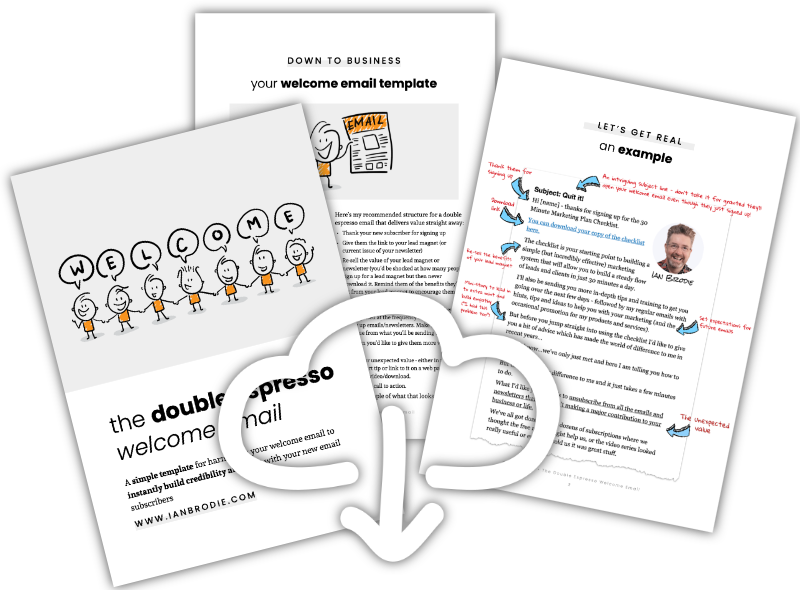
And the very best way to do that is with an email newsletter. Sign up for Unsnooze Your Inbox to get my best tips, insights and strategies for succeeding with newsletters and emails - and get the bonus "Double Espresso" welcome email template for building instant credibility.

Featured

More Clients Memorandum

Open this for vital but boring technical stuff

Posted on November 25th, 2020.

Probably not the best subject line, but it amused me :)

We're going to go on a quick detour today before we resume our journey into writing effective emails.

Because there's an area of email marketing that's massively overlooked yet has a huge impact.

Deliverability.

Us marketing types tend not to talk about deliverability much because it's not very glamorous. But the fact is that if your emails don't make it through to the inbox it doesn't matter how great they are, they won't have any impact.

And these days deliverability is getting increasingly tough. Email providers like Gmail and Outlook are determined to make sure that only the most important emails that their customers want get through to the primary inbox. And often commercial emails end up being filtered out.

Because of that, improving deliverability can often have a much bigger impact on your results than anything clever you can do with the content of your emails.

I don't claim to be the world's greatest expert on deliverability. But I've found 4 things that make a real difference:

  1. Get the technical stuff right.
    Email systems use stuff like Sender ID and DKIM to authenticate that emails coming from your email marketing system are genuinely from you. If you don't have these set up correctly you can really damage deliverability. Your email marketing system provider will have details on how to do this in their help files.
  2. Get your email address whitelisted.
    Getting your subscribers to add you to their address book and other steps to make sure your emails get through can definitely help and it's easy to do. My whitelisting instructions are here. They were created using Chris Lang's free whitelist generator.

    By the way – if you haven't done so already, adding my email address to your contacts list and dragging my emails to the primary tab if you're on gmail would be super helpful – thanks!)
  3. Write Engaging Emails that get Opened, Read and Replied.
    Easier said than done of course, but the more your subscribers open, read and take action on your emails, the more email providers like gmail or yahoo think that your emails are worth sending to the inbox for everyone using their systems. And conversely, the more people ignore your emails the more likely they are to get sent to spam or just filtered out across the whole system.
  4. Actively Manage Engagement.
    This is really the corollary to point 3. If you have subscribers who don't open your emails for a significant amount of time, then there's a good chance they're never going to open them and they're simply sending signals to the email providers that your emails should go into spam.

    Most email marketing systems have engagement management features or the ability to create automations that let you manage this.

    Of course it's not quite black and white. Some may spring back into life – especially if you have a long sales cycle. So my preference is to reduce the frequency of sending to them rather than delete them completely. But either way, you need to do something to prevent building up a big rump of unengaged subscribers who drag down your deliverability.

Hopefully that wasn't quite as boring as I made out :) And it's certainly something you should be looking at if you want to succeed with email marketing.

Featured

Get Clients Online

The opposite of pressure

Posted on November 22nd, 2020.

Hi – Ian here (apparently that's my catch-phrase :o ).

Last email I said that for high-value services you want to avoid doing what most email marketing training recommends: putting pressure on your subscribers to buy.

Flash sales, 5-day cash machines and the like all work for low-value products where a bit of pressure nudges a potential buyer into saying yes.

But for a high-value product or service when someone isn't ready to buy, putting pressure on them pushes them away. It backfires.

So what do you do instead?

The answer is a bit blindingly obvious I'm afraid. But rarely done.

If someone isn't ready to buy, then instead of pushing them to buy, you should get them ready to buy instead.

Unfortunately, getting people ready to buy isn’t easy and it takes time. Which is why most marketing people prefer quick tricks and hacks and “secrets”.

Getting people ready to buy starts with understanding what needs to be in place for your clients to be ready. 

And while there are differences that are unique to your specific situation, the good news is that a lot of it is common across all clients:

  • Firstly, people only buy something significant when they believe their problem or goal is big and urgent.
  • And if they're going to buy from you they'll want to know that you understand them and their challenges – and that you're on their side.
  • To have confidence you'll be able to help, they'll need to see that you have new ideas, insights and experience (new to them at least). And solutions that actually work.
  • And for any kind of service they'll want to know that you’re the kind of person they and their team can work with.

And it turns out that these are all things you can get across – or at least make significant progress on – in emails.

I'll talk about how to do it in more detail in future emails, but here are a few examples to get you going:

  • Rather than just sending your readers a tip, explain it via a story about how you experienced the problem yourself – or a case study of a client. That'll show your readers you understand them and their challenges.
  • Rather than just sending out emails with the same advice as others are giving (no matter how good it is) – focus your tips on the areas where your advice is different.
  • Be open in your emails about your beliefs, the causes you champion and the way you believe things should be done. You'll attract people with similar beliefs who want to work with people like you. And just as importantly you'll repel the people you wouldn’t have got on with.

Every email you send needs to be interesting and valuable to your readers – otherwise they won't read them. But in your emails you can also cover so much more that gives your readers what they need to know and feel to be ready to buy from you.

– Ian

Featured

More Clients Memorandum

This key step brings your value proposition to life

Posted on November 11th, 2020.

I left you on a bit of a cliffhanger last email – sorry – just not enough room in a single email!

So we'd got up to rating the different areas of value we provide to clients and how different they were to what our competitors offered. All based on feedback from clients and our own assessment of our strengths and weaknesses.

And I said there was one key step you need to do before deciding on your value proposition.

And that's to take a step back from all this data on the value you currently provide and how different you currently are…

…and think about what you want it to be.

And not only is this a crucial step, it's immensely liberating.

(Thanks again to Sean D'Souza's book The Brain Audit for this idea).

You don't have to worry if you're not quite bringing enough value or if you're different enough and how you'll somehow wordsmith that into sounding great.

You decide the value you want to deliver and the difference you want to have.

Now obviously you have to ground it in reality. Build it on the strengths you've already identified rather than conjuring it out of thin air.

But just look at where you are and think about where you could be in 3 months or 6 months time if you really put your mind to it.

And then make that your value proposition. Something ambitious and truly valuable.

To give you a practical example, I've been thinking about the value proposition for my website in the last week or so. It's essentially the same process.

What I've heard time and time again from clients is that the blog posts and tutorials on my site are really practical and more in-depth than they've seen elsewhere.

And they're more “real world” – they're things a typical consultant who's not focused 100% on marketing can actually do.

They also like the human side of me being honest with what's worked and not worked for me – there's a degree of trust there because I don't pretend to be some all-knowing guru.

And when I benchmarked my site against other sites that cover marketing for consultants what I saw was that a lot of my articles (in particular the “ultimate guides” and my value-based marketing guide) were indeed much more in-depth and comprehensive that the shorter blog posts I see on other sites.


And those posts are where the majority of my website traffic comes from too.

So I found myself thinking “Could my site realistically become the ‘go to' reference site for marketing for consultants (or coaches or trainers)?”.

The place you would go to for in-depth, practical guides to the major topics.

And the conclusion I came to was that yes, it could.

It's ambitious.

I'd have a lot of work to do to go from a handful of really in-depth articles on topics I just happened to get inspired to write about to much more comprehensive coverage.

But I could get there over time.

Going back to our two key value proposition criteria, it would be immensely valuable to potential clients and it would be a huge differentiator.

The value would stand out a mile. No need for clever wordsmithing.

Most likely it would do very well in Google search too.

Perhaps most important of all, the more I thought about it, the more excited I got about the idea.

It was something that would really be valued. And something I could get my teeth into.

In addition to all the logical stuff about value propositions, that's something you want too.

Something that gets you excited.

I don't think you can get that from just playing around and evaluating your existing strengths and offers.

I think you need to come up with something that's a stretch for you that you can work towards.

Then you have a value proposition that's both powerful in terms of its ability to attract clients and in its ability to motivate you to action.

Does your value proposition do that yet?

Featured

More Clients Memorandum

The grunt work of creating a powerful value proposition

Posted on November 8th, 2020.

Now that you've got input from your clients about why they hired you, It's time to start crafting your value proposition.

I like to do this in a fairly structured way. And even if you're not mathematical by nature I think this helps.

What I do is list all the big areas of value I think that the business I'm looking at brings to their clients – based on what they say and what their clients have given them feedback on.

I think of the big problems they solve. The big goals they help them achieve. Then bounce around the financial, emotional and practical value that brings. Eventually, I want to rate the size of the value on a 1-5 scale just to make sure I'm focusing on the biggest ones.

Once I have a shortlist of the big areas of value I try to think about how each one is different to what their competitors offer.

Again, I'm going to try to use a 1-5 scale to rate the size of difference.

Sometimes – though it's very, very rare – you might offer some type of value that no one else does. A problem or solution only you can provide.

But normally you're focusing on the same areas of value as your competitors – you're just delivering them in a different way.

I help my folks get more clients and I'm certainly not the only one who does that. So when I'm thinking about how I'm different I need to think about how I deliver that differently.

Do I help them get more new clients than anyone else? Are they higher quality clients? Do we get them faster? Is it easier for them to do, or does it take less time?

Perhaps I use a different methodology that they find easier to fit into the way they work? Perhaps it's more in line with their values and they feel more comfortable doing it? Perhaps it's more reliable and consistent?

Think through all the ways in which you deliver the different types of value you've listed and rate how different they are to what others are doing.

By now you should have a ranked list of the types of value you can bring to your clients rated on how big the value is, and on how different it is to what your competitors are offering.

So if you were a sales trainer, the chances are that the primary value you bring is always going to be about helping your clients get more sales. But perhaps you have a number of unique ways you do that, for example:

  • Your services are specifically focused on reinforcement of learning after the training course – meaning your clients really get results rather than having their people forget what they learned.
  • Your training is based on a deeper understanding of the psychology of buyers and so it leads to a greater success rate.
  • You're specialised in pharmaceutical sales – so your training is tailored to that market and the people you train can apply what they learn immediately rather than having to reinterpret it for their situation.

Which of these should you focus your value proposition on?

Most likely the one that's the most different from what others are offering.

So check: how many other trainers I compete with focus so much on reinforcement after the training course? How many go deep into buyer psychology? How many are specialised in pharma?

The answer to those questions tell you what to emphasis in your value proposition.

But don't jump to creating your value proposition quite yet. We still have one last step which we'll cover in the next email.