Ian Brodie

Ian Brodie


Navigation
Archive Archive for 2011
Featured

Marketing

Marketing that Actually Works

Posted on May 12th, 2011.

Here's a little video showcasing some highly effective marketing that worked on me last week – despite my best efforts to look down on it and ignore it.

There's plenty to learn here about grabbing attention, building interest and creating a compelling case for action. It's for a product, rather than a service but the principles can be equally applied to consulting, coaching or any other profession.

Hope you enjoy it – and hope you start your own swipe file too.

Ian

Featured

More Clients Memorandum

Marketing lessons from a geeky kid

Posted on May 8th, 2011.

As promised, a bit of a personal story this time…

I was never very popular at school.

Don't get me wrong: I was never bullied, and I had a good circle of close friends.

But I wasn't one of those kids who was popular with everyone. I wasn't very sporty, and I wasn't really interested in music.

I was much happier thinking about computers and what happened in the previous night's episode of Blake's Seven (and if you remember Blake's Seven it means you're probably as old and as geeky as me).

Within my small circle of friends with similar interests, I was well-liked and listened to, and I felt appreciated.

But every now and then, I wished I was one of the cool kids. One of the ones everyone liked.

So every now and then I'd look up what was in the pop charts. Find something to say about the school rugby team.

Something with broad appeal rather than the geeky stuff I liked myself. Something funny or clever I hoped everyone would like.

You can probably guess what happened next.

My attempts to please everyone never got anywhere. Passing comment on the current number one was certainly a more “acceptable” topic to the majority than the ins and outs of the latest Commodore Pet computer.

But it was no different to what everyone else was saying. It didn't turn anyone off. But neither did it turn anyone on.

Eventually, I learned that it was far better and far more personally satisfying to engage meaningfully with my small circle of friends.

We'd discuss Sci-Fi and computers. We liked model trains and other nerdy stuff that makes me cringe thinking back.

But the truth is I built deeper and more meaningful relationships with that small group by focusing on what we really liked than I ever got near to by trying to please everyone.

And the same goes for marketing.

Whether you're communicating by email, or you're giving a presentation, there's a huge temptation to focus on the majority. To not say anything controversial and to try to please everyone.

But when we try to please everyone, we end up coming across as bland and wishy-washy.

We may not upset anyone, but neither do we inspire anyone.

And whether you want people to be friends with you or to buy from you – you have to inspire them. Not upsetting them is not enough.

So if you're writing an email – write for your real core audience, don't worry about the rest. Don't worry about losing subscribers and getting complaints from the people who don't like what you have to say.

They were never going to become your clients anyway.

If you're giving a presentation, don't worry about your scores on those awful feedback sheets.

All you should care about is your impact on the few audience members who might become customers or who might go out and do something with your message.

Focus on inspiring the few, not mollifying the many.

And actually, you'll find that there are more of the few than you think. Certainly enough to help you build a flourishing business.

Featured

Marketing

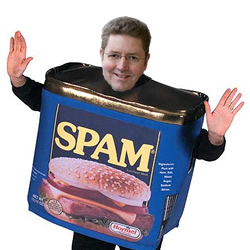
Are you Spam?

Posted on May 4th, 2011.

Are You Spam?Are your presentations and seminars thinly disguised pitches for your services?

When you phone up contacts and ex-clients, is it only ever when you want them to hire you or refer you?

Are your articles and blog posts mainly teasers for the “real stuff” which people have to hire you for?

When I meet you at a networking event do you hit me with a cleverly constructed elevator pitch designed to grab my attention and interest in how you can help me?

Take a minute to think about your marketing and business development practices.

Really.

Don't just read on to the next sentence. Think about which of them create value for your clients and prospects in and of themselves. And which are simply you promoting your services.

Lots of the latter and not so many of the former? Then your marketing is the real-world equivalent of spam.

An unsolicited, unwanted, annoying interruption.

Am I being a bit tough here? Setting an unrealistic standard?

I don't think so.

The bar is raising all the time for marketing. Each and every one of us is getting less and less tolerant of being interrupted and sold to.

So when we're the ones doing the marketing, we need to keep up.

We need our marketing to inform, educate or entertain in areas that our clients care about. Preferably all three. Just “getting your name out there” is no longer good enough.

———-
This post was inspired by the discussion on copywriting headlines on Lindsey Donner's How to be Amazing at Everything blog post.

Featured

More Clients Memorandum

How to write engaging emails

Posted on May 1st, 2011.

Last time we talked about what to include in a “nurture sequence” of emails designed to build credibility and trust with a potential client and so to eventually win their business.

I finished off the email by saying “Next you have to write it in an entertaining and engaging way”.

At that point you probably thought “hah – easier said than done”. And you'd be right.

But it's crucial to be able to do this. If people don't read your emails it doesn't matter what you put in them – it won't do a jot for your credibility, or build an iota of trust.

Ideally, you want people to look forward to receiving your emails and to open them straight away.

One reason they'll do this is if your emails contain a lot of useful information. Your knowledge of your clients' main problems, challenges, goals and aspirations tells you the topics you should be writing about.

But your emails also need to be entertaining too. We get so many emails these days, it's the entertaining and interesting ones that stand out.

Becoming an entertaining writer is a tough task. Nowadays I get many compliments on my writing (though I know there's still a lot of room for improvement).

But it wasn't always this way.

When I first started writing it was very stiff and formal. It was a bit like I was lecturing my readers.

And, to be frank, talking down to people is hardly a good way of endearing yourself to them.

So early on I learnt to write more casually. In particular, to write like I speak.

Imagine you're talking to a close business friend. What kind of language and speech pattern would you use with him or her? That's the kind of language you should be using when writing to potential clients.

That means using short paragraphs and sentences and simple words. And using the appropriate short forms: “I'll” rather than “I will”, “isn't” rather than “is not”.

I also learnt that using stories works much better than using facts and figures.

Personally, I'm a facts and figures guy. Probably because my first degree was in Maths.

But most people aren't. Most people enjoy and are persuaded much more by an interesting story or anecdote. It really brings your point home.

One of the first emails you probably got from me was “Hope is not a Strategy” where I illustrate how you need to take an active approach to your marketing by telling the story of what happened to me when I first set up my business.

I get a lot of people replying to that email telling me how it really hit a nerve and resonated with them.

I think the reason is that I tell my story. I don't just say what they should or shouldn't do – I say what happened to me and what worked for me.

Finally, write often and read often. I try to blog at least once a month and have been doing so for over a decade. Often much more frequently.

If you go back to my early blog posts you'll see how my writing has changed over the years.

I've gained the confidence to try out new things and “be myself” in my writing, rather than who I think I should be.

And by reading well-written blogs – particularly those with a very different style to yours – you come to appreciate what works and what doesn't.

In the next email I'm going to share a personal story that will help you see how to write in ways that will connect much better with your audience.

Featured

Marketing

The Excruciatingly Painful Task that’s Critical to Your Marketing Success

Posted on April 29th, 2011.

Do The WorkI've written a few times about just how important having valuable content on your website is to your success at getting clients online.

And the truth is that nowadays, creating valuable content is central to almost anything you do in marketing. It's perhaps the best way of differentiating yourself from everyone else who claims they can do the same as you can.

Want to win clients with presentations and seminars? You need great content.

Want to get more referrals? Give your referrers a report or video or other piece of great content to give away and you'll get many more referrals.

Want to use networking to get clients? How much more powerful is it to be able to send potential clients you meet a brilliant article or report than just your business card?

Want to earn the loyalty and repeat business of your current clients? Send them great new insights, benchmarking and analysis for free.

All based on having great content.

The downside?

Developing great content is hard. Excruciatingly painful at times.

I'm currently working on a private membership site full of my very best ideas, training and knowledge on marketing and sales for consultants and coaches. So far it's been my very best work. I love the material. I love what it's going to be and how it's going to help people.

But it's so, so painful to develop. Like pulling your own teeth out.

With rusty pliers.

And I know I'm not the only one who feels this way. Creating content is a huge issue for so many professionals.

Today though, I read a short book that set lightbulbs off in my brain and, I'm certain, will help me accelerate developing this material 10-fold. It could do the same for you.

It's a Kindle book by author Steven Pressfield (bestselling author of The Legend of Bagger Vance and The War of Art).

You can get it either on a Kindle device or via the free Kindle readers for iPhone, Android, Mac and PC.

You can get it here.

I thoroughly recommend it. It's a quick read – probably took me about 30 mins. And it could have a huge impact on your ability to develop powerful, client-getting content.

Ian

Featured

Marketing

What Carl Sagan Taught Me About Marketing

Posted on April 27th, 2011.

“Extraordinary claims require extraordinary evidence”

Growing up I was a bit of a fanboy of Carl Sagan. Although clunky by modern standards, Cosmos was a ground breaking TV programme and opened my eyes to the wonders of the universe. Later in life I found inspiration in “The Demon Haunted World”.

One of Sagan's most famous sayings was “Extraordinary claims require extraordinary evidence” (although the concept was originated by Pierre-Simon Laplace back in the 18th century).

Sagan was talking about scientific and paranormal claims. But it's equally applicable in today's world where we're bombarded by advertising messages and claims promising us everything from younger looking skin and 6-pack abs to success with the opposite sex, a fulfilling career, a secure retirement, brainier kids and untold riches.

And one of the dominant phenomena of the current era is that we've just stopped believing all these claims.

The problem is even worse on the web. Internet marketers have become obsessed with louder, shoutier headlines with claims that you can make millions in a few months “at the push of a button” or with just a few hours work a week.

And after the initial rush of excitement, most of us look at those claims and think “if they really could do that, why are they trying to sell me a $37 ebook?”.

Of course, the same applies to our own marketing too. We may firmly believe our coaching will help our clients find an amazing new career, or become a great leader, or double their business profits in 6 months. But from where our potential clients are sitting – in a boring job, or failing to motivate their team, or struggling to get by – those claims seem awfully bold.

So we need to prove them.

Lengendary copywriter Gary Bencivenga focused on this. While others were obsessing about clever headlines and hooking-in readers emotionally, Bencivenga stressed that the most important factor in an advert was unquestionable proof – and yet it's so rare.

How can we prove what we say?

  • We can give a “reason why” – a logic to our claim. In Bencivenga's case he talked about an advert he created as a kid to sell worms to fishermen. His headline of “Local worms catch more fish” gave a plausible logic as to why you should buy his worms.
  • We can give evidence: testimonials, case studies, notarized statements of income.
  • We can give strong guarantees.
  • We can demonstrate what we say. If we're promoting consulting, training or coaching on a specific area where we claim to be an expert we can prove that expertise in our presentations, seminars, articles and blog posts.
  • We can give results in advance: share ideas that help our clients improve before they even work with us – so that they'll believe our claims about how they'll improve once we're hired.

And the bolder our claims, the stronger our proof needs to be. As Sagan said:

Extraordinary claims require extraordinary evidence

Featured

Selling

Do You Really Need a New Sales Process?

Posted on April 27th, 2011.

Sales ProcessI read a thought-provoking blog post by Dan Waldschmidt today entitled The Lie of a “Better” Sales Process.

In it Dan argues that we spend far too much time looking for a shiny new way of selling that will improve our results – and far too little time getting better at using the perfectly adequate process we already have.

I'd agree with him up to a point.

If you've already got a decent sales process or methodology in place, then switching to a new one is going to have little impact on your success. Some methodologies are better suited for selling professional services than others (SPIN, Solution Selling and the ORDER process from Let's Get Real immediately spring to mind). But given a decent methodology, you're usually far better off getting better at using it than starting again from scratch.

However, there's an exception to this rule.

And it's one that, sadly, applies to many consultants, coaches, lawyers and other professionals.

If you don't use a methodology at all – then you need to find a decent one.

If you “just wing it”, you think you're a “natural salesperson” or you use what you've learned from your personal experience – the chances are your performance is way below what it could be.

Sales isn't just an art. It's been studied based on decades of experience and observation of thousands of sales meetings. And that includes large, complex professional services sales.

If you're using just your own experience or what you've learned from colleagues and you're up against a competitor using a process based on these decades of experience from thousands of people then you're going to be outgunned time and time again.

And before you invest in sales training focused on “tips and techniques” – make sure you have a solid process in place too. Otherwise most of what you learn will be pointless. Rather like trying to learn how to “fade” a golf ball when you haven't got your basic swing sorted.

——

How about you? Have you switched sales processes and had great success? Or has it just been a horrendous waste of time? Drop me a comment below, it would be great to share experiences.

Featured

More Clients Memorandum

How to make email marketing work

Posted on April 24th, 2011.

Last time I talked about how you can use email marketing “autoresponders” to nurture potential client relationships on autopilot.

But how do you create a good autoresponder sequence?

Well, I'm not going to pretend it's easy. Since writing this post I've written an entire book about email marketing. But here are some hints.

Start by thinking through a timeline. At the start of the timeline is your potential client today. Write down their “state of mind” right now as it relates to the sort of services you provide.

So, for example, if you're a procurement consultant they may start off worried that they're spending too much on external purchases. Feeling out of control and victimised by their vendors. Confused as to where to start, etc.

Now think about their state of mind after you've worked together.

Perhaps they're feeling in control. Elated that they've saved 20% of their external costs, etc. Whatever state of mind you typically leave your clients in when you've had a big success with them.

Now here's the crucial step…

Wind back a little bit.

What state of mind do they need to be in before they'll be ready to hire you?

You may think initially that this is the same as the initial state of mind – but it's not.

Initially they may be confused and concerned – but are they motivated enough to hire you (hopefully for a significant fee)?

Usually before clients hire professionals they need to have built up some degree of confidence in three things:

-> Their problem is big – and they need to fix it urgently.

-> You've got the skills, capabilities and track record to help them.

-> You're the kind of person they'd be comfortable working with.

Chances are they don't feel all of these things initially.

So before they're ready to hire you, you're going to have to take them on a journey to get them into this state of mind.

If you think through the individual steps needed to do this, and the natural order of doing them – that gives you your autoresponder sequence.

So, for example, sharing some case studies of other clients in similar situations and their realisation of how bad their situation was can help raise urgency.

As can sharing any diagnostics they can use themselves or early warning signs they've got a problem.

Success stories of people who've made significant improvements from their position can help them believe that it's not a lost cause for them.

Just go through – step by step – the very specific things that they need to believe before hiring you and you've got an outline for your sequence.

Next you have to write it in an entertaining and engaging way. And, of course, you have to be writing about topics your client's are inherently interested in. You can't just send them stuff that tells them how great you are!

But that's what our next email is all about…

Featured

More Clients Memorandum

Nurturing clients on “autopilot”

Posted on April 17th, 2011.

We've been talking recently about the importance of nurturing or romancing your potential clients. And in the last email I shared my simple system for categorising clients into As, Bs and Cs and investing time each week or month to think of how to build your relationships with those As and Bs.

But what about the Cs?

Who are those C category potential clients? Well, they're mostly people I haven't met or had detailed discussions with yet – so I don't really know whether they could be great clients for me. That means I can't afford to invest a ton of time yet into creating a tailored plan for developing my relationship with them.

Historically, C category clients have been largely ignored by most professionals. Maybe they received a Christmas card or maybe a newsletter every now and then. But most professionals invested their valuable time in their As and Bs.

And that was the right strategy. There just aren't enough hours in the day if you're having to do all your nurturing by hand.

The Power of the Internet for Building Client Relationships

I'm sure you won't be surprised to hear me say at this stage that “the internet has changed everything”. It's a bit of an overworked phrase.

But it has. It really has.

Through online marketing on the web it suddenly becomes viable to keep in touch and add value to C category prospects.

And it's well worth doing so. You may not yet know whether they could become great clients for you, but they might.

“Might” isn't good enough if you have to invest time and effort into communicating with them. But if you can do it essentially for free, then “might” is not bad at all.

And if you can build up a very large number of “might”s then it can become incredibly powerful.

With old-school nurturing you can invest your time in (say) a portfolio of 25 potential clients each with a 20% chance of becoming a client. That means you'll get 5 clients from your nurture activities.

Now let's say your C category potential clients only have a 1% chance of becoming a client. Doesn't sound so good initially. But what if you can nurture relationships with 1,000 of them? That gives you 10 clients. Or even 5,000 of them?

Suddenly the economics begin to change.

And through the web, hooking up with 1,000 or 5,000 potential clients isn't unrealistic at all. If you can get sufficient traffic to your website, and if you can offer them something of value to get them to sign up to receive communications from you – then building a list of thousands of subscribers who could become clients isn't such a tall order.

In fact, it's exactly the strategy I've followed to build my business.

By optimising my website, doing targeted pay-per-click advertising, and harnessing social media I get lots of website visitors from people who could be potential clients.

By offering relevant free reports or videos in return for them signing up I've had thousands of people opt-in to receive communications from me.

And by sending (hopefully) useful emails like this one I can demonstrate to readers my knowledge and expertise in how to win new clients.

So over time, if I keep adding value, many of the people who receive these emails will choose to contact me and we'll end up working together.

It's an approach that – once set up – runs almost on autopilot. it works when I'm out of the office or even asleep.

And, to be frank, it's rather more pleasant than knocking on doors touting for business.

And it's something almost everyone can do for their business.

More details on how next week…

Featured

Mindset

What's Your Story?

Posted on April 16th, 2011.

PersonasIn the world of espionage they call it your “legend”. In drama, it's a character's “backstory”. In marketing we often call it a “persona”.

In essence, it's the stories about you, your history, your experiences which uniquely qualify you to do the things you claim you can do. The things that give credibility to your services.

If you're a an innovation consultant, perhaps you spent 10 years at Apple and know how the very best do it. If you're an IT outsourcer, perhaps you used to be the CIO of a major corporation and know just what CIOs need from outsourcing. If you're a leadership coach, perhaps you interviewed the 10 most prominent leaders in your sector and know what they do that makes them so effective.

In my post on Marketing Half-Truths I showed how important this backstory can be. How it can give you significant credibility and also make you more interesting to clients.

I'm not talking here just about your achievements or your CV. Just a list of stuff you've done is neither interesting nor memorable.

What I'm talking about is crafting a coherent and memorable story that brings a logical underpinning to your capabilities and services.

It works best if you can sum it up in one sentence. “<your name> can <do what you say you can do> because <your story which justifies it>”.

In my case, I can help consultants and coaches get more clients because I've done it myself – despite being far from a natural at business development.

Here are some others from my Authority Marketing podcast interviews:

Drayton Bird can do world-class copywriting because he's an obsessive student of the art and learned personally from the very best.

Greg Alexander can use benchmarking to improve sales performance because he's an ex-Sales VP who teamed up with a benchmarking geek to devise a method that really measures what drives sales success.

Tom Searcy can help small businesses beat their bigger competitors to land huge clients because he's done it time and time again himself and has turned his experience into a practical methodology.

In each of the cases, the history of the person lends credibility to what they say they can do.

Knowing their backstory, I'm going to hire each of them ahead of someone who claims to be able to do the same, but doesn't have the same credibility in their story.

So do you have a credible backstory like this?

I'm not suggesting you make one up if you don't. But what you can do is identify and focus on the elements in your own history which support your claims. This could be jobs you've done, experiences you've had, something you've studied, or a quirk of your personality.

What sort of stories typically work well?

In no particular order, here's a list of types of backstory which can work well. See if your experience can fit into any of these templates:

  • “I've done what you want to do”. This is a particularly powerful one. If you've done yourself what you're advising others to do (turned around a company, led a large organisation, doubled the sales of your business) then it makes sense to people that your advice will be good.
  • “The researcher“. You may not have done yourself what you're advising people about – but you've studied those who have and become an expert on what drives success based on multiple examples.
  • The power behind the throne”. You were the guy behind the scenes advising, guiding and coaching others who've become big successes in the way your potential clients want to. Who did Roger Federer turn to recently to revitalise his career? Paul Annacone, the guy who helped Pete Sampras to nine of his Grand Slam victories.
  • “The pioneer”. You've the guy who's come up with new ideas in your field. A new theory of leadership. The first application of benchmarking to HR or whatever.
  • “The man on a mission”. You're dedicated to a cause – reducing waste in the public sector, democratising leadership.
  • “The champion”. This time you're dedicated to a particular type of business. Like Tom Searcy, for example, who champions small companies in their fight to win big deals against their big competitors.
  • “The safe pair of hands”. You want someone to manage a big IT project? This guy's done dozens. He knows every trick in the book and lives and breathes these projects.
  • “The engineer”. The guy who sees everything as a puzzle to be solved. Incredibly curious and obsessive about cracking every problem he gets given. You have a tough marketing challenge? Give it to him and he'll figure it out.

And, of course, there could be a whole bunch more.

In every case, something about the character or the experience of the persona gives credibility to why you should hire them. People can understand simple stereotypes like this. The can mentally file them and associate them with good things.

And if they're playing their role well, their behaviour and the stories they tell should be congruent with that stereotype.

So what's your story?

———-

PS For more information on using personas as part of business development, check out Dan Kennedy's work on Personality in Copy, and Jay Abraham and Rich Schefren on Maven Marketing.

Image by Nicolas Nova