Ian Brodie

Ian Brodie


Navigation
Archive Archive for 2011
Featured

More Clients Memorandum

So, are you going to do this?

Posted on June 12th, 2011.

One of the things Kathy and I always wanted was a big garden.

When we found our dream home in 1994 that was one of the things we fell in love with.

Sure, it was a little overrun. But it was huge. And it had potential. Three big borders and a woodland area shaded under horse chestnut trees.

And the most exciting bit for me was the prospect of getting my own little vegetable patch at the bottom of the garden.

It was something I'd always dreamed of. I come from a family of gardeners. Back in the mining villages of the North East you pretty much had football and your allotment.

That was life outside of work.

Unfortunately, the spot we'd earmarked had been used as a dumping ground for years by the previous owner. A quick bit of digging around and I discovered an overgrown knee-high wall and a buried climbing frame in there – just for starters.

It looked like a ton of work to sort out, so the vegetable patch plan got shelved for a bit.

And then a bit more.

And then a bit more still.

Pretty soon, I'd settled into thinking it might never get done. The thought of clearing that area was just so overwhelming.

And maybe it was OK like that. Maybe I could grow a few vegetables in the flower borders. or in pots. That would be alright, wouldn't it?

Not what I'd dreamed of, but OK really.

But Kathy hadn't forgotten my dream.

And after a couple of years of me putting things off she asked me the simple question: “are we going to do this or not?”

I knew by the look in her eyes that “no” wasn't an acceptable answer.

So late that summer I got out a spade and began to dig.

I'm not going to tell you it was easy when we got started – it wasn't. It was back-breaking work clearing that plot. Every spare hour every weekend for a month.

I still remember Kathy working away while heavily pregnant with our eldest. I remember us both being shattered every evening.

But I also remember the 20 plus years we've now had that vegetable patch.

The first crops – lettuce, carrots, peas, sweetcorn.

Growing giant onions, and giant parsnips in drainpipes for fun.

Putting up a greenhouse, and getting bumper harvests of tomatoes and peppers.

And most of all just being down there. Working on the garden and having somewhere away from work I could go to relax and think.

None of it possible without that first step of getting a spade and putting it into the ground.

Now you know where this is going, of course.

Sometimes in the last 20 or so years I've had the same feelings of being overwhelmed in my work and business.

Workload so high it seemed like I'd never get anything done.

So much to do to make an impact with so many potential clients. Not knowing where to start really. And nothing happening fast.

I'm betting you've felt like that too, at times.

So easy to put things off and think maybe it's OK.

Maybe things will sort themselves out. Maybe it doesn't really matter if the business doesn't grow this year or I don't bring in all those clients I was dreaming of.

But eventually, you have to ask yourself “am I going to do this or not?”

Because once you decide you are, all it takes is for you to put that first spade in the ground.

Sure, it'll be back-breaking work for a while. Dreams don't come easy.

But when they do come. When it does happen, they're so much better than you'd ever imagined.

So what about you? Are you going to do this or not?

Featured

More Clients Memorandum

Why selling benefits can (sometimes) lose you sales

Posted on June 6th, 2011.

“Focus on the benefits, not the features”

I'm sure you've heard this a million times.

It's standard marketing dogma. Focus on benefits. The problems you solve. The results people get from working with you.

Normally that's absolutely the right thing to do.

But sometimes it's absolutely wrong.

You see, focusing on benefits implies that's why people buy. And that's not always the case.

Imagine yourself in this scenario:

You're the CIO of a multinational. You've been set a target to reduce expenditure by 10% across the board.

You're looking at outsourcing. One firm is quoting you savings of 15%, the other 20%?

Which one do you go with. The 20% is a no-brainer, right?

Not necessarily.

15% and 20% are both significantly better than your budget. Both will keep the board happy.

In theory, you might go for the 20% to get the maximum benefit. But there's another huge factor that's going to be weighing on your mind. One that more often than not will determine your decision.

RISK.

You see, you might get an extra pat on the back for getting those extra savings – if they come off.

But if something goes wrong. If the outsourcer fails to deliver, if your systems start failing or your users start complaining all the time. Then you're in big trouble.

So as a buyer, you're rarely out to simply maximise benefits. You're looking to hit your target benefits at minimum risk.

And you'll see this buying behaviour repeated time and time again. Especially in large corporations and the public sector where maximising benefits will get you a small bonus or a pat on the back, but buying something which fails will get you the sack.

So as a seller (especially to large corporations or the public sector) you've got to focus not just on the benefits you'll bring – but on making sure they see you as the lowest risk option.

If you're like me, and you're a small or solo business, you're automatically at a disadvantage in these circumstances. By default, large businesses will see you as a risk.

So that means that very often, the focus of your “pitch” needs to be on minimising the perceived risk of working with you (and maximising the perceived risk of working with someone else).

Next time you're bidding for a big piece of work with a major customer, spend some time putting yourself in your potential client's shoes and brainstorming what risks they might see in the project and in working with you.

Maybe it's financial stability. Maybe it's continuity if you get hit by illness. Maybe it's that you don't understand their business. Maybe it's whether you can work in a unionised environment.

Whatever the risks you spot, make sure you address those risks.

Because just banging on about the wonderful benefits of working with you is going to get you nowhere if your client is frightened it may all fall apart and they won't see any of them in practice.

Featured

Marketing

Intrinsic Value Marketing: Marketing that Actually Works Episode 2

Posted on June 3rd, 2011.

Here's the next in our series of videos looking at slightly unusual or unexpected marketing that actually works very effectively. In this case we look at a powerful principle that you don't see used very often in professonal services.

http://www.youtube.com/watch?v=OmD-2BP_Ulw

Don't forget – keep an eye out for this type of marketing and add it to your swipe file.

Ian

Featured

Selling

My Worst Sales Meeting EVER

Posted on June 3rd, 2011.

fightBack when I first started doing business development as part of my consulting role, I had an absolutely awful experience in a sales meeting.

So bad I still get a knot in my stomach thinking about it.

But I'm going to tell you about it in all its gory detail because I think there are some useful lessons to be learned from it for all of us.

Here's the story…

I'd just finished running a project to improve the marketing capabilities of a manufacturing client based in Paris.

The project had been a huge success and we'd already seen over 10% improvements in sales in every country where we'd implemented the new strategies for them. A really big deal as they were in an ultra competitive market.

I'd closed the deal on the initial project, then run it and sold a couple of extensions over an 18 month period. Somewhere over $5m in total.

The idea was that I'd speak to the head of marketing of a similar business based in the UK to explain to them what we'd done and sell them an equivalent project.

This was my first time opening up a client relationship like this from scratch and it was a big opportunity for me personally to make a name for myself as a “rainmaker”. I really wanted to make this work and saw this as a critical first step to my next promotion.

We got the meeting set up through our telemarketing team – and we knew from our research that this client was struggling and needed the sort of improvements we were capable of delivering for them.

I was pretty nervous before the meeting, but the guy was friendly and pretty soon I was into the flow – explaining the case study and going through all the fantastic benefits and bottom line improvements my client had seen from our work together.

I came to the end of my case study and waited for him to start asking questions.

Nothing.

I waited some more.

Still nothing.

“Let me tell you about some of the other things we did”, I said, and launched into some more examples from the project.

Still no response.

I had absolutely no idea what to do next. The guy was like a stone wall. He showed no emotions. No interest.

“Is there anything you'd like to discuss?” I asked.

“No thank you”.

And that was about it. I can't remember exactly how we closed out the meeting – it's a bit of a blur. But I was so embarrassed and uncomfortable I just wanted to get out of there.

Not surprisingly, nothing came of the meeting, and it didn't result in me instantly becoming a legendary rainmaker.

Now you can probably spot a number of very basic errors I made. As a starter I spent far too much time talking, and not enough time asking questions and listening.

And when he didn't respond – when he stonewalled me – I was far too passive. After all, he agreed to give up an hour of his time to meet with me – there must have been something on his mind that he thought he could get out of the meeting.

But what I think was at the core of my problems in that meeting was my attitude.

I was far too needy, too desperate to make the sale.

So when there was silence, I felt pressured to fill it.

When the potential client wasn't cooperating, I didn't call his bluff. I didn't want to upset him. I played along instead.

As a result, we didn't have a peer-to-peer conversation. It was vendor-to-potential customer.

Me trying to please him.

And that's just not the right tone when you're trying to establish a trusted advisor relationship. The potential client can feel you're trying too hard. That you're desperate to make the sale. And it doesn't feel right to them – they don't feel they can trust someone who's trying to sell them.

Why did I fall into that subservient role?

I put myself under too much pressure to make the sale.

In my case, it was because I wanted to make rapid career progress. I was “on a roll” and I was desperate to make the next leap up. But it backfired.

Today I see the same problem with solo professionals and small businesses who put themselves under far too much pressure in their sales meetings. In their case, the problem is that they need almost every meeting they have to result in a sale. Their pipeline is weak and they have very few sales meetings lined up – so almost every one of them needs to convert.

And it backfires.

As a consultant, coach or other professional, the more you feel you need to make a sale, they less likely you are to exhibit the kind of peer-level trusted advisor behaviours that your clients are actually looking for. And so the less likely you are to make the sale.

It's why very often when clients ask me how to improve their conversion rate of meetings to sales, my answer is often nothing to do with the sales meetings themselves. It's to improve their marketing so they're getting many more meetings with people who are more likely to become clients and so they’re less desperate to sell in each one.

Once they have a steady flow of quality leads and the pressure to sell in each meeting is off, they're much more likely to have an effective meeting. And paradoxically, they're much more likely to sell.

Could this apply to you?

Have a look at your numbers. If you find you need to convert a very high percentage (50%+) of your leads to sales in order to hit your targets then the chances are you don't have enough leads and you're putting yourself under too much pressure.

Rather than trying to polish your sales techniques and get an ultra-high conversion rate, take a look at how you can generate more high-quality leads.

PS – click here for my short video with a step by step approach to becoming a trusted advisor

Featured

Selling

Why "Finding the Pain" is a bad strategy

Posted on May 29th, 2011.

I've been a big fan of Alan Weiss's work for a number of years.
It was probably reading Million Dollar Consulting while on holiday in Hong Kong many years ago that inspired me to go solo.

I don't always agree with everything he says (I suspect Alan would say those are the times when I'm wrong). But his arguments are always well made and based on probably more experience of high level solo consulting than anyone else.

One of the thing's I've heard Alan say on a number of occassions is that “finding the pain” went out with the ark. That it's no way to sell your services.

That had always puzzled me. Finding the pain for me means diagnosing the client's problems and understanding which are the biggest priority (and so motivating them to buy).

I always wondered what he didn't like about it. Perhaps he considered it to be manipulative or something?

Thanks to the power of the web, these days we have a chance to interact with “superstars”, not just read their books. So when Alan repeated this statement on a blog post recently I asked him to elaborate.

His answer was incredibly significant.

His point was not that “finding the pain” was unethical – or even that it didn't work. But that it led to commoditisation. Problem solving to address clear areas of pain is something most organisations have got good at, and that a whole bunch of consultants and coaches can do pretty well.

Or put it this way, lots of car mechanics and engineers can fix a broken engine. But how many can design and build a new one?

Who is it that gets paid the big bucks? Not the guy down your local repair shop.

So by focusing on aspirations and innovation instead you set yourself ahead of the pack. You're not easily copied, and you're not doing work that the client finds difficult to justify paying high fees for because they could probably have done it themselves.

To my mind, this is more important today than it's ever been.

Whether we're talking about decreasing purchasing costs, writing a marketing plan, creating a website or improving your people management skills: 5 years ago if you needed to do it you had a very limited choice of people you could find to help who you were confident would do a good job.

These days you can go online and find decent free guidance, buy a training course, or hire one of a myriad of competent advisors willing to help at highly competitive rates.

So for consultants and coaches, the days of an easy six figure income just because you're skilled in something clients need are over. It's just too easy for clients to find competent help at low cost.

If you do want that six figures and more income then simply solving problems isn't going to be enough. You have to help them innovate. Achieve something they didn't even know was there. Deliver something remarkable the problem-solvers can't match.

Sure, you might have to start by fixing some core problems – find the pain and stop the bleeding in medical terms. But you then have to move on to something much bigger.

If that's making you feal uneasy, it's a good thing. It makes me feel uneasy too because the implications are big.

It means we have to constantly stay at the leading edge of our field. We can't just learn our trade then happily ply it for 20 years.

And it means we have to find the clients that need more than problem solving. That have the appetitie for something bigger.

But it also means we're going to have an interesting and rewarding time doing it.

——
Image by A Strakey

Featured

More Clients Memorandum

Did you know?

Posted on May 29th, 2011.

We've come a long way since I sent you the email Hope is not a Strategy.

We've talked about finding your niche, developing a compelling value proposition, figuring out what marketing approaches will work for you, nurturing relationships, selling and managing clients.

Now I'm sure a lot of times you read some of the emails, thought “I know that” and moved on.

But I'd ask you to consider something for a moment.

Something that applies not just when you read my emails,  but whenever you read any hints, tips and guidelines – or when you're on a training course.

“Success in marketing and business development is driven not by what you know – but by what you do.”

I've seen it lots of times in training courses: those I've delivered, and when I've been a student too. I've seen it when people read books or websites.

I do it myself.

The moment I hear something I know already I get a satisfied glow. I nod sagely. I kind of feel validated.

And that warm, validated feeling seems to stop me from asking the killer question:

Not “do I know this?”

But “do I do this?

Because that's the question that leads to action.

That's the question that leads to improvement.

And that's the question that leads to results.

So next time you read or hear something about marketing or sales (or pretty much anything) and you find yourself thinking “yeah yeah, I know this – nothing new” – catch yourself. Change that thought.
Try:

“Do I do this?”

Then “Should I do this?”

Then “When will I do this? How will I do this?”

And then you'll start progressing in leaps and bounds.

Featured

More Clients Memorandum

Talking when there’s nothing to talk about

Posted on May 22nd, 2011.

Hey there – it's Ian here again.

In my last email I railed against the practice of equating marketing and relationship building with “schmoozing” and highlighted that the best way of building relationships with clients can be to overdeliver on your projects with them.

But that doesn't mean you should restrict your relationships with clients to just business.

It just means you should see relationship building as an intrinsic part of delivery, not something unrelated you swoop in and do later.

And often it's the little side conversations or the informal chats over coffee where the client opens up and shares information that may turn into opportunities in other areas for you.

As he often does, David Maister sums it up well. In his video on “The Rules of Relationships” he says “The key to great communication is talking when there's nothing to talk about. If you only talk when the kids have been arrested, you will deal with the issues, but you won't build the relationship”.

You can watch the video here by the way:

Rules of Relationships

Every interaction you have with your client is a chance to build your relationship – or not.

Focus first on delivering or overdelivering on your engagement. But do also take the time to talk about bigger, wider issues. Or just to build your relationship on a human level too.

Featured

Strategy

"Filter Bubble" Marketing

Posted on May 18th, 2011.

I recently watched a thought provoking TED talk by Eli Pariser on the dangers of Online “Filter Bubbles”.

Pariser noticed that Facebook and other social networks have started filtering what you see based on your actions on the site (Google's beginning to do the same with search results). In Eli's case, because he mainly clicked on the links of his liberal-minded contacts it started filtering out posts from his conservative contacts.

As he pointed out, what that does is create little “filter bubbles” around us online where we only get to see things we're already interested in, agree with, or are positive towards.

But, of course, as a sensible thinker – he doesn't want to just see the things he already agrees with. He wants to be challenged – to see alternative points of view (and so should we). Hence the danger of these filter bubbles.

Putting aside philosophy for one minute – it got me thinking about the impact on marketing.

I think we have a very similar situation going on. And it's about the difference between selling people what they need and what they want.

In the good old days (or bad old days, depending on your perspective) when marketing and selling was primarily in-person, you had a chance to “open your client's eyes” to what they really needed – even if they didn't originally realise it.

They didn't know they were paying way over the odds for their stationery. But when you got chatting to them at a networking event you were able to ask a few questions and help them see what was they were missing.

They didn't realise what an impact their poor leadership skills had on employee turnover and the growth of their business. But your presentation to the local chamber opened their eyes and they came up to see you after the event.

But nowadays, where so much of marketing has switched online, you just don't get those “eye opening” opportunties.

They might have come to your leadership seminar at the local chamber because they always go to chamber events and there wasn't much else on. On the web, there are a million choices and options for them to go elsewhere.

You might have had them as a captive audience for short discussion at that networking event. On the web, they just don't bother clicking on emails or discussion threads that they're not already interested in.

And they don't “bump into” you like they do in the face to face world. On the web, they search for what they want and if you don't match that, they never see you.

And with the increasing prevalence of filters, chances are they're not going to see anything at all you do on social media unless they're already interested in what you're saying before you say it.

So in other words, trying to sell what you know they need (even if they don't) is becoming inceasingly futile online. Like shouting into the wind.

What's the answer? How do you sell to people in filter bubbles?

It's not simple – but a good place to start is to switch your emphasis away from persuasion (from convincing whoever is in front of you that they really need what you have) and towards search (finding the people who already want what you have).

And if you do have something that people need but don't know they do, you've got to find some way of framing it in terms of what they already want.

They need to improve leadership skills? Couch it in terms of the business growth or improved productivity they already want.

Start with where they are, not where you want them to be and maybe you'll be able to break into their filter bubble

—-
Many thanks to James Ward who introduced me to Eli Pariser's talk on TED, and to Julie Kay who added more thoughts on focusing on people who already know they need what you have.

Featured

Marketing

How To Escape Marketing Overwhelm

Posted on May 17th, 2011.

Do you ever feel overwhelmed when you look at your pipeline and think about what you need to do to fill it?

You're not alone.

I think it's the curse of business owners and executives these days. You look at how many new clients you need to bring in to hit your targets and then you try to think about how you're going to do it.

But it's so difficult to know where to start. What will actually work?

Back in the day, you pretty much had the choice of networking, direct mail, telemarketing or advertising when it came to marketing. Each with their own established best practices and rules.

Today we've got organic and paid search, social media, social media ads, video marketing, email marketing. And it all seems to be changing all the time.

I've lost count of the number of “next big thing” emails I've had trying to convince me to buy the latest and greatest method for getting a so-called flood of clients with some newfangled technique.

And that's just Facebook!

When you're just starting out – or even if you're fairly well established – it can all be so overwhelming. So difficult to know what to do.

It was a big issue for me when I set out on my own. In some ways because I focus on marketing and sales it's worse – because I deliberately keep tabs on all the newest approaches.

Every time I tried to think of what I should do I couldn't get a clear picture in my mind. And all the stories of other people succeeding with this method or that method just confused me further.

So how on earth do we figure out what to do without spending every waking hour networking, phoning, tweeting or blogging?

Well, what follows is an approach I evolved that worked for me to clear the fog of uncertainty and give me some clarity on what to do.

I can't promise it will work for you – but give it a try – it's been helpful to a number of people I've shown it to.

The key to is to break down your marketing into manageable chunks. Ones you can think about sensibly. Too often, when we think about how we're going to get new clients we lump all our potential clients into one amorphous blob.

And you know what? You can't market to an amorphous blob.

So I found it helpful to split my clients into Top Clients and Others. For me, Top Clients are the top 10 clients I'd really love to win over the next 6 months. Clients who – if I got to do business with just one or two of them – could set me up for the year. For you it might be a top 5 or a top 20. But essentially it's a small number of ideal clients you can think about individually.

You could go more sophisticated and split into A/B/C or suchlike. But let's keep things simple for now.

The “others” are clients I'm not going identify specifically or do a specific plan for – too many of them. But I do aim to win a number of them via more general marketing.

Then I split my marketing into short term and long term.

Long term marketing is all about building “gravity”. Doing the things that will attract clients to you so you don't have to actively seek them out. Thought leadership, stuff with your website and the like.

But long term marketing takes time before it pays off. So you also need some short term activities to try to bring in clients right now. The kind of stuff that pays the bills while you work on the long term side.

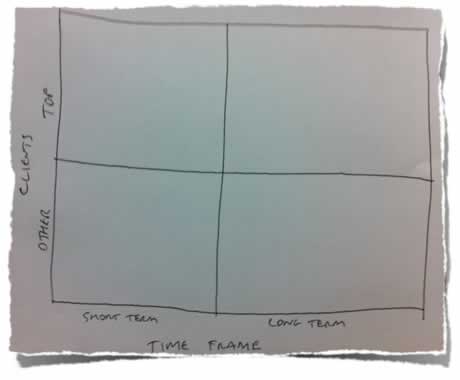
Then – because I'm a consultant and it's part of the union rules – I draw a little 2 x 2 matrix to represent this. Client types on one axis and time frame on the other. Rather like this:

Then I think through what marketing activities would be the most appropriate in each box for each client type/time frame combination.

Splitting it up like this makes it much easier. Instead of struggling to see what marketing will magically work for all clients in all circumstances, I can take a “horses for courses” approach. It's much easier to see what marketing will work in the short term for my top 10 clients, or to nurture relationships with the thousands of “other” prospects who visit my website for example.

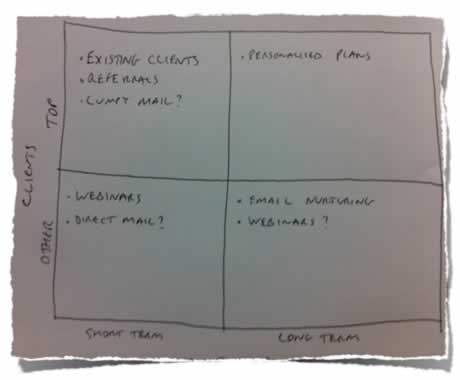
Usually, I end up thinking about referrals and extending existing client relationships for my top clients in the short term. And I develop unique, personalised nurture plans to build my relationship with my top prospects in the long term.

For the broader set of target clients, I'll may pencil in approaches like webinars or direct mail in the short term – and I'll focus on using email marketing nurture campaigns in the long term. Here's an example of what the matrix might look like for a typical client:

Of course, your matrix will look different depending on your analysis of what marketing approaches will work for your specific clients – and what you're good at.

But the key is that by breaking it up into this matrix rather than trying to eat the elephant all in one go, you zap the overwhelm.

As I say, I can't promise it'll work for you – but it's worked for me and many others – I suggest you give it a go.

Featured

More Clients Memorandum

Superpleasing your way to success

Posted on May 15th, 2011.

In these recent emails we've focused mainly on how to attract and win new clients.

But once you've got 'em, how do you get 'em to stay – and to buy more from you?

The best method I've found is the concept of “superpleasing” introduced by David Maister in his classic work “Managing the Professional Services Firm”.

We all know that getting more work from existing clients can be the most profitable source of new business. They already know us and trust us – and we've (hopefully) done good work for them.

So it should be a much easier sell to get them to buy more from us – provided they need the other things we're offering.

Sadly, in most businesses and also for individual practitioners – we focus most of our marketing effort on much lower payoff activities.

Running an advertising campaign, trying to cold call new prospects, or networking to meet new people, for example.

It just seems kind of sexier to focus on brand new clients than it does to build our relationships with our existing and previous ones.

And when we do try to market to existing clients, we often go about it completely the wrong way.

We equate marketing with meetings and “schmoozing”. We invite the client out to an event. Or we arrange for our managing partner to meet them to “chat them up”.

Those are the things our marketing budget is geared up for – events and non-billable time.

Now there's nothing wrong with these activities. Sometimes they're just the right thing. But more often than not there's something much more effective you can do with your time and money.

Think about it from your client's perspective instead.

If you were your client, what would be more valuable to you:

  • a chat with the managing partner (who probably doesn't really know your business all that well)
  • or the person working with you massively over-delivering on the work they're doing?

90% of the time, clients will go for the latter.

So instead of spending our marketing time and money schmoozing our clients – we should spend it “superpleasing” them.

Instead of spending time with clients at a social or business event, or in “marketing meetings” – spend it on the project you're working with them on and do an even better job than you would have done otherwise.

Instead of buying an advert or putting on a marketing event – spend the money to arrange a value-added session with your client's management team where you show them 5 new ways of implementing the results of your work and getting a better ROI.

In short, spend your time and money in any way you can think of so that the client not only thinks you did a great job for them (which should be the baseline) but that they think you've done the best job of any service provider they've hired.

Ever.

Don't think marketing – think value for your client.

Now you can't do this for every client. You need to focus on the high priority ones who have the potential to give you lots of new business, or strong referrals to other potential clients.

But if you superplease them like this it's the strongest way of getting them to buy more and to recommend you with enthusiasm