Ian Brodie

Ian Brodie


Navigation
Searchtime
Featured

Marketing

Getting Your Marketing Done: Top Tips to Get Results

Posted on December 17th, 2010.

All the great marketing plans in the world mean nothing if you don't get them implemented.

And I must admit, this is the area I'm personally the weakest at. I get my kicks from thinking: innovating or solving problems. It's probably what makes me quite a good consultant.

But I'm not so good at actually implementing my ideas myself. I just don't find that quite as exciting.

And my experience from working with hundreds of consultants, coaches and other professionals over the years is that I'm not alone.

It seems endemic that we prefer the intellectual to the practical or relationship sides of business.

So if like me, you're in that camp then the following implementation tips that I've picked up over the years may help you. They've made me vastly more effective at getting things done and getting results than I used to be.

The first tip is simple, but not often followed: don't attempt too much at once.

In previous posts, I've talked about planning your major lead generation campaigns. For an individual, my experience is that it's difficult to manage more than 3 or 4 such initiatives in a year.

And it's usually best to implement them sequentially rather than in parallel. When we multi-task we think we're achieving more, but we rarely give enough focus to each individual task to do it excellently.

And if you think about it logically, given we all have limited time, if you do 4 things in parallel it's going to take you 4 times as long to complete those tasks.

And since you usually don't see any results until you've finished – it means you don't get any results until right at the end.

But if you do each task at a time, you get the first one finished in a quarter the time and you start getting results straight away. Then you do the next and start getting results from that, etc.

Of course, it's not quite as simple as that – but it's not far off.

So focus on one important initiative at a time – hold back on your excitement and enthusiasm to work on them all at once.

Next, don't try for perfection initially. Don't spend ages trying to get your talk absolutely perfect, or your 2-minute introduction for networking, or your article or brochure. Once you're 70 or 80% there, start using it.

That last 20-30% will take ages – and you'll never get it right. The only way to get your marketing right is to test it in the real world and see how people react – then refine it.

I remember very clearly how I spend an absolute age perfecting the way I was going to introduce myself when I went networking.

At the first event where I used my clever introduction, I thought I'd done a great job with the group I introduced myself to. All according to plan. Then a new person joined the group and asked me what I did.

Slightly flustered I kind of stumbled over my introduction and got it much less than word perfect.

But the comment I got from another member of the original group was very revealing: “Oh, that sounded much less scripted” he said. “And I think I actually know what you do now”.

Oops. My attempts to get something perfect had led me astray.

So just get something good, not perfect. Then refine it in the real world based on feedback. Remember – imperfect action beats perfect inaction every time.

Next create action habits. What I mean by this is get into a regular routine of doing things which drive action. It's a bit like going to the gym first thing every morning so it becomes an ingrained habit.

In my case, I find that if I review my project plans every Monday morning and transfer the key upcoming activities either to my schedule (if they're going to take more than about 15 mins) or to my To-Do list – then it gets them prioritised and more likely to happen. I try to get every major activity actually scheduled so that it doesn't get pushed aside by busywork.

Then every morning I check my schedule and To-Do list and I'm off with a clear plan for the day.

Doing this doesn't just help me get organised – it reminds me of all the important activities I have to do and puts a little hustle into my day.

I find that if I don't do this I have a tendency to “goof off” in-between tasks, not realising just how much I have on my plate.

Of course, this particular routine might not work for you. Find your own routine that gets you moving – and make it a habit.

Finally, make commitments. For things which I know I need to do but don't particularly enjoy I'll force myself into action by making a commitment to it.

For example, I'll tell Kathy I'm going to write an article and ask her to ask me about progress at the end of the day. Or when I do the first blog post or email in a series I mention what's coming next so people are expecting it. These external commitments help to keep me on track.

Whatever you do…

…make sure you do something.

My experience is that the people who are the most successful at marketing and business development are simply the ones who do it the most.

Marketing is all about action. Yes, you must do some solid thinking in advance of course. But without action, there are no results.

Don't be the person who sits back and watches others thinking “I could do better than that”. Go out and actually do better.

Ian Brodie

PS – to put a little oomph into your marketing and get practical support for doing it, rather than just learning it – check out the details of Momentum Club by clicking the link below.
Featured

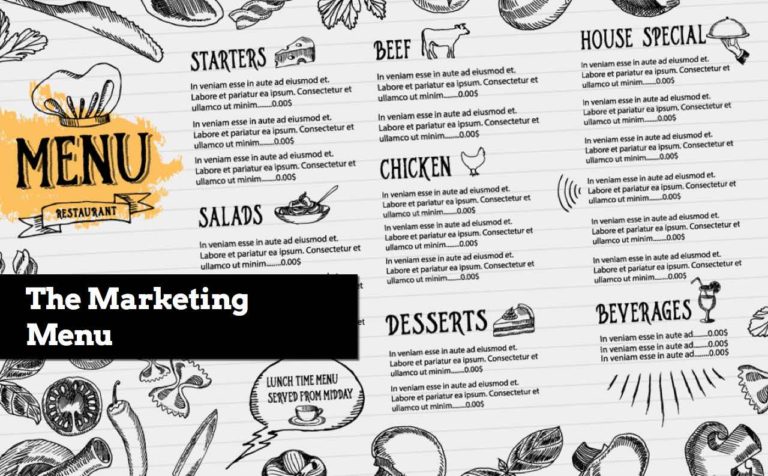
The Marketing Menu

Posted on December 14th, 2010.

The Marketing Menu PDF you can download below is a guide to the most effective marketing methods for generating leads for consultants, coaches and other professionals.

But before you jump into it, here are a few rules of thumb to bear in mind.

Firstly, remember that your very best source of clients is always going to be your existing contacts.

Now I know that doesn't sound very sexy. It always seems much better to bring in brand new leads from cold. But it's much, much easier to convert someone who already knows you, already trusts you, and already sees you as credible.

So make sure you're regularly in contact with your ex-clients, current clients and people who nearly became clients. The people you've already built credibility and trust with.

Make sure you're fully nurturing those relationships before you turn to colder prospects.

Secondly, make sure you've fully exploited the potential for referrals from your current contacts too. Again, these will be much more likely to convert into paying clients than cold prospects.

Now when you do move to broader lead generation it’s best to start by aiming to master just one approach at a time.

Which one should you start with?

The first question to ask yourself is whether you’re in a “one-to-few” business where you tend to work with a small number of very high-value clients? For example, a consultant working with 2 or 3 clients a year, some perhaps paying a six-figure sum or more per engagement.

Or whether you’re in a “one-to-many” business where you work with a larger number of clients each paying a smaller amount? For example, a coach working with a few dozen or so clients on an ongoing basis. Or like me, you might run a membership program with potentially hundreds of members.

If you’re in a “one to few” business it means two things:

Firstly, because each client engagement is big, you’ll have to build a really strong relationship with your prospective client to win it. Potentially talking to many people in the client organisation many times and maybe going through a formal procurement process.

Secondly, you can afford to spend more time winning each one because of the high ROI you get if you win.

So putting those together implies you need to focus and target a small number of potential clients and put a lot of personal effort into winning each engagement. Spread yourself too thin and you won’t win any of them.

That means that the sort of marketing that will work best for you will be very targeted. Things like referrals, working your personal network. Contacting high-value potential clients and offering to do a presentation for them on trends in their industry.

And your follow-up will often be quite manually-driven and personalised.

By contrast, if you’re in a “one to many” business and work with a large number of clients every year, it means you need your marketing to reach much wider. And you can’t afford to invest so much of your time per potential client on each opportunity.

That means we’re talking about much more automated or leveraged marketing – at least initially until an opportunity becomes likely to close.

That might mean doing presentations at industry conferences. Using online advertising leading people to a lead magnet and nurture emails. Or using content marketing or SEO to get people to that lead magnet.

And your follow-up is much more likely to be automated – email marketing being the usual suspect.

Quite a different strategy.

Of course, most businesses will lie somewhere in between these extremes. And many of us have a range of service offers including both “one to many” and “one to few”. Nonetheless, understanding where the majority of your clients and engagements lie on this spectrum will give you crucial insights into what marketing approaches will work best for you.

Next, look at three factors to identify the specific types of marketing you should focus on:

What is the reach of this approach? In other words how many of your potential clients to it get you in front of? For example, personal networking may connect you with dozens of people, an article in a trade journal may reach thousands.

How deep will the impact of this approach be on each potential client you reach with it? In particular, how much will it establish credibility and trust? For example, an article in an industry journal will probably do a lot to raise your credibility but because you’re not interacting with people personally it probably won’t do much for trust. A small scale seminar may hit both credibility and trust.

Will you enjoy doing it and are you good at it? It’s all well and good figuring out that presentations at big conferences will build credibility with your ideal clients, but if the thought of speaking on stage turns your stomach it’s probably not the best method for you right now.

As you can imagine, if you’re in a one-to-many business you’ll need an approach that primarily gives you a lot of reach. The more impact it has the better, but you don’t need a huge degree of impact for someone to buy a fairly low-cost service from you.

On the other hand, if you’re in a one-to-few business you’ll need an approach that gives you as much impact as possible and reach is less important.

In both cases though, you need an approach you can make work for you. One that’s within your technical capabilities, fits into the time you have available and is something you feel comfortable doing (and ideally enjoy).

The following chart gives a guide to the typical reach and impact of some of the more common lead generation tactics. Click on the image to download the PDF to your computer.

In practice, the reach and impact of a tactic for you and your specific audience may be different.

For example, your reach with networking events is likely to be much higher if your audience is small businesses or specific professions rather than executives in corporates. But the chart is a great starting point for you to base your analysis of your specific situation on.

Featured

Selling

How To Differentiate Yourself When You’re Selling

Posted on December 9th, 2010.

We talk a lot about differentiation in marketing. Differentiation is something that sets us apart. Unique attributes of our services that are valued by our clients but that can't be easily reproduced by our competitors.

At it's simplest level, it could be a service we can deliver that no one else can. Or perhaps we specialise in working with a particular sector so we have more experience and knowledge in that field.

Differentiation in marketing can make us the obvious “go to” person for a client who recognises they need our unique skills and capabilities.

We talk much less about differentiation in selling however. But it's just as important.

If we're face to face with a client trying to persuade them to choose us over a competitor then unless we're different in some way, the client will end up choosing on price.

Differentiation at this level is hard. By the time a client is talking to us face to face they've already discarded the firms and individuals who aren't specialised in their sector (if that's important to them) or who don't deliver the services they're looking for.

At this stage, the short list almost always comprises firms who can perfectly well help them address their problems or opportunities (or at least claim they can). They might do it in a different way to us. But at the end of the day, it's highly likely that they'll claim they can achieve the same end results.

If a client says they want to reduce their indirect procurement costs by 20% – all the consultants pitching to them will say that's what they'll deliver.

If a client says they want a smooth divorce that doesn't impact the kids, all the lawyers will say that's what they'll deliver.

If a client says they want their accounts done quickly and efficiently with minimum hassle – then pretty much every accountant they speak to will say that's exactly what they'll do.

And if everyone is saying they'll do the same thing – then the only thing that sets them apart in the client's mind is their price, right?

That's not good. Certainly not if, like me, you price at a premium because you believe you deliver a premium service.

So when it comes down to the crunch. When you're sitting 1-1 with a client and discussing what you'll do for them, how on earth do you differentiate yourself?

Well, the first thing you need to accept is that simply identifying the client's needs and then telling them you'll address them isn't enough. Everyone will do that.

Here are some ways you can differentiate yourself in these competitive selling situations:

The “Safe Pair of Hands” Strategy

You may all promise you'll deliver what the client wants. But from the client's perspective, there can be major differences in how confident they are that you'll make good on that promise. If you're able to prove through testimonials, references, or just how much you seem to understand their situation, then they'll feel more confident that you'll be able to deliver what they want. And so they'll pick you rather than selecting on price.

The “Relationship” Strategy

People choose to work with people they like and trust. They won't pick you if they don't think you can do the job. But once you've proven that, then they'll almost always choose someone they like and feel they can partner with over someone they don't.

The “Change the Game” Strategy

When you're interacting with a potential client and talking about their needs – if you can identify problems or opportunities that they haven't thought of themselves – then you can mark yourself out as being different. The quality of your diagnosis immediately marks you out as being an expert – and (rather fortuitously) can prompt the client to question the abilities of your competitors who didn't highlight these new ideas.

It can be a risky strategy if the client has fixed ideas about what they need and doesn't want to be challenged. But it can be a particularly powerful way of pulling the rug from under entrenched incumbents who have better relationships than you and are seen as safer pairs of hands.

What's Your Strategy?

These aren't the only strategies you can use in sales situations – but they're good ones. Ones which I've seen work time and time again.

Whenever you're in a competitive selling situation you absolutely must have a differentiation strategy in place. Just diagnosing the client's needs and saying you'll meet them is not enough. That's the baseline – everyone will do that.

Unless you want to end up competing on price you must have a compelling reason why they should choose you. It might be different for every client – but you need one for every client. And that means in every competitive sales situation you've got to put the time and effort into developing it.

So for those upcoming bids, pitches and sales meetings you've got: what's your strategy?

———-

Image by Foto43

Featured

Marketing

Do you really need a USP?

Posted on November 27th, 2010.

If you've been the recipient of any marketing advice over the last decade or so you'll no doubt have been told that you can't possibly succeed without defining your “Unique Selling Proposition”.

The concept was pioneered by advertising legend Rosser Reeves in the 1940s. Reeves' belief was that each advert should have a USP which:

  • Highlighted a specific and real benefit to the consumer of buying the product
  • Was one the competition could not or did not have
  • Was so strong it could “move the masses” to buy your product

There's a lot to like about this concept. It can be a powerful and succinct way of communicating with your clients – but unfortunately, since Reeves' day it's been mangled and misapplied repeatedly.

Note the order in which Reeves describes his points – start with benefits, then uniqueness.

Unfortunately, the very phrase “Unique Selling Proposition” tends to lead people to start off thinking internally about what's unique about them rather than thinking externally about the value or benefit they bring to clients.

If you start by focusing on what's different about you, you frequently end up with a proposition that just doesn't resonate with clients. There probably aren't many lawyers who wear clown suits – but I wouldn't recommend it as a USP.

For that reason, I sometimes prefer the phrase Value Proposition to USP. It forces you to think first about the value you bring – and then second about how it's different to what others do.

Being able to articulate the value your services bring is particularly important when that value is intangible.

If you help clients with leadership or team building or anything where there’s not an immediate dollar value associated with the results you get for them, then you need to find a way of making that value more tangible and visible. Because at the end of the day no matter how enthusiastic your client is to work with you, when they have to go and get the budget and compete against all the other people looking to spend that same pot of money, they need a really strong business case for why they should be spending it with you.

The first step in developing a powerful value proposition is to review your insights from your ideal client persona to identify their biggest problems, challenges, goals and aspirations that you can help them with. Choose the ones with the greatest financial and strategic impact.

If you end up with a long list, narrow it down to the ones where what you deliver is the most different to what your competitors offer. If needed you can do a simple rating of the value of each area and how different it is on a scale of 1-5 and select the highest scoring ones to explore further.

As you do this, remember that in order to win clients, you don't have to be completely unique and the only person in the world doing something. You just have to be unique in the eyes of your potential client.

In other words you have to be different to the other potential suppliers they're considering, not everyone else in the world. If you're a coach who works with small businesses based in Manchester, it really doesn't matter that another coach in New York does something similar to you. What matters is that you're different and add more value than the other coaches your client is considering in Manchester.

Next, you need to articulate your value in a way that's instantly clear to potential clients.

A good way to do this is to try to put your value into a series of value proposition templates:

  • I help [target clients] get [desired outcome] (or I help [target clients] [solve unwanted problem])
  • I help [target clients] get [functional value] which results in [bottom line/emotional value]
  • I help [target clients] get [desired outcome] without [undesired side effect]
  • I help [target clients] get [desired outcome] even if [typical objection]
  • I help [target clients] get [desired outcome] with [additional benefit]
  • I help [target clients] get [desired outcome] in [specific timeframe]
  • I help [target clients] get [desired outcome] using [unique approach]
  • The only [unique difference/outcome] designed specifically for [target clients]

The first template is one you'd use in a relatively new or immature market where clients know they have a problem they want to get rid of or an outcome they want to achieve, but there aren't a lot of alternative solutions for them available in the marketplace.

In that case, just telling them you can solve their problem is enough. If you have an issue that's causing a lot of pain but you've never heard anyone offer a solution before it's a huge relief when someone says they can help with your specific problem and you tend not to need a lot more persuading.

More usually though, there will already be people offering to help them with that problem. So you need to offer a solution they see as a better fit for them.

That might be a solution without some of the undesired side effects that normally go with it (e.g. “more sales without becoming a pushy salesperson”) or a solution that addresses some of the common objections your ideal clients have (e.g. “build your own website even if you can barely use Microsoft Word”).

Or it might be they get additional benefits from your particular service, or you get them those benefits in a specific timeframe or with a guarantee, etc.

Use the templates as starting points and triggers for your thinking – not a straightjacket. And get your ideas out on paper first before worrying about wordsmithing them. Once you've identified a value proposition statement that feels the most attractive to potential clients you can strengthen it by making it more specific, succinct and memorable.

In practice, you won't necessarily use the “I help…” format everywhere. It's just a good way of starting your thinking.

On your website home page, you'll probably want to word your value proposition more in terms of what your clients will get. For example “Rapid Sales Growth for Software Startups”.

In that case, you might use “I help software startups grow their sales quickly” in your Linkedin profile or on your About page. But on your home page, you want to make it more about them than you and use the “Rapid Sales Growth for Software Startups” version.

Follow this simple process and you should end up with a solid Value Proposition.

And if you want in-depth training and direct help to do this, Creating a Powerful Value Proposition, is one of the core modules in my Momentum Club Rapid Results Program. If you'd like to start getting better results from your marketing and business development then you can find out more by clicking the button below:

Featured

News

Don't Vote For Me

Posted on November 25th, 2010.

I was honoured recently to find out I'd been nominated for the “Top Sales Blog of 2010” award.

And I do mean honoured. The awards are run by Jonathan Farrington who I have the utmost respect for. In the field of sales, Jonathan is one of the elder statesmen. A gentleman and a hugely knowledgeable authority.

And the nominations were based on an entirely objective formula – looking at the popularity and google ranking of the blogs (I think I came in at #6 globally).

But here's the thing: the final decision is made by internet voting.

*** UPDATE *** Jonathan's just told me that the vote only counts for 50% of the result. The rest comes from a panel of judges

We do all know that anything decided by internet voting is bullshit, don't we?

Who wins in an internet vote?

Either someone who's popular, or someone who knows how to game the system.

It's incredibly easy to fix internet voting. If you have lots of website visitors or social media followers – ask them to vote for you.

If you're smart and you think the PR will help, hire some folks in a third world country to vote for you. Or do it yourself through an IP proxy, if you've got too much time on your hands.

Currently I'm at #2 in the voting for Sales Blog of 2010. Is it because I have the best or second best sales blog?

No. It's because I'm popular. I have a lot of Twitter followers and I shamelessly asked them to vote for me here.

Anthony Iannorino is number one. I guess he did something similar. We're miles ahead of anyone else.

So here what I'm going to ask you to do. I'm going to break with years of tradition and buck all the “rules”.

What I'd like you to do is go to the site with the list of all the blogs here.

And I'd like you to actually read them all.

Rather than voting for me ‘cos you like me, I'd like you to actually read the blogs. They're all excellent. They're all full of great ideas and tips which could really help you.

Rather than treating this as an opportunity to vote for someone you like (that would be me) – I'd like you to treat this as an opportunity to explore the best of the best. Learn something valuable. Then vote for the one you think is the best – not the person you're the most friendly with.

Now, of course, here's the $50,000 question: who would I vote for? And who do I reccomend you vote for?

Well, personally, I'd vote for Charlie Green's blog.

You may know Charlie as the author of the Trusted Advisor and Trust Based Selling.

Here's the thing: all the rest of us write great stuff. Really valuable hints and tips. Articles that can radically improve your results at selling.

But Charlie writes the only blog that can change your life. He writes about trust and what it means to us, our clients, our families, our life.

Out of all of us, it's Charlie who's really making a difference – not just helping people get a bit better.

Out of all of us, it's Charlie who's driving for that deeper understanding and meaning.

Out of all of us, he's the one who's going to change the world for the better.

Vote for Charlie.

*** UPDATE *** Hey, judges – you vote for Charlie too.

Featured

Mindset

Overcoming Procrastination

Posted on November 24th, 2010.

A slightly off-topic post, but one that should be highly relevant to most professionals: overcoming procrastination.

Since most professionals have a high degree of control over their activities and schedules, they very often fall victim to procrastination.

Last night I read an excellent article in the New Yorker reviewing a collection of essays on procrastination – and how to overcome it.

The good thing about the book is that it presents a variety of different viewpoints on procrastination (rather than one dogmatic view) and hence offers a range of potential solutions.

Here's a quick summary of some of the major viewpoints and my experience and ideas on how to use each one to overcome your own procrastination.

Viewpoint: Procrastination happens when you're overwhelmed. You have so much on your plate that doing any specific task doesn't seem like it will help – so you put off the tasks and do something trivial instead.

Idea: Take a radical review of your tasks and cut out those that aren't absolutely essential. get down to a psychologically manageable task list. And in future, only take on essential jobs.

Viewpoint: You procrastinate with something if subconsciously you don't think it's worthwhile.

Idea: Sometimes your subconscious is right. If there's a particular task you're avoiding, take a good look at whether it really is worth doing.

Viewpoint: You procrastinate when you don't realise the full impact of doing so. In other words, if you realised how much damage you're really doing by avoiding the task, you'd get on and do it.

Idea: Make sure that before adding tasks to your “to do” list you've properly assessed what you're required to do and the impact of doing/not doing it. Often I find that I'll write down actions but not really think them through and so I don't realise what impact delaying them has. Make sure you break down big tasks into concrete steps – it's much easier to procrastinate big, fuzzy things than specific actions. Probably also a good idea to remind yourself of the impacts on a regular basis too when reviewing your to-do list.

Viewpoint: Procrastination is a natural condition that's almost impossible to overcoming using your own willpower.

idea: Use external rules and help to get you to stay on track. Create deadlines and commit to them publicly. Find an accountability partner who you can discuss progress with your goals with. Join a mastermind group who will support you (this has really worked for me in the past). Block yourself from distractions (head to a room with no TV, use Freedom to block the internet etc.)

My take is that there's not one simple cause of procrastination – so there's not one best way to beat it. But by looking at some of the different ideas above you should be able to find something that helps you.

Featured

How To Find Your Ideal Niche

Posted on November 23rd, 2010.

You already know that focusing on a specific niche is a powerful marketing strategy. No surprises there.
target-clients
But most people struggle to actually decide on what the right niche is for them.

Here’s my guide to figuring out what your ideal niche is.

Step 1: Brainstorm Potential Niches

I find the best place to start is to look at your previous clients and try to identify common factors between the very best clients you worked with. Clients where you did your best work, enjoyed working with them, and got paid well for it.

Ask yourself these 3 simple questions to come up with options for potential niches:

  • Who are the types of client most likely to have the problems or goals I can help with?
  • Who are the types of client I have the most experience and expertise working with?
  • Who are the types of client I absolutely love working with?

That should generate a decent shortlist of different types of client you might be able to focus on. For example, perhaps the clients who most often have problems you can help solve are marketing and sales teams in the pharmaceutical industry. Or perhaps you’ve got the most experience working with new startups or turnaround situations or with newly-promoted executives. Or maybe you enjoy and get the most fulfilment working with young leaders.

Your next step is to look at each of these options you’ve identified and evaluate how viable they really are.

Step 2: Evaluate Your Niche Ideas

There are really three factors you need to weigh up when you’re trying to settle on a niche.

The first is the Economics of the niche. Or in real terms – can I make money from this niche?

Here are some questions to ask yourself:

  • Are there a significant number of potential clients who have this problem or goal?
  • Is this an urgent problem for them? Is it near the top of their priority list? Will they be willing to pay a premium to have it solved?
  • Do they have the money to pay for professional support? Are they used to hiring outside help? Are there others doing this type of thing and being successful with it?
  • Can I reach them? Are they active on social media platforms? Do they visit certain websites? Read certain magazines? Go to certain conferences? Can I buy a list of them or find them on a Linkedin search?

This final point is often overlooked – but it’s vital. For example, it’s all well and good identifying “managers who’ve lost their mojo” as ideal clients for your motivational coaching services – but how do you find them? How can you tell from outside whether a manager has lost his or her mojo? What methods or media can you use to connect with them?

If you can’t reach your ideal clients (or they can’t reach you), they’re never going to be able to hire you.

By the way, here’s a quick tip to see if there are potential clients actively looking for solutions: harness the power of the web. There are a couple of free tools you can use that tell you what people are searching for on Google.

The first is Ubersuggest which will tell you the approximate search volumes for keywords and related phrases you put into it. Put in your services, the problems you solve and related phrases as keywords. you’ll often be surprised at what people are really searching for and what they’re not.

Another good source of ideas is answerthepublic.com. This site takes a keyword and looks at the typical questions people type into Google about it and turns them into a visualisation like this:
Answer The Public

Perhaps the ideal situation is to find a particular problem or issue that many people in a particular sector or industry have.

The problem provides the motivation to hire you. The sector specialisation makes them easier to reach.

The second factor is your Expertise and Experience.

What knowledge, skills, relationships, experience or other factors do you have that will set you above your competitors and make you the first choice for your niche.

Sometimes just focusing on the niche is enough in the early days if you’re the only one doing it. But if the niche is attractive it won’t be long before you’ve got company. There seem to be an awful lot more marketing consultants targeting consultants and coaches these days than when I started up, for example.

To prosper in an attractive niche you need to stand out in some way. To be able to deliver better results to your clients, or do it in a different way to your competitors. I’ll be coming back to this important area in a future article.

The final factor is your Enthusiasm.

Why is enthusiasm so important?

Well, if you’re passionate about a niche, you’ll go the extra mile or two to succeed in it. You’ll continue to grow your capabilities and stay ahead of the competition.

You’ll have a natural interest in your clients – so you’ll get to know them inside-out.

You’ll stay focused during tough times. You’ll spend your spare time talking about the subject on social media and making connections.

Your passion will rub off on the people you meet.

And eventually, it will pay off.

You’ll become well known in your niche. Someone people go to for help and advice. You’ll be the first port of call.

And so when your clients need services like yours – you’ll be the first person they call.

Of course, passion on its own isn’t enough. It’s perfectly possible to be passionate about something no one is willing to pay for. Or that you’re a real novice in and don’t have useful expertise to share (you should see me trying to play football, for example).

And don’t be lulled into the popular notion that you somehow need a “calling” to a certain area or to feel like you were born to do it to be passionate about it. The evidence from many studies on career satisfaction has shown that what we really need is to do work where we have autonomy, where we’re working with good people, where we have a chance to master what we’re doing, where we get feedback, and where we feel we’re contributing. You can get that in many areas.

My first passion at work was IT (yeah, they had computers in those days, though admittedly some pretty big ones). When doing an MBA to improve my management skills I got more and more interested in business strategy and then over time in marketing. If you’d asked me back in 1988 when I entered the world of work whether I was passionate about marketing I’d have said you were crazy. But now, it’s the thing I get most excited about.

So for a profitable niche, you need all 3: something you’re passionate about, you have distinctive capabilities in, and where the economics work.

Step 3: Focus Your Efforts on Your Niche

This is the key step.

Now you have to turn your ideas about your niche into reality.

Start by reviewing and refining your marketing. You may have seen my advice on using Customer Insight Mapping to really understand your target clients and get inside their heads. Make sure you do this for your newly defined niche clients.

Next, figure out how you’re going to reach those niche clients. What will work best: networking, referrals, direct mail, pay-per-click. Pick the approach that will reach your target clients and that you can do well.

Most importantly – ruthlessly cut out all your marketing activities that aren’t directly focused on your niche.

That networking event you go to every other week: how many of your niche clients go there? Enough to justify you going?

Your website: does it clearly state the sort of clients you work with and how you help them? The same goes for your Linkedin profile.

Make sure everything is aligned to your target niche and cut out the activities that aren’t.

Now if an attractive client drops in your lap who’s outside your target niche I’m not saying you shouldn’t work with them. But you shouldn’t be out actively targeting and courting clients outside your niche.

This step can be hard initially. But once you get going you’ll be shocked how much time it frees up, and how much more productive and decisive you can be once you know what you should really be focusing on.

If you want an in-depth guide to finding the right niche for you and the best marketing strategies to win clients in that niche fast, Momentum Club is your best bet for getting results.

You’ll get all my best strategies and practical tips to help you attract and win more clients.

Featured

Selling

Pencil Selling: A Powerful Technique for Building Engagement and Buy-In

Posted on November 9th, 2010. Pencil Sketch

One of the most powerful techniques I've come across for building relationships with clients while you're selling to them is the concept of pencil selling.

It's also one that I've almost never seen anything written about.

In fact if you google “pencil selling” then 90% of the results you'll find are about awful, pushy, cheesy techniques used in answer to the powerplay command in an interview of “sell me this pencil”.

But pencil selling is completely different. It's about building engagement and trust with a potential client through the sales process.


The Wrong Way to Do a Sales Meeting

When most professionals meet with a potential client to discuss how they might be able to help they typically come armed with a brochure or a big pack of slides. We consultants are the worst with the latter – often seemingly trying to batter a client into submission with the sheer weight of our slides.

These presentation materials are a sort of comfort blanket. They provide certainty for us. We've had time in advance to think them through and perfect them. They look professional.

But in reality, they actually stand in the way of building a relationship with your potential client. Of really engaging with them.

And sometimes we get even worse – we take a laptop into the meeting and present slides from there – putting an actual physical barrier between ourselves and the client.

Now I've nothing against maybe leaving a brochure behind after you leave. And maybe the odd pertinent slide (if you've already discussed with the client something you're then presenting ideas on).


But in an early sales meeting, your key objective is to engage with the client. To get him or her to open up and share with you what their real challenges are. To delve into them and pull out the impact so they're motivated to do something about it. To get them to commit to moving forward to the next step with you.

You won't get there by presenting at them.

And that's what having pre-prepared slides inevitably does – you present them. And presenting means you talk and they listen. The exact opposite of the dialogue you want.

Now you'll know from my other blog posts on selling professional services that being able to ask smart questions is one of the absolute keys to engaging a potential client.

But at some point, as a professional, you need to start sharing your own ideas and tentative thoughts. You need to be opening up the client's thinking.

This is where pencil selling comes in.
 

The Pencil Selling Strategy

Simply put, pencil selling is where – in your meeting with a potential client – you sketch out ideas and concepts which illuminate and enhance your discussion with them.

And I mean that literally, not metaphorically. Getting out a pencil or pen and sketching out a concept on paper.


In practice, what it looks like is that you position a blank pad of paper between you and the client (you are sitting next to the client aren't you? Not opposite.)

Then depending on what you're discussing, you sketch out a diagram which pulls together some of the concepts you've been talking about. And you use it to illustrate your thinking.

So if you're talking about improving their product launch capabilities – maybe you sketch out a rocket and talk about how the product itself is the fuel in the rocket. But how you also need a guidance system – your segmentation and marketing so that the rocket hits its target. And then your performance measurement and management system is like the radar – spotting obstacles ahead and adjusting the flight.

Or the client is talking about building a stronger organisation – so you sketch out a greek temple with a series of pillars representing the major components (business functions, perhaps) supporting the roof (their goals). And of course, you sketch in the foundations and talk about what they need to be in an organisation (people, culture, technology, etc.).


Or maybe you sketch a simple 2 x 2 diagnostic and hand the pencil to the client – asking them to show where they are on the map.

The possibilities are endless. the key is that you use the diagram both to illustrate a point or concept – and as an engagement device to get the client interacting.

You want them to make their additions to the diagram. To “get their fingerprints on it” and begin to take ownership.

How much more effective is that than showing some pre-prepared slides about who you are and what you do which they know anyway because they looked at your website?


Mind you – it sounds difficult.

How do you make up all these different diagrams and diagnostics on the fly?

Of course, the secret is: you don't.

You have a repertoire of diagrams and diagnostics you can use repeatedly with minor tweaking.

Think back to recent client discussions. How many times have you been asked the same questions? How many times have you described the way you run projects, or what the three core components of a marketing plan are, or what makes organisations creative?

Most of us probably have half a dozen or so core concepts which we repeatedly use with clients in slightly modified form.

Rather than (or in addition to) turning those into bullets on powerpoint slides – spend some time figuring out how to draw them out as quick diagrams you can recreate with clients.

Then try it out next time you meet a client. You'll see how much more effective it is at building a relationship and getting the client energised and interacting with you than presenting a bunch of slides is.


Featured

Selling

Why Are We So Afraid Of Selling?

Posted on November 1st, 2010.

Selling Professional Services is tricky.

Most professionals intensely dislike selling. In fact, I'd go as far to say that a great many fear it.

The thought of having to sell ourselves brings butterflies to our stomachs, makes our palms sweat, and triggers all sorts of negative thoughts:

“I didn't do years of training to have to go out and sell”.

“I'm the expert here, people should be coming to me, I shouldn't have to beg for work”.

“Selling is beneath me”.

In fact, some professionals can't even bring themselves to call selling by it's proper name. They call it business development or even marketing. When really they mean selling: engaging with potential clients and persuading them to hire you.

Why do we get such intense emotions when it comes to selling?

The most common response is that it's “fear of rejection”.

But that's far too simplistic a view. What on earth is “fear of rejection” really? We get rejected all the time. What are we really afraid of?

In my experience, there are multiple factors.

Sometimes we're worried that we might damage client relationships by being “too pushy” and asking for sales.

Sometimes it's because we have a very negative stereotypical image of salespeople. The sales people we've come across are the Ricky Roma, Willy Loman “used car salesman” types and we don't want to be like them. (Apologies to all the professional used car salespeople out there who of course aren't at all like the stereotype).

But the issue I see more often than not is that we're worried what others might think of us. We're worried that by “selling” we might come across as desperate. We have a self image of a highly successful professional we want everyone to buy in to.

Of course, we make all sorts of excuses and rationalisations. The time isn't right to call. A direct mail sales letter is “unprofessional”. Clients' don't respond well to being asked for referrals.

We're none of us immune to this. I did – and to some extent still do – this all the time. I have to catch myself when I start talking to myself like this and shake myself up.

Next time you find yourself thinking like this, take a step back and consider whether this is the reality – or whether the real issue is that you're worried what the client or prospect might think of you.

And then think about how much preserving that image is worth to you. Is it worth limiting your career for? Is it worth risking the livelihood of your business – and your family for?

Sometimes we just have to get over ourselves and get on and do what's needed.

Featured

Get Clients Online

How to Get More Clients Online: Part 3 – Make it Easy to Become a Client

Posted on September 26th, 2010.

So far we've talked about how to get visitors to your website and how to nurture relationships with them online so that they build trust and confidence in your capabilities.

But how do we get them to actually buy? To become paying clients?

Well, to a certain degree, our nurturing activities will have built our relationship to the point where we're the first person they think of when they have a need and they're ready to buy.

But we can do more than that.

One of the barriers to clients hiring consultants, coaches and other professionals is that we often don't have an easy, low cost, low risk, entry level service for them.

This applies both offline and on. but it's particularly important online.

The truth is that despite all our efforts to build trust and demonstrate our capabilities, clients will always perceive an initial piece of work with us to be risky.

Yes, we've showcased our expertise in our articles, blog posts and newsletters. And they've perhaps got a sense of who we are from our emails and maybe even some videos.

But it's still a big risk.

And the more costly and complex an initial engagement with us is, the more risky it seems.

And unfortunately, we often exacerbate this perceived risk by not having an easy, low cost way of doing business with us.

Often the only way to engage with us is to take our $1,000 per month coaching services. Or to hire us for a £20,000 consulting project.

Having such a high initial entry point turns a perceived risk into a huge one. Online especially so as the potential client will have had less direct contact with you.

But what if your potential client had a low cost way of hiring you or using your services? I'm not talking about heavy discounting to get an entry point. I'm talking about crafting a small, but highly valuable service that can be delivered at little cost to yourself but which will give the client more first hand experience of working with you.

This could range from short benchmarking exercises and assessment projects to creating online training courses, private membership sites or even the traditional online ebooks.

Look at it this way: who's most likely to buy your high end coaching or consulting services: someone who you've never worked with before but you've put a lot of effort into selling to, or someone who joined your online training site, then upgraded to a group coaching programme and who then came to one of your weekend retreats?

Creating a “product ladder” – a series of ascending value products and services – like this does three wonderful things for you:

Firstly, it allows a broader range of people to experience working with you and hence qualify themselves for buying your more expensive services.

Secondly, it essentially turns your marketing into a paid activity. You're marketing your higher level services primarily through your lower level services. All you have to focus on is getting people to make the easier step of getting on the first rung of the ladder and from then on they're paying you as you entice them up to the next step. Contrast this with the difficulty of trying to persuade them to jump to the top step right from the bottom.

Finally, because you now have a steady flow of qualified prospects for your higher level services flowing through your “system”, you can create more costly (and more value-added) higher end programmes. You might struggle to sell (say) a $20,000 programme cold, but to clients who've already got tremendous value from your $10,000 coaching group it's not such a big leap.

Now creating this ladder of products and services is not necessarily easy. There are some professions where the range of services you can offer is restricted (law springs to mind). But with a little creative thought you can construct a series of escalating value products in most professions.

It's also worth thinking about how you can introduce services which overcome the traditional geographic and time restrictions which most professionals face.

Offering telephone coaching, for example, frees you up from having to be physically near to your clients. And electronic products – books, videos, private membership sites – free you up from a direct exchange of your time for money. With these services, you can begin to deliver 1 to many and get a much higher return on your time.

Once you've defined the steps in your product ladder, you then focus your online efforts on selling the service at the bottom rung. Since it's low cost it rarely needs a huge sell. Then focus on delighting the customers of that service and market your higher level services to them.

It's a whole lot easier and more effective than trying to sell that huge consulting project cold.