Ian Brodie

Ian Brodie


Navigation
Searchtime
Featured

Mindset

What's Your Story?

Posted on April 16th, 2011.

PersonasIn the world of espionage they call it your “legend”. In drama, it's a character's “backstory”. In marketing we often call it a “persona”.

In essence, it's the stories about you, your history, your experiences which uniquely qualify you to do the things you claim you can do. The things that give credibility to your services.

If you're a an innovation consultant, perhaps you spent 10 years at Apple and know how the very best do it. If you're an IT outsourcer, perhaps you used to be the CIO of a major corporation and know just what CIOs need from outsourcing. If you're a leadership coach, perhaps you interviewed the 10 most prominent leaders in your sector and know what they do that makes them so effective.

In my post on Marketing Half-Truths I showed how important this backstory can be. How it can give you significant credibility and also make you more interesting to clients.

I'm not talking here just about your achievements or your CV. Just a list of stuff you've done is neither interesting nor memorable.

What I'm talking about is crafting a coherent and memorable story that brings a logical underpinning to your capabilities and services.

It works best if you can sum it up in one sentence. “<your name> can <do what you say you can do> because <your story which justifies it>”.

In my case, I can help consultants and coaches get more clients because I've done it myself – despite being far from a natural at business development.

Here are some others from my Authority Marketing podcast interviews:

Drayton Bird can do world-class copywriting because he's an obsessive student of the art and learned personally from the very best.

Greg Alexander can use benchmarking to improve sales performance because he's an ex-Sales VP who teamed up with a benchmarking geek to devise a method that really measures what drives sales success.

Tom Searcy can help small businesses beat their bigger competitors to land huge clients because he's done it time and time again himself and has turned his experience into a practical methodology.

In each of the cases, the history of the person lends credibility to what they say they can do.

Knowing their backstory, I'm going to hire each of them ahead of someone who claims to be able to do the same, but doesn't have the same credibility in their story.

So do you have a credible backstory like this?

I'm not suggesting you make one up if you don't. But what you can do is identify and focus on the elements in your own history which support your claims. This could be jobs you've done, experiences you've had, something you've studied, or a quirk of your personality.

What sort of stories typically work well?

In no particular order, here's a list of types of backstory which can work well. See if your experience can fit into any of these templates:

  • “I've done what you want to do”. This is a particularly powerful one. If you've done yourself what you're advising others to do (turned around a company, led a large organisation, doubled the sales of your business) then it makes sense to people that your advice will be good.
  • “The researcher“. You may not have done yourself what you're advising people about – but you've studied those who have and become an expert on what drives success based on multiple examples.
  • The power behind the throne”. You were the guy behind the scenes advising, guiding and coaching others who've become big successes in the way your potential clients want to. Who did Roger Federer turn to recently to revitalise his career? Paul Annacone, the guy who helped Pete Sampras to nine of his Grand Slam victories.
  • “The pioneer”. You've the guy who's come up with new ideas in your field. A new theory of leadership. The first application of benchmarking to HR or whatever.
  • “The man on a mission”. You're dedicated to a cause – reducing waste in the public sector, democratising leadership.
  • “The champion”. This time you're dedicated to a particular type of business. Like Tom Searcy, for example, who champions small companies in their fight to win big deals against their big competitors.
  • “The safe pair of hands”. You want someone to manage a big IT project? This guy's done dozens. He knows every trick in the book and lives and breathes these projects.
  • “The engineer”. The guy who sees everything as a puzzle to be solved. Incredibly curious and obsessive about cracking every problem he gets given. You have a tough marketing challenge? Give it to him and he'll figure it out.

And, of course, there could be a whole bunch more.

In every case, something about the character or the experience of the persona gives credibility to why you should hire them. People can understand simple stereotypes like this. The can mentally file them and associate them with good things.

And if they're playing their role well, their behaviour and the stories they tell should be congruent with that stereotype.

So what's your story?

———-

PS For more information on using personas as part of business development, check out Dan Kennedy's work on Personality in Copy, and Jay Abraham and Rich Schefren on Maven Marketing.

Image by Nicolas Nova

Featured

Mindset

5 Crippling Beliefs That Keep Consultants And Coaches In The Poor House

Posted on April 12th, 2011. Myths

There's a myth often perpetrated in the media that consultants and coaches earn easy money doling out simplistic advice while hard-working salaried employees get on with the “real work”.

In my experience, the truth is very different. Most independent consultants and coaches work long hours, dedicated to helping their clients. They're still there plugging away long after the “hard-working employees” have gone home.

Yet most earn less than they did in the corporate world. And many struggle to survive.

It's not for want of talent or hard work.

Most usually it's because they're not good at marketing and selling their services.

And often, that stems from “crippling beliefs” they have about marketing and sales that undermine their attempts to get new clients.

In my time I've seen 5 particularly damaging beliefs that are commonly held by consultants, coaches and other professionals. Beliefs you must eradicate if you want to succeed at winning clients.

Crippling Belief #1: “If I do good work, people will hear about me”.

Painful truth: no they won't.

Sadly, good news doesn't travel. When researchers TARP looked at word of mouth, they found that if you have a bad experience with a business then on average you'll tell 12 people, and those 12 people will tell 6 others each. You've probably heard this or a similar statistic before.

However, a much less reported finding is that they also found that if you have a good experience with a business then on average you'll tell just a couple of friends. And those friends won't remember much, and won't tell anyone else at all.

And the problem with relying on word of mouth is that as most people practice it, it's a passive strategy. You're reliant on the goodwill of others to generate leads for you.

If you want more clients? Well, you just have to hope you get more recommendations.

So while word of mouth is great – relying on it alone is a sure road to the poor house.

Crippling Belief #2: “I just need to get my name out there”.

Painful truth: it won't make any difference.

Having your name out there more, having more people know about you, just means you're adding more noise to the constant barrage of promotional messages we all face every day.

“Getting your name out there” causes consultants and coaches to pay for advertising, send out meaningless flyers, and hire SEO companies to generate traffic to dead-end websites.

Unless you have a message that resonates with potential clients and that sets you apart from the myriad of others clamouring for attention then getting your name out there is pointless.

Crippling Belief #3: “I can copy what others are succeeding with”.

Painful truth: it might be working for them, that doesn't mean it will work for you.

These days we're overwhelmed with opportunities and information. Every day we see others “crushing it” with webinars, events, product launches, direct mail, networking, social media…

It's incredibly easy to become distracted – to try copy all the things other people (who always seem somehow less talented than us, but more succesfull) are doing.

But if we do this we'll hop from strategy to strategy. Always following the latest technique we've heard about and never mastering any of them.

And worse still, just because networking or social media or direct mail worked for one of your competitors or someone you saw speaking at an event doesn't mean it will work for you. Your clients are different. Your skills are different.

You have to tread your own path. Learn from others, but find the things that work for you. Then focus on them and become a master at them.

Crippling Belief #4: “I can't find the time for marketing”.

Painful truth: if you don't market, you'll soon have plenty of time on your hands.

Not having the time for marketing sounds ludicrous when you say it – but I hear it or something similar again and again.

You don't find the time for marketing – you make the time.

I advise most small firms and solo professionals that they should be spending between 10 – 20% of their time on marketing and business development. More in the early stages of their business.

If you can't make that time, then you've either got your priorities wrong, or (if you need to be billing for 80%+ of the time to make ends meet) you've got your economic model seriously wrong.

More usually, the problem is that people avoid marketing because they don't feel competent or comfortable with it, and unlike the area where they're an expert, it holds out the terrible potential for failure and rejection.

If you want to be successful you've got to get over this, and you've got to get over yourself. You've got to knuckle down, book the time, and get your marketing done.

Crippling Belief #5: “I'm not a (natural) salesperson”.

Painful truth: almost no one is a natural salesperson. It doesn't stop them, and it shouldn't stop you.

For some reason, many of us seem to have acquired this belief that “natural salespeople” kind of pop out of the womb that way. So we look at people who are good at selling and we assume we could never be like that and feel overwhelmed.

But the truth is that when we look at people who are good at selling, we're seeing the finished article. The product of years of experience and training. They didn't start off that way.

Sure, there are some skills like listening, empathising, making friends and being sociable that some people seem to be naturally good at or pick up at an early age. But those are perfectly learnable skills for us too. Along with the more structured skills involved in selling.

And we don't need to have perfected our skills to still have success with them. Most people see significant improvements in their success rate winning clients just by learning and following a simple, structured sales process.

Empowering Belief: “I CAN do this. I will do this”.

Marketing and sales isn't some magical thing you have to be born into. It's a set of simple principles and steps that anyone can do.

And it doesn’t have to be the pushy, hypey type of marketing that many of us would hate to do (see my article on How To Market Without Using Hype for details).

What it does take is a commitment to learn what you need to do and then to put it into action.

Can you do this? Will you do this?

Featured

More Clients Memorandum

Practical tips for romancing your clients

Posted on April 10th, 2011.

In the last email I talked about the importance of courting your clients. Investing in building a high-quality relationship with them.

Great in theory – I don't think anyone would disagree with the concept.

But why do so few people do it in practice?

The truth is that romancing your clients is hard work.

It's a bit of a grind. And it's work that doesn't pay off immediately.

Consistency is the key – you need to be regularly in touch, not just calling when you need something from them.

Consistency requires you to be systematic. And I have to admit, I'm far from the most systematic of people by nature.

So this has always been a bit of a struggle for me. I'm always tempted to focus on shiny new toys rather than keep focusing on old friends.

To keep myself on the straight and narrow I devised a simple system that even I can use to make sure I'm being consistent with my client nurturing activities. It might be helpful to you too.

These days my business is all online and automated so I don't do so much personal nurturing of relationships and more. But this system worked very well when I did, and I thought it might be helpful to you too.

There are three steps to it.

The first is to list and categorise your potential clients. I use a fairly simple approach:

* I mark those clients who would be ideal for my business and who could bring me a lot of work as category A.

* Potential clients who are close to ideal, or who are ideal but small and wouldn't bring me a lot of business I mark as category B.

* People I've met who are interesting, but I don't yet know if they'd make good clients I consider as category C for now.

My primary method of keeping in touch with this C category is via my email newsletter which, of course, my As and Bs also get. Note: I don't sign them up for this unless they say they want it. I might send them a link to sign up or offer to do it for them. But I won't add them to my list without permission.

The second step is to write down your goals for your relationship with your A and B category potential clients.

In particular, I focus on what I'd like to achieve with them (perhaps it's that they hire me for coaching, or maybe it's a big training project) and what they need to know and feel before they'll be ready for that.

So, for example, if I'd like them to become a coaching client, perhaps what they need to know and feel is that I understand their challenges and that I've got the skills to help them overcome them.

Maybe they also need to feel that I'd be a nice person to work with – we'd have a good time working together.

And perhaps they need to have confidence in their own abilities and that achieving the sort of goals they're aiming for really is possible.

Over time I've found I'm able to identify common patterns of what potential coaching or consulting or training clients need to feel to be comfortable hiring me – so I don't have to rethink this stuff from scratch every time.

I also write down what I know they're interested in and what would be useful for them based on my interactions with them so far and a bit of research with our friend Google.

Then the third step is simply to review my lists on a regular basis and take action.

For A category potential clients I'll look at the list of names, what I'd like to achieve with them and what would be useful for them on a weekly basis. For the Bs it's every month.

Then based on that reminder, I'll plan some activities for the week where I do something to help progress towards my goal.

Sometimes it'll just be sending them useful information or inviting them to an event I think they'll benefit from. But it's better if I can be sure that what I'm doing is leading us towards the goal.

So if I'm sending them useful information, I'll usually try to make sure it's something that will build their confidence in my skills (an article I've written that talks about a client I worked with, for example).

Or if I feel they need to grow their confidence that what they're thinking of doing is really possible, I may send them a case study of someone who's done something similar.

I don't always manage to come up with something every week. But I do manage to come up with things often enough to build a good, strong relationship.

And thinking about them every week increases the likelihood that during the week I'll spot something relevant for them as I'll be more aware of what would be useful.

It's this regular drip-drip-drip of action that makes the system work.

We've probably all made lists and categorised our clients before.

I'm sure most of us have identified our clients' needs and interests and promised ourselves we'll use that information to build a better relationships with them.

But where almost all of us fall down is that we fail to turn that into regular action.

If you're not doing this stuff week in, week out, it really won't have much impact.

So if you're like me and this systematic nurturing doesn't come naturally – make sure you build yourself a weekly habit like this and build it in to your schedule.

Because, as we said last week, for the majority of your prospects, it won't be your first contact that turns them into clients – it'll be your 5th, 6th, 9th, 10th or more

Featured

More Clients Memorandum

Romancing your way to more clients

Posted on April 3rd, 2011.

In my recent emails I've focused on the planning and activities needed to make your initial contact with potential clients.

Now it would be great if at that initial point of contact, it turns out that your potential client is ready to buy right then and there.

But in reality, that's very rarely the case.

In my experience, 80-95% or more of the time, your initial contact will be with prospects who could be great clients – but who just aren't quite ready to hire you yet.

It could be they haven't yet realised they have an issue you can help with.

Or they haven't seen the magnitude of the challenge and aren't yet addressing it with urgency.

Or very often, they haven't seen enough from you yet to trust you and believe in your capabilities.

Or it may even be that you ended up pitching for some work but lost out to a competitor.

Typically what happens next is that you'll move on to your next “hot prospect”. You'll focus on the next initial meeting or call you have arranged, or that new proposal you've been asked for.

But has that potential client you've been focusing your attention on up to now suddenly become a bad prospect?

Are they suddenly not a good fit for your services because they're not ready to buy yet, or they've chosen to go with a competitor?

It could be that during your initial contact with them you discovered some new information which tells you they're not a good prospect. But nine times out of ten that's not the case.

Usually the answer is that they're still a good prospect – only not for now. Maybe 3 months or 6 months or 18 months down the line.

The trouble is that most of us will act as if they're no longer a high potential client. We'll devote all our energy to our new hot prospects and ignore the people who only weeks ago were top of our list.

As a result, when 3 months, 6 months or 18 months has passed and they're now much more ready to buy – do they turn to us?

If we've ignored them over that time, or only contacted them to ask if they were ready yet, then the chances are that we won't be the one they call.

Who would you call in those circumstances?

Someone you spoke to months earlier but who never contacted you again – or someone who kept in touch by sending you useful, relevant information? Someone who introduced you to useful contacts and invited you to interesting events.

No matter how great your credentials and capabilities, if you ignore a potential client they're never going to find out how great you are.

As David Maister used to point out, the situation is very much like the difference between romance and “one night stands”.

If you're looking for a significant commitment from someone, then the chances are they're not going to make it on the first date. You need to romance them over time.

You need to show that you genuinely care about them – and that you're the sort of person they're looking for.

That's not going to happen if you use the “one night stand” tactics of trying your luck then moving on to the next person if you don't hit it lucky straight away.

Think of the difference in approaches. Succeeding with one night stands (at least so I'm told – obviously I have no first-hand experience ;) ) is all about you. It's about putting on a show. Looking the best you can, having the best chat up lines and pick up techniques.

Romance is all about the other person. Genuinely listening to them. Understanding what they're looking for (and maybe deciding you're not right for each other).

Doing nice things for them. Proving to them that you're the one. It's not about using clever chat or techniques.

All of this requires an investment of a not-insignificant amount of time and effort. In the world of personal relationships, it's pretty difficult to romance more than one person at a time.

In the world of business relationships, you can manage a few more and they rarely expect you to be “exclusive”.

But nonetheless, it's very difficult to romance more than a handful of clients personally at any given time. So before you make that investment, you need to make sure that they really are right for you and that you're right for them.

So let's put that into practice.

Out of the potential clients you met in the last few weeks, write down a short list of the small number who could be those “perfect” clients for you.

Then think through and write down what you can do over the next few weeks to start romancing them.

Keep building that list week-in, week-out. And keep planning those romance activities for the highest potential clients on your list. It'll pay off sooner rather than later.

Featured

Mindset

Marketing Half Truths

Posted on March 31st, 2011. Half Truths

Did you listen to my recent Authority Marketing Podcast interview with Drayton Bird? Hasn't he led an amazing life?

The interview reminded me of something I've long felt but never spoken about before. Something I describe as one of Marketing's biggest “half truths”.

Have you ever heard anyone say “your clients aren't interested in you – only what you can do for them”? Or “they don't care what you do – only the result they'll get”? Or the old classic “clients are tuned into WIIFM – what's in it for me”?

Well, of course, that's marketing 101. Real basics.

But it's also only half the story.

Here's the thing: weren't you fascinated by Drayton's anecdotes about his experiences, for example? And what are the most popular programmes on TV? The soap operas or character-based dramas like House or CSI.

We humans are fascinated by interesting characters. We want to know why House is the way he is – not just watch him cure the patient. We want to see the interplay between Grissom and Sara – not just the solution to the crime.

And vitally important for professionals – those stories lend credibility to our expertise. We hear Drayton's stories of studying human nature in his parents' pub. Of researching direct marketing more than anyone else. Of learning from the greats. And of making mistake after mistake until he got it right.

And so we think “yes – he must know what he's doing”.

So although clients initially focus on what's in it for them – what results you'll deliver for them. They're also interested in your story. What is it in your backstory that makes you credible to deliver those results.

And that means that as a consultant, a coach or other advisor, you need an interesting and credibility-bestowing backstory.

I don't mean you make one up. But you look at your story and pick out the elements that make you credible in what you do.

Did you obsessively research your subject, for example? Or have you, like Drayton, “made every mistake in the book and then some” – you've got the experience and scars that mean you can steer your clients away from the problems you hit.

Perhaps you're the champion of the little guy (or big guy) like them. Or maybe you've been the guy behind the scenes pulling the strings making others like them successful.

Or maybe it's a combination of those things.

In the next post I'll run through some of the most effective “stories” you can have.

But for now, just think about your own story and what elements of it give you the most credibility in what you do.

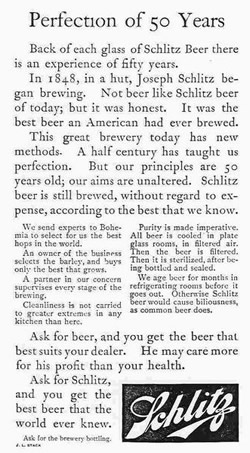
Hopkins' Schlitz Beer AdPS – it's not just people that people are interested in the backstory of. One of the most successful print advertisements of all time was the legendary Claude Hopkins' ad for Schlitz Beer shown here.

Did the ad focus on the refreshing taste, or how the beer would make you feel? Was it all about the result?

Nope. it talked about the 50 years of brewing experience. It described the care they took selecting the hops from Bohemia. It detailed the supervision of the process, the cleanliness, the purity, the filtration and the storage.

In short, it gave the backstory of the beer. It gave credibility to the claim that it was the best beer in the world.

And the impact for Schlitz? It went from fifth in the market to first in a few months and stayed there for years.

That's the power of a good backstory. One that goes beyond just WIIFM.

Featured

More Clients Memorandum

My best tips for “making things happen”

Posted on March 27th, 2011.

We've reached the stage in our process where it's time to take action. To make things happen.

We know who our ideal clients are. We thoroughly understand what makes them tick.

We've got an irresistible value proposition and we've planned the right lead generation activities to make our first contact with them.

Now we have to turn those plans into action.

And I must admit, this is the area I'm personally the weakest at. I get my kicks from thinking: innovating or solving problems. It's probably what makes me quite a good consultant.

But I'm not so good at actually implementing my ideas myself. I just don't find that quite as exciting.

And my experience from working with hundreds of consultants, coaches and other professionals over the years is that I'm not alone.

It seems endemic that we prefer the intellectual to the practical or relationship sides of business.

So if, like me, you're in that camp then click here for my simple “implementation tips” that I've picked up over the years. They've made me vastly more effective at getting things done and getting results than I used to be.

Featured

More Clients Memorandum

Don’t miss this crucial marketing step

Posted on March 20th, 2011.

Today's email is about a crucial step in your marketing that many of us miss out – and it costs us big time.

If you've followed my “soup to nuts” emails so far you'll know we've touched on identifying our ideal, target clients. We've built deep understanding of their needs and figured out what makes them tick.

We've developed a compelling value proposition and identified what marketing approaches are the best to get our message across to them.

Time for action then?

Not quite.

Almost all of the strategies we're going to use require planning. Even something as seemingly simple as networking needs you to identify the right events, to develop a simple benefit-focused introduction and a set of questions to ask.

And you'll need to figure out what your follow-up approach is going to be.

Without planning, even the most effective marketing will fail to deliver results.

Case in point: when I first started up on my own I decided I wanted to use speaking & seminars as a way of getting in front of potential clients.

But for over a year it just didn't happen.

The reason: wanting and wishing aren't the same as planning and doing.

But once I'd set myself a target of 12 presentations or seminars to audiences with at least 10 or more potential clients I was spurred into to action.

I broke down the target into months and planned the activities I needed to do to hit that target.

I brainstormed potential events & venues, thought through the topics I would focus on that would be likely to lead to potential clients engaging with me, and identified the resources I would need to achieve my goal.

Once I had my plan in place, I became more aware of possibilities for offering my services as a presenter.

And by reviewing the plan and progress initially weekly and then monthly, I kept the pressure on myself to hit the target.

And it worked. I beat my target after only 9 months.

Simple stuff. But I hadn't done it the year before, because I hadn't taken the simple step of setting a target and making a plan.

What Makes an Effective Plan?

An effective plan is not just about the details of activities and milestones.

What's more important is to think through the objectives and deliverables – and what are the critical success factors – the “must do”s that will make sure you achieve your objectives. The things you can control.

In my case I set a goal of getting at least 6 clients from my talks during the year – and I reckoned I'd need to do 12 talks to audiences of at least 10 potential clients to do it.

That was my final goal. But in order to achieve that goal I needed to develop a high quality talk, and to find the right events to speak at.

I also needed to develop a follow up system to identify who in the audience was really interested in the topic and to then convert them into clients.

Those were my critical success factors.

They may seem obvious now in retrospect, but it took a few minutes of brainstorming to make sure I really understood what they were and had prioritised them above all the other things I could have been doing.

That led me to create a simple plan – focusing first on getting a compelling topic and doing a brief synopsis.

Then working in parallel on developing the talk itself while finding the right events to speak at and speaking to the organisers to get booked.
Then I worked on creating the talk itself and the follow-up system just in time to deliver the first one.

Do I really need to do all this planning?

Absolutely yes.

I've seen so many professionals who think they can wing it. That once they've identified their key marketing approaches they can just make them happen and hold all the details in their heads.

They can't. They fail.

Or worst of all, they experience minor success – so they keep on doing it, not realising how much more effective they could be if they planned properly.

If you haven't got a written plan that you're reviewing week-in, week-out for the key marketing approches you're going to use to bring in clients then inevitably you'll be distracted by the day to day pressures of client work and running the business.

Don't fall into that trap. Get planning.

Featured

Selling

Why I’ve Changed The Way I Sell – And Why You Should Too

Posted on March 17th, 2011.

An email I got last week from a fellow consultant made me think about how the way I sell has changed in some important ways over the last few years. I thought you might be interested and it might help you make some changes in the way you sell too.

What's triggered the change is a difference in clients.

What I'm finding is that more and more, clients approach me having done a much more thorough exploration of their problems and opportunities than before. And often they have a solution in mind already, even before they've spoken to me.

Perhaps you've found this with your clients too?

In the “good old days”, I found clients were aware of the symptoms they were seeing in their business. But they usually didn't have the knowledge or experience to know why they were happening, what the true depth of impact was, and what the solution might be.

So my sales process focused on diagnosing their problem, exploring the true impact, and suggesting some potential solutions. Basic consultative selling really.

This process did three critical things. Firstly it established what the real issue was so that I was proposing the right solution. Secondly, by exploring the true impact, we could see whether the problem was worth solving (and if it was, it motivated the client to hire me to solve it).

Thirdly, behind the scenes, it established me as an expert.

Because I was able to diagnose their problems – show them what the real issue and the true impact was when they had been looking primarily at the symptoms – it gave me credibility. It gave clients the confidence that I'd be able to solve those problems because I'd understood what they were when they hadn't.

But fast-forward to today and it's a different scenario.

Now they've done their research online. (I knew nothing good would come of that darned interweb thing).

And if they're coming to you believing they've already diagnosed their problems and have the solution then your relationship is very different.

You're no longer a trusted partner and advisor guiding them through the problem-solving process. You're a vendor they're telling what they want.

If all you can do in response to what they're asking for is to nod and say “yes, we can do that” then where's your value added?

In particular, you're not filling the client with confidence in your expertise. Worse still, you're not providing any differentiation from all the other vendors he's been to see who say “yes, we can do that”.

How's he going to choose if all you vendors look the same?

Price. Yuck.

So, how do we get out of this “vendor trap”?

Well, one great way is if they've educated themselves on your website and they see you as the leader in the field and the only one they want to work with. That's what I'm aiming for with my marketing and it's something I encourage you to aim for too.

But in many cases (even with all the effort I put into the web) that won't be the case. They'll have educated themselves via other sources. Maybe good ones, maybe bad ones. But either way they're coming with much more information about their issues already.

How do we handle that in a sales meeting?

Well, the good news is that you're still the real expert.

A few hours of research on the web may point them in the right direction – but it doesn't give them the depth of experience and knowledge that you have.

You just have to get that across to them.

Now telling them you're an expert isn't going to cut it. You know that.

Even testimonials, awards and all those articles you've had published in prestigious magazines don't cut it.

What works best is creating what I call “lightbulb” moments.

These are where, in your discussion with your potential clients, lightbulbs suddenly go off in their heads. Something you say helps them see things differently.

They get deeper insight into their problem. They suddenly see a much better solution. They realise they're looking at the wrong issue.

Anything that makes them take a mental step back.

And most importantly – anything that makes them realise there's a bit more to this that they first thought. And that you really know what you're talking about. And that you're different from those other guys who just nodded and said “yes, we can do that”.

So how do you get those wonderful lightbulb moments?

Well, you could do it by being a genius. By being so smart that on-the-fly you can spot new issues, ideas and insights that trigger the lightbulb moments for your clients. Personally, I don't rely on this method.

I use an approach I learned from the rather excellent book Escaping the Price Driven Sale

In essence, what you do is a mini audit of your services and the projects and other work you do for clients.

Normally what you'd do in these audits is think through what problems each service solves for your clients. The typical benefits they deliver and what they could be worth to your clients.

Here you go a bit further. You look for surprises. For each service you've delivered you look for what was new, insightful, unusual and surprising to the client you were working for. Try to find the things that are often “news”. The things that most clients didn't realise before they started working with you.

Let's say you're a supply chain consultant and you find that clients are often surprised that on inventory reduction projects, you usually get better results not by improving forecast accuracy, but by improving production flexibility. (I just made that up by the way – please don't email me if you're a supply chain expert and I'm talking nonsense).

Or you do sales training and you find that most sales training initiatives fail not because of the training itself – but because it's not followed up and reinforced by coaching and mentoring afterwards.

In fact, lightbulb moments related to implementation and making stuff work in practice are often the very best – because they show you don't just know the theory – you're really been there and done it.

Turn your most common examples into questions you can ask, and gentle responses you can give.

“Where do you believe most of the cost reductions are going to come from?”.

“Hmmmm. You know, with most of the clients I've worked with, they've found that in practice, …”

You mustn't upstage your client and make them look like an idiot. What you want to do is ask enough insightful questions that they come across the answers themselves – or at least begin to see a glimmer of them. Then you build on that and share some of your experience. They'll take much more ownership of ideas you seeded that they got to themselves (and they'll give you credit for them too).

I can't promise this will work every time. Sometimes the client really has come up with the right answer themselves already. Or they've got their mind set and they just don't want to listen. That's just the nature of the game these days.

But very often using this technique will help you change the game so that you're not just a vendor saying “yes, we can do that”. You're an insightful trusted partner that they'll want to do business with.

Featured

Selling

What's Your Step #2?

Posted on March 7th, 2011.

Keep Out!Would you like to grab a coffee some time to discuss how we might be able to help each other out?
No.

How about we meet up and we can talk about how we might be able to support your business?

No.

Could I schedule a short meeting with you where we can find out more about your business and see if some of our services might be valuable to you?

No.

Would you be open to a short meeting to explore your business challenges and how our solutions could help?

No, no, no.

Maybe I'm getting grumpier in my old age, but I just don't want to meet people for sales meetings any more. Nor do I want to have a coffee with potential partners who might be able to work with me some indeterminate time down the line. Nor do I want to discuss who I know that might be helpful for your business and vice versa, thank you very much.

Now I might say yes to some of these out of politeness to someone I know or as a favour.

But I don't really want to have these meetings.

Maybe you're a bit like me too. I'm desperately short of time. And my business is doing very well – so I have no desperate issue to solve that will spur me to have a meeting with someone who could help.

I don't want to have these meetings, because to be frank, I get no immediate value from them.

Telling you about my business so you can craft a solution to a problem I don't think I have doesn't do it for me. Nor does a plesant coffee where we discuss how we might help each other some time in the future.

I need value now. Instant gratification if you will.

If I'm going to give up my most precious and scarce asset, my time, then nowadays I'm only going to do it if I can see immediate benefit for me.

It doesn't have to be money in my pocket right now. In fact, I'm even willing to pay to go to events where I learn something important. And I'll spend an hour or longer on a webinar if I think it's going to teach me something valuable.

But an “initial meeting” where we just talk about my business in the hope you'll be able to come up with something that will help me (for a price, of course). No way.

And that's why I ask: “what's your step #2?”

Step #1 is easy. Step #1 is that initial connection with a potential client or referrer. You go networking and meet people. You send them a letter. You ask to connect on Linkedin. You get a referral from a mutual acquaintance. They visit your website.

We know how to do Step #1.

But what do you do next? How do you really engage with them?

What seems like a few short years ago, people were much more willing to have these exploratory initial meetings. If a consultant sounds sensible on the phone and they've done good work for similar companies to mine, it was worth spending an hour with them to see if they had anything of value.

I don't have that hour today. I need to know I'm going to get something of value in the actual meeting.

So Step #2s that work to get me engaged with you today are things like:

  • Inviting me to a seminar you're running on a topic of interest to me
  • Offering to share some benchmarking information on what my competitors are doing in a 1-1 meeting
  • Sending me a report or video with ideas I can immediatley apply to improve my business
  • Inviting me to a webinar where you show me how to do something I'm struggling with right now

In other words, you need a Step #2 that actually adds value to me right away.

I suspect it's the same for your clients. You need a Step #2 that adds value to them right away.

‘cos if all you have as Step #2 is an exploratory or sales meeting – we're not going to show up.

*** By the way – if you liked this post – do me a favour and tweet it or like it – or better still, add your comment

———-

Image via www.signgenerator.org.

Featured

Mindset

How Productivity Tools Destroy Your Productivity

Posted on February 28th, 2011.

I love gadgets.

I've bought every sort of smartphone right from the Treo through Windows smartphones to my shiny new iPhone 4.

And I love tools too. I must have bought every available to-do manager on the market.

So with all these productivity tech and tool purchases you'd have thought I'd become more productive, right?

Well, in the sense that I can now fill my downtime with activities, yes.

If I'm on the train or in a cab I can read my email. Using my online CRM I can browse my client and prospect details anytime, anyplace, anywhere. If I'm in the middle of nowhere I can still keep in touch with my Twitter buddies.

But the truth is that none of these activities are particularly vital for my business. They're not unimportant. But they're not crucial.

In essence, the tools have made me more productive at the mundane. They've allowed me to do “admin” when I wouldn't previously have been doing anything.

Or would I?

If I think back at what I really used to do when I was sitting on a train, or in a cab it turns out I wasn't doing nothing.

If I was on a train then usually I'd be reading. Learning useful stuff. Or thinking about a client or project – maybe planning or taking notes.

And actually, this is important stuff. Actually taking the time to think about my work and my clients or to improve my knowledge and skills.

Way more important than answering emails, tweeting or doing admin.

The fact that I'm “always online” with my iPhone has meant that I now spend more time reacting to events (email, tweets, even phone calls) than I do proactively thinking and planning. My ability to get access to this constant electronic stimulation has squeezed out the quiet time where I used to actually do some of my best thinking.

And it gets worse.

Being constantly online has conditioned me now to check my email when I'm a bit bored to see if something interesting has come in.

And usually it has.

Not something important. Probably nowhere near as important as the document or the plan or the idea I was supposed to be working on when I got a bit “stuck”. But interesting.

And if there's nothing interesting on email I'm sure there will be on Twitter. Or I could always check my website stats for the 20th time today.

Lord help me, I've even just checked email right now while I was in the middle of writing this blog post.

And who knows how bad I'd be if I had a Blackberry with that awful red light that tells you when you get a new email. I'm not sure I'd ever be able to resist checking what had come in.

In truth, we've got more productive at the things that aren't really important – and less productive at the thoughtful hard work that really is.

We're obsessed by “real time”. I had to laugh recently when otherwise-sensible social media guru David Meerman-Scott lauded the new development in Tweetdeck that meant you got instant updates rather than every 30 seconds. ‘Cos being 29 seconds behind the times is going to kill ‘ya…

Now here's the thing: I'm not saying all these productivity tools and technology are a bad thing. Even if they were, it's too late – the genie's out of the bottle.

But what we need to do – me especially – is learn to become their master, not their slave.

To use them when it actually is productive – not to oust otherwise productive activities because checking email is intellectually easier and more stimulating.

So next time you find yourself checking email more than a couple of times a day – or whipping out your Blackberry in a cab to check Twitter. Think to yourself whether this really is the best use of your time.

So how about you? Have you managed to tame your tools and use them really productively?

———-
Image by Jeff Kontur