Ian Brodie

Ian Brodie


Navigation
Searchtime
Featured

More Clients Memorandum

Talking when there’s nothing to talk about

Posted on May 22nd, 2011.

Hey there – it's Ian here again.

In my last email I railed against the practice of equating marketing and relationship building with “schmoozing” and highlighted that the best way of building relationships with clients can be to overdeliver on your projects with them.

But that doesn't mean you should restrict your relationships with clients to just business.

It just means you should see relationship building as an intrinsic part of delivery, not something unrelated you swoop in and do later.

And often it's the little side conversations or the informal chats over coffee where the client opens up and shares information that may turn into opportunities in other areas for you.

As he often does, David Maister sums it up well. In his video on “The Rules of Relationships” he says “The key to great communication is talking when there's nothing to talk about. If you only talk when the kids have been arrested, you will deal with the issues, but you won't build the relationship”.

You can watch the video here by the way:

Rules of Relationships

Every interaction you have with your client is a chance to build your relationship – or not.

Focus first on delivering or overdelivering on your engagement. But do also take the time to talk about bigger, wider issues. Or just to build your relationship on a human level too.

Featured

Marketing

How To Escape Marketing Overwhelm

Posted on May 17th, 2011.

Do you ever feel overwhelmed when you look at your pipeline and think about what you need to do to fill it?

You're not alone.

I think it's the curse of business owners and executives these days. You look at how many new clients you need to bring in to hit your targets and then you try to think about how you're going to do it.

But it's so difficult to know where to start. What will actually work?

Back in the day, you pretty much had the choice of networking, direct mail, telemarketing or advertising when it came to marketing. Each with their own established best practices and rules.

Today we've got organic and paid search, social media, social media ads, video marketing, email marketing. And it all seems to be changing all the time.

I've lost count of the number of “next big thing” emails I've had trying to convince me to buy the latest and greatest method for getting a so-called flood of clients with some newfangled technique.

And that's just Facebook!

When you're just starting out – or even if you're fairly well established – it can all be so overwhelming. So difficult to know what to do.

It was a big issue for me when I set out on my own. In some ways because I focus on marketing and sales it's worse – because I deliberately keep tabs on all the newest approaches.

Every time I tried to think of what I should do I couldn't get a clear picture in my mind. And all the stories of other people succeeding with this method or that method just confused me further.

So how on earth do we figure out what to do without spending every waking hour networking, phoning, tweeting or blogging?

Well, what follows is an approach I evolved that worked for me to clear the fog of uncertainty and give me some clarity on what to do.

I can't promise it will work for you – but give it a try – it's been helpful to a number of people I've shown it to.

The key to is to break down your marketing into manageable chunks. Ones you can think about sensibly. Too often, when we think about how we're going to get new clients we lump all our potential clients into one amorphous blob.

And you know what? You can't market to an amorphous blob.

So I found it helpful to split my clients into Top Clients and Others. For me, Top Clients are the top 10 clients I'd really love to win over the next 6 months. Clients who – if I got to do business with just one or two of them – could set me up for the year. For you it might be a top 5 or a top 20. But essentially it's a small number of ideal clients you can think about individually.

You could go more sophisticated and split into A/B/C or suchlike. But let's keep things simple for now.

The “others” are clients I'm not going identify specifically or do a specific plan for – too many of them. But I do aim to win a number of them via more general marketing.

Then I split my marketing into short term and long term.

Long term marketing is all about building “gravity”. Doing the things that will attract clients to you so you don't have to actively seek them out. Thought leadership, stuff with your website and the like.

But long term marketing takes time before it pays off. So you also need some short term activities to try to bring in clients right now. The kind of stuff that pays the bills while you work on the long term side.

Then – because I'm a consultant and it's part of the union rules – I draw a little 2 x 2 matrix to represent this. Client types on one axis and time frame on the other. Rather like this:

Then I think through what marketing activities would be the most appropriate in each box for each client type/time frame combination.

Splitting it up like this makes it much easier. Instead of struggling to see what marketing will magically work for all clients in all circumstances, I can take a “horses for courses” approach. It's much easier to see what marketing will work in the short term for my top 10 clients, or to nurture relationships with the thousands of “other” prospects who visit my website for example.

Usually, I end up thinking about referrals and extending existing client relationships for my top clients in the short term. And I develop unique, personalised nurture plans to build my relationship with my top prospects in the long term.

For the broader set of target clients, I'll may pencil in approaches like webinars or direct mail in the short term – and I'll focus on using email marketing nurture campaigns in the long term. Here's an example of what the matrix might look like for a typical client:
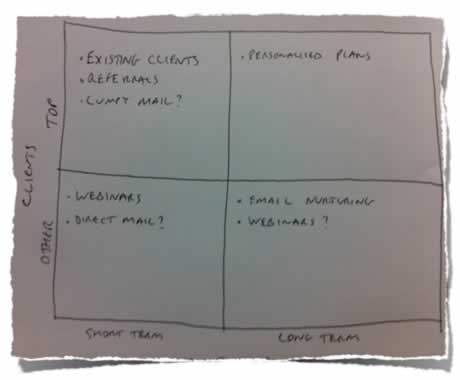
Of course, your matrix will look different depending on your analysis of what marketing approaches will work for your specific clients – and what you're good at.

But the key is that by breaking it up into this matrix rather than trying to eat the elephant all in one go, you zap the overwhelm.

As I say, I can't promise it'll work for you – but it's worked for me and many others – I suggest you give it a go.

Featured

More Clients Memorandum

Superpleasing your way to success

Posted on May 15th, 2011.

In these recent emails we've focused mainly on how to attract and win new clients.

But once you've got 'em, how do you get 'em to stay – and to buy more from you?

The best method I've found is the concept of “superpleasing” introduced by David Maister in his classic work “Managing the Professional Services Firm”.

We all know that getting more work from existing clients can be the most profitable source of new business. They already know us and trust us – and we've (hopefully) done good work for them.

So it should be a much easier sell to get them to buy more from us – provided they need the other things we're offering.

Sadly, in most businesses and also for individual practitioners – we focus most of our marketing effort on much lower payoff activities.

Running an advertising campaign, trying to cold call new prospects, or networking to meet new people, for example.

It just seems kind of sexier to focus on brand new clients than it does to build our relationships with our existing and previous ones.

And when we do try to market to existing clients, we often go about it completely the wrong way.

We equate marketing with meetings and “schmoozing”. We invite the client out to an event. Or we arrange for our managing partner to meet them to “chat them up”.

Those are the things our marketing budget is geared up for – events and non-billable time.

Now there's nothing wrong with these activities. Sometimes they're just the right thing. But more often than not there's something much more effective you can do with your time and money.

Think about it from your client's perspective instead.

If you were your client, what would be more valuable to you:

  • a chat with the managing partner (who probably doesn't really know your business all that well)
  • or the person working with you massively over-delivering on the work they're doing?

90% of the time, clients will go for the latter.

So instead of spending our marketing time and money schmoozing our clients – we should spend it “superpleasing” them.

Instead of spending time with clients at a social or business event, or in “marketing meetings” – spend it on the project you're working with them on and do an even better job than you would have done otherwise.

Instead of buying an advert or putting on a marketing event – spend the money to arrange a value-added session with your client's management team where you show them 5 new ways of implementing the results of your work and getting a better ROI.

In short, spend your time and money in any way you can think of so that the client not only thinks you did a great job for them (which should be the baseline) but that they think you've done the best job of any service provider they've hired.

Ever.

Don't think marketing – think value for your client.

Now you can't do this for every client. You need to focus on the high priority ones who have the potential to give you lots of new business, or strong referrals to other potential clients.

But if you superplease them like this it's the strongest way of getting them to buy more and to recommend you with enthusiasm

Featured

More Clients Memorandum

Marketing lessons from a geeky kid

Posted on May 8th, 2011.

As promised, a bit of a personal story this time…

I was never very popular at school.

Don't get me wrong: I was never bullied, and I had a good circle of close friends.

But I wasn't one of those kids who was popular with everyone. I wasn't very sporty, and I wasn't really interested in music.

I was much happier thinking about computers and what happened in the previous night's episode of Blake's Seven (and if you remember Blake's Seven it means you're probably as old and as geeky as me).

Within my small circle of friends with similar interests, I was well-liked and listened to, and I felt appreciated.

But every now and then, I wished I was one of the cool kids. One of the ones everyone liked.

So every now and then I'd look up what was in the pop charts. Find something to say about the school rugby team.

Something with broad appeal rather than the geeky stuff I liked myself. Something funny or clever I hoped everyone would like.

You can probably guess what happened next.

My attempts to please everyone never got anywhere. Passing comment on the current number one was certainly a more “acceptable” topic to the majority than the ins and outs of the latest Commodore Pet computer.

But it was no different to what everyone else was saying. It didn't turn anyone off. But neither did it turn anyone on.

Eventually, I learned that it was far better and far more personally satisfying to engage meaningfully with my small circle of friends.

We'd discuss Sci-Fi and computers. We liked model trains and other nerdy stuff that makes me cringe thinking back.

But the truth is I built deeper and more meaningful relationships with that small group by focusing on what we really liked than I ever got near to by trying to please everyone.

And the same goes for marketing.

Whether you're communicating by email, or you're giving a presentation, there's a huge temptation to focus on the majority. To not say anything controversial and to try to please everyone.

But when we try to please everyone, we end up coming across as bland and wishy-washy.

We may not upset anyone, but neither do we inspire anyone.

And whether you want people to be friends with you or to buy from you – you have to inspire them. Not upsetting them is not enough.

So if you're writing an email – write for your real core audience, don't worry about the rest. Don't worry about losing subscribers and getting complaints from the people who don't like what you have to say.

They were never going to become your clients anyway.

If you're giving a presentation, don't worry about your scores on those awful feedback sheets.

All you should care about is your impact on the few audience members who might become customers or who might go out and do something with your message.

Focus on inspiring the few, not mollifying the many.

And actually, you'll find that there are more of the few than you think. Certainly enough to help you build a flourishing business.

Featured

Marketing

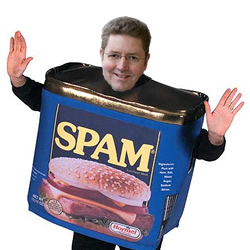
Are you Spam?

Posted on May 4th, 2011.

Are You Spam?Are your presentations and seminars thinly disguised pitches for your services?
When you phone up contacts and ex-clients, is it only ever when you want them to hire you or refer you?

Are your articles and blog posts mainly teasers for the “real stuff” which people have to hire you for?

When I meet you at a networking event do you hit me with a cleverly constructed elevator pitch designed to grab my attention and interest in how you can help me?

Take a minute to think about your marketing and business development practices.

Really.

Don't just read on to the next sentence. Think about which of them create value for your clients and prospects in and of themselves. And which are simply you promoting your services.

Lots of the latter and not so many of the former? Then your marketing is the real-world equivalent of spam.

An unsolicited, unwanted, annoying interruption.

Am I being a bit tough here? Setting an unrealistic standard?

I don't think so.

The bar is raising all the time for marketing. Each and every one of us is getting less and less tolerant of being interrupted and sold to.

So when we're the ones doing the marketing, we need to keep up.

We need our marketing to inform, educate or entertain in areas that our clients care about. Preferably all three. Just “getting your name out there” is no longer good enough.

———-
This post was inspired by the discussion on copywriting headlines on Lindsey Donner's How to be Amazing at Everything blog post.

Featured

More Clients Memorandum

How to write engaging emails

Posted on May 1st, 2011.

Last time we talked about what to include in a “nurture sequence” of emails designed to build credibility and trust with a potential client and so to eventually win their business.

I finished off the email by saying “Next you have to write it in an entertaining and engaging way”.

At that point you probably thought “hah – easier said than done”. And you'd be right.

But it's crucial to be able to do this. If people don't read your emails it doesn't matter what you put in them – it won't do a jot for your credibility, or build an iota of trust.

Ideally, you want people to look forward to receiving your emails and to open them straight away.

One reason they'll do this is if your emails contain a lot of useful information. Your knowledge of your clients' main problems, challenges, goals and aspirations tells you the topics you should be writing about.

But your emails also need to be entertaining too. We get so many emails these days, it's the entertaining and interesting ones that stand out.

Becoming an entertaining writer is a tough task. Nowadays I get many compliments on my writing (though I know there's still a lot of room for improvement).

But it wasn't always this way.

When I first started writing it was very stiff and formal. It was a bit like I was lecturing my readers.

And, to be frank, talking down to people is hardly a good way of endearing yourself to them.

So early on I learnt to write more casually. In particular, to write like I speak.

Imagine you're talking to a close business friend. What kind of language and speech pattern would you use with him or her? That's the kind of language you should be using when writing to potential clients.

That means using short paragraphs and sentences and simple words. And using the appropriate short forms: “I'll” rather than “I will”, “isn't” rather than “is not”.

I also learnt that using stories works much better than using facts and figures.

Personally, I'm a facts and figures guy. Probably because my first degree was in Maths.

But most people aren't. Most people enjoy and are persuaded much more by an interesting story or anecdote. It really brings your point home.

One of the first emails you probably got from me was “Hope is not a Strategy” where I illustrate how you need to take an active approach to your marketing by telling the story of what happened to me when I first set up my business.

I get a lot of people replying to that email telling me how it really hit a nerve and resonated with them.

I think the reason is that I tell my story. I don't just say what they should or shouldn't do – I say what happened to me and what worked for me.

Finally, write often and read often. I try to blog at least once a month and have been doing so for over a decade. Often much more frequently.

If you go back to my early blog posts you'll see how my writing has changed over the years.

I've gained the confidence to try out new things and “be myself” in my writing, rather than who I think I should be.

And by reading well-written blogs – particularly those with a very different style to yours – you come to appreciate what works and what doesn't.

In the next email I'm going to share a personal story that will help you see how to write in ways that will connect much better with your audience.

Featured

Marketing

The Excruciatingly Painful Task that’s Critical to Your Marketing Success

Posted on April 29th, 2011.

Do The WorkI've written a few times about just how important having valuable content on your website is to your success at getting clients online.
And the truth is that nowadays, creating valuable content is central to almost anything you do in marketing. It's perhaps the best way of differentiating yourself from everyone else who claims they can do the same as you can.

Want to win clients with presentations and seminars? You need great content.

Want to get more referrals? Give your referrers a report or video or other piece of great content to give away and you'll get many more referrals.

Want to use networking to get clients? How much more powerful is it to be able to send potential clients you meet a brilliant article or report than just your business card?

Want to earn the loyalty and repeat business of your current clients? Send them great new insights, benchmarking and analysis for free.

All based on having great content.

The downside?

Developing great content is hard. Excruciatingly painful at times.

I'm currently working on a private membership site full of my very best ideas, training and knowledge on marketing and sales for consultants and coaches. So far it's been my very best work. I love the material. I love what it's going to be and how it's going to help people.

But it's so, so painful to develop. Like pulling your own teeth out.

With rusty pliers.

And I know I'm not the only one who feels this way. Creating content is a huge issue for so many professionals.

Today though, I read a short book that set lightbulbs off in my brain and, I'm certain, will help me accelerate developing this material 10-fold. It could do the same for you.

It's a Kindle book by author Steven Pressfield (bestselling author of The Legend of Bagger Vance and The War of Art).

You can get it either on a Kindle device or via the free Kindle readers for iPhone, Android, Mac and PC.

You can get it here.

I thoroughly recommend it. It's a quick read – probably took me about 30 mins. And it could have a huge impact on your ability to develop powerful, client-getting content.

Ian

Featured

Selling

Do You Really Need a New Sales Process?

Posted on April 27th, 2011.

Sales ProcessI read a thought-provoking blog post by Dan Waldschmidt today entitled The Lie of a “Better” Sales Process.

In it Dan argues that we spend far too much time looking for a shiny new way of selling that will improve our results – and far too little time getting better at using the perfectly adequate process we already have.

I'd agree with him up to a point.

If you've already got a decent sales process or methodology in place, then switching to a new one is going to have little impact on your success. Some methodologies are better suited for selling professional services than others (SPIN, Solution Selling and the ORDER process from Let's Get Real immediately spring to mind). But given a decent methodology, you're usually far better off getting better at using it than starting again from scratch.

However, there's an exception to this rule.

And it's one that, sadly, applies to many consultants, coaches, lawyers and other professionals.

If you don't use a methodology at all – then you need to find a decent one.

If you “just wing it”, you think you're a “natural salesperson” or you use what you've learned from your personal experience – the chances are your performance is way below what it could be.

Sales isn't just an art. It's been studied based on decades of experience and observation of thousands of sales meetings. And that includes large, complex professional services sales.

If you're using just your own experience or what you've learned from colleagues and you're up against a competitor using a process based on these decades of experience from thousands of people then you're going to be outgunned time and time again.

And before you invest in sales training focused on “tips and techniques” – make sure you have a solid process in place too. Otherwise most of what you learn will be pointless. Rather like trying to learn how to “fade” a golf ball when you haven't got your basic swing sorted.

——

How about you? Have you switched sales processes and had great success? Or has it just been a horrendous waste of time? Drop me a comment below, it would be great to share experiences.

Featured

More Clients Memorandum

How to make email marketing work

Posted on April 24th, 2011.

Last time I talked about how you can use email marketing “autoresponders” to nurture potential client relationships on autopilot.

But how do you create a good autoresponder sequence?

Well, I'm not going to pretend it's easy. Since writing this post I've written an entire book about email marketing. But here are some hints.

Start by thinking through a timeline. At the start of the timeline is your potential client today. Write down their “state of mind” right now as it relates to the sort of services you provide.

So, for example, if you're a procurement consultant they may start off worried that they're spending too much on external purchases. Feeling out of control and victimised by their vendors. Confused as to where to start, etc.

Now think about their state of mind after you've worked together.

Perhaps they're feeling in control. Elated that they've saved 20% of their external costs, etc. Whatever state of mind you typically leave your clients in when you've had a big success with them.

Now here's the crucial step…

Wind back a little bit.

What state of mind do they need to be in before they'll be ready to hire you?

You may think initially that this is the same as the initial state of mind – but it's not.

Initially they may be confused and concerned – but are they motivated enough to hire you (hopefully for a significant fee)?

Usually before clients hire professionals they need to have built up some degree of confidence in three things:

-> Their problem is big – and they need to fix it urgently.

-> You've got the skills, capabilities and track record to help them.

-> You're the kind of person they'd be comfortable working with.

Chances are they don't feel all of these things initially.

So before they're ready to hire you, you're going to have to take them on a journey to get them into this state of mind.

If you think through the individual steps needed to do this, and the natural order of doing them – that gives you your autoresponder sequence.

So, for example, sharing some case studies of other clients in similar situations and their realisation of how bad their situation was can help raise urgency.

As can sharing any diagnostics they can use themselves or early warning signs they've got a problem.

Success stories of people who've made significant improvements from their position can help them believe that it's not a lost cause for them.

Just go through – step by step – the very specific things that they need to believe before hiring you and you've got an outline for your sequence.

Next you have to write it in an entertaining and engaging way. And, of course, you have to be writing about topics your client's are inherently interested in. You can't just send them stuff that tells them how great you are!

But that's what our next email is all about…

Featured

More Clients Memorandum

Nurturing clients on “autopilot”

Posted on April 17th, 2011.

We've been talking recently about the importance of nurturing or romancing your potential clients. And in the last email I shared my simple system for categorising clients into As, Bs and Cs and investing time each week or month to think of how to build your relationships with those As and Bs.

But what about the Cs?

Who are those C category potential clients? Well, they're mostly people I haven't met or had detailed discussions with yet – so I don't really know whether they could be great clients for me. That means I can't afford to invest a ton of time yet into creating a tailored plan for developing my relationship with them.

Historically, C category clients have been largely ignored by most professionals. Maybe they received a Christmas card or maybe a newsletter every now and then. But most professionals invested their valuable time in their As and Bs.

And that was the right strategy. There just aren't enough hours in the day if you're having to do all your nurturing by hand.

The Power of the Internet for Building Client Relationships

I'm sure you won't be surprised to hear me say at this stage that “the internet has changed everything”. It's a bit of an overworked phrase.

But it has. It really has.

Through online marketing on the web it suddenly becomes viable to keep in touch and add value to C category prospects.

And it's well worth doing so. You may not yet know whether they could become great clients for you, but they might.

“Might” isn't good enough if you have to invest time and effort into communicating with them. But if you can do it essentially for free, then “might” is not bad at all.

And if you can build up a very large number of “might”s then it can become incredibly powerful.

With old-school nurturing you can invest your time in (say) a portfolio of 25 potential clients each with a 20% chance of becoming a client. That means you'll get 5 clients from your nurture activities.

Now let's say your C category potential clients only have a 1% chance of becoming a client. Doesn't sound so good initially. But what if you can nurture relationships with 1,000 of them? That gives you 10 clients. Or even 5,000 of them?

Suddenly the economics begin to change.

And through the web, hooking up with 1,000 or 5,000 potential clients isn't unrealistic at all. If you can get sufficient traffic to your website, and if you can offer them something of value to get them to sign up to receive communications from you – then building a list of thousands of subscribers who could become clients isn't such a tall order.

In fact, it's exactly the strategy I've followed to build my business.

By optimising my website, doing targeted pay-per-click advertising, and harnessing social media I get lots of website visitors from people who could be potential clients.

By offering relevant free reports or videos in return for them signing up I've had thousands of people opt-in to receive communications from me.

And by sending (hopefully) useful emails like this one I can demonstrate to readers my knowledge and expertise in how to win new clients.

So over time, if I keep adding value, many of the people who receive these emails will choose to contact me and we'll end up working together.

It's an approach that – once set up – runs almost on autopilot. it works when I'm out of the office or even asleep.

And, to be frank, it's rather more pleasant than knocking on doors touting for business.

And it's something almost everyone can do for their business.

More details on how next week…