Featured
Posted by Ian Brodie on June 13th, 2016.

A couple of weeks ago I woke up to a nightmare scenario for any email marketer.
As I do most days, I tapped away to write an email I thought would be useful, interesting and fun for my subscribers. Job done, I shot off a test email to myself to make sure the links were all working.
5 minutes later, it hadn't arrived in my inbox. Another 10 minutes and it still wasn’t there. I sent another one.
Still nothing.
Then I spotted a notification that there were new emails in my Gmail promotions tab.
Surely not? Surely my own emails that I read on a regular basis aren't going into my promotions tab?
But yes, they were.
According to Email Deliverability expert Chris Lang, you get an 8-10% increase in opens and clicks simply by being in the primary tab rather than the promotions tab on Gmail.
That's a huge difference. And it's a direct hit on your revenue if email is a key part of your marketing.
Lang estimates that Gmail runs about 40% of the world's email behind the scenes. In my case, since my clients tend to be smaller businesses it's probably higher.
So ending up in the promotions tab is bad, bad news.
So why was I in there and more importantly: what could I do to get out? I started looking around for answers.
Click here to find out why emails end up in the Promotions Tab and how to get out if you're in there too »
Featured
Posted byIan Brodie on June 12th, 2016.
If you've hung around on forums or at events for any length of time you'll no doubt hear people asking “what's the best…?”
What's the best email system? What's the best landing page design?
What's the best way to introduce yourself? What are the best questions to ask?
And it's good to be on the lookout for good ideas and to try to understand what “best practice” looks like.
But you have to remember that best practice for someone else might not be best practice for you. Or it might be only marginally better and not worth the costs of switching.
Even if something would work better for you, you just might not want to do it.
Every now and then I do webinars to promote a product and I usually have a deadline for whatever I'm offering. I'll send follow up emails after the webinar and try to make each one useful, with a reminder of the deadline.
Now I absolutely know for a fact that I would get more sales if I sent more emails and was more aggressive in each one. Pretty much every test I've seen has shown that sending 2, 3 or even 4 or more emails on the last day of a deadline gets you more sales.
But it's just not something I want to do to my audience.
It's not even about long term vs short term. In my mind, it's about being a decent person and not trying to bludgeon out every possible sale.
(Yeah, I know the line about how if you believe your product helps people it's your duty to get them to buy it. I think that's just a convenient rationalisation for over-aggressive salespeople).
Being successful in business isn't about maximising sales or profits. it's about maximising how good you feel. As long as you're doing well, I don't think those extra few sales are worth it.
So don't assume that you need to do the absolute “best” thing in everything you do. Make the choices that work for you.
Featured
Posted byIan Brodie on June 7th, 2016.
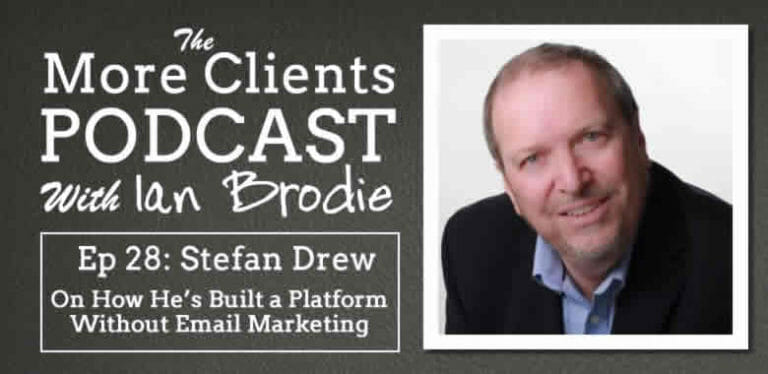
It pains me to say this, but email marketing is not the only answer :)
OK, all joking aside, what is vital for any business is to build a platform: a way of regularly communicating and keeping top of mind with your ideal clients.
Email marketing is a particularly powerful way of doing that. But it's not the only way.
In this podcast Stefan Drew explains how he built a successful platform for his consultancy in the education sector without using email marketing.
You'll see that the same principles that normally apply to email marketing can also be applied to other media to build that personal connection with potential clients that leads to a steady stream of work.
Stefan and I also discuss how he's managed to get so much good PR for his business and clients including regular slots on radio and in the press (including a time when he temporarily became a reporter on the collapse of the Berlin wall!).
More importantly he gives his tips for how you can break in to getting media appearances on a regular basis.
Click here to listen to the podcast »
Featured
Posted byIan Brodie on June 6th, 2016.

In last week's video I talked about the psychology of reconnecting with some of your best old contacts that you've slipped out of touch with, and I gave you a simple strategy for reconnecting based on using LinkedIn and getting in touch by sharing valuable content.
In this weeks video I share 2 powerful techniques that can work just as well, or even better, for reconnecting and adding value at the same time.
Watch this week's 5 minute marketing tip to find out what they are and how to use them.
Click here to watch the video »
Featured
Posted byIan Brodie on May 30th, 2016.

In our last few videos we've looked at generating new leads – new initial contacts with people you don't know.
But what about all those contacts, Linkedin connection and business cards of people you met, but didn't properly follow up with? How to you reconnect with your old contacts in a way that's painless for you and them, and generates real leads for your business?
Watch this week's 5 minute marketing tip to find out.
Click here to watch the video »Featured
Posted byIan Brodie on May 29th, 2016.
One of the best things I ever did with my marketing was to simplify it.
I used to try to do waaay too many different things. I suspect my natural arrogance told me I could be great at everything.
But I can't.
I'm pretty good at writing these emails. That's because I've written over a thousand of them. The ones I write today as so much better than the ones I started writing nearly 10 years ago.
The same goes with blog posts, webinars, presentation, networking, etc.
I only do a handful of marketing activities today. But because I do them often I do them pretty darned well.
Do you try to do too much?
If so, it's probably because you're hoping to hit on the “one thing” that will get amazing results for you.
But the truth is there isn't one thing that will knock the ball out of the park every time. And it certainly won't the very first time you do it.
You need to pick a small number of marketing tactics that seem a good fit for you and keep at them. The more you do them the better you'll get and the better your results will be.
Simplify, simplify, simplify.
Featured
Posted byIan Brodie on May 27th, 2016.
“Keep It Simple Stupid” is a phrase apparently coined by Kelly Johnson, the lead engineer at the Lockheed Skunk Works, responsible for the Blackbird spy plane amongst others.
Sometimes we use the phrase to mean we should keep things simple so (stupid) people don't make mistakes.
But its original meaning is better I think: that the very best designs are simple ones.
I was on Skype a couple of nights ago chatting with Steve Gordon of “Unstoppable Referrals” fame. We were bouncing ideas and swapping stories of what has worked well for us in our marketing.
One common theme we found: our simplest marketing got the best results.
It's oh-so tempting to add complexity and sophistication to your marketing. To create complex “funnels” with multiple paths for different situations.
But at the end of the day, the marketing that works best is the marketing that really hits on an urgent need your ideal clients have and offers a clear solution to that need.
In the past few weeks we've talked a lot about lead generation. We've covered lead magnets, getting the attention of your audience, engaging them.
Through all this, make sure you're keeping it simple.
Focus your efforts on getting one great lead magnet that solves one problem for your ideal client. Find one reliable source of traffic and connections, and use one method of engaging and following up.
Get that running smoothly before you add anything else. And when you do add something, do it step by step. One new thing at a time. Get that running smoothly before adding anything else.
Keep it simple.
It's not just easier, it works better.
Featured
Posted byIan Brodie on May 24th, 2016.
Sooooo – you've got a method for generating leads (see last week's video for how). You've “connected” with them. What now?
You've got to make a great first impression if you want them to quickly progress to becoming clients.
And that means three things: building credibility, building a relationship, and building action. Find out how in this week's video:
Click here to watch the video »
Featured
Posted byIan Brodie on May 18th, 2016.
Last week we looked at the “ACE Formula” with the three key steps for successful lead generation:
- Get the Attention of your ideal clients
- Connect with them so you can follow up
- Engage with them to initiate that follow up and start building credibility and trust quickly
This week we look at the best methods for that first step: getting the attention of your ideal clients.
No one method works best for everyone, so in this week's video I show you how to decide what will work best for you and your clients…
Click here to watch the video »
Featured
Posted byIan Brodie on May 15th, 2016.
Every now and then I get an email from someone that runs along the lines of…
“Ian, I love your material and your ideas, but….”
…and what comes next usually makes me cringe because it's a problem I suffer from myself….
“…I have so much on, I'm really struggling to make the time to implement what you recommend”.
Sound familiar?
It certainly is to me. I take on too many projects. Get too excited by shiny new things.
In some senses, it's fear of missing out. I've got to try that exciting new marketing tool just in case it turns out to be the best thing ever.
It never does, of course. And the time I spent learning it and trying to get it to work is time I'm not spending on the core of my business which I already know gets results.
Crazy.
But very easily done.
Are you trying to do too much and getting overwhelmed?
The only solution, really, is to scale back. Stop doing some of the things which might work a bit, but aren't huge winners for you.
Years ago I scaled back on face-to-face networking. Then I stopped answering the phone unless it was a pre-arranged call.
I've significantly cut back on some social media too.
You're only going to make big progress if you really focus on some key activities in your business. Make sure they're the right ones.
 Ian Brodie on June 13th, 2016.