Ian Brodie

Ian Brodie


Navigation
Searchtime
Featured

The Proven Path to Building Authority (Part 5)

Posted on February 19th, 2017.

The Proven Path To Building Authority

- Part 5: Cut Out The Middle Man -

Ian Brodie
Hi - Ian Brodie here...

In my last article on building authority I showed you a method for evaluating any marketing strategy to see whether it will work well for you to help you establish your pre-eminent market position.

In this article I'm going to talk about the types of strategy I like to use best and that I believe work well for most people.

If you think of a lot of the traditional approaches to getting visible with your ideal clients, they all involve going through a third party. If you want to get a book out there, you used to need to go through a publisher. if you want to appear on a Tv or radio show or podcast, you're reliant on the host saying yes. If you want an article to appear in a prestigious publication or even as a guest blog post on someone else's site, you need them to say yes to it.

Wouldn't it be better if you could just go direct to your ideal clients?

Bruce Henderson

Bruce Henderson thought that when he founded the Boston Consulting Group in 1964. He didn't have the established connections and powerful alumni network that firms like McKinsey who'd been around for about 40 years by then had.

But he did have great ideas. A distinctive point of view.

But rather than waiting and hoping to get his ideas published in magazines his potential clients were reading, or spending years trying to get a book deal, Henderson simply mailed his ideas in the form of essays called "Perspectives" directly to them. 

Henderson likened his essays to a “punch between the eyes”. They were deliberately provocative - he wouldn’t publish anything that he thought executives already knew about. Those provocative ideas shook up enough of the executives who read them and gave them enough new ideas that they came knocking on Henderson's door to work with him and his new firm.

So much so that within a decade, BCG had become the biggest Strategy Consulting firm in the US.

Not only was this direct route faster than trying to go through third-parties, it was also uncensored. Henderson could make his opinions as hard-hitting as he wanted in order to provoke a reaction from his audience without worrying about what publishers or editors thought. And he could promote his firm's services as the answer to the challenges he raised and the logical choice to implement the solutions he proposed.

Direct mail is still a very viable method for getting your Distinctive Point of View across to a small, identifiable target audience like senior executives in major corporations. But in the 50 or so years since Henderson started using direct mail to get the attention of prospective clients there have been quite a few innovations we can now use to go direct to our audiences.

In particular, the targeting options available for advertising on Google, Linkedin or Facebook allow us to find pretty much any audience we want to build authority with and to get our message directly to them either through advertising or (on Facebook or Linkedin) by connecting with them.

Now, of course, advertising or messaging in and of themselves don't build your authority. What you need to do is use your advert or message to offer your potential clients a "lead magnet". A distilled form of your Distinctive Point of View that offers them some immediate benefit and so entices them to sign up to get it, and allows you to follow-up with them to deepen your authority over time.

One of the most effective lead magnets I've used over the years has been my "21 Word Email That Can Get You More Clients". It's a simple technique for following up with a certain type of prospect that gets results fast. It sounds powerful and easy to implement, and it is powerful and easy to implement.

By offering it through adverts on Facebook and Linkedin I got a large number of potential clients to sign up for it. And when they tried it and it worked, it raised my authority just like Bruce Henderson's Perspectives did five decades ago.

Now I'm not saying "don't write a book" or "don't do guest blog posts". What I am saying is that the fastest way to get your Distinctive Point of View visible to your ideal clients is to go direct to them online. Either through advertising or by connecting and publishing so they see it.

That's where I'd start, and it's where I recommend you start too.

In the Authority Breakthrough program I teach you all the steps you need to know to make a success of direct advertising on Linkedin and Facebook, and connection strategies on Linkedin to get your content to potential clients for free.

If you'd like to find out more and apply to join the program, just click here.

Cheers

Featured

More Clients Memorandum

Do you believe this?

Posted on February 19th, 2017.

It seems to me that there's a kind of “cult of hardship” amongst entrepreneurs.

Many of us seem to glory in how hard we work. Telling everyone on social media how we were up at 5am and got in hours of work before the rest of the world rose.

Many entrepreneurs seem to wear their hard work like a badge of honour. Like you're not really a proper business person if you're not working 18 hours a day and being worn out all the time.

I think that's madness and I just don't believe it.

In my experience, some of the most successful business people live quite normal lives. They're good at working the 80:20 rule and focusing on the big things that bring them the biggest results rather than obsessing over the small things that don't.

They realise that we're in business to have a great life, not to let business become our life.

And they make sure they're enjoying their business too. Working with the clients they enjoy working with, on projects they find stimulating and rewarding.

Easier said than done, of course. You need to be good at generating plenty of leads to be able to pick and choose the right clients for you.

But not impossible.

Not if you put your mind to it

Featured

More Clients Memorandum

This is always worth remembering

Posted on February 12th, 2017.

In the last few weeks I've been talking to a few “normal” people.

By normal I mean people with a 9 to 5 job. Who don't own their own business, or aren't involved in the consultingy, coachy, trainingy type world most of us work in.

Sometimes it's easy to envy people in that position. You go to work, you come home in the evening. You get a pension. Sick pay. Easier to switch off.

In our world it's difficult to switch off. We're either thinking about our own businesses or thinking about our clients' businesses pretty much 100% of the time. There's always something more to be done.

And we don't get any of the perks of an employed person either.

But what I heard from the “9 to 5″ers was boredom. Lack of motivation. No real feeling they were achieving something. Lack of freedom. Lack of control. Politics. Resentment at having to do stuff they didn't particularly want to do.

Sometimes it can feel tough to run your own business or do client-service work. But never forget just how mind-numbing the alternative is.

And never forget the freedom we have to do things we love, with people we enjoy working with, and on things that make a real difference.

And if you run your own business and you're not doing those things – why not? You only live once.

Featured

The Proven Path to Building Authority (Part 4)

Posted on February 7th, 2017.

The Proven Path To Building Authority

- Part 4: Five Criteria for Increasing Your Visibility -


Ian Brodie

Hi - Ian Brodie here...

I've been banging the drum about the importance of focusing on a receptive audience and having a Distinctive Point of View in my last couple of articles.

So I'm guessing that by now you're probably chomping at the bit waiting for me to share the practical methods you can use to get yourself and your point of view visible to that audience to start building your authority.

But I do want to stress again before we start - there's no point in trying to get visible unless you have something remarkable and different to say. Without that, you get visible, but ignored. You're like the TV ads we fast-forward through on TiVo or Sky+, or the flashy banners our brains have trained themselves to ignore on websites.  

But, proselytising over, once you have that distinctive point of view, how do you make sure the right people get to see it and you begin to build relationships with them?

Should you write a book? Should you be active on social media and if so, which ones? What about podcasts, or even TV?

The truth is that any method can work, the big question is which method is going to work best for you, in what conditions, and at what cost in time and money?

When you're thinking about which approach to use and what will work best for you, the first place to start is of course, the knowledge you’ve built up about your ideal clients. What sort of media do they consume? What are their common characteristics that would allow you to find them? 

Based on that knowledge you can rate each media on a set of criteria which will indicate whether they’re a good choice to reach and influence those ideal clients.

Evaluating Approaches To Visibility

Here are the things you should be looking for in any media or approach to get visible with your idea clients:

  • Will this approach allow you to target and reach a high number of your ideal clients? For example, if your clients are in the supermarket trade in the UK you're far more likely to reach them through an article in The Grocer magazine than The Economist.
  • Will this approach allow you to make a big impact on potential clients? For example someone reading a book will take on more of your ideas than someone reading a short article.
  • Does this approach have inherent prestige? For example, appearing on a panel at an event alongside other well-known experts in your field.
  • Does this approach play to your communication strengths? Are you better at writing, speaking, answering questions, etc.
  • Does this approach take significant time and money? For example, a short interview on a podcast can be done in an hour and will likely appear in a few days. Writing a book can take over a year or longer before it reaches the market.

Using these criteria and you knowledge of your ideal clients, you can evaluate any potential approach and come up with a reasonable idea of whether it will work well for you.

Of course, the proof of the pudding is, ultimately, in the eating. but this can give you a big headstart and rule out a number of dead-ends which you might end up wasting a ton of time exploring.

You don’t need to do anything fancy with the rating system. A simple High/Medium/Low or 1-5 scale will work fine. In fact I find that when you work through criteria like this the best approaches usually leap off the page at you.

So let's look at a few examples...

Writing a Book. Writing a book is often seen as the ne plus ultra of methods for becoming seen as an authority, but in my experience it's not the place I would start.

A book scores very highly on our criteria for impact and for prestige (even today when everyone and their poodle seems to have written a book). And writing is a learnable skill, particularly with the aid of a good editor.

But where a book falls down is two-fold. Firstly, it takes time. I managed to get my book Email Persuasion written and published in about 5 months. But I don’t know many people who've done it as fast as that. Typically a book takes 9 months or more for most people to write. And if you're being published commercially it can take up to a year by the time it hits the bookshelves.

More importantly, if you're not already an established name in your field it can be very difficult to reach a large number of your ideal clients with your book.

There are over 2 million new books published a year nowadays. About a third by traditional publishers and two thirds self published. The average U.S. nonfiction book is now selling less than 250 copies per year and less than 2,000 copies over its lifetime. And that average includes the blockbusters that sell 10s or 100s of thousands, so the typical book usually just sells a few hundred or maybe a thousand copies.

If you go on to Amazon and search for any topic you'll find tens of thousands of books on that topic. I just searched for "Business Strategy" this morning and 66,149 books showed up. The authors of the top 10 or 100 books are certainly benefitting and are seen as authorities. Maybe even the top 1,000. But the rest?

Speak to any of the major publishers about an idea you have for a book and the first thing they’ll ask you about is your "platform". In other words, how big a following do you already have. They know that without an established platform, the vast majority of books are doomed to live in the lower reaches of Amazon search and to only appear on the bookshelves of you, your Mum and the people you post a copy to.

Now don't get me wrong. Writing a book is perhaps the very best way of cementing and enhancing your authority once you've built up a solid audience. But it's not the place to start (unless you get very, very lucky).

What about Social Media?

Well, the first thing to remember is that Social Media or even Facebook or Linkedin isn't a channel or approach in it's own right. You need to get more specific about what you're going to do because the results will vary hugely. Using a Facebook page, or sharing in relevant Facebook groups, or using Facebook advertising - those are methods.​

So let's say you're considering being active in a Linkedin group answering questions as a method for becoming visible as an expert. let's go through the criteria.

Will this approach allow you to target and reach a high number of your ideal clients? That's very much dependent on whether your ideal clients are members of the group and how active they are at using the group. Unfortunately, Linkedin has removed most of the data on groups in it's latest update - but you can at least see the number of members underneath the group name:


Look at the recent discussions on the group. Are they one-way dumps of sales pitches or links to blog posts with do discussion or interaction? Or are many members getting involved and discussing things? Obviously you want the latter rather than the former.

How about the impact you can make with potential clients? Well, if the group is highly active with potential clients asking real questions and if they're not being flooded with answers from other experts like yourself then you might well be able to. Answering specific questions with detailed answers including examples can go a long way to establishing expertise.

Does the approach have inherent prestige? Not really. Not unless, perhaps, it's a group you've started and you're seen as the leader.

Does it play to your communications strengths? Are you good at interacting in a friendly way on social media and answering questions? If so it could well work.

Does this approach take significant time and money? Money no. Time yes - a lot.

Because you're answering questions from individuals rather than publishing something to a broad group,  you're essentially establishing authority one person at a time (or at best, the handful of people who read that discussion). You can increase the return on investment of your time by focusing on questions you think have general appeal and that many people seem to be interested in. And you can republish your answers in a blog or email. But overall, this approach is pretty time consuming.

You can use this method to evaluate any approach or media for its suitability to help position you as an authority. As you'll have noticed, one thing the method highlights is that there's no "one best method" that works for everyone - one more reason why you shouldn't listen to all those folks pitching their solution-du-jour as the answer to all your problems.

What works for you won't necessarily work for someone else. That guru may have built a huge audience using Facebook posts and a Youtube channel, but that doesn't mean the same thing will work for your ideal clients or that your skills are well suited for it. Make sure you properly think through whether the latest method everyone is getting excited about will work for you.

Some additional notes on the criteria:

  • Pay particular notice to the size and value of your audience. If you target senior executives in major corporations you're much more likely to benefit from a highly targeted direct and personal approach to reaching them (e.g. referrals or even direct mail) rather than blasting out a message to a huge audience and hoping they'll see it. You can afford to spend more time and money per person too.
  • When you're evaluating whether you can reach your target audience with an approach, pay more attention to the absolute number you can reach rather than the percentage. For example, maybe only 5% of your audience would ever watch live online video, but that doesn't mean you should immediately rule it out. If the audience size is 200,000 and you only need a dozen or so clients a year then the 10,000 people who do watch live video is easily enough to build authority with.

    I know from my own experience that I initially discounted Facebook Advertising as an approach to get my ideas more visible with potential clients because I knew that most of them weren't big Facebook users at the time. What I missed was that plenty were - easily enough to build a significant following once I started using it - and of course, it was growing fast.

  • Don't forget that the approach you use to get visible is only the start. You don’t build authority from one interaction only. That's why I always value approaches that allow follow-up communications more that those that are just one-off (e.g. if someone signs up to your email list from you blog vs someone who reads an article from you in a magazine with no link to your website). More on this in a few article's time.

That's it for now. In the next article I'll talk about what I think is the best approach to get visible and start building authority from scratch.

You can read that article here. Enjoy!


Featured

More Clients Memorandum

Growing your business without losing control

Posted on February 5th, 2017.

Control is important to business owners.

Not just being in charge of the business, the finances, the people. But also being in control in the sense of knowing that your results are predictable.

Unfortunately, that gets trickier and tricker as you try to grow a business.

To grow you usually have to do new things. And doing new things can be very exciting – but unpredictable.

Many people make the mistake of getting over-enamoured with the shiny new things they try in their business. And the whole training, coaching and advice business thrives on telling people they should be doing new things. That's how we make money.

But you should never neglect your core: the thing that's working for you right now.

So when you try new things, only try one new thing at a time. Whether that's a new source of traffic, a new lead magnet, a new email nurture sequence or whatever. Keep everything else the same.

If the new thing works better than your old way of doing things that's great, Swap it in and swap out the old method. Move on to the next thing.

But keep things in control. Don't try out 2 or 3 or 5 new things. You'll have no idea what really works and what doesn't and you'll probably mess up the performance of your core business.

Despite what the gurus might tell you, you don't need to change everything to grow fast. You just need to get one thing working better then iterate.

Featured

The Proven Path to Building Authority (Part 2)

Posted on February 1st, 2017.

The Proven Path To Building Authority

- Part 2: Breaking In To A New Market -


Ian Brodie

Hi - Ian Brodie here...

As I mentioned in my previous article (click here to re-read it), it's much easier to build authority with people in your "adjacent possible" than it is to go further afield where you have few connections.

But what if you have no choice?

What if you move to a new field or geographic area with no existing contact base? Or you have such a burning desire to get into a new field that you just can't let go?

In truth, I was in a similar situation when I started up. My adjacent possible was with consultants, coaches and trainers where I had a good contact base, a track record, and knew the issues and the lingo.

Unfortunately for me, my contact base was largely national and international. Very little locally (and there aren't many big consulting firms in the UK outside of London).

There are, however, a lot of law firms.

So while I was getting work around the country from my adjacent possible, I decided to focus on becoming seen as a marketing and sales expert by local law firms so I wouldn't have to travel so much.​

Law firms aren't hugely different to consulting firms.

They're partnerships. Clients hire them based on their expertise and their relationships. They're staffed by smart people who, by nature, aren't all that comfortable with marketing and selling.

In fact, in my favour, consulting firms are largely recognised as being ahead of the game compared to law firms when it comes to business development.

Unfortunately, what I came to understand pretty soon after trying to get meetings with law firms was that if you didn't have law firm experience, most of them didn’t want to speak to you.

So, how to you get people who don't respect your experience to want to meet with you? To think you're an authority?

Well, sometimes you get lucky. You bump into the right person who's open minded enough to give you a start.

Usually you don't. Usually you need something special. Something that's so irresistible to them that they feel they absolutely need to listen to you.

I've found the best way to create something irresistible like that is through your own proprietary research.

Unless you're already an industry veteran you're unlikely to be able to use your experience to come up with something irresistible to them. And even if you did somehow invent a genius idea, they wouldn't believe it was applicable to them because of that lack of experience.

But if you get your hands dirty and interview a a dozen or so potential clients (or people who can provide information of great interest to them, like their customers) about a top priority issue for them, then all of a sudden you've got access to valuable information that they can't get from anywhere else.

And because you're doing a research project, potential clients are happy to meet with you to take part in the research. Its flattering. They'll get access to the results of the research. And it's non-threatening - you're not there to sell to them.

Not everyone will agree to speak to you. But an exponentially higher number will than if you just tried to get a sales meeting with them or offered to do a presentation for them. 

Nearly a decade ago when I was trying to make it locally I interviewed partners in law firms about business development best practices.

Before I did the interviews I was just an outsider who knew how consultants did things, but not how things worked in law firms.

After 20 interviews I had more knowledge on what worked in business development in law firms than any individual partner or even teams of them had built in decades.

All of a sudden they were glad to speak to me. They came along to events I spoke at. Most importantly, they "leant in" and paid rapt attention when I spoke.

Suddenly I was an authority.

It took a lot of work, of course.

20 hour-long interviews plus setup, analysis, writing and presenting. And a lot of thinking time. End to end it took me many months before I was ready with the results.

But it's do-able. If you really want to break in to a new field (or you have no choice) it's the best way I know.

(And if you’re reading this thinking "this sounds like too much work", you've got to ask yourself how much you really want to get into that new field if you're not prepared to do the work).


Authority Research Blueprint

If you're up for it, I have a free guide which will set you in the right direction.

No sign up needed. Just click on the image or link below to download a copy.

It'll take you through every step of the research process. From figure out what to research, to setting up interviews, carrying them out, and presenting or publishing your results. And it includes the interview questions I asked in my research with law firms as an example.

Just click here to download it.

Next...

In the next article we're going to talk about the critical component you need to get maximum visibility with your target clients.

For today though, if you think a research project might be the right route for you, download the Authority Research Blueprint and work through it.

That's it for now,


PS You can find the next article on building authority by clicking here.

Featured

The Proven Path to Building Authority (Part 1)

Posted on January 31st, 2017.

The Proven Path To Building Authority

- Part 1: Harnessing Your "Adjacent Possible" -


Ian Brodie

Hi - Ian Brodie here...

Thanks for signing up for my mini-series of articles on becoming known as an authority in your field. 

The first article is below and I'll drop you an email with a link to each of the following articles in the series. Or you can click the link at the bottom of the article to "fast forward" to the next one.

As you'll have read in my initial email, I'm currently enrolling new members into my Authority Breakthrough program for people who want the fastest route to becoming seen as an authority in their fields.

When I first created the program I ran a survey on what the biggest challenges people faced when trying to become seen as an authority.

Overall, three challenges came out well ahead of the others and these are what I'm going to focus on in this series of articles:

  • Getting visible and getting your message in front of the target clients you want to build authority with.
  • Standing out and differentiating from your competitors in a crowded market.
  • Getting focused and finding the time to do the actions necessary to build authority on a consistent basis.

So let's talk about the big issue of visibility first. In other words, if you're a genuine expert in your field but you're not part of a big firm and you haven't published a best-selling book or already have a well-known name, how do you get your ideal clients to notice you enough for them to realise you're an expert?

Well, the first step is to understand who your ideal clients really are, and where you need to be visible to get their attention.

Sounds obvious, but you won't believe how many people make the mistake of going where it's easy and comfortable for them to go, rather than going to the places where they're really going to connect with their ideal clients.

Case in point: I knew a consultant once who was a leading expert in marketing and sales for large manufacturing firms, but who was trying to drum up business by going to those local business networking breakfasts so many small businesses go to.

His friends had all told him it worked for them, and he bought into the "you never know who knows who" line and the remote hope that someone he met over breakfast in a chain hotel at an ungodly hour in rural Cheshire would just happen to know the head of marketing at a major international manufacturing firm.

And, truth be told, it was comfortable for him too. There were always friendly faces, nice conversations. People impressed by his expertise and who promised to introduce him to any big business marketing people they met.

It never happened. 

He was kidding himself to think that the people he met at local networking events - lovely though they were - were likely to introduce him to the sort of people he wanted to meet. But the alternative seemed much more daunting. 

That consultant was me, by the way, a decade ago before I found much better ways of connecting with potential clients and eventually transitioned to helping others like me do the same.

I see the same problem repeated with online marketing today. Consultants who target large corporates writing guest blog posts for small business websites. Or vice-versa: experts on a big topic with global interest trying to cold email a handful of prospects to talk to them face to face.

Realism Is Your Best Friend

If you want to get visible to your ideal clients, you need to know where they hang out (both virtually and physically).

And the best way to do that is to ask them.

Now, if you find yourself thinking "but I don’t know enough of them to ask", you have a problem. You're not being realistic.

If you don't know anyone in your target market well enough to ask a few questions to set you on the right path, what are the chances that they'll be ready to work with you if you do manage to eventually connect with them? And what are the chances you'll understand them and their problems well enough to be able to communicate in ways that resonate with them?

There's a concept in biology called "the adjacent possible". It means that, for example, in the primordial soup before life evolved, the basic chemicals like methane, ammonia, water and carbon dioxide might well combine to make something more complex like formaldehyde. But they're not going to instantly spark a living, breathing creature even though all the fundamental components are there. It's too big a leap.

But once you have formaldehyde, there are now more targets in the adjacent possible and it can combine to make something more complex. Then more complex still. And eventually you get what we have today.

In the case of marketing and getting visible, you're most likely to be able to get visible to people in your own "adjacent possible". People one-step removed from your current circle of visibility. 

If you've worked in senior roles in IT organisations all your life and have now moved into executive coaching, who do you think you're more likely to be able to find connections with? Senior IT executives, or executives in Advertising Agencies or the Public Sector?

And if you got your message in front of them, who would your stories and examples most resonate with? 

Now I know that for some people reading this, that message might disappoint you.

Perhaps you've spent all your life working in one field and you're bored with it and want a change. Or you're looking at a new area and find it immensely exciting even though it's completely new to you.

I'm not ruling out the possibility it'll be a huge success for you leaping from one field to a new one that's completely different. It's been done before. But it's the exception rather than the rule.

And when it's been done it's usually because there's some common thread that gives credibility in the new field. "I used to be an actor, now I work with senior executives who need to improve their speaking skills and presence", for example.

If you do want to move from where you are, you're much better off plotting a series of incremental and achievable steps to get there. Build up your visibility and network as you go, rather than trying to make a leap to a completely new field from scratch.​

It's what I did when I set up.

After I came to the realisation that trying to find a ready supply of major manufacturing firms based close enough to me so that I wouldn't have to travel wasn't really on, I looked at other markets to focus on.

And I realised that although my consulting clients had all been major international manufacturers, what I'd learned to do as well as the work I did for them was market and sell consulting services to them.

And a huge number of the contacts I had were consultants or ex-consultants who had moved into coaching or training or similar roles.

So while working in exciting and fast-growing local sectors like the media and high-tech looked appealing, the reality was I had very few contacts in those areas, no relevant experience to show them, and I didn’t really speak their language. My "adjacent possible" was consultants and related fields.

In the next article I'll show you a method for breaking in to a completely new field if you do decide that it's what you want to do. But it's far easier to go somewhere in your "adjacent possible" - and that's what I did.

And since you have contacts in your adjacent possible, you can ask them questions that will help you understand how to get more visible and how to stand out.

The best way to do this is over the phone or face to face over a coffee. Tell them you're looking to publish some of your ideas and share approaches that have been successful, and that you're looking to find out where best to publish to reach people like them. 

If you've got any sort of relationship with them (or you can get an introduction from someone else who has) then many of them will be willing to give you 10-15 minutes to answer a few questions.

Let Your Clients Tell You Where To Go

Ask them an open question first about where they get new information in their field. They might jump straight to something you can use directly, or they might mention something you hadn't thought about at all.

Next, ask about what websites they visit and any blogs or newsletters they read. Or any podcasts or video channels they subscribe to.

Ask about any print magazines they read or events they attend to get information relevant to their role. And what social media they use on a regular basis.

Ask them about what type of information is the most useful to them (e.g. case studies, new research). And finally ask them what the biggest challenges they face are that they look for new information and ideas about (this is quite an intrusive question, so ask it last after you've built up rapport).  

If you can get half a dozen or more answers to those questions you'll have a brilliant idea of what will get you more visible to these people.

If you already have an email list you can send a short survey to get more data. Or post the survey in groups on Linkedin or Facebook or private forums (with the permission of the group owners). The nice thing is that you're not pitching for business in any way so the survey will be viewed as non-threatening. 

If you do go down the survey route, I'd still do the personal interviews first: you get more in-depth, quality information and that personal touch will also enhance your relationship with the person you interview.

Knowing where your ideal clients go to get the information they rely on and the sort of information they look for will save you hours and hours of wasted effort. It'll allow you to take an 80:20 approach to produce the kind of material that will make your audience sit up and take notice, and get it in the places they're most likely to see it.

Of course, you might not be able to jump straight to communicating with them in all the channels they mention. If Harvard Business Review is their print magazine of choice you're not going to get an article published from a standing start anytime soon.

But it's something you can work to if you want. And the other information on blogs, podcasts and social media will give you something more immediate to shoot for.

Next...

In the next article we're going to step sideways for a bit and talk about how you can begin to get visible in a completely new market. But for now, I want you to start taking action to build this picture of the best places to be visible for your "adjacent possible" clients.

And as soon as you know what some of these media are, make sure you're looking at them yourself. You can't expect to get published on blogs or in magazines you’ve never read; or to appear on podcasts you don't listen to. So start building up your familiarity now. 

That's it for now,


PS You can find the next article on getting visible in a new market by clicking here.

Featured

More Clients Memorandum

Declutter your marketing

Posted on January 29th, 2017.

Decluttering your life has become rather trendy in the last few years.

Whether you're doing it with the missionary zeal of a Marie Kondo or just having a good old spring clean, there's something rather satisfying about removing clutter and mess from your life.

The same thing works in your marketing too.

Over the years we add layers of complexity to our marketing. We start plugging little gaps and adding contingencies for exceptions than happen once in a blue moon.

Before we realise it, our nice simple marketing system has become a bit of a behemoth.

So just like decluttering your wardrobe or house, it makes sense to take a step back every now and then and audit what you're doing.

Is everything really necessary? Could you cut out various activities and still get pretty much the same results in a lot less time?

I've decluttered my way out of a few products I was selling and supporting in the last few years that weren't really bringing me anything much. And the time that freed up has enabled me to focus more on what I really enjoy doing and what really brings me results.

Make a list of all the things you do in your marketing and cast and “80:20” eye over them. What can you cut down on or stop completely?

It's often more than you think and can make a big difference to your workload. 

Featured

Get Clients Online

How to Get Star Ratings for Your Site in the Google Search Results

Posted on January 25th, 2017. How To Get Star Ratings In The Google Search Listings

Ever done a Google search and noticed that some sites have star ratings next to their listings, while most don't?

If a site is showing up as 4 or 5-star, it's going to get more clicks than sites with no stars at all. And people visiting the site are going to be going there with a good impression before they even land on the site.

And although Google don't release details of their algorithm, many SEO experts believe that having good star ratings and reviews can help you move up the search results. If nothing else, because people are more likely to click to your site because of the star ratings that higher clickthrough rate will move you up the listings over time.

I've found that since implementing this I've gone up in the search results a couple of places for some of my main page 1 keywords.

As it turns out, despite the fact that hardly any sites have star rating in their search listings, it's pretty easy to make happen. It's fiddly, as you'll see, but relatively easy.

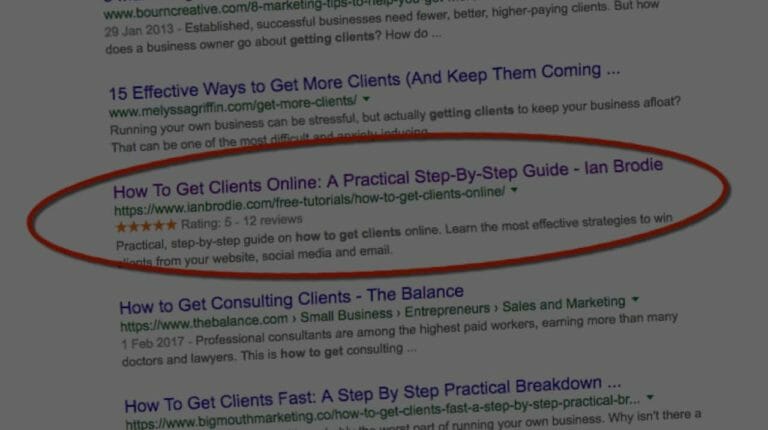
I implemented some simple changes to my site and within 4 days I had star ratings next to my site for searches for my name, and the next day the star ratings were there for other important keyword searches for me as you can see below.

Star Ratings in Search Results

So how do you get star ratings to show up?

Click here to find out how…

Featured

More Clients Memorandum

Why simple is the key to success

Posted on January 8th, 2017.

Ever seen a world-class juggler on TV or in a show?

They'll juggle with 8 balls, or 4 flaming torches, or a handful of razor sharp knives. I even saw Steve Rawlings juggle with furniture recently.

All very impressive.

But here's the thing. If you're trying to learn to juggle, you don't start with 8 balls, a bunch of flaming torches, razor sharp knives or furniture.

You start with just one ball. Then move up to two. Then do three.

You start simple and master the basics.

It's the same with any sport or musical instrument, or learning to drive.

Start by mastering the fundamentals. And often that's al you'll need.

But with marketing we seem to think we need to do everything. Usually all at once.

We're encouraged to go on twitter, do video, webinars, email, seo, snapchat. Every time a new platform appear some expert pops up telling us it's the future and we all need to be using it.

But marketing is just like juggling. Try to do too much from the start and you'll just drop everything.

Instead, focus on one. One source of leads. One lead magnet. One follow-up method. One approach to converting contacts into clients.

Master the fundamentals first.