Ian Brodie

Ian Brodie


Navigation
CategoryMarketing
Featured

Marketing

Shock and Awe Marketing

Posted on October 2nd, 2011.

Picture these two different scenarios:

Scenario 1:
You've done some great work for a client. They sing your praises to one of their peers – an ideal potential client for you – then give you a call to say they've done so and suggest you get in touch with them.

So what do you do?

Perhaps you call that potential client to set up a meeting? Maybe email them?

What does that do to the dynamic?

All of a sudden you've gone from someone they've had recommended to someone who's pushing. Someone trying to get a meeting with them. Someone trying to sell to them.

It's only a subtle shift. It's not like they now see you as some awful agressive salesperson.

But it is a shift. You've had to “draw down” on the favour bank established when your client recommended you.

And what are you going to do when you meet them? You have to figure out whether they need you, what they need, when, and you have to demonstrate to them that you know your stuff and they can trust you.

Feels a lot like a sales meeting to me. Probably does to the potential client too.

So bang, you're a vendor.

Scenario 2:
Exactly the same as above.

Except instead of calling them to set up a meeting you send them something instead.

Perhaps a CD or a video. Not a “showcase video”. Lord no, please not a “showcase video”.

But something useful. Something that would be really valuable to them. Something they would want to listen to or watch because of the intrinsic value it brings – not because you happen to be in it and you've asked them to look at it.

You know the sort of thing. You being interviewed on audio with 20 minutes of your best ideas on leadership. A video showing you creating a successful adwords campaign and describing the key elements. Your top tips on reducing overheads.

If you've written a book then, of course, that would work brilliantly. But if you haven't, then a CD or video is pretty easy to create. And can actually work just as well.

What's the dynamic like now?

Now you've deposited more into the favour bank rather than withdrawn. Now they've had something valuable from you that they feel grateful for – especially if it gives them something they can immediately do and get results from.

Now they've seen you're an expert. You know your stuff.

Now they want to call you.

Completely different ball game.

Isn't scenario 2 so much better than scenario 1?

And so much less painful when it comes to meeting them. No push. No feeling salesy.

But here's the catch. It takes work.

You've got to make that CD or video.

And you've got to nail your colours to the mast. No weasling around just saying what you think they want to hear when you meet them. No just reflecting back what they say. No BS.

You have to take a stand. You have to say what you think. You have to risk them disagreeing.

And you have to actually be good at what you do. You have to have some different ideas (for them). New insights (to them).

You don't have to be Michael Porter or Tom Peters or Seth Godin.

But you do have to say something they won't have heard time and time again before. You have to have something more than “don't work in the business, work on the business” or “work smarter not harder” or other overused crap. Clichés and obvious truisms aren't going to cut it.

It's going to take some courage. And some confidence.

But if you can take that step. Make that CD. Get it published properly (it'll be less than £100/$100 to get 50 of them done).

If you can have something that blows the socks off people before they even meet you. The full shock and awe treatment.

Well, you don't need me to tell you what a difference that's going to make to your results.

Are you going to do it?

Featured

Marketing

3 Critical Marketing Traps for new Coaches, Consultants and Freelancers

Posted on September 28th, 2011.

I don't know about you, but when I went solo as a consultant/coach, my first few months were filled with excitement and terror in equal measure.

It was wonderful to know I could do anything I wanted and everything was dependent on me.

It was terrifying to know I could do anything I wanted and everything was dependent on me.

Your initial challenge as a solo professional is to land your first client. I was lucky: as a veteran consultant I knew enough people who sent work my way in the early days to buy me time to get fully established.

But I made mistakes too. Some big, some small. In particular, there were three things I wish someone had told me when I started.

Firstly, I wish someone had kicked my butt early on and told me if I wanted to succeed I needed to take action. It sounds obvious, and I wasn't filled with wishful thinking. But I was overly optimistic. Overly confident that something would turn up.

That overconfidence meant that I took the easy path. Concentrated on the interesting work I had rather than on the tougher task of getting out and winning new work.

Secondly, I wish someone had told me to swallow my pride. To reach out to more old contacts and tell them I was available. To hook up with as many people as I could – build my contact network quickly.

And finally, I wish someone had told me that when things started going right, when the clients and the money started flowing in, I should step up to the next level. Start working on longer term things that would make life easier. Get clients flowing in to me rather than me having to go out to get them.

Of course, things turned out very well in the end. But I could have got to where I am faster. I could have made things easier for myself.

If you want to get a headstart as a solo professional, avoid the mistakes many make in the early days, and set yourself on the fast track to success then head over and register for the free “Taking the Plunge” audio masterclass series.

There are 10 speakers (including me) giving their best advice and experience on the key areas you need to succeed as a solo or self employed professional. The topics covered include:

  • How to get your first paying clients (me)
  • How to get started as an independent consultant (Michael Zipursky, founder of Business Consulting Buzz – the leading website for business consultant)
  • How to “find your mojo” and turn it into a business proposition (Andrew Thorp, founder of Mojo Life)
  • Getting started as an independent coach (Gladeana McMahon, author and Chair of the Association for Coaching)
  • How to start building your business network (Heather Townsend, author of the FT Guide to Business Networking)
  • Getting started as a freelance trainer (Sharon Gaskin, founder of the Trainer's Training company)
  • Getting everything done when you're self-employed (Meg Edwards, senior coach with the David Allen company – of “Getting Things Done” fame)
  • How to keep on top of the admin needed to run a business (Helen Stothard, founder of HLS services, Virtual Assistants to coaches)
  • How to develop your business proposition (Mike Harris, author – and a guy who's built three billion dollar companies!)
  • How to manage the transition to self employment (Antoinette Oglethorpe, expert career coach for the self employed and organiser of the series).

I give it a huge recommendation for anyone either thinking of going solo, or in their first few years of working for themselves.

Featured

Marketing

Are You Building Your Tribe Yet

Posted on August 18th, 2011.

I'm going to talk about a marketing strategy that's not for everyone.

It's hugely powerful, perhaps the most powerful strategy there is. But as I say, not for everyone.

The strategy is to build a tribe, a following, a “gang” – call it what you will.

Seth Godin wrote about it in his book Tribes (though to be honest, I think he overcomplicated it).

I touched on it when I wrote about Authority Marketing recently – establishing yourself as a leading expert in your field. Building a tribe goes one step further.

Building a tribe means creating a following of people who not only respect you, not only believe you know what you're talking about – but support you, want you to succeed.

Or more exactly, they want what you stand for to succeed.

You see, creating a tribe is about more than you. It's about a cause, a higher purpose.

To build a tribe you have to stand for something, champion something.

Back in the 80s my wife used to shop a lot at Body Shop. It wasn't just that they had great products. It was what they stood for.

Notwithstanding the later controversies about whether they were quite as green as they made out, at the time it felt good to support a company which stood for something we believed in.

Of course, the products had to be great too. But later, when the high street stores started bringing out comparable (and cheaper) “natural” brands we stayed loyal.

We felt we were part of a cause. And we were evangelists to those who hadn't “seen the light”. We identified with the people behind the business and what they were trying to do.

Can “normal” businesses like yours or mine inspire the same fierce loyalty and feelings of belonging?

Sure we can.

We all stand for something when you think about it. None of us is purely in it just for the money.

I interviewed consultant John Seddon recently for my Authority Marketing podcast series (you can listen here: John Seddon Interview). John's company is hugely successful and they win a lot of improvement projects with the public sector.

But they don't just win them because they're good at what they do. They win them because Seddon is an evangelist for systems thinking led improvement. He has a passion for improving the public sector ‘the right way” and is fiercly critical of the status quo. That's attracted a tribe of people who buy in to his philosophy.

My friend Charlie Green is the go-to guy for improving trust in business. But he hasn't just got there because he's an expert in trust. He's got there because he has a point of view on what businesses should be doing to build trust – on what's right and what's wrong.

Another friend, Tom Searcy, leads the field in advising companies on winning big sales through RFPs. But he's not a cold technician. He's a cheerleader and advocate for small businesses fighting against their bigger competitors to win those big sales.

Whose cause do you champion?

Perhaps you're a leadership trainer looking to unleash all the hidden talents in organisations. or a career coach who loves to help people find their calling. or a supply chain consultant on a mission to cut waste and bureacracy. Or a marketing consultant looking to generate growth in neglected inner cities.

For myself, over the years, I've seen myself becoming more and more an advocate of “pain free” ways of marketing and selling. Of approaches that allow professionals to win clients without being pushy or sleazy – and actually enjoying what they do. A champion of “pain free marketing” as it were.

What about you? Do you have such a passion?

Because if you actually stand for something, if you can build a tribe around that, then marketing becomes a whole lot easier and more pleasant.

Featured

Marketing

Why Networking Doesn’t Work (for me)

Posted on August 18th, 2011.

Are you a good networker?

I was pretty good. Invested in training. Read all I could. Went to some great events organised by some wonderful people.

I put the work into it. Practised and practised. Even got good enough to be asked to teach networking skills to others.

But it frustrated the hell out of me.

Perhaps you've experienced something similar? I used to go to events, meet people, ask them about their business, probe some of their challenges, tell them about what I did if asked.

All the stuff you're supposed to do.

I did OK. But nowhere near as well as I thought I should be doing.

After a few years it finally dawned on me what was going on.

You see networking, like any marketing, is a game.

And it's a game of skill. The people who do best at networking are the ones with the best networking skills.

Now that might sound like stating the bleeding obvious, but bear with me.

By networking skills I mean how well you interact with others, how good a listener you are, how well you can get across what you do in an interesting and memorable way.

Of course, there's more to it than that. But critically, success at networking is not particularly dependent on the depth of your expertise. On being the best in your field.

Don't get me wrong – you have to be good at what you do. Eventually your reputation will catch up with you if you're not.

But you don't have to be the best.

What happens is that when you enter that room, you're on a level playing field.You could be the world's leading expert in your field, it doesn't matter. No one knows you.

By the time they leave the room, the impression they have of you will be based on 5 minutes of interacting with you.

Even if they meet you multiple times over multiple events, their impression of you will be based on a very small amount of time.

Enough time for them to tell if you're a nice person. To tell if you listen to them and engage with them. Enough time for your networking skills to shine.

But nowhere near enough time for your depth of expertise and experience to show. For them to tell if you're really the world's leading expert or just a decent hardworking professional who does a good job.

And that's when I realised why networking wasn't working for me.

At the risk of sounding immodest – I really am an expert (in the rather limited field of marketing and business development for consultants and coaches – I'm pretty much a duffer at everything else).

My networking skills are good. But no better than dozens of others who've done the training and put in the work like I did.

Put me in a room alongside an averagely skilled marketing consultant who's a master networker, and he'll come out with the business, not me.

That's the nature of networking.

Nothing wrong with that. But it told me that I needed to find marketing methods that played on my unique skills.

For me, doing presentations at events rather than just attending them gave me a chance to showcase my expertise – and it worked far better for me at building relationships and winning clients.

As, of course, does my website, webinars, articles, etc.

Nowadays I only do marketing that showcases my expertise and builds my percieved authority.

What can you learn from this?

Whatever your personal edge – whether you're a technical expert, someone with decades of experience, you're a wonderful person to work with, you always get results, you're the cheapest there is.

Whatever it is – you need to use a marketing approach that showcases it.

Don't use approaches where you're just one of many like I did for so long with networking.

Focus on something that will let you shine.

So what approaches worked better for me (and will probably work better for you too)?

They're the strategies I outline in detail in Momentum Club. You can grab a $1 trial and start implementing those strategies right now by clicking here.

Featured

Marketing

How To Become An Authority In Your Field

Posted on July 12th, 2011. Authority Marketing

For me, establishing yourself as one of the leading authorities in your field is the most powerful strategy for those in the advisory professions. As the web and the ability to find pretty much anything or anyone online becomes all pervasive, clients are now able to find the “best person for their needs”, rather than just the “best person they can find locally”.

Being a recognised authority in your field doesn't mean you'll win all the work – or even most of it. But it does put you in line for the most interesting and lucrative work.

It's not a strategy that's for everyone. There's absolutely nothing wrong with being “damn good at what you do” – but not necessarily the leader in the field.

Personally though (and for obviously self-interested reasons) I'm fascinated by what it is that these authorities do to establish their market presence. So I set about interviewing them to find out.

I have more interviews planned, but I wanted to share with you some common themes emerging from the research so far and to see what you thought.

What makes an Authority?

The first common factor is that all the authorities in my study so far have made their name in tight niche.

Charlie Green established himself as the go-to guy for becoming a Trusted Advisor. Tom Searcy focused on “whalehunting” – winning big clients. John Seddon is “the systems thinking guy for service businesses”. And so on.

Now, later on, many of the authorities expanded their reach. Charlie is now a recognised leader in Trust generally – not just for advisors, for example.

But they all started out in a relatively tightly defined niche.

Secondly, they all developed deep expertise in their field.

Now you may have heard people saying that you can “fake it 'til you make it”. That you can claim authority first, then develop the expertise.

– Bullshit –

Each of the authorities in my study dedicated themselves to mastery of their field.

Drayton Bird is well into his 70s – yet he's a lifelong student of direct marketing and continues to invest heavily in his own education. The detailed benchmarking that Greg Alexander and his team do gives them insights into sales performance that no other consultants can match. Jane Mason lives and breathes breadmaking and is constantly looking into new techniques, methods and recipes.

Now you don't have to be seen as the #1 expert globally to be an Authority. You just need an audience who values what you do and sees you as the Authority for them. That's where specialisation can help.

And transparency too. Be honest about what you know and what you don't. If you're just a couple of steps ahead of your audience, tell them. Be the guy (or gal) who's a trailblazer for them. Who shows them what's working and what's not right now to achieve the goals they're aiming at.

All of the Authorities I interviewed are passionate about what they do too.

None of them would have dedicated the time and effort they did into becoming leading experts if they didn't have a true passion for their fields.

Sometimes that passion was born of frustration: John Seddon's grew from anger at how badly the UK government was managing improvements in the public sector.

Sometimes it was part of their upbringing: Jane Mason's parents taught her the importance of natural food, good company and living well.

And sometimes it just grew: Drayton Bird fell into direct marketing accidentally when he was desperate for a job. But he fell in love with it and became one of direct marketing's true evangelists.

All of my authorities developed a clear market positioning: they stand for something.

Drayton and John are famous for being outspoken – fierce critics of poor performance in their fields. Tom is the champion of small businesses – helping them win big deals against giant competitors. Greg is on the side of Chief Sales Officers, having been one himself and been frustrated with the poor support he'd been given. Charlie is an advocate of trust based relationships and long term thinking in a world of short term transactions. And Jane promotes social enterprise and community building through bread-making.

We know who they are and what they stand for. There's no ambiguity. No “we do everything” or “we do whatever you want”. We know who to go to if we want what they've got.

Finally, they all have the courage to speak out about what they believe in.

Not everyone likes them. Not everyone agrees with them. But they don't pander. They don't say what they think people want to hear – they say what they believe in and they say it with power and passion. Listen to a presentation by “Entrepreneur's Guru” Robert Craven, for example – he pulls no punches.

To use social media terminology – they've built fans rather than just friends.

How does this apply to you?

Could you do this in your business? Is there something you're passionate enough about and expert enough about to become an authority on?

Do you have the courage to go down this route with your marketing? To stand for something. To risk annoying or alienating potential clients who don't agree with you?

It's worked for the authorities in my study – could it work for you?

I'd love to hear your views – just drop me an email at ian@ianbrodie.com

And if you want to listen to the interviews, they're all here.

Featured

Marketing

3 Marketing Lessons Stolen From My Local Coffee Shop

Posted on June 22nd, 2011.

About 2 years ago, a new coffee shop called Caffe Latte opened in our local village.

It was a bit of a risk: we had a bypass built a decade ago and since then the village centre has slowly died. And I must admit, I didn't rate its chances of success highly.

But it's worked brilliantly. Not only is it thriving, but it's revitalised the centre of the village. Far more people come into town and use the local shops – and there's a real sense of community returning.

Kathy and I love to take a walk up there a couple of times a week. We often take a book or some work to do and just sit there for a couple of hours.

I've been in there so often I kind of know the business inside out now. And I've picked out three lessons from how Francesca, the owner, has marketed Caffe Latte that I think we consultants and coaches and other professionals can learn from. Particularly if we're a small firm or one-man-band.

Francesca competes against the big chains in other local towns – Starbucks, Costa, Cafe Nero. Just as we might compete against Accenture, KPMG or Linklaters.

Positioning. The first thing Francesca got right was the positioning of the business. It's not just a “like Starbucks but cheaper” – pricing is roughly at the same level. She recognised that we don't choose a coffee shop because it's a few pence cheaper than the alternative. We choose it for taste, atmosphere, food – a whole range of reasons.

Yet so many professionals position themselves as “like X, but cheaper” (substitute the name of a big firm for X – usually the firm the professional used to work for).

The thing is, you're not like Accenture or KPMG or Linklaters. You're not a big name that no one got fired for hiring. You're not a bland but safe bet. You're an individual with a whole load of things to offer that you need to focus on rather than just being a cheap version of a big firm.

Personality. What Caffe Latte has in abundance is personality. It's a reflection of Francesca really. Quirky, fun. You go there and you feel part of the family – like Norm in Cheers. The staff are all like that too.

As solo professionals or small firms that's something we can do too. We don't have to conform to a bland corporate image. We don't have to please everyone. We just need to find a few clients who can love us for life.

If we put our personality and our passion into our business we can stand out a mile compared to our corporate competitors. Yet so few of us do so.

Instead, we hide behind our smart suits and corporate websites. We speak in corporate tongue rather than in the plain English we'd use at home or with our friends. How many solo professional's websites have you seen that say “we” when there's only the one of them in the firm (sadly, mine used to be like that too – though thankfully I've grown out of it).

We shouldn't be trying to copy the corporates – we should be trying to find our own unique personality and voice.

Innovation. That's a big word. Can a coffee shop really innovate? Well, yes in the sense of constantly trying out new things to see what works and abandoning things that don't.

Francesca started up with a big kids area and creche. Didn't work. So she changed it.

She tried hosting themed days and celebrations. Worked brilliantly.

She tried live music. Didn't work. Stopped it.

She tried changing the menu, adding new food and sweets no one else was doing. Worked brilliantly.

She's used Facebook for marketing. Installed free wifi. Worked brilliantly.

The big chains don't have the flexibility or the bravery to allow their stores to try out new stuff like this. They all have to be the same.

And that's a huge advantage you can have over your big competitors too. In the time it would take them to set up a committee to look into doing a feasibility study to develop a business case to maybe think about something new – you can have tried it out and figured out whether it will work or not.

Yet how many of us use that advantage? How many of us are constantly trying out new offers, new services, new marketing tactics?

Caffe Latte has been such a success they're now franchising the model out across the country. Maybe we ought to think about what we can learn and apply to get our own equivalent success.

And, of course, if you're ever in the little town of Handforth just South of Manchester – do pop in to Caffe Latte and you might well see me in there.

Featured

Marketing

Clients, Not Markets

Posted on June 17th, 2011.

Grean LeafUnderstanding markets is important. Big trends. Overall pictures. What clients want generally. Where to position your firm to hit a “sweet spot”.
But when you're communicating, you must speak to clients, not markets.

Markets don't hire you, clients do. Markets don't build relationships with you, clients do.

Is that just a semantic difference? Fiddling with words?

I don't think so. Because it affects our psychology.

When we think and talk markets we think of groups, averages, generalisations.

When we think and talk of clients – or better yet, client – we think of individuals and details.

Too much market-think and our communications become generic and wishy-washy. We try to talk to everyone in the market and end up connecting deeply with no one.

Write with one specific client in mind – your ideal client, your “most likely to buy” client, your “I'd really love to work with” client – and your words have depth and meaning. You can write details. And you can connect.

Many marketers shy away from this – frightened that they're being too narrow and they'll miss out on the broader market.

That rarely turns out to be true. Not unless you're a huge megafirm that needs to be all things to all people to maintain your size.

How many clients do you really need to build a thriving business? For most of us it's a tiny percentage of the “market”. If you think about a good client and the business you get from them over a year, then for many of us the number of that sort of client we need often doesn't hit double figures.

We don't need to appeal to a broad market. We need to connect deeply with a small number of perfect clients.

So stop thinking about markets – and start thinking about those individual clients.

Featured

Marketing

Intrinsic Value Marketing: Marketing that Actually Works Episode 2

Posted on June 3rd, 2011.

Here's the next in our series of videos looking at slightly unusual or unexpected marketing that actually works very effectively. In this case we look at a powerful principle that you don't see used very often in professonal services.

http://www.youtube.com/watch?v=OmD-2BP_Ulw

Don't forget – keep an eye out for this type of marketing and add it to your swipe file.

Ian

Featured

Marketing

How To Escape Marketing Overwhelm

Posted on May 17th, 2011.

Do you ever feel overwhelmed when you look at your pipeline and think about what you need to do to fill it?

You're not alone.

I think it's the curse of business owners and executives these days. You look at how many new clients you need to bring in to hit your targets and then you try to think about how you're going to do it.

But it's so difficult to know where to start. What will actually work?

Back in the day, you pretty much had the choice of networking, direct mail, telemarketing or advertising when it came to marketing. Each with their own established best practices and rules.

Today we've got organic and paid search, social media, social media ads, video marketing, email marketing. And it all seems to be changing all the time.

I've lost count of the number of “next big thing” emails I've had trying to convince me to buy the latest and greatest method for getting a so-called flood of clients with some newfangled technique.

And that's just Facebook!

When you're just starting out – or even if you're fairly well established – it can all be so overwhelming. So difficult to know what to do.

It was a big issue for me when I set out on my own. In some ways because I focus on marketing and sales it's worse – because I deliberately keep tabs on all the newest approaches.

Every time I tried to think of what I should do I couldn't get a clear picture in my mind. And all the stories of other people succeeding with this method or that method just confused me further.

So how on earth do we figure out what to do without spending every waking hour networking, phoning, tweeting or blogging?

Well, what follows is an approach I evolved that worked for me to clear the fog of uncertainty and give me some clarity on what to do.

I can't promise it will work for you – but give it a try – it's been helpful to a number of people I've shown it to.

The key to is to break down your marketing into manageable chunks. Ones you can think about sensibly. Too often, when we think about how we're going to get new clients we lump all our potential clients into one amorphous blob.

And you know what? You can't market to an amorphous blob.

So I found it helpful to split my clients into Top Clients and Others. For me, Top Clients are the top 10 clients I'd really love to win over the next 6 months. Clients who – if I got to do business with just one or two of them – could set me up for the year. For you it might be a top 5 or a top 20. But essentially it's a small number of ideal clients you can think about individually.

You could go more sophisticated and split into A/B/C or suchlike. But let's keep things simple for now.

The “others” are clients I'm not going identify specifically or do a specific plan for – too many of them. But I do aim to win a number of them via more general marketing.

Then I split my marketing into short term and long term.

Long term marketing is all about building “gravity”. Doing the things that will attract clients to you so you don't have to actively seek them out. Thought leadership, stuff with your website and the like.

But long term marketing takes time before it pays off. So you also need some short term activities to try to bring in clients right now. The kind of stuff that pays the bills while you work on the long term side.

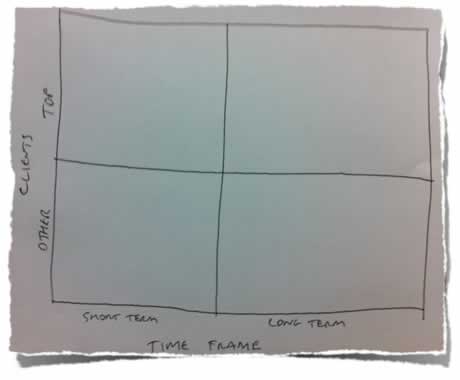
Then – because I'm a consultant and it's part of the union rules – I draw a little 2 x 2 matrix to represent this. Client types on one axis and time frame on the other. Rather like this:

Then I think through what marketing activities would be the most appropriate in each box for each client type/time frame combination.

Splitting it up like this makes it much easier. Instead of struggling to see what marketing will magically work for all clients in all circumstances, I can take a “horses for courses” approach. It's much easier to see what marketing will work in the short term for my top 10 clients, or to nurture relationships with the thousands of “other” prospects who visit my website for example.

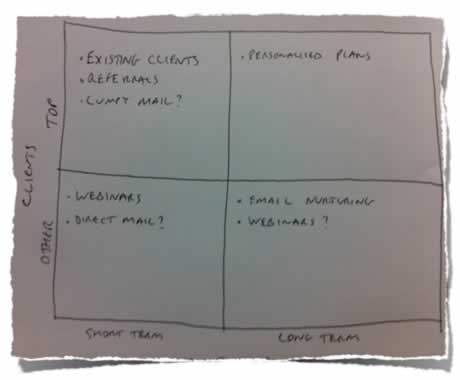
Usually, I end up thinking about referrals and extending existing client relationships for my top clients in the short term. And I develop unique, personalised nurture plans to build my relationship with my top prospects in the long term.

For the broader set of target clients, I'll may pencil in approaches like webinars or direct mail in the short term – and I'll focus on using email marketing nurture campaigns in the long term. Here's an example of what the matrix might look like for a typical client:

Of course, your matrix will look different depending on your analysis of what marketing approaches will work for your specific clients – and what you're good at.

But the key is that by breaking it up into this matrix rather than trying to eat the elephant all in one go, you zap the overwhelm.

As I say, I can't promise it'll work for you – but it's worked for me and many others – I suggest you give it a go.

Featured

Marketing

Marketing that Actually Works

Posted on May 12th, 2011.

Here's a little video showcasing some highly effective marketing that worked on me last week – despite my best efforts to look down on it and ignore it.

There's plenty to learn here about grabbing attention, building interest and creating a compelling case for action. It's for a product, rather than a service but the principles can be equally applied to consulting, coaching or any other profession.

Hope you enjoy it – and hope you start your own swipe file too.

Ian