Ian Brodie

Ian Brodie


Navigation
CategoryMarketing
Featured

Marketing

My Worst Performing Email EVER (And How To Avoid Making The Same Mistake Yourself)

Posted on June 24th, 2012.

Email PerformanceLast week I sent out an email that had the worst open rate I've had for an email ever.

The email got 20% fewer opens than normal. For a business like mine that has email marketing at its core, that's a disaster.

And for someone like me who's studied email marketing in depth, bought pretty much every training course there is on email marketing, and who's been interviewed on email marketing best practices on more than one occasion it's a little embarrassing.

So what went wrong?

Well, the truth is, I fell into a trap that very many people do with their marketing. I got too clever.

Here's the offending email subject line:

“Spooked By Shadows”

You can probably see what's wrong with it straight away. There's no real motivation for people to open it.

The email itself is a good one. All about the importance of not being scared in your marketing by what your competitors might be doing.

So the subject line “Spooked By Shadows” is a clever one. Alliterative too, and reads nicely.

Clever. But not effective.

Many years ago John Caples studied the most effective headlines for adverts – and identified that the three types of headline that work well are:

  • Benefits: the headline indicates the benefit you'll get by reading on (or buying the product)
  • News: the headline refers to something in the news that people already want to hear about
  • Curiosity: the headline invokes curiosity – the prospect reads on to find out what the headline means

The same principles apply to email subject lines.

Benefit headlines are often the strongest. Subject lines like “How to find your ideal niche” work because they promise to reveal how to do something your readers (or in this case my readers) really want to know.

And you can often combine types. “5 ways of winning clients with mobile apps” is a benefit headline (winning clients) combined with news (mobile apps are hot at the moment) and it's also curiosity (“I wonder what those 5 ways are…”).

And my email contained…none of them.

Well maybe a bit of curiosity. Perhaps someone wondered what I meant by “Spooked By Shadows”.

I fell into the trap that so many do of trying to be clever and funny with my marketing.

But I really should have stuck to being effective.

If you're writing emails, adverts or sales pages you should stick to being effective too. Follow Caples' advice and stick to benefits, news or curiosity.

If you'd like more in-depth tips on email marketing – completely free – you can sign up for my series of Email Marketing Power Tips here:

Email Marketing Power Tips >>.

Featured

Marketing

Authority Marketing: Martin Lewis Builds Authority, Sells Website For £87m

Posted on June 2nd, 2012.

Martin LewisIf you're in the UK you probably heard that in June 2012, Martin Lewis, the “Money Saving Expert” pocketed the tidy sum of £87 million by selling moneysavingexpert.com to Money Supermarket.

Well, actually, he's already promised £10m to charity, so he won't be pocketing all of it. But not a bad day's work really.

Without doubt, the value of the site is based on Lewis's position as the leading authority on saving money in the UK.

He was the UK's number one person searched for on google in 2009, and number 2 after Cheryl Cole in 2010. In a recent poll of mothers in the UK on who was the biggest champion of consumer rights, he took a massive 49% of the votes.

So how did he rise to the top of the herd? He started off his life as a reporter no differently to hundreds of other consumer journalists. And there are dozens and dozens of consumer advice websites, price comparison sites, money saving forums and columnists.

Why did Lewis rise to the top?

Well, there are some prerequisites:

Firstly, he really is an expert. In his own words “I'm a nerd, but a very proud nerd. Staying up to three in the morning doing spreadsheets on credit cards is not cool”.

I'm sure you've seen lots of courses and gurus on the web telling you you can become an “instant expert” (if you buy their course, of course). Bullshit.

To become an authority you need genuine expertise. Lewis shows this. Challenge him on the latest credit card rates or the best deal on your energy bills and he'll rattle off an unerringly accurate list of your options.

And while there are shortcuts to building expertise, it doesn't happen overnight. And it takes hard work.

Secondly, he recognised early on that to achieve what he wanted, just being an expert wasn't enough. He would have to have influence.

In the nicest sense of the word, he's a great self publicist. He writes multiple newspaper columns and appears on TV and radio shows almost every day of the week.

But the publicity isn't all about him. he doesn't go on TV to promote himself. He goes on TV to give useful advice to people. Everything he does gives Value in Advance. He gives freely of his expertise.

But for me, the most important factor in how he became an authority is that he doesn't just give advice to consumers – he champions their cause.

He's an outpoken critic of hidden charges and bad deals. He's not afraid to call out big companies or government when they let the consumer down.

He's led the charge on reclaiming bank charges, missold pensions and overpaid council tax.

And he's lobbied government tirelessly for improved financial education in schools.

Martin Lewis isn't just an expert. He's the guy we trust, because we know he's fighting our corner. He's looking out for us.

We don't second guess his motives. We don't wonder what's in it for him. We know we can trust him. He's one of us. On our side.

He's THE authority because of that combination: expertise, influence and trust.

So in your field – how do you rate on those dimensions?

Would your potential clients see you as a deep expert?

Are you influential? Are your ideas seen and shared widely?

And are you trusted? Are you seen as the champion of your clients? Do you put yourself on the line for them?

If you want to be seen as an authorty you need all three.

Featured

Marketing

How A Long Dead Genius From The 60s Can Make Your Marketing More Effective And Less Painful

Posted on May 30th, 2012.

Eugene SchwartzAs the TV show Mad Men demonstrates, the world of advertising in the 60s was a pretty interesting place to be. And one of the most interesting guys in the field was Eugene Schwartz.

He was one of the highest paid copywriters in the business, and billed himself as the hardest working.

Decades before anyone else was getting into it, Schwartz was using techniques learned from Zen Masters to enhance his output. He used a method uncannily similar to the recently published Pomodoro Technique for productivity. And his method for fueling his creativity matches up to techniques taught today.

He used those techniques to get very rich working only 3 hours a day, 5 days a week, and spending the rest of his time collecting art (and giving much of it away to museums).

And in his book Breakthrough Advertising, published in 1967 (and which sold for up to $900 until it was recently republished) he wrote some deeply profound words about marketing.

Here's one quote I keep coming back to:

Let’s get to the heart of the matter. The power, the force, the overwhelming urge to own that makes advertising work, comes from the market itself, and not from the copy.

Copy cannot create desire for a product. It can only take the hopes, dreams, fears and desires that already exists in the hearts of millions of people, and focus those already existing desires onto a particular product.

Schwartz was talking about advertising, but what he says applies to all marketing.

And it explains why most of us find marketing and selling so painful.

Most of us imagine that our job in marketing is to persuade. To convince a potential client that they want what we've got. To create a desire for our services.

And we feel bad about that because it feels manipulative. We're trying to push them from where they are to where we are.

But Schwartz says that doesn't work. We can't create desire. Instead we need to channel the desires they already have.

Instead of pushing them from where they are to where we are, we go to where they already are. We show them how what we've got satisfies that desire.

We don't push. We uncover.

And, of course, if what we've got doesn't satisfy their desire, we move on. Because there's no point trying to persuade them that actually they should want what we've got. We can only channel what they aready want.

So in a nutshell, Schwartz has given us the clue not only to marketing that isn't painful and salesy. But to marketing that actually works.

And it turns out they're one and the same.

Featured

Marketing

Google’s "Zero Moment Of Truth": Why They’re Right And Why They’re Wrong

Posted on May 10th, 2012.

Zero Moment Of Truth BookA few weeks ago Google launched their first business book, ZMOT: Zero Moment Of Truth. You can download a pdf for free at the ZMOT site.

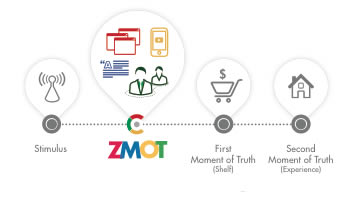
The concept of the book is simple. Google have taken the model of shopping popularised by P&G and added a step to reflect the way we actually buy today.

The traditional model starts with a stimulus – an advert on TV for an iPad perhaps. Then we have our First Moment Of Truth – our first experience of the product on the store shelf. Then our Second Moment Of Truth is our actual experience of the product when we've bought it.

In essence, consumer marketing has been build around this model for years. Stimulate an interest, impress at the store, deliver a great post-purchase experience.

Google's ZMOT model adds a fourth step. The Zero Moment Of Truth.

Zero Moment Of Truth Model

In this model, after the stimulus, the Zero Moment Of Truth step comes next where the potential buyer researches their options – usually online. They google the product. Check out reviews. Ask for opinions on facebook and twitter. Look up more details and alternatives.

Only after that do they take a look “on the shelf” for the product in the real world.

Makes sense?

Absolutely. It's not really a new model – more a neat way of summarising what's become a commonly accepted picture of how buying now works.

And you could argue that consulting, coaching and other professional services have always had the Zero Moment Of Truth step – long before online was an option.

When you're buying a complex, costly and intangible service there is no “shelf” to inspect the product on. So you have to rely on previous experience, referrals, testimonials, what other people say about their service and its provider. Or on the value the service provider gives you in advance of the purchase that “proves” his capabilities.

And these days that process is now much richer with the huge increase in information available online and easy access to people willing to give their opinion.

If fact, Google's book has some very illuminating “heat maps” showing, for example that the biggest wave of research activity when buying groceries happens a few hours before the purchase – but for a car it's 4-6 months in advance.

So yes, Google are right. There are some hugely important things going on before the first contact with the product or service. And the web has increased the importance of that phase.

But here's where Google is wrong. It's not a “moment” of truth. It's a series of moments. It's a relationship.

People don't research their car 5 months in advance and then do nothing until the day of the purchase. They continue to build their knowledge of their potential purchase and the people they might be buying it from. Over time, their confidence grows until they feel ready to make that big outlay.

And it's the same with professional services. Even more so in fact.

That Zero Moment Of Truth is really an extended courtship between the potential client and the service provider. With much of it happening without any direct involvement from the service provider themselves. The client is finding out more about them, checking if they really know their stuff and can deliver results. Getting a feel for what it would be like to work with them.

They're using the web. They're talking to others they know.

And by the time you first talk to them, their mind is almost made up.

So what are you doing to make sure that weird kind of courtship that's happening with your website and all your other marketing channels before a client contacts you is working effectively? How are you managing your Zero Moment Of Truth?

Featured

Marketing

The "Potting On" Strategy For Winning Clients

Posted on April 29th, 2012.

Winning Clients With The Potting On StrategyI spent a few hours in our main greenhouse today “potting on” some tomato, cucumber, and pepper seedlings.

For non-gardeners, potting on is a critical activity where you transplant a young seedling from a seed tray or small pot to a larger pot. It gives the roots of the plant more room to grow and more compost to grow in.

If you don't pot your seedlings on they can become weak and “leggy” with not enough space to expand and not able to pull enough nutrients from the compost.

Business relationships often need “potting on” too. Whether you're trying to nurture face to face relationships with people you meet at events or online relationships with newsletter subscribers.

Everyone talks about “keeping in touch”, but it takes rather more than that if your goal is winning clients.

It takes more than just a quick chat at networking events. Or occasional emails to tell people what you're doing.

Winning Clients is about Nurturing Relationships

Just as plants need more nutrients and more space to grow and bear fruit, you've got to build more depth into your relationships if you want them to bear fruit too.

Before potential clients are going to be ready to hire you they have to have deep confidence in your capabilities and trust that your relationship with them will work out. That won't just come from casual conversations at events. But it might come if you invite them to see you present. Or you send them an article you've written. Or they talk to some of your previous clients.

The key to winning clients is to take a planned approach to your nurturing. Just as an expert gardener knows what a plant needs to flourish, so an expert business developer knows what a client needs before they'd be ready to hire them. And as they grow, that's exactly what they give them. In just the right amount, at just the right time.

When the relationship needs “potting on”, that's what they do.

So, how are your gardening skills? Do you know what your client relationships need to flourish and bear fruit? Do you have plans in place to give them that nourishment?

———-
Image by “Katemonkey”

Featured

Marketing

Marketing Presentation Tips: Holding Your Audience's Attention Right To The End

Posted on April 25th, 2012.

Marketing Presentation TipsEver had that awful feeling that you're losing your audience? They start looking distracted. Perhaps even fiddling with their blackberries. There seems to be nothing you can do do get their attention back.

And yet you know that if you're doing a marketing presentation, you need them to be concentrating at the end when you make your call to action. If no one's listening what hope do you have of getting them to follow up with you afterwards?

I'm going to share with you a little tip that will help you keep your audience alert and paying attention.

But first let's look at why it's so difficult to keep your audience awake…

Sadly, the attention span of most audiences is about 20 minutes. After 30 minutes of the typical presentation many are flagging badly. After 40, you've lost most of them.

And unfortunately, 40 minutes is the typical length of most keynotes.

The end result: most marketing presentations fail miserably to achieve their objectives.

Well, unless their objective was to get the audience to rush off at the end.

Keeping Your Audience Paying Attention To Your Marketing Presentation

What causes an audience to lose their attention?

Sometimes it's the skills of the presenter. A presenter who continually “ums” and “ahs”, speaks monotonously, and distracts you with annoying body language is always going to struggle.

But sometimes even very good presenters can lose your attention. In those cases the issue is often the structure of the presentation.

You see, we humans are made to keep on the lookout for the unexpected. A twig snapping or leaves rustling outside the cave that might indicate a predator is about to pounce.

If we hear that twig snap, we're on alert. We pay close attention to everything we see and hear. Adrenaline pumps through our veins keeping us wide awake.

But when we see that the twig was just our neighbour from the cave next door we relax. We know what the mystery was. We stop paying attention.

They use this all the times in horror films to scare us witless. They set up the scene. The potential victim hears a noise in the house. We're on edge waiting for something awful to happen. They keep us on edge, then…

It was only the cat. We relax.

Then boom, the axe murderer pounces and we all jump up in shock.

We can't help it. When we think we know what's coming, when the mystery has been removed: we relax and stop paying attention.

And this happens all the time in presentations.

The presenter starts by summarising what he's going to tell us. Then in the first few minutes he makes his main points. The rest is elaboration, evidence, variations on a theme.

Important stuff. But the moment we decide we know what's coming, we switch off.

If there's no mystery, there's no attention.

Have you ever started reading a detective novel or watching a “whodunnit” and someone gives away the ending?

How often do you read to the end of the book anyway or watch the full TV show?

If you're anything like me, pretty much never. The suspense, the mystery has gone. it's impossible to pay attention.

It's like that with presentations too. But with a twist.

Far too many presenters give away the ending too soon. Once they've “told 'em what they're gonna tell 'em” there ain't much mystery left.

If your audience think there's nothing new coming, their brains are hardwired to relax and stop paying attention (paying attention is hard work – you need to reserve it for important times when something new and dangerous might be coming).

So how do you turn this knowledge into an attention keeping marketing presentation?

Set up your main points at the start – but don't reveal them. Tell people you're going to reveal the 3 surprising secrets that the top ad agencies have kept to themselves for years (or whatever) – but don't tell them what those secrets are up front.

Use the “but first…” technique that I did at the start of the article to keep people anticipating the big reveal.

And once you've revealed your key points, if you have more to say you need to do something else to keep them paying attention.

That's the “twist” I mentioned above.

And I'm sure you've guessed by now, the twist is teeing up a new mystery to keep up the attention level. By saying “there's a twist”, for example.

Add these elements of structure to your marketing presentation and like a good mystery novel, you'll have your listeners hanging on until the very last word.

Featured

Marketing

The Most Important Skill In Marketing

Posted on April 23rd, 2012.

The Most Important Skill In Marketing

What's the most important skill in marketing?

Your networking skills? Copywriting ability? Creativity? Ability to deliver a great presentation or to get referrals?

All important skills. But I believe there's something way more important.

It's the ability to put yourself in your client's shoes.

To think like them. Understand what they want and need. What they feel. What angers them, what fills them with joy.

You can be the greatest marketing strategist in the world. Have the best execution skills. But if you don't deeply understand what your clients are looking for then your marketing is going to miss the mark every time.

And I don't just mean the obvious.

What they need is often straightforward. And they'll often tell you what they want too (not necessarily the same thing as they need).

But understanding why they want it. The real motivating factor that they can maybe only half articulate themselves. That's the real key to marketing communications that resonate.

You can see the impact of such understanding and empathy in a non-marketing example here

Understanding what they fear is vital too. They may absolutely want what you've got, but they won't buy if they're worried you don't have experience working with people like them. Or that your business is too big, or too small. Or that you'll be too tough on them. Or too soft. Or a whole host of other concerns they may have.

If you don't know what those concerns are, you can't deal with them.

And you've got to know what else is on their mind and what else is going on in their world.

I was speaking to a client recently who described a conversation he had with a CFO where the executive showed him his email inbox. “I get 30 emails from consultants and coaches wanting meetings with me every day” he said. “If I don't know them already, I delete them”.

Try emailing clients like that. Or cold calling.

Offering an email newsletter on your website is fine if your clients don't have a 100 other people doing just the same.  If they do, you need to be offering a lot more to get their attention.

Clients don't view your marketing in isolation. Your marketing appears in their inbox, doormat, ears or eyes along with thousands of other messages daily. If you don't understand what else they're being exposed to how can you hope to do something different and grab their attention?

All good marketing starts with a deep understanding of your client.

And that's why I say it's the most important skill in marketing.

Agree? Disagree? Love to hear your views – drop me a comment below.

———-
Photo Credit: Mike Licht

Featured

Marketing

Marketing Quiz…

Posted on April 17th, 2012.

Bob DylanQuick marketing quiz for you…

As a buyer, are you more or less likely these days than in the past to hang up the phone if you get cold called (irrespective of what's on offer)?

Are you more or less likely to tell an assistant in a shop that you're fine when they approach to ask if you need some help?

Are you more or less likely to research a purchase before ever speaking to potential service providers?

Are you more or less likely than in the past to search for a real expert (wherever they may be) in something you need help with rather than settling for someone nearby who's OK?

If you answered “more” to one or more of the above questions (my guess is you probably answered more to them all) then here's the real question:

If that's how your behaviour as a buyer has changed – how has your marketing changed to reflect the fact that your own buyers will have changed in the same way?

———-

Image: Dylan, of course, from the cover of The Times, They Are A-Changin'

Featured

Marketing

How I gained instant credibility and enhanced my visibility whilst gaining new clients

Posted on March 7th, 2012.

This is a guest post by my good friend Griselda Kumordzie Togobo. Check out her other tips for small business.

Imagine a room of potential clients (large or small, whatever you're comfortable with).

You have their undivided attention and the opportunity to present you and your business in the best possible light. Whilst on stage, you give them a preview of the solutions you provide, transformations and successes experienced by clients, sharing your expertise with a willing and grateful audience.

What could regular opportunities like this do for your business?

Speaking is the one place where you have permission to ask people to unplug and just focus and listen to what you have to say. When you go on stage, immediately the audience view you as an authority.

One good speaking gig keeps giving and giving long after you’ve walked off stage. This is because; you never know who is in the audience or the ideas your talk may be generating.

Let me explain what I mean by this.

I got my first FREE public relations feature in a multinational multilingual publication because the editor was in the audience at a conference I spoke at. FREE PR in a popular magazine that generated further opportunities to speak at two other conferences and make new valuable business connections.

I also just signed up a new client who was present at a conference I spoke at six months ago. It took a while. I carried on nurturing the relationship off stage, but we got there in the end. She viewed me as a highly credible prospect because she had seen me on stage and then subscribed to my insider tips newsletter.

So how can you start?

There is no reason to panic about speaking in front of an audience. You don’t have to be a professional speaker to do this. Increasingly “experts” are expected to be able to present on their areas of expertise or share their success to inspire and educate other business owners. So start small before a forgiving audience, and work your way up.

Before you know it, you’ll be invited to speak at conferences you had only dreamed about previously. My first speaking event when I started was at an event organized by a life coach – I got my first two clients from there and was hooked. You can’t blame me. I had found a way of marketing my business that I loved, was pain free and less time consuming than networking.

Speaking is one of those abilities that can be developed with practice. Seek every opportunity to speak in front of an audience, whether you are paid for it or not and you’ll gradually get better at it

No matter how you look at it, speaking is a vital part of promoting a consulting, coaching or professional service business. I always encourage my clients to give it a try. Why not give it a go too?

Griselda Kumordzie Togobo is a business consultant, coach, speaker and writer dedicated to helping business owners increase their cash flow, profits and productivity. She is a chartered accountant and holds an MPhil in Industrial Systems, Manufacture and Management from Wolfson College, Cambridge University. Griselda is the founder of AWOVi Consulting, a consulting practice that provides cashflow and profit enhancement solutions to owners of small and medium sized businesses using her unique blend of business development and financial management techniques. For more tips visit http://www.awovi.com.

Featured

Marketing

My Odd Job Man: Marketing Genius

Posted on February 23rd, 2012.

We have a guy called James who comes round to our house and offers to do odd jobs every now and then.

Youngish guy, big grin, the odd tooth missing. Looks like he's had an interesting life.

When he came round last week it struck me that in many ways he's a great role model for marketing.

We first met James a year or so ago when he knocked on our door offering to clean our gutters for £20.

Now we didn't know him from Adam at the time. But the gutters really did need doing, it's a tricky job getting up on ladders to do it yourself, and for only £20 – what did we have to lose?

So we said yes.

He set off to clean them, and as it was a pretty sunny day, he chatted to us as he did it.

When he'd finished, as we were paying him, he said:

“You know, your decking could do with a bit of wood preserver on it”.

He was right, it could. But it's a big job – we have a lot of decking surrounding the extension to the house we built a few years ago.

So he quoted us a very reasonable price (not that we checked or got any competitive quotes – but it seemed cheap for the amount of work) and we agreed for him to do it.

A couple of days later he was back to do the decking. He worked like a dog for 2 days – sanding the decking down and hand painting it all with the wood preserver.

As we paid him, he said:

“You know, if you've got any other jobs need doing – painting, repairs, anything, just give me a call”.

And as it happens, we'd been thinking about getting the main room in the extension and the hallway painted.

So guess what? James ended up doing that too.

So from what started out as a £20 job to clean out our gutters, he ended up with a small 4 figure sum.

Not a bad bit of business development work really!

How to become a Marketing Genius

What were James's “secrets”?

Well, firstly, he had a low cost, low risk entry level offer.

When we first met him, we didn't know if he could do a good job or whether we could trust him. But for £20 it wasn't much of a risk.

When he did a good job, and when he chatted to us as he did it, he built his credibility and his relationship with us.

Next, he used his eyes, ears and common sense to spot something else we needed doing – the decking.

By working flat out on it and charging a good value price, he built his credibility and relationship further.

Having built his credibility, he'd earned the right to ask if there was anything else that he could help with. And there was.

Now here's the thing. James is “just” an odd job man.

But how many of us highly qualified professionals have that low cost, low risk entry level offer where we can prove ourselves?

Not many.

How many of us professionals keep our heads up and our eyes and ears open to spot other areas we can help our clients in – rather than just knuckling down, doing the work and getting out?

Not many.

And how many of us have the confidence in our own capabilities to know that after having done good work, offering to help in other areas is not being pushy or salesy – it's actually appreciated by our clients who need that help.

Once again, not many.

The next few years are probably going to be pretty tough for many professional firms. But I suspect James is going to do OK.

If you'd like to discover the practical steps to making your next year successful too, check out the $1 trial of my Momentum Club by clicking here.