Ian Brodie

Ian Brodie


Navigation
CategoryMarketing
Featured

Marketing

The Best Lead Channels: Lead Generation Q&A Day 5

Posted on October 25th, 2012.

On Day 5 of Lead Generation Q&A we're looking at the best lead “channels” or strategies. Which approaches work best to generate high quality leads for high value services.

It's not an easy question, but in the video I'll show you how to figure out what will work best for you.

Featured

Marketing

Lead Nurturing: Lead Generation Q&A Day 4

Posted on October 24th, 2012.

On Day 4 of Lead Generation Q&A we're looking at an area that many people get completely wrong – and it leads to them losing or dropping the majority of their leads.

It's your mindset towards lead generation and what you do with leads when you get them

Featured

Marketing

Lumpy Mail: Lead Generation Q&A Day 3

Posted on October 23rd, 2012.

On Day 3 of Lead Generation Q&A we're looking at how to use “lumpy mail” to get through to difficult-to-reach prospects.

I'll show you what lumpy mail is, and the three critical success factors for using it effectively.

Featured

Marketing

Content Marketing Tips: Lead Generation Q&A Day 2

Posted on October 22nd, 2012.

On Day 2 of Lead Generation Q&A we're looking at how to use content marketing to grow your business online.

I'll walk you through a simple strategy for using guest blogging to build traffic, and my best tips on doing content marketing on a shoestring.

Featured

Marketing

How To Find Your Niche: Lead Generation Q&A Day 1

Posted on October 21st, 2012.

So here we are: Day 1 of our Lead Generation Q&A sessions.

In this video I cover one of the trickiest challenges for many businesses – how to find the right niche or specialism to fuel your growth.

You'll see me disagreeing with what almost everyone says about niches – and giving some practical tips to help you find the right one for you.


If you have any questions yourself on generating leads for your business, you can ask them here >> Ask Your Questions
…and I'll do my very best to answer them. Every day I'll post a new video answering the top questions asked.

And if you think others in your network would benefit from having their lead generation questions answered, then please share this video using the social media sharing buttons.

Cheers!

Ian

Featured

Marketing

Your Lead Generation Questions Answered…

Posted on October 19th, 2012.

When I surveyed my email subscribers a couple of weeks ago to ask what their biggest marketing and sales challenge was, the biggest answer by far was Lead Generation. It got more votes than all the other answers combined.

I hear the same thing on webinars, in discussion forums and social media. The biggest problem most people face is generating leads: that initial meaningful contact with a potential client.

As a result, I'm launching Lead Generation Q&A. For the next 5 days I'll be posting a video a day answering questions on Lead Generation. More details in the video below:


So if you have any questions on generating leads for your business, pop them in the comments below and I'll do my very best to answer them. Every day I'll post a new video answering the top questions asked.

And if you think others in your network would benefit from having their lead generation questions answered, then please share this video using the social media sharing buttons.

Cheers!

Ian

Click here to ask your questions in the comments section >> Comments

Featured

Marketing

Do you pass the "Tapping Game" test?

Posted on September 29th, 2012.

TappingWhen what we do is complex and intangible we rely on our communications skills to get our message across to our clients.

They can't touch, kick or properly test drive what we do. So the largest part of what they think of us and whether think they want to hire us is driven by how well we're able to get across our message.

Only it turns out that getting our message across is a lot more difficult than we think.

Here's an example.

In their book, “Made to Stick”, Chip and Dan Heath tell the story of Elizabeth Newton and her research at Stanford in 1990.

Newton created a simple game where she assigned people to one of two roles: ‘tappers’ or ‘listeners’. Tappers received a list of 25 well-known songs, such as “Happy Birthday to You”. Each tapper was asked to pick a song and tap out the rhythm to a listener by knocking on a table. The listener’s job was to guess the song, based on the rhythm being tapped.

In the test, tappers tapped out 120 songs. And listeners only managed to guess 3 of them.

But that wasn't the point of the test. The real purpose of the test was to see how well tappers thought they'd do.

And the tappers predicted that the listeners would guess right 50% of the time.

50% vs their actual score of 2.5%. Huge difference.

Turns out the problem is what's known as “The Curse of Knowledge”.

Once the tappers knew the tune they could hear it in their head. It was obvious to them that the taps sounded like the tune. They couldn't understand how anyone wouldn't be able to pick it up.

But to the listeners it was just random taps. They rarely had a clue what it was.

The same thing applies to our communications. Once we have an idea in our head we're staggered that everyone else doesn't “hear it”. That they don't understand what we understand.

As a result, our communications far too often assume a level of knowledge and familiarity that just isn't warranted.

If we want our ideas to get across then we need to turn them from the abstract to the concrete. Something our listeners can picture for themselves. Something it's easy for them to grasp.

The Tapping Game story is a great example itself. I could have just talked about how it's easy to make assumptions and about how much other people understand. But that's an abstract concept. Illustrating it with a story brings it to life. Makes it memorable.

Or as the Heath brothers put it – it makes it “sticky”.

So how do you score on the Tapping Game? how many of your messages about your business get through?

50%, or nearer 2.5%

Worth thinking about.

———-
Image by Brian Auer

Featured

Marketing

More Leads Than You Think

Posted on August 31st, 2012.

SearchingAsk most professionals and business owners what their biggest marketing challenge is and the answer you'll hear more than any other is “lead generation”.

Ask what they mean by a “lead” and the answer is always “contact with someone who needs my services” or something similar.

Dig a little deeper and ask over what timeframe, and the answer is always “now” or “soon”.

And that's the problem.

The reason we don't have many leads is that we focus on trying to connect with people who are ready to buy right now.

There just aren't that many of those people.

Go through this thought experiment. If you think of all the businesses or individuals in your market who are a great fit for you. Right size of company, right geography, right sector, right attitude. Whatever defines your ideal client.

Out of those people – what percentage will believe they have a need for your services or those of someone like you right now or in the next couple of weeks?

For most people it's a small percentage. 1%. 5%. 10% at most.

Then think of those same businesses or individuals – what percentage of them will come to believe they need your sort of services in the next year? The next 2 or 3 years?

The number rises dramatically. Maybe to 30%. 50%. 80%

So in other words, when you first connect with a potential client. Be it at a networking event, via a sales letter, or them coming to your website. The chances are very slim that they need your services soon – that they're a “lead” in the commonly used sense.

But the chances are very high that they'll need your services in the next 3 months, 6 months, 1 year or 3 years.

What's the difference between the two? Time. You'd ideally like to be talking to that person in 3, 6 12 or 18 months time when the time is right and they're ready to buy.

What's the best way of of getting to speak to them then?

Keep talking to them. You've made your initial connection – now build a relationship. Demonstrate your credibility so they call you when the time is right.

What do we actually do?

We ignore them. We focus our energy on finding people who are ready right now. Trying to find the needle in the haystack rather than nurturing relationships with potential clients for the future.

Lead generation is tough if you only see leads as people ready to buy right now.

If you switch your mindset to leads being people who will buy in the future, there are many, many more of them. Orders of magnitude more.

Nurture those relationships and you'll have a ton more leads when the time is right for them.

———-
Image by rightee

Featured

Marketing

A Decades Old Marketing Tip That's Just As Powerful Today

Posted on August 14th, 2012.

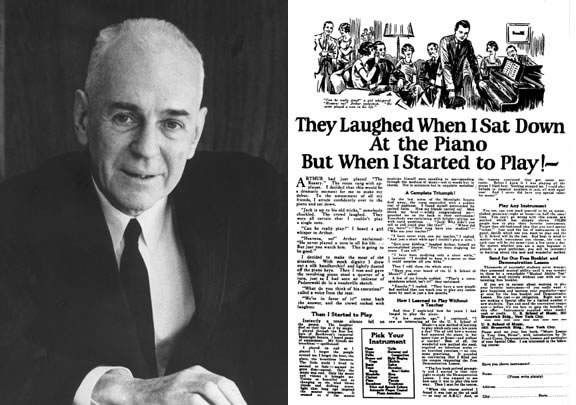
John Caples

It was John Caples who created the terrifyingly beautiful guidance for marketers:

“First you need to enter the conversation going on in your prospect's mind”.

That's him in the picture above by the way, along with one of his most famous advertising pieces – written when he was just a rookie at Ruthrauff and Ryan in 1925.

First you need to enter the conversation going on in your prospect's mind. It's one of those maxims that gets more profound the more you think about it.

Have a think for a few seconds yourself – what does it mean for you?

In its original context of advertising it told copywriters that if they wanted to get the attention of their prospects they couldn't force their message on them. They had to start by keying in to things the prospect was already thinking about.

Things they were worried about. Or dreamt of. Or were excited about. Or just interested in.

That's why the most effective headlines for ads (or subject lines for emails and blog posts) focus on the benefits the prospect will receive, or on something in the news right now, or work by eliciting that ever present human emotion: curiosity.

By starting where your prospect already is you can gently move them to where you'd like them to be.

It's marketing judo rather than a full frontal attack.

And it works. Really well.

But the “conversation already going on…” strategy works in many more situations than just advertising.

Having an initial sales meeting with a potential client. You need to start from where they are. Do they trust you or are they wary? If so you'll need to address that before you move on.

Using testimonials on your website? Don't just use the standard “Ian's great, we loved working with him” type. Think through what remaining concerns about working with you might someone have at the time when they check out your testimonials. Then make sure the testimonials address those concerns. (For a great set of questions to ask to do that, see this article by Sean D'Souza).

Asking for a referral? Think what's going on in the mind of the person you'll be asking. What will they be worried about? What might they see ask the risk of referring you?

At almost any time when you need to be persuasive, always start from where your potential client already is. Enter the conversation going on in their mind.

Featured

Marketing

Good Marketing, Bad Marketing

Posted on July 13th, 2012.

It's not often you see really good and really bad examples of marketing from the same company in the same week – but Giffgaff here in the UK have done just that.

Giffgaff are a sim only mobile phone company. You buy their sim, stick it in your own phone, and you get an absolutely tremendous deal: £10 a month for 250 minutes, unlimited texts and unlimited data is their core deal.

So since they're offering what looks like the very best deal on the market, you'd think their advertising would focus on this benefit.

No, of course not.

Giffgaff has sponsored a bunch of TV shows, including The Big Bang Theory which is where I first came across them. Yeah, I admit it, I watch geek comedy.

Their great idea for their sponsorship was to show a little image before the show and during every ad break that says…wait for it..”Giffgaff – the mobile phone network that's run by you”.

Whaaat?

No mention of them having the best tariffs out there, with unlimited data.

Just that their network is apparently run by me and you.

I'm not even sure what that means. But it doesn't sound that good. I don't want to run a mobile network – feels like hard work. I just want a great deal.

Apparently, the “run by you” thing is because they do a lot of their customer support through user forums where subscribers help each other out. So overheads are lower, and so they can afford to give you better deals.

OK. So that makes sense. But I couldn't possibly have guessed that from the 10 seconds of “The mobile phone network that's run by you”.

They've fallen into classic bad marketing. They've tried to be clever instead of effective. They've focused on the feature, not the benefit. And they've made me work too hard to figure out what I'd be getting.

After months of me watching these promos and doing nothing, I actually ended up switching to them. Not because of the ad – but because of word of mouth. Someone told me what their actual tariffs were and said they'd had a great experience with them.

So I checked it out, switched. And then saw an example of great marketing from them.

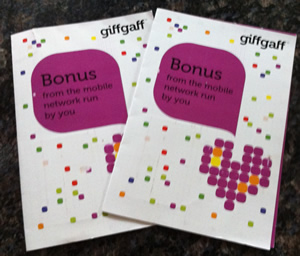
About a week or so after joining, I got these through the post.Giffgaff sim cards

They're Giffgaff sim cards I can give to my friends. When they activate them, they get £5 of free credit and I get £5 of credit on my number too.

It's a brilliant example of referral marketing done well.

They got the timing right: a couple of weeks in, I've had enough time to be sure the network performs well and I get good reception. I can recommend them with confidence. But it's not so long that the novelty and delight at the savings has worn off.

They got the incentive right: they recognised that we're not all purely “what's in it for me” motivated. We like to do good things for our friends. The incentive is £5 for me – but more importantly, £5 free calls for the person I give the sim to. So I don't feel all sleazy for recommending something where only I get the benefit. The person I recommend it to benefits too.

And they made it easy for me to make the recommendation. I don't have to go to a website to order an extra sim. Or fill in all sorts of details. Or wait for it to be delivered. It's there in my hand right now. I just have to give it to the person I'm recommending it to. Easy. And quick.

I just wonder who gets paid the most in Giffgaff. The genius who came up with the referral giveaway. Or the idiot “creative” who came up with the clever-but-useless advert? Sadly, I suspect the latter.

More importantly – what can you learn?

Firstly, when it comes to advertising: don't forget the basics. Focus on benefits not features. And don't fall into the “cleverness” trap.

And for referrals, make it easy for someone to refer you – don't make them do all the hard work. Use Linkedin to identify exactly who you'd like a referral to rather than having them figure it out. Ask for a referral when they're confident in your capabilities and are feeling the benefits of what you've done for them.

And harness altruism, not just self interest. Help them see how the person they'll be referring you to will benefit. Create a free report or gift of some sort they can give from you to the person they refer
you to that will make them feel like they're doing the person a favour, not just recommending someone to them.

And keep an eye out yourself for good and bad marketing to learn from!