Ian Brodie

Ian Brodie


Navigation
AuthorIan Brodie
Ian Brodie

Ian Brodie

https://www.ianbrodie.com

Ian Brodie is the best-selling author of Email Persuasion and the creator of Unsnooze Your Inbox - *the* guide to crafting engaging emails and newsletters that captivate your audience, build authority and generate more sales.

Featured

More Clients Memorandum

I love it when a plan comes together

Posted on March 8th, 2015.

I got news recently that one of my clients had just won a huge contract, beating out some very large competitors.

That's always good to hear and it proves that it really is possible for small firms and sole practitioners to win against big firms; if they get their approach right.

In this case she'd used an in-depth lead magnet to get the attention of the potential client. She'd followed up regularly for a couple of months sharing further useful information.

She'd had a meeting with the potential client too where she ran through the content of her lead magnet and discussed with them how the principles could work for their organisation (rather than trying to sell to them).

The end result was they asked her to work with them rather than choosing the two big consulting firms they'd also been talking to too.

It's hard being a small player. The temptation is to cut your prices and position your self as “as good as the big firms, but cheaper”. But that rarely works.

You may be cheaper than the big firms, but you're perceived as riskier. And lowering your prices adds to that perception.

Going the other way and positioning yourself as having more expertise makes you the less risky option. And you can charge more too.

It starts with having a great lead magnet that establishes your credibility and opens your client's eyes to the challenges they're facing and some of the things they could do to resolve them.

After that, you need to nurture your relationship to build more credibility and trust until they're ready to buy.
Featured

Get Clients Online

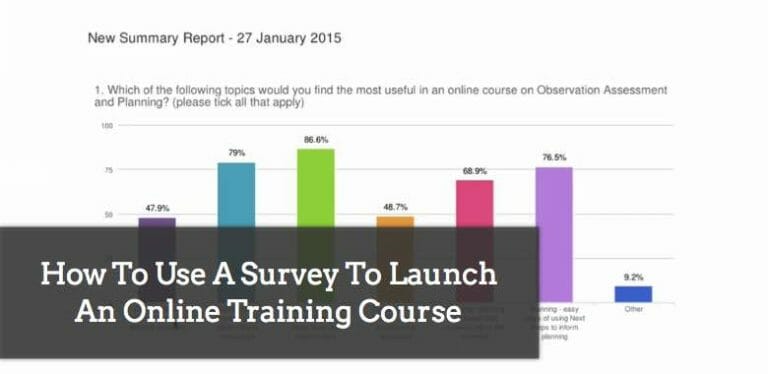
How To Use a Survey to Launch an Online Training Course

Posted on March 4th, 2015.

I've had a bunch of questions in about the details of the survey we used to help launch Kathy's online training course recently.

Quick background: we've wanted to launch an online training course in Kathy's business for ages and a few weeks ago we finally bit the bullet.

But rather than jump straight into developing the course “blind” we decided we wanted to run a paid pilot first to make sure the concept was viable (a strategy Bryan Harris and Danny Iny have both written about).

[Tweet “Never create a training course ‘blind'. Use a paid pilot to prove the concept first”]

And to make sure we got the pilot right, we ran a short survey with Kathy's email subscribers to find out what would be the most valuable things for the course to cover.

End result: the pilot launch was a great success: nearly 25% of the people who completed the survey signed up and paid for the pilot within a couple of days.

Here's how we ran the survey, the questions we asked and the psychology behind them.
 
Click here to see the video »

Featured

More Clients Memorandum

Forgotten strategy delivers stunning results

Posted on March 3rd, 2015.

We've been wanting to launch an online training product in Kathy's business for ages.

Of course, there's always something else to do. But a few weeks ago we bit the bullet.

Rather than develop a course blind, we decided to run a paid pilot first (ie people pay to be on a pilot of the course and get a chance to get personal feedback and shape the course).

So we sent out a survey to Kathy's “small, but lovely” subscriber list and got just over a hundred responses telling us what they wanted to see in the course.

Kathy analysed the results, finalised the agenda for the course, and sent it out with an offer for people to join at a discounted price before the course started.

And you know what? It worked like crazy.

Believe it or not, asking people what they want and then giving it to them actually works!

Within 24 hours half the pilot slots had been claimed and paid for. And the rest went in the next couple of days. We had to close off registration a couple of days early because we were full. 

It's easy these days to get tied up in complicated techniques to tweak your headlines, redesign your landing pages and implement complex marketing funnels.

But sometimes those long forgotten strategies that have worked since time immemorial are worth revisiting.

Ask your clients what they want and give it to them is my tip for the week :)

(Yeah, I know it's oversimplifying. I know that sometimes they don't know what they want. But you know what? Often they do. Ask them).

Featured

More Clients Memorandum

Do you struggle to keep up sometimes?

Posted on March 1st, 2015.

Do you struggle to keep up sometimes?

I know I do.

There's not a week passes by without some new shiny object being proclaimed as the future of marketing or winning clients.

And since I teach marketing (and I'm a pretty extreme Resource Investigator) I just can't resist checking them out.

But when you have clients to support and products to build, you really don't have the time to try every new technique or tool. Let alone actually implement them properly.

And I know from speaking to many people that the constant pace of new things they're forever being told they need to know about can be pretty overwhelming.

I certainly don't have all the answers, but I do a couple of things that help.

Firstly, although I look at a lot of new things, I'm quite slow to change what I use “in anger” in my business. The thing I think you have to bear in mind is that changing some of the core things you do has a huge overhead.

You have to learn the new strategies and tactics. Then there's a bunch of time to put them in place. Then a whole lot of trial and error to get them to work. Then even more time to actually get them to perform at a level better than you were at before.

The end result is that unless the increase in performance is very big, all the gains you get are written off by the transition costs.

So I change my core marketing quite slowly.

Secondly, I've learned how to measure, analyse and test the effectiveness of my marketing.

That means that when something new comes along I start off with a pretty good sense of whether it will work for me, and I can test to see what the reality is.

That means I'm not just blindly implementing every new thing that comes out.

Finally, I've carved out time to test promising new ideas.

That may sound like more work, but it saves me in the long run.

For the last few years, for example, my main source of traffic and subscribers has been through blogging on my own site and other peoples. But after doing some experiments I switched over to focusing on Facebook advertising last year and it's saved me a ton of time.

Controlled experimentation, rather than just dabbling, lets you continuously improve to get better results for less investment of time.

Over the years my own tests have allowed me to get more subscribers and more clients with less investment of my own time to do so.

You can do the same.

Featured

More Clients Memorandum

Reciprocity not all it’s cracked up to be?

Posted on February 25th, 2015.

Ever since Robert Cialdini wrote Influence it's been the go-to book for business owners and marketers wanting to understand the psychology of their customers and the little tweaks they can make to influence them to buy more.

And it's been taught in thousands of courses on marketing.

One of the cornerstones of Influence is the concept of Reciprocity: that if you do something good for someone, they'll do something good for you in return.

There are lots of prominent examples of reciprocity: the waiter giving an extra mint and getting a bigger tip for example.

We've applied it to online marketing too: we give away free stuff in the hope it'll encourage people to buy from us.

But new research published in the Annual Review of Economics last year (in an article entitled Rethinking Reciprocity) has highlighted that the concept might not work quite the way we originally thought.

In particular, it's looking like reciprocity may be a lot less to do with an innate human desire to return favours and more to do with the social pressure to be seen to return favours.

That doesn't make much difference to our waiter: he or she still gets a bigger tip by leaving that extra mint because everyone at the table is a witness to the act and there's social pressure on the tipper.

But for those of us who market online, it's difficult to harness social pressure when our customers are sitting alone in front of a computer screen and no one knows what they're doing.

Now I'm not saying we should abandon all our ideas of reciprocity just based on a small scale laboratory experiment.

But it's worth thinking about.

In particular, if you want reciprocity to work for you online you probably need to make a personal connection. Let the “recipree” (if that's a word) see a photo of you or watch you on video. Connect with them on social media or send a personal email.

Of of course, you could follow my preferred strategy: do good things for people because it's the right thing to do, not because you expect to get a reward some time in the future :)

Featured

Get Clients Online

New data: sell now or nurture?

Posted on February 24th, 2015.

I came a cross an interesting new study yesterday.

It was based on an analysis of 250,000 “sales emails” sent cold by sales reps to potential clients.

Not my area really, but it highlighted something I've been obsessing about for the last 12 months or so.

In the study they found that the best response (in terms of replies) to emails happened for brand new leads.

The second best response was a tie between the remaining leads that were less than a week old and leads that were over a year old. 

The response from leads in between was often less than half that of the extremes of new and old.

Seems strange in a way, until you realise something critical. Your potential clients are not all one homogeneous lump that all behave the same way.

People often argue about whether it's best to try to sell immediately to new prospects or to nurture your relationship with them. The truth is it's not either/or its both/and.

Some new prospects will be ready to buy right away. Probably not something big, but the whole reason they found you, visited your website or signed up for your emails was because they were ready to take action.

These are the ones driving up the response of fresh leads in the report.

On the other hand, many potential clients will be earlier on in their decision process. It will take time to build the credibility and trust needed before they'll be ready to buy. And the level of urgency of their issue will need to grow too.

That's why when it comes to email marketing I say that you can (gently) sell all the time. You never know when someone is ready to buy.

But to make it work you have to lead with value. Give people something great, then show them how they can get more of it by buying from you or hiring you.

That way the people who are ready will consider your offer. The people who aren't ready will appreciate the value you gave them and will be more ready to buy next time.

Don't think either/or when it comes to sales. Think both/and.

Featured

More Clients Memorandum

It ain’t what you do

Posted on February 22nd, 2015.

You know the old saying… “It ain't what you do, it's the way that you do it”.

I've found it's often true.

Earlier this week (by the time this email goes it it may be rather longer than that though) I met up with a bunch of guys with a variety of different businesses.

All successful and growing. But the really interesting thing was that everyone was doing completely different marketing.

One guy was focusing on webinars. Another was doing a lot of guest writing and PR. Another was using google adwords. Yet another was focused on facebook ads. And another was organising live events.

All different strategies.

The common factor: each person had become an expert in their own strategy and was making it work for them.

When we shared ideas and experiences we realised that many of us knew very little about the strategies the others were using.

And that's a good thing. We have businesses to run and clients to serve. No need and no time to learn everything.

But you must master at least one.

Featured

More Clients Memorandum

If he can do it, you can too

Posted on February 18th, 2015.

Kathy and I spent this weekend having a brief stopover in New York before heading to San Diego.

One thing we'd really been looking forward to was a visit to the Guggenheim museum. It didn't disappoint.

In addition to the usual exhibits, they had a fascinating feature on the conceptual artist On Kawara.

It included all of his major pieces, from his date paintings done over 48 years to his “one million years” list of the million years preceding the creation of the idea.

What really caught my attention were his postcards. Over decades he sent a variety of postcards daily to friends round the world all focused on specific ideas. One set listed all the places he'd visited that day. Another the people he'd met.

For one series he sent postcards every day for twelve years listing the time he got up that day.

Now you might argue it takes a very strange mentality and obsessive nature to create works like that.

But what I found interesting was the discipline he applied to send two to three postcards every day for 12 years. It didn't matter what the weather was like, whether he was ill, had others things to do or was travelling the world.

Every day for twelve years he sent those postcards without fail.

I've got to believe that if a conceptual artist can be disciplined enough to send a handful of postcards every day for over a decade then the rest of us  should be able to manage a few emails a week, or phone calls to clients or any other form of follow-up.

Let's be honest, the rewards are more tangible and immediate for us than for an artist.

All it takes is the application of a little discipline and those rewards can be ours.

If he can do it, so can we.

Featured

More Clients Memorandum

Your clients’ reality detector

Posted on February 15th, 2015.

You remember a couple of weeks ago I mentioned the lady who'd emailed me supposedly looking for feedback on something but then pitched a product at me when I gave that feedback?

Here's something else she did badly wrong.

In our first few emails we'd been chatting spontaneously. When it came to her pitch, the whole tone and style of her email changed.

All of a sudden she was using words that didn't sound like her. She was capitalising and using exclamation marks where she hadn't before.

The sentence construction was different. Her whole tone of voice was different.

She'd clearly copied and pasted what she sent me from a standard “best practice” sales email.

And it was obvious.

It really jarred.

I think there's something almost sacred about real human conversation, whether by email or face to face.

We have a reality detector. We know when a conversation is real or when someone is just parroting lines they've been told to say.

You've no doubt felt it when people lob their elevator pitch at you. Or you're talking to them and suddenly they get the inkling you might be a potential customer and their whole tone switches from being interested in you to getting out the great benefits of their product.

It doesn't work. It breaks the spell.

One of the great skills to learn is how to get your point across naturally. To write as if you're speaking to someone. And to speak to them properly rather than regurgitating “best practice” sound bites.

Give it a go next time you introduce yourself for example.

Have in mind what you want to get across (usually who you help and what they get from working with you). But don't use a scripted version with clever “designed to sell” words. Just say it.

I know that sounds strange. But, for example, if someone asked you what your favourite book was and why, you'd be able to answer them and I'm sure you'd give some good reasons that might prompt the person to check out the book.

It would be convincing, but it wouldn't sound canned, because you made it up on the spot based on your genuine liking for the book.

See if you can do the same for your business.

Featured

More Clients Podcast

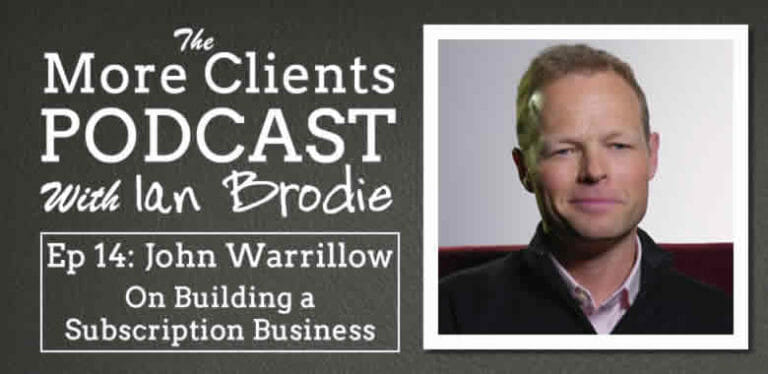
Building a Subscription Business: Interview With John Warrillow

Posted on February 11th, 2015.

I'm sure it won't have escaped your attention that more and more businesses are moving to subscription models.

Whether that's Microsoft and Adobe switching form selling software as one-off purchases to leasing access to their products through Office 365 and Creative Cloud. Or whether it's HP's “Instant Ink” subscription service, the Dollar Shave Club or the myriad of membership programs apeparing in almost every niche.

Subscription businesses are hot property right now.

When John Warrillow wrote the bestselling book “Built to Sell”, one of the critical factors he found that significantly increased the value of a business was whether it had subscription customers. In some cases businesses with recurring revenue through things like maintenance contracts or memberships were valued at up to three times the level of businesses with the same revenues but derived from one-off customers.

It was the importance of subscription revenues on business valuations that drove John to research further and write “The Automatic Customer: Creating a Subscription Business in Any Industry”. In this new book John details nine different business models for subscription businesses along with the steps needed to succeed with each model and the metrics and strategies for building and retaining subscription customers.

In this revealing podcast interview John discusses why subscription models can be so valuable and why they've become so popular today. He shares the subscription models that work best for consultants, coaches and other professional service businesses and the best strategies for attracting and retaining subscription customers.

If you're looking to scale your business beyond 1-1 client work and to build a more reliable revenue base and more valuable business then I highly recommend you listen to this podcast.

Click here to listen to the interview »