Ian Brodie

Ian Brodie


Navigation
AuthorIan Brodie
Ian Brodie

Ian Brodie

https://www.ianbrodie.com

Ian Brodie is the best-selling author of Email Persuasion and the creator of Unsnooze Your Inbox - *the* guide to crafting engaging emails and newsletters that captivate your audience, build authority and generate more sales.

Featured

More Clients Memorandum

New environment = new ideas

Posted on May 10th, 2015.

I like to get out of the house on Sunday. There's something about working from home that makes you go a bit stir-crazy sometimes, so getting out is nice.

And I've found recently that changing my environment can do wonders for productivity.

I spent half a day in a coffee shop and wrote four and a half thousand words on a monster article I'm working on (who knows, it might even turn into a book at some point).

I don't like to take calls when I'm out (seems rather rude to shout away into a phone when people are trying to grab a coffee).

But for thinking, planning and writing it just seems to work well to sit by yourself with a bit of a general buzz going on behind you in a coffee shop.

I even used to do it when I was running big projects as an employed consultant. I'd escape from the office every few days to get some quiet time for thinking and planning. Although I must admit, sometimes I was planning my escape from employment :)

I'd advise you to try to change your environment every now and then. Get out and do some work from a coffee shop. Or sit in a meeting room by yourself for a while.

It can make quite a big difference.

Featured

More Clients Memorandum

3 mistakes most bloggers and emails make with writing

Posted on May 3rd, 2015.

I'm not going to pretend I'm some kind of brilliant writer. But I've had my share of success through emails, blog posts, articles and a best selling book.

So I often get asked to give feedback on other people's writing. Here are some basic mistakes I see made time and time again:

1. Trying too hard to be clever

I can't tell you the number of times I've seen people trying to use clever puns, aliteration, cutesy phrases. Especially in the vital areas of headlines and email subject lines.

It doesn't work.

In marketing you want clarity first. If you can be clear and write something clever or funny at the same time that's great. But very few people can. Instead they write something vaguely humourous that fails to get across the key points.

Focus first on being clear. And in your headlines and subject lines make sure you get across the benefits of what you have to offer.

2. Writing that's too complex

This was my big achilles heel when I started. I'd have big long sentences with complex clauses and multiple commas.

Often the only person who could understand what I'd written was me. And if I read it a day later sometimes even I couldn't decipher what it meant.

It's a particular challenge when you have quite detailed knowledge and you see shades of grey.

You want to caveat everything. Lay out all the different situations and complexities.

But if you confuse all your readers you achieve nothing.

It takes work to simplify your writing yet still get across a complex message. But you have to put in that work.

3. Writing that doesn't go anywhere

A lot of writing just peters out.

The writer makes their main point, then kind of rambles on a bit. Then it just ends.

In almost all marketing-related writing you need a call to action. And I've seen many people fight shy of calls to action.

They don't want to be too pushy. They're hoping people will just spontaneously know what to do and do it.

But they rarely do.

If your article has given a clear reason for taking some action, then ask your readers to take that action.

If it makes sense and it's a fit for them, they will. If it isn't a fit they won't.

Don't make their decisions for them by not giving them the choice.

Of course, now I've said that all good marketing-related writing needs a call to action, I need to have one too.

Normally it would be something suggesting you join the %mctrial% trial of Momentum Club.

But what I really want you to do this week is just pick one piece of your writing. A important blog post or email for example.

Read through it and just tick off where you're trying to be too clever. Where your writing is complex. And mark a big X if you don't have a call to action.

Do this for your next half dozen pieces of writing and I promise you it will improve.

Featured

More Clients TV

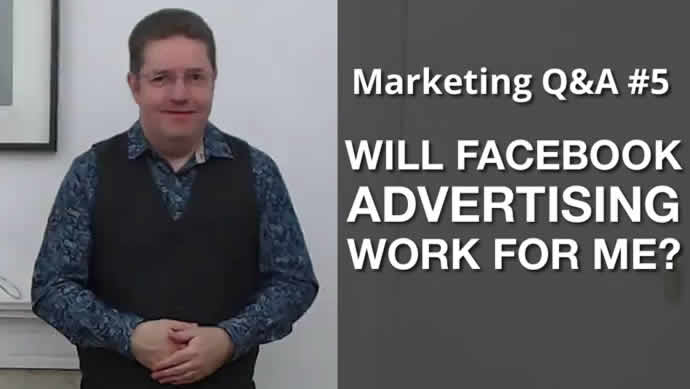
Will Facebook Advertising Work For Me?

Posted on April 28th, 2015.

Hi – welcome to another Marketing Q&A Video.

A slight departure from the norm this week. Rather than answering a question sent in by one person, I'm going to look at a questions that dozens upon dozens of people asked in my recent survey on what you would want in a Facebook Advertising course.

The question in various forms was “will Facebook Advertising work for me?“. So in other words we know Facebook works for consumer oriented businesses, but will it work for b2b? Or if your clients are dentists? Or lawyers? Or senior executives?

The problem is that if you speak to a Facebook evangelist (probably with a course to sell) they'll tell you it works for everyone. And if you speak to a skeptic, they'll say it only works in consumer markets.

Of course, the truth is that Facebook Advertising doesn't work for everyone. Nor is it only good for consumer businesses. It works for very many business to business markets too. But you have to do some digging to figure out if it will work for you.

In this video I show you some simple tools and techniques you can use to see whether Facebook Advertising can reliably work for you.
 
Click here to watch the video »

Featured

Get Clients Online

Which of these will win?

Posted on April 26th, 2015.

I've been testing a new widgety thing on my website..

As you probably know, the main goal of my site is to get people to sign up for these regular emails. That's my best way of being helpful and building a relationship.

So normally I keep things very simple on the site. Just the content, a few links, and various sign up boxes.

No distractions. Nothing much to take people away from signing up.

But on the other hand, you've probably seen those little thumbnails at the bottom of articles on news sites with links to other related articles on the site.

They increase the amount of articles on your site people read, so that increases the opportunities people have to sign up. Although they may choose to read another article instead of signing up.

So which one will get me more signups? Plain and simple with all the focus on signing up. Or getting more articles read and hopefully more signups that way.

Here's another dilemma…

You want people to sign up for a webinar from advertising. Do you promote the webinar directly, or offer some sort of lead magnet to get email subscribers and then promote the webinar to subscribers?

One route is more direct. The other offers instant gratification to subscribers so may well get more people to sign up initially, but they might not then go on to register for the webinar.

Which will win?

Frankly, I have no idea in either case.

I can see the logic on both sides of the argument.

The only way to know is to test.

And you have to do the test for yourself too. You can use other people's results as guidelines and starting points. But in that second example I know people who've tested and got more registrations going directly to the webinar and others who've tested and got more through a lead magnet.

Understanding analytics and testing may be the most important skills when it comes to online marketing.

No matter how talented you are at writing. No matter how great your headlines and calls to action are. Eventually, someone who knows how to test and improve will iterate their way past you.

It's not glamorous, but it's effective.

Learn how to use Google Analytics.

Use a tool like Visual Website Optimizer or Optimizely to test different options like headlines, offers and optin form designs on your website and see which one does best.

Not every test will produce a winner. But over time your results will improve step by step.

And no one will know why, but you.

So no one will be able to get the same results as you :)

Featured

More Clients TV

The Best Tools And Techniques To Create High Quality Marketing Videos

Posted on April 21st, 2015.

Welcome to another Marketing Q&A video.

This week's question is from Rob and it's about the best tools and techniques for making high quality videos quickly for your website.

Short marketing videos can build your relationship with potential clients much faster than perhaps any other online marketing channel. But it's easy to get overwhelmed with the choice of technology and tools available to use.
 
Click here to find out the simple tools you can use to get started easily »

Featured

Get Clients Online

OK, I was wrong

Posted on April 19th, 2015.

I've been doing a bunch of housekeeping on my website this week and I ran across an old blog post from 2008 entitled “Is it just me who hates webinars and video?”

I won't bore you with the details of why, back then, I was having a grumble about video and webinars in particular.

But I was rather pleased to read the first line of the blog post. it read:

“Update: OK. I was wrong”.

We all make mistakes

Or we're right at the time. But times change.

I've noticed it seems to be a strong characteristic of human nature that once we've taken a position we'd much rather stick to our guns and defend it to the hilt than admit we were wrong. Even to ourselves

I'm very subject to that fault, I know. Which I why I was so pleasantly surprised by my public admission of being wrong.

I wonder if there are some things you cling to? Some ideas you won't let go of?

Something you're doing that in your heart of hearts you know isn't producing results, yet you keep doing it because you don't want to admit failure?

The literature of success is filled with stories of people who kept going against all the odds. Who soldiered on when everyone told them that they were making a mistake. That's a heroic story we all like to hear.

But I wonder whether we also ought to be telling more stories of people who realised they were wrong and changed tack. Who listened to sensible feedback. Doesn't sound quite as inspiring. But probably more likely to result in success.

Featured

More Clients TV

The Best Ways to Promote a New Product or Programme

Posted on April 13th, 2015.

Welcome to another Marketing Q&A video.

This week's question is from Lorna and it's about the best ways of promting a new product or programme – especially when you feel uncomfortable approaching individuals or organisations cold.

Getting this right can make a huge difference to the success of a new product launch.
 
Click here for my simple tips on promoting new products »

Featured

More Clients Memorandum

Groundhog day

Posted on April 12th, 2015.

Here's a conversation I have with someone every couple of weeks – not the same person each time of course ;)

Here's how it goes:

Fella: “Ian, what's the fastest way of attracting more clients?”

Ian: “Create something uniquely valuable and give it away to potential clients in exchange for their contact details and permission to keep in touch”.

Fella: “But isn't that a bit old fashioned, isn't everyone doing that?”

Ian: “Are you doing it?”

Fella: “Well, no, but…”

..there then follows a bunch of excuses why he (or she) just can't get round to producing a lead magnet, how it probably wouldn't work in their business, blah blah blah.

For me there's no more powerful method of establishing yourself as an expert in your field, getting your relationship with a potential client off on the right footing, and identifying who's really interested in what you have to offer.

And believe me, most of your competitors don't do this.

And those that do, don't do it all that well.

So do me a favour. No more groundhog days for me. Make sure you have a strong lead magnet in place.

Featured

More Clients Memorandum

Learn from the best

Posted on April 5th, 2015.

Christopher Booker says there are just 7 basic plots in fiction: overcoming the monster, rags to riches, the quest, journey and return, comedy, tragedy and rebirth.

Whether he's exactly right or wrong, its certainly true that the same “formulas” come up time and time again in successful literature.

It's the same for poetry, music and art too. There are certain patterns which are appealing to the human eye, ear and brain.

So if you want to write a bestselling novel or a number one pop song, you stand a better chance of success if it follows one of the successful formulae of previous hits.

That's not to discount creativity. And it's not to say that there aren't plenty of successes that trod a different path. Just that your safest bet is to be creative within a pattern that people find inherently appealing.

I believe it's the same with marketing too.

A friend of mine shared an idea he'd had for a sales letter with me a couple of weeks ago, asking for feedback.

I pointed out that the headline looked and sounded a lot like John Caples' classic ad from 1926, “They laughed when I sat down at the piano…but when I started to play!”

He liked that connection (the Caples letter made millions for the US School of Music) and ran with it. He wrote a brilliant sales letter in that style and it ended up being his most successful promotion ever.

Now his letter is far from a copy of the Caples original. If you read it and didn't know the inspiration you wouldn't pick up any connection.

It's very different. But it has the same kind of feel and cadence. It picks up on the same emotions – the hero doubted at the start proves his detractors wrong.

Marketing that works can be repeated again and again.

David Ogilvy's classic ad for Rolls Royce “At 60 miles an hour the loudest noise in this new Rolls-Royce comes from the electric clock” was actually based on an ad for Pierce-Arrow cars from 30 odd years earlier.

And it's been re-swiped and used by Landrover just recently too.

Martin Conroy's “Two Young Men” advert for the Wall Street Journal that ran from 1975 to 2003 and reputedly generated them over a billion in sales was actually based on an ad from 1919 for the Alexander Hamilton Institute.

Successful marketers – whether they're writing sales letters or emails or blog posts – take their inspiration from “swipe files” of marketing that's worked well in the past.

Marketing that works because it's based on timeless principles of human nature.

Have you got a swipe file?

If you haven't it's time to start building one.

Whenever you see an ad or an email or a web page that works to sell to you take a copy and file it. Ideally make sure the marketing piece is proven to work (Denny Hatch's “Million Dollar Mailings” is a great source for this).

Of course, you must, must, must use these for inspiration and NOT to copy verbatim.

But just reading through classic marketing before you write can have a big impact. And studying them and learning what makes them work is even better.

You might even get your best results ever like my friend.

Featured

More Clients TV

How to Market Using LinkedIn Groups

Posted on March 31st, 2015.

Welcome to the second weekly Marketing Q&A video.

This week's question is from Anna and it's about the best ways of marketing using Linkedin Groups.

There are many active Linkedin groups filled with your potential clients. But can they be used effectively for marketing? Should they? If so, what are the best ways?
 
Find out in today's video by clicking here »