Ian Brodie

Ian Brodie


Navigation
AuthorIan Brodie
Ian Brodie

Ian Brodie

https://www.ianbrodie.com

Ian Brodie is the best-selling author of Email Persuasion and the creator of Unsnooze Your Inbox - *the* guide to crafting engaging emails and newsletters that captivate your audience, build authority and generate more sales.

Featured

More Clients Memorandum

Peter Thiel’s powerful question

Posted on March 12th, 2017.

You might well have heard of Peter Thiel. He was one of the founders of Paypal, was the first outside investor in Facebook and made a bunch of other successful early stage investments.

He has a question he asks of businesses he's thinking of investing in:

“Tell me something that's true, that almost nobody agrees with you on”.

According to Thiel, it tests for originality of thinking and the courage to say something the interviewer might disagree with.

I think it's a great question to ask yourself too. It can really highlight how you're different to your competitors.

What you do can be copied fairly easily. Skills can be developed. But beliefs are deep seated.

What you believe about your your industry, your clients and your competitors sets the frame for how you run your business. It makes you, you.

I spent some time recently thinking about what I believe about marketing that most others in my field don't. Here's what I came up with:

1. I believe that great marketing is simple marketing. It doesn't have to be super complicated and convoluted to work.

2. I believe that ethical marketing can work. That being nice, being generous with your time, giving value in advance instead of holding back can deliver results.

3. I believe you don't have to work 24 hours a day, 7 days a week to be successful. You can fit good marketing into 1 day a week. And you can have a good life outside of business.

4. I believe that giving value in advance and nurturing relationships until people are ready to buy leads to a stronger, more sustainable business that trying to cash in with short term promotions and product launches.

5. I believe you can (and should) build strong personal relationships online through email, video, interactions in groups. Relationship building doesn't have to be face to face.

6. I believe that online marketing offers the biggest opportunity there has ever been for small and solo businesses to win out over large competitors, if they can master it.

There's probably nothing too controversial in there. But taken together it's a different way of doing business to most.

I know many people who don't really believe online works for consulting and coaching. I know many online businesses who focus on launches and affiliate marketing and getting as much cash in to their coffers in as short a time as possible.

And I know far too many people who have given up their social and family lives in the pursuit of business success.

What you believe helps you stand out.

What do you believe that's different?

No need to tell me. Write it down. More importantly, live it.

Featured

More Clients Memorandum

Do you sell to old fogeys like me?

Posted on March 5th, 2017.

I was born the year England won the world cup, so I've been around a bit :)

And while improvements in diet, healthcare and exercise mean that many of us are way more physically active than our parents' generation at this age, one thing that marches inexorably on is the change in our brains.

I'm sure I don't need to tell anyone from their late 40s onwards how annoying it is to constantly have things on the tip of your tongue, but not quite be able to remember them.

Apparently that's caused not by a deterioration in memory per se, but by a decline in our ability to suppress distractions.

So learning #1 when it comes to selling to older people is to keep things simple, clean and uncluttered.

And it turns out our older brains are more emotionally resilient too and able to bounce back better from setbacks.

For me, one of the most interesting findings from recent research into older brains is about what stimulates the amygdala, the area of the brain devoted to primal emotions.

In young brains the amygdala is stimulated by both positive and negative images. But in older brains, the amygdala is only stimulated by positive images. It's like we've learned to screen out negative stimuli.

It's accepted wisdom in marketing that “fear of loss” is a much stronger motivator than “anticipation of gain”. But this recent research suggests that may not be the case for older customers.

That's great with me. The vast majority of my clients and online customers are older. And I absolutely prefer sending out positive messages and focusing on opportunities rather than “twisting the knife” and miring people in their current problems.

How about you?

Do you sell to older people? Have you taken into account that they may react intellectually and emotionally in different ways to younger or middle-aged people?

Worth looking into. 

Featured

More Clients Podcast

[Podcast] Brent Adamson on Winning Business with Commercial Insight

Posted on February 28th, 2017. Brent Adamson on Winning Business with Commercial Insight

Brent Adamson of the CEB is back :)

You may remember my podcast with Brent from a few weeks ago where we looked at his research into the “Challenger Customer” and its implications for selling high-value products and services.

You might also remember that we touched on the concept of “Commercial Insight”. It's perhaps the most effective method for individuals and firms to both differentiate themselves vs competitors and motivate their potential clients to take action.

So I got Brent back for a second interview to dive into more details on Commercial Insight.

In the interview we talk about:

  • What Commercial Insight is.
  • Why traditional “thought leadership” doesn't work and the missing component you need.
  • How to develop your own Commercial Insight for your products and services.
  • How to communicate your Commercial Insight in a way that spurs potential clients to action, rather than causing them to reject or react against your new ideas

Click here to listen to the podcast »

Featured

More Clients Memorandum

Rethinking 80:20

Posted on February 26th, 2017.

Many years ago I wrote an article called “Challenging the 80:20 rule”.

In it I pointed out that the 80:20 rule doesn't always work.

There are plenty of sectors, for example, where 20% of your customers don't make up anywhere near 80% of your sales. Often more like 50% at best in many retail businesses for examples.

Or they make make up 80% of your sales this year, but a different 20% will make up 80% of your sales next year.

I kind of regret writing that article.

Not because it was wrong. It wasn't.

But because I worry that some people, after reading it, might have abandoned the whole idea of 80:20, which is not what I was trying to say.

My point was that you need to be smart in your application of 80:20 and to check it with data rather than blindly assuming it always works.

In my case for example, I definitely don't have an 80:20 rule with my clients. Because right now (as of 2017) most of my focus is on Momentum Club and its members, the most anyone can pay me most of the time is $97 a month. I don't have any “mega clients” who pay me a ton more.

But while I don't have a client 80:20, I absolutely do have a product 80:20. And I have a marketing 80:20. Most of my subscribers and new customers come from a very small number of marketing tactics I use and almost all my customers go through my email marketing process.

That means that I can really focus my time on mastering and using a handful of marketing techniques. And I save a ton of time by not doing the rest.

Do you have an 80:20?

It might not be in your client base, it might be in your activities. Or your products. But there will be one somewhere if you look hard enough.

Find it and you can save a ton of time and get better results by cutting out the stuff that's not high value and doing more of the stuff that is.

Featured

More Clients Memorandum

Do you believe this?

Posted on February 19th, 2017.

It seems to me that there's a kind of “cult of hardship” amongst entrepreneurs.

Many of us seem to glory in how hard we work. Telling everyone on social media how we were up at 5am and got in hours of work before the rest of the world rose.

Many entrepreneurs seem to wear their hard work like a badge of honour. Like you're not really a proper business person if you're not working 18 hours a day and being worn out all the time.

I think that's madness and I just don't believe it.

In my experience, some of the most successful business people live quite normal lives. They're good at working the 80:20 rule and focusing on the big things that bring them the biggest results rather than obsessing over the small things that don't.

They realise that we're in business to have a great life, not to let business become our life.

And they make sure they're enjoying their business too. Working with the clients they enjoy working with, on projects they find stimulating and rewarding.

Easier said than done, of course. You need to be good at generating plenty of leads to be able to pick and choose the right clients for you.

But not impossible.

Not if you put your mind to it

Featured

More Clients Memorandum

This is always worth remembering

Posted on February 12th, 2017.

In the last few weeks I've been talking to a few “normal” people.

By normal I mean people with a 9 to 5 job. Who don't own their own business, or aren't involved in the consultingy, coachy, trainingy type world most of us work in.

Sometimes it's easy to envy people in that position. You go to work, you come home in the evening. You get a pension. Sick pay. Easier to switch off.

In our world it's difficult to switch off. We're either thinking about our own businesses or thinking about our clients' businesses pretty much 100% of the time. There's always something more to be done.

And we don't get any of the perks of an employed person either.

But what I heard from the “9 to 5″ers was boredom. Lack of motivation. No real feeling they were achieving something. Lack of freedom. Lack of control. Politics. Resentment at having to do stuff they didn't particularly want to do.

Sometimes it can feel tough to run your own business or do client-service work. But never forget just how mind-numbing the alternative is.

And never forget the freedom we have to do things we love, with people we enjoy working with, and on things that make a real difference.

And if you run your own business and you're not doing those things – why not? You only live once.

Featured

More Clients Memorandum

Growing your business without losing control

Posted on February 5th, 2017.

Control is important to business owners.

Not just being in charge of the business, the finances, the people. But also being in control in the sense of knowing that your results are predictable.

Unfortunately, that gets trickier and tricker as you try to grow a business.

To grow you usually have to do new things. And doing new things can be very exciting – but unpredictable.

Many people make the mistake of getting over-enamoured with the shiny new things they try in their business. And the whole training, coaching and advice business thrives on telling people they should be doing new things. That's how we make money.

But you should never neglect your core: the thing that's working for you right now.

So when you try new things, only try one new thing at a time. Whether that's a new source of traffic, a new lead magnet, a new email nurture sequence or whatever. Keep everything else the same.

If the new thing works better than your old way of doing things that's great, Swap it in and swap out the old method. Move on to the next thing.

But keep things in control. Don't try out 2 or 3 or 5 new things. You'll have no idea what really works and what doesn't and you'll probably mess up the performance of your core business.

Despite what the gurus might tell you, you don't need to change everything to grow fast. You just need to get one thing working better then iterate.

Featured

More Clients Memorandum

Declutter your marketing

Posted on January 29th, 2017.

Decluttering your life has become rather trendy in the last few years.

Whether you're doing it with the missionary zeal of a Marie Kondo or just having a good old spring clean, there's something rather satisfying about removing clutter and mess from your life.

The same thing works in your marketing too.

Over the years we add layers of complexity to our marketing. We start plugging little gaps and adding contingencies for exceptions than happen once in a blue moon.

Before we realise it, our nice simple marketing system has become a bit of a behemoth.

So just like decluttering your wardrobe or house, it makes sense to take a step back every now and then and audit what you're doing.

Is everything really necessary? Could you cut out various activities and still get pretty much the same results in a lot less time?

I've decluttered my way out of a few products I was selling and supporting in the last few years that weren't really bringing me anything much. And the time that freed up has enabled me to focus more on what I really enjoy doing and what really brings me results.

Make a list of all the things you do in your marketing and cast and “80:20” eye over them. What can you cut down on or stop completely?

It's often more than you think and can make a big difference to your workload. 

Featured

Get Clients Online

How to Get Star Ratings for Your Site in the Google Search Results

Posted on January 25th, 2017. How To Get Star Ratings In The Google Search Listings

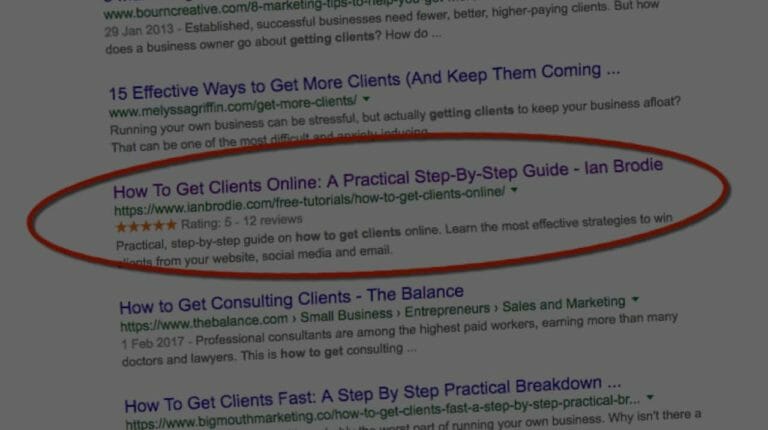
Ever done a Google search and noticed that some sites have star ratings next to their listings, while most don't?

If a site is showing up as 4 or 5-star, it's going to get more clicks than sites with no stars at all. And people visiting the site are going to be going there with a good impression before they even land on the site.

And although Google don't release details of their algorithm, many SEO experts believe that having good star ratings and reviews can help you move up the search results. If nothing else, because people are more likely to click to your site because of the star ratings that higher clickthrough rate will move you up the listings over time.

I've found that since implementing this I've gone up in the search results a couple of places for some of my main page 1 keywords.

As it turns out, despite the fact that hardly any sites have star rating in their search listings, it's pretty easy to make happen. It's fiddly, as you'll see, but relatively easy.

I implemented some simple changes to my site and within 4 days I had star ratings next to my site for searches for my name, and the next day the star ratings were there for other important keyword searches for me as you can see below.

Star Ratings in Search Results

So how do you get star ratings to show up?

Click here to find out how…

Featured

More Clients Memorandum

A surefire way to screw up your marketing

Posted on January 22nd, 2017.

In last Sunday's email I shared with you my “start from scratch” system: the type of marketing I'd do if I was starting my business again.

The essence of that system is simplicity. Focus on one ideal client, start with one source of leads, one lead magnet, one way of nurturing relationships, one method for converting leads in to clients.

Get that working before trying to add in any new tools and techniques, no matter how sexy they look.

But that's not the way most people do marketing. They hear that referrals work best, so they do a bit of that. Then someone tells them they should be on Twitter (or Linkedin or Periscope or…) so they do a bit of that. Then they do a bit of networking. And a bit of email marketing.

All done with good intentions. They spot other people who are succeeding doing these things so they assume they can do them too and get the same results.

But it's a bit like trying to learn to juggle by starting with the 5 flaming clubs, three razor sharp knives and a bowling ball you saw one of the world's top jugglers throwing around on TV.

You don't start by trying to copy what the people who've been doing it for decades are doing now. You start by copying what they did when they started.

With juggling that means throwing one ball and then two until you can do it reliably. Then mastering a basic 3 ball cascade.

With marketing it means focusing on one ideal client, one source of leads, one lead magnet, one way of nurturing relationships, one method for converting leads in to clients.

Start simple until you master it. Then build on it.