Ian Brodie

Ian Brodie


Navigation
Searchtime
Featured

More Clients Memorandum

Do what others aren’t willing to do

Posted on September 22nd, 2013.

If you do what everyone else is doing, you're going to end up with the same mediocre results as everyone else.

Common sense really.

To get exceptional results you have to be willing to do what they're not.

Over the years I've realised that most people aren't willing to:

  • Invest their time in producing outstanding thought leadership to share with potential clients
  • Produce a regular (weekly or more frequent) newsletter to keep in touch to build relationships
  • Master new technologies like webinars or online video
  • Give up their evenings and weekends to build their marketing assets while still working with clients to pay the bills
  • Ask for help when they need it
  • Invest their time in research to develop new, valuable and unique ideas for their clients
  • Partner with people who might be considered competitors
  • Ask clients for referrals and run the risk of them saying no
  • Turn down clients who aren't an ideal fit for them

Just being willing to do a few of these puts you way ahead of most of your competitors.

James O McKinsey, founder of the eponymous consulting firm is reputed to have once hired a room opposite a potential client he was pursuing just so he could bump into them “accidentally” in the corridor.

What are you willing to do that others aren't?

Featured

More Clients Podcast

Winning Clients With Social CRM

Posted on September 17th, 2013.

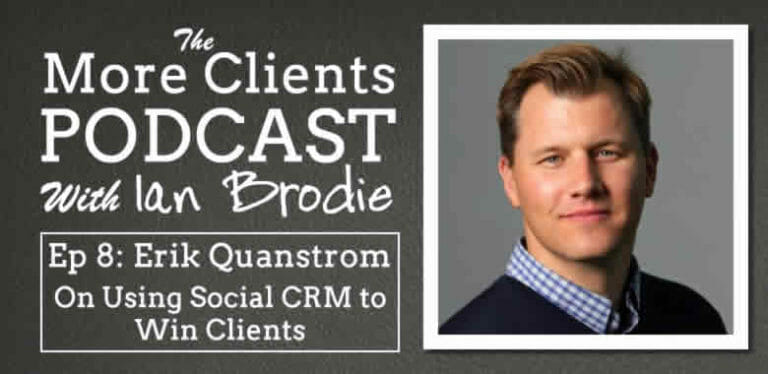
This episode of the More Clients Podcast is an interview with Eric Quanstrom, Chief Marketing Officer of Social CRM vendor Nimble.

Before jumping straight in to the podcast I want to explain a little bit about Social CRM and how we can use it to help us win clients.

CRM or Customer/Client Relationship Management systems have been around for quite a while. They allow you to store client and prospect profiles, log any communications you have with them, plan activities with them and (on some systems) to plan and track specific sales opportunities.

What Social CRM systems do is add in external information from social media.

So in your CRM system you then get to see the latest Linkedin status updates from your contacts or their recent tweets all in one place. And you can interact with them through those channels right from the CRM rather than having to head off to Linkedin or Twitter or email.

On the podcast Eric explains some of the ways people are using Nimble (and of course, other Social CRM systems) but I want to say a little first about one of the big opportunities I see for Social CRM. I call it Social Nurturing (or sometimes, if I'm feeling frisky, Social Stalking).

We all know how important it is to nurture relationships with clients and prospects. You need multiple interactions with people before they'll be ready to buy from you.

But traditionally, it's been quite hard to keep those relationships up. You meet someone at an event. You send them a follow up email. You might send them an article you've written you think they'd be interested in. But what then?

I teach a simple system in Momentum Club that helps you think through what activities to use to add value to your relationships with clients and prospects. And I recently added Social Nurturing into the mix because it can make it much much easier.

The reason is that Social Nurturing bases your nurture activities on what's important to your clients and prospects right now. So rather than trying to guess what they would they be interested in and value and then sending it to them, you use social media to “spy” on them to see what they really are interested in.

Just 5-10 minutes every day or so checking up on what your top prospects and clients are saying on social media can give you a huge amount of insight into them both business-wise and personally.

I experimented with Social Nurturing last year and was surprised at just how much information it's possible to glean by looking at Tweets and status updates.

With one MD of a professional service firm I followed, for example, I quickly identified what his favourite foods and wines were, where he liked to go on holiday, his favourite football team and what he thought about their current form (in quite vivid language), his tastes in music, and some of the big things he was thinking about for his business (because of the articles he tweeted links to).

And we chatted a number of times too. I retweeted some of the articles he was tweeting. He did the same for me. And we exchanged @messages.

I'd met him face to face a couple of times before but this deepened our relationship and gave us something meaty to talk about next time we met. And you can use similar strategies to initiate contact with someone that then leads on to a face to face or telephone conversation.

You can do Social Nurturing the hard way by compiling private Twitter lists and looking at them, then jumping to individual Linkedin profiles (or maybe even Facebook). Or you can do it much quicker by using a Social CRM that brings all the data into one place.

And a new breed of Social CRM starting from scratch and based around these social features like Nimble is growing up.

In this podcast, Eric discusses some of these strategies you can use using a Social CRM system to make your marketing and business development more productive and more effective. He covers both social nurturing and the idea of “social signals” pulling out information from social media data that tells you when you need to be doing something pro-actively with your contacts.

Click here to listen to the interview »

Featured

More Clients Memorandum

A different and powerful way to think about marketing

Posted on September 15th, 2013.

Over the years I've gently changed the way I do my marketing.

What I've come to realise is that “little and often” beats “big and infrequent”.

If we're only communicating with our potential clients quite rarely, then it has to have a huge impact every time.

Not only does that put a ton of pressure on us, not only is it really difficult to market so well that we have a huge impact every time – it can also misfire.

In these cynical times, if your marketing is trying too hard to persuade (because it's the only shot you've got) then your client's defences will go up. They'll feel like they're being sold to and won't trust the message.

But if you're communicating with them frequently, it doesn't have to be perfect every time. And you don't have to have a huge sales pitch in each communication.

For example: since I switched to emailing a few times a week rather than a few times a month it's meant that in each of my emails I can focus on sharing valuable information first, and just including a short message about what I have to sell.

Over time, it adds up and has more impact than when I emailed infrequently and had to put more in each individual email about what I was selling.

I guess it's a bit like learning at the right pace over time, rather than cramming for an exam and forgetting it all a few days later.

The “little and often” philosophy also fits well with the time pressures our clients are under. Thinking of emails again, a huge monthly email is likely to get filed to be read later (and then never read). A shorter email every few days can be quickly read when it comes in.

Little and often isn't just about email. It works for networking, giving presentations, appearing in the press.

It's easier to do. And it has more impact. As long as you can be systematic about it and keep it up.

Featured

Get Clients Online

Wide Boys in Coffee Shops (and Why You Should Get Yourself a Decent Marketing Education)

Posted on September 12th, 2013.

delboyI was doing one of my favourite things in the world yesterday: grabbing a coffee and reading on my iPad (in this case, Guy Kawasaki's book on book publishing: APE). This time my rather pleasant afternoon was interrupted by a conversation at a nearby table that I just couldn't help listening into.

“Don't worry, leave all that stuff to us. Barry'll build you two or three backlinks every day and that'll get you up to the top of Google sharpish. And we'll knock out a blog post or two for you every week. No hassle. You don't have to worry about any of that”.

To someone with a basic understanding of how Google works and how these days it's got pretty darned good at ignoring (and penalising) artificial link building that sounds like a recipe for disaster.

And when you understand that the real value of blog posts isn't about churning out mindless drivel so that you've “got some content” on your site, but instead can be the very best way of establishing your expertise and authority in your marketing; then your heart just sinks when you hear about someone “knocking out a blog post”.

But unfortunately, the man and two women listening seemed to lap it up. I guess it sounded like their prayers had been answered. Winning clients online seems complicated and the rules seem to change all the time. How wonderful for this nice man to say he can do it all for us and get us tons of website visitors and customers.

Of course, a few months later and a few hundreds if not thousands of pounds lighter, they might be thinking something different.

That's why it's so important as a professional or business owner to get yourself a basic grounding in effective marketing. Both online and offline. Outsourcing all that stuff sounds great, but unfortunately the marketing world is full of wide boys who'll promise you the earth and bamboozle you with sensible sounding jargon. But who really don't have a clue what they're doing.

Your only weapon is education. Even if you're not going to be doing any of this stuff yourself, make sure you know how it should be done so you can spot these cowboys and steer clear of them.

———-
Image by Edmond Wells

Featured

Marketing

Myths and ‘mythconceptions’ about getting published

Posted on September 2nd, 2013.

Caroline TalbottToday's blog post is by Caroline Talbott, leadership coach, author, and long time reader of this blog! Caroline's book Essential Career Transition Coaching Skills was recently published by Routledge.. Over to you Caroline…

We’ve all been told (not least by Ian!) – get yourself known, become a Visible Expert, an ‘Authority’. And we all know that writing a book is a fantastic way to do that – but where do you start?

Here’s the story of how I got mine into print – I hope it’s helpful to you in doing the same.

Myth number 1: Finding a publisher is difficult.
Not so in my case – it was about using my network, demonstrating my credibility, taking advice – and persistence.

My book came about when I saw a post in a professional coaching forum from a fellow member who is the Editor of a coaching book series – she was asking for ideas for new titles, I made some suggestions and one of them she liked. I took her advice about how to write the proposal and a sample chapter – she liked that too, and so did the publisher – eventually. It took a lot of waiting, chasing and a little bit of re-positioning. But getting the contract in my hand was a major moment!

So the best tip I can give you is: find someone, using your network, who has a need for what you want to write about (as with any product or service) rather than writing something and THEN trying to find a need…

Myth number 2: Writing a book is hard
I must say this is the part I loved! The following are my tips for how I got into the flow and made this enjoyable.

Content: If you choose a subject you are really an authority on you will know what you want to say – and you will move in circles with other experts who have different but equally valid takes on the subject. Tap into their ideas and feature them in the book – you’ll then have a range of interesting perspectives. And also a host of people with a network for promoting your book!

Find your voice: Don’t try and write in some fancy, artificial way that’s not you. Writing a blog is a great way to start and to practice with short pieces – and you get feedback.

Just put yourself out there: There’s also nothing quite like a blog to give you the courage to write down your stuff. I remember the trepidation when I pushed the button to publish my first blog post – and then the adrenalin rush when I saw it on the Internet. You know what you’re talking about so don’t spend hours agonising over “Will other people agree?”. As I’ve learnt from Ian, no one can please everyone and the people who are attracted to you are the ones who will want to read your book and work with you. Take the attitude ‘It’s my book and if I say that’s right – it’s right!’

Getting down to it: Set aside time every day to write (or everyday that it’s physically possible). Our minds are freshest and most creative in the morning so just get up, start writing. Great excuse to hang around in your dressing gown! Begin by writing as a stream of consciousness and then critique it afterwards.

Myth number 3: You’ll be asked to do endless rewrites
Not so. After I’d written each chapter I asked fellow coaches to peer review my work. I owed a lot of coffees/lunches etc afterwards but most said how much they enjoyed reading it. The upshot was that there was nothing I had to rewrite, just a few suggestions that were left up to me to use if I wanted to.

Myth number 4: Once it’s written your work is done
No, definitely not. The publishers employ a very helpful band of copy editors, proof checkers, co-ordinators etc etc who support you in getting the manuscript ready for printing. But you still need to do a lot of checking yourself to ensure that it’s exactly as YOU intended. I have to say most of this is still something of a mystery to me – and that’s one of the benefits of using a publisher – because if you self publish you have to do all this yourself. And it’s not easy when you have 60,000 words to contend with!

Does all this take a long time? Yes. I was given a year to write my book and then it took almost another year to get it on to the shelves. But it sure is worth it when you get your own printed book in your hand and see it on Amazon, and then read the 5 star reviews!

What would I do differently? I think the one thing I would change is that I would have put less content into this first book. I could then have got it out there faster – and would have more material for a sequel!

So what are you waiting for? The most difficult step is the first one so plan your strategy and get started – there’s no time like now. Why not you, why not now? If not now, then when?

With over 30 years experience in business, Caroline Talbott develops leaders and their organisations through executive coaching, leadership and Organisation Development and change consultancy, and. She is the author of ‘Essential Career Transition Coaching Skills’.

You can connect with Caroline at the Professionals in Leadership blog, on her website Caroline Talbott – catalyst for change or via twitter as @CaroCatalyst

Featured

More Clients Memorandum

Curing yourself of hot lead syndrome

Posted on September 1st, 2013.

One of the worst diseases you can have in marketing is “hot lead syndrome”. Constantly looking for and chasing potential clients who need what it is you have right now.

It sounds rather innocent. What could be wrong with trying to find people who are ready to buy right now? Cuts out all that faffing around waiting until the time is right.

The trouble is, when what you sell is a valuable professional service, you need to build up a high degree of trust and credibility with potential clients before they'll be ready to hire you.

And that doesn't happen overnight.

A hot lead may be ready to buy right now, but 99% of the time they won't be ready to buy from you if you haven't built that relationship with them.

Hot lead syndrome sees you hopping from prospect to prospect, losing out the vast majority of the time to service providers who've invested in nurturing relationships.

It's a losing game.

Instead, identify who your ideal clients are and catch them earlier when they're first exploring their problems or establishing their goals and aspirations.

Build credibility by helping them get clear on where they should be headed and giving them insights on what they should be focused on to get there.

Keep in touch, regularly adding value as they get closer to making a decision.

Then when they finally become a “hot lead”, you'll be the person they turn to.

It takes courage to invest in building relationships like this. Confidence that it will pay off. And the strength to hold off from desperately chasing hot leads.

But it's far, far more effective.

Featured

Marketing

How To Market Without Using Hype

Posted on August 27th, 2013. Don't Believe The Hype

There used to be a time when over the top marketing hype was restricted to get rich quick schemes and the like. But these days it seems to have infiltrated almost every sector.

In my own field there now seem to be daily offers and webinars that promise to teach you how to get floods of clients without selling, make millions in passive income just by knocking up an ebook or online training course, or to make six figures from group coaching just by holding a few webinars and running some Facebook ads.

Of course, none of it works. Or more accurately, it doesn't work for 99% of people who try it. The truth behind these extravagant claims is usually that…

Click here to find out how to beat hypey marketers >>

Featured

More Clients Memorandum

Why copycat marketing is the first step on the road to ruin

Posted on August 25th, 2013.

What's the first thing most people do when they start to work on their marketing?

Usually it's to look at their competitors.

If it works for them, it'll work for me, right?

They go to business breakfasts and chamber of commerce events? So should I.

Their website has lots of nice images and a clever slider thingy? So should mine.

They have a social media manager posting on Twitter and Facebook all the time? You get the picture…

The trouble with this is twofold.

Firstly, of course, the chances are it's not working for them. Most professional businesses are woeful at marketing and just stumble through more by luck than design.

And secondly, even if it does work for them, just doing the same sort of marketing isn't going to work for you.

Here's the thing. Your clients often have very little to judge you and your services on in advance of working with you. So they go by what they can see.

If your marketing is no different to your competitors, what are they going to think about your services?

Unfortunately, they're going to infer that your services are no different to your competitors either.

Being conservative with your marketing, just copying what others are doing: far from being the safe route, it's a surefire step on the road to ruin.

Don't do it.

I'm sure you wouldn't, of course. So maybe pass this message on to someone weaker-willed who might ;)

Featured

More Clients Memorandum

Stop chasing…really

Posted on August 18th, 2013.

Have you ever watched one of those romantic comedies where the hero or heroine spends the entire movie chasing after unrequited love, only to discover their true love was right under their nose all the time?

You know the ones. They send them gifts. They do them favours. They put their jobs or reputations on the line for them yet they get nothing back.

A bit clichéd really. And in the real world, sensible people don't really chase potential lovers quite so desperately unless they get some form of reciprocation. Some sign the other person is really interested. Some commitment and action from them too.

But in the world of marketing and selling, we often do chase desperately after potential clients who've shown no real interest in us. And just like the movies, the more we keep chasing the less interested they get.

It rarely turns out well.

Chasing clients. Nagging them to see if they've looked at your proposal. Calling and emailing again and again to see if they'll have a meeting with you.

It's all much more likely to push clients away than to bring them towards you.

No one likes being chased. It makes you feel guilty. And it makes the person doing the chasing look desperate.

And even if you do manage to land the client, it starts your relationship off on absolutely the wrong foot. You're supposed to be an equal partner. A trusted advisor. Not a needy, clingy puppy.

Why do we end up in chase mode?

Desperation I think. If we've only got a handful of leads in our pipeline then we need to land every one we can. So we chase after lost causes. We push potential clients harder than we should because we need something to happen now.

The answer?

Not sales training. Not getting better at closing.

The answer is to have more leads. To not be reliant on that potential client you feel you have to chase.

When you're confident there are genuinely “plenty more fish in the sea” (or plenty more leads in your pipeline) you can let that client who's not responding move on and focus your energy on something more productive.

And the confidence you get will make you better at selling too.

So stop chasing. Start generating more leads.

Featured

More Clients Memorandum

Here’s where I screwed up

Posted on August 4th, 2013.

About five years ago I took on a client I knew I shouldn't have.

You know how it goes. The negotiations get a bit painful. They seem to be a bit too interested in what happens if things don't go well rather than in discussing how to make sure they do go well.

You just don't get the feeling that they're going to be easy to deal with.

But in the end, they offered a deal with a big upside so against my better judgement I agreed to take on the project.

It went fine at first. But the more time went by, the more difficult it became to get hold of their senior executives. Despite the fact that the success of the plan we were developing was hugely dependent on the leadership of their senior team.

As time went by, actions were left undone, important conference calls just never happened.

Everything kind of fizzled out.

And, of course, the big upside that made the deal look attractive never materialised.

Over the years I've often thought about that project.

I used to think of all the things I could have done to make it work. I could have been more insistent on getting their time. Forced the issue when I saw that it wasn't going to work. Maybe even come up with a strategy that was less reliant on the senior team to make it work.

But eventually, I came to realise that by far the easiest solution would have been simply to avoid the project in the first place.

Projects and clients like this are a huge drain on your time and energy. They distract you from what's important. Cause you to question yourself.

Even if the money looks good, they're NEVER worth it.

Don't screw up like I did. If something feels wrong with a client or project, walk away.

Invest your time and effort in finding clients that are going to be great to work with. Who are going to energise you rather than drain you.

You can use the practical, client-winning strategies I share in Momentum Club.

Or you can develop your own approaches to generating enough leads that you don't have to say yes to every potential client.

Whatever route you go down, save yourself a lot of time, energy and heartache by working only with clients who are perfect for you.