Featured
Posted by Ian Brodie on July 23rd, 2014.
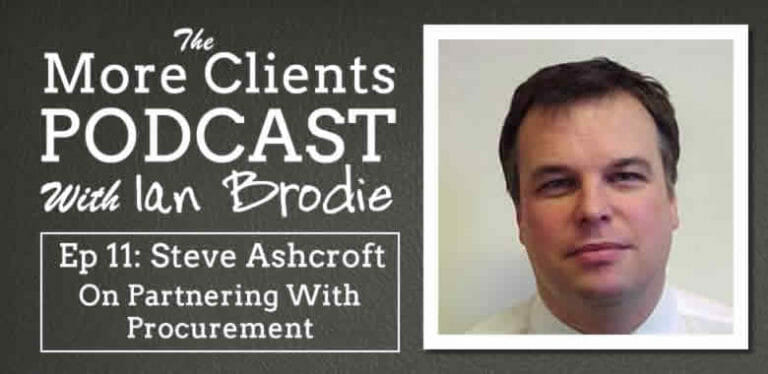
If you're selling your services to corporates or even mid-sized companies, chances are you'll bump into procurement.
You may need to submit proposals, take part in formal tender processes, get onto the approved supplier list, or just have them OK your letter of engagement.
And you've probably discovered that sometimes working with client's procurement teams isn't easy.
Sometimes it feels like their only goal is to drive down your price. Or keep small suppliers like you out of the equation.
In this podcast I interview procurement expert Stephen Ashcroft. Steve's worked with procurement teams in 33 of the UK's largest private companies and some of the biggest public sector organisations to help them improve the way they buy. And he's increasingly working with professional service firms to help them improve their relationships with clients' procurement teams.
In the interview Steve shares what procurement are really focused on, how small firms can differentiate themselves against larger competitors, and the best ways of working with procurement to make sure you “stay in the game”.
Click here to listen to the interview »
Featured
Posted byIan Brodie on July 20th, 2014.
I've just watched an excellent TED video from “Undercover Economist” Tim Harford.
In the video Harford tells the story of Archie Cochrane, a Scottish doctor, who while being held in a prisoner of war camp managed to figure out how to cure the prisoners of a mystery ailment (which he was suffering from himself) using a makeshift “split test”.
Later on after the war he challenged the medical establishment over the most effective post-operative treatment for heart patients. Again, using a simple test of the two different approaches to prove his case.
Harford uses the example (and others) to warn us against overconfidence in our ability to engineer solutions to complex problems and show that trial and error is most often the best route to a successful answer. You can watch the video here for more details.
The exact same thing is true in winning clients.
It's nice to think that someone out there can just hand us the answers to make our marketing work perfectly. But the truth is that what works in one business may well not work in another. Even if on the surface they look very similar.
So you need to use “best practices” as sources of inspiration to then test out, rather than taking them as the definitive answer to what your business needs.
I recently ran a test on my signup forms that resulted in a 59.3% improvement in optin rates. In other words for the same amount of traffic to my home page I'm now getting nearly 60% more optins.
And you can test things in the “real world” too, not just online.
Many people seem to be in a constant search for the perfect “elevator pitch” or introduction. They read one piece of advice and change their own introduction. Then they read another recommendation or “magic formula” and change it again.
But until they test it, they'll never know which format really works best or whether it makes any difference at all.
What they could do is try introducing themselves in one way at one set of events and another way at another. And keeping track of who got which introduction. Then measure how many follow-up calls or meetings they got from each introduction.
Not 100% scientific as there are many other variables. But do it enough times and keep good records and you'll begin to develop a decent picture of what works best for you.
Not all your tests will work, of course. I'm currently testing different text on the button on my website forms. The one I thought would perform best is currently getting 74.8% fewer optins than the control. But at least I now know not to switch to it, which I would have done if I'd just listened to others and gone based on my instinct.
What are you testing right now in your business. If you're not testing, you're not improving.
Featured
Posted byIan Brodie on July 6th, 2014.
You've probably heard the “only handle it once” principle in productivity where you should strive to only handle paperwork or emails one time and deal with them fully rather than keep returning to them and doing a crappy job each time.
I've found a similar principle to apply to a lot of marketing too. I like to call it the “Work Hard Once” principle (a phrase I first heard from Taki Moore).
I was reminded of the principle when I ran a webinar for recently on follow-up systems. Follow-up is a great example of “Work Hard Once”.
What normally happens with follow-up is we meet someone (or we send them a proposal or they become a client or any number of situations then need follow-up). We know we should be following up. After all, the majority of sales takes multiple contacts before your potential client will be ready to buy.
But more often than not we try to “wing it” with follow-up.
We have the meeting and the next day we think “what should I do to follow-up?”. And we shoot off an email or something.
Then if we're lucky, a couple of weeks later we remember the meeting and realise we've not heard back. So we try to think of something else we can do to keep in touch. If we're pushed for time, we often end up with another email saying “just checking up” or “have you made a decision yet?”.
Hardly the kind of inspiring follow-up that will build credibility and strengthen our relationship.
The problem is that we're trying to do important stuff like this on the fly when we're busy. So we do a half-arsed job of it.
It's inevitable when we're under pressure. No one does their best creative thinking when they're pushed for time.
What we need to do is have the strength to take time out every now and then to do our important thinking. To “work hard once” on creating a template or process that we can then tweak and re-use again and again later.
In this case we should brainstorm the different situations where we're likely to need to follow-up and then create some decent templates (emails, ideas for phone calls or letters or other things to do) that we can reuse with minor tailoring every time we get into those situations.
Work hard once to come up with a great template, then use it time and time again. Rather than reinventing the wheel (badly) every time.
What are the marketing tasks you do again and again that would benefit from taking time out and creating templates for so that you do them brilliantly every time without having to constantly rethink everything?
Work hard once on these and you'll be repaid many times over.
Featured
Posted byIan Brodie on June 29th, 2014.
We're most of us in the business of change.
Maybe you're a coach or consultant who works directly with clients helping them change and improve. Or maybe you provide advice or services to clients that they then use to make a change themselves.
Either way, like me, you probably spend a bunch of time advising your clients to change (and lamenting it if they don't). After all, it's the only way they'll make improvements and achieve their goals.
Of course, when it comes to ourselves it's a different story.
We set ourselves ambitious goals, but often we don't change the “system” we use to get them.
For us, our “system” is what we're doing day-in, day-out, week-in, week-out.
If we do the same things we did last year, our results will be a lot like last year. And the year before.
If we want different results, we've got to do different things.
For the first few years of running my own business I got better results simply by getting better at what I did and doing more of the same. But eventually you hit a plateau. It felt to me for a year or so like I was just spinning my wheels.
So for the last few years I've been making significant changes every year.
I started focusing more on my online courses to get more scale. I put the prices of my 1-1 work up. And I started emailing more frequently.
Some of that was uncomfortable. Some of it required me to learn new skills so I invested in courses and spent some time talking to people I thought had mastered what I wanted to learn.
And some of it required some late nights working on course material and content long after everyone else was tucked up in bed or watching TV.
I must admit, I went down a couple of blind alleys with some of the things I tried. But most of it worked. And it worked well enough to make a significant difference to my business.
We all advise our clients to change. So how much are you prepared to change yourself? How much are you prepared to invest in your own future?
I can't guarantee that what you try will work 100%. But I can guarantee that if you don't do anything different, you won't get any different results.
Featured
Posted byIan Brodie on June 23rd, 2014.

A lot of focus gets put in Email Marketing on subject lines.
After all, if no one opens your email, no one is going to take action or buy.
But after opening it, if they then don't read it or they scan it and just close it without properly reading; it's the same end result. No action and no sales.
And frankly, making your emails readable is something even marketing experts screw up regularly as we'll see in a few moments.
Click here to discover the 3 big mistakes and how to fix them »
Featured
Posted byIan Brodie on June 18th, 2014.

Love them or hate them, for many businesses competitive bids are unavoidable.
You know the ones. You have to send in a proposal, present your plan to a gathering of the great and good. Answer a bunch of tricky questions.
Here's my experience:
You don't win by doing great proposals. You don't even win by doing great presentations.
You can lose by having a rubbish proposal and a rubbish presentation of course. And you can edge ahead when it's neck and neck. But it's unlikely that a brilliant proposal and presentation will snatch victory from the jaws of defeat.
You win in these competitive situations by going in ahead.
Having the odds stacked in your favour before the process starts.
Click here to find out how »
Featured
Posted byIan Brodie on June 1st, 2014.
You've probably heard that old saying before: “A bird in the hand is worth two in the bush”.
Or as Hugh Rhodes originally wrote in The Boke of Nurture or Schoole of Good Maners in 1530, “A byrd in hand – is worth ten flye at large.”
And while it's true in most cases that it's better to focus on something you have with certainty rather than chasing things that might not come off, there are some important cases in marketing where the rule absolutely doesn't apply.
One of the questions I get asked most often by clients and subscribers is how I follow up on prospects that have gone quiet.
My answer usually surprises them: I don't. Not really.
I'll send one thing of value related to our discussion. Then one “seems like priorities have changed, call me if you want to progress” message.
And, of course, if they're email subscribers they'll get regular emails from me.
But I won't chase.
Over the years I've found chasing to be a huge pain with very little payoff. Sometimes it works. But overall you're much better devoting your energies to finding more prospects who are motivated to get going. Who get back to you on time.
So in this case, a bird in the hand definitely isn't better than two in the bush. Especially if the bird in your hand is dead. (Or to pre-empt the Monty Python references, if it's stunned or pining for the fjords).
“Now that's all well and good Ian” you might be thinking. “But that only works if you've got plenty of other prospects to work with”.
And that's absolutely true. If that prospect who didn't get back to you is the only one you've spoken to for months then you're kinda stuck. You have no option other than to desperately chase.
That's one of the reasons why being able to generate a steady flow of leads for your business is so vital.
It eliminates the peaks and troughs from your business. Allows you to select the very best prospects to work with. And means you never have to chase.
Featured
Posted byIan Brodie on May 25th, 2014.
I spent some time with a friend this week who is a world-class business developer “offline” but who hasn't managed to make an impact online (despite spending a small fortune trying to do so).
He's got some brilliant online courses too. More than just the usual slides and audio, but live training with exercises, online quizzes, all sorts.
He just hasn't sold many of them.
The problem is that he's a bit of a “seat of the pants” person.
He's great live. Huge personality, loads of people love him. And because he's smart and hardworking he make time to follow up with key prospects.
But he's not a great systems guy. He thinks in terms of presentations and meetings and calls. Each one is a one-off event.
What he doesn't do is think of the big picture. How leads flow into a pool of prospects you then nurture and make offers to. And how you can tweak each stage to get more leads, more conversion into prospects, more conversion into clients.
Over the years my business has become more and more online focused and I think it's this ability to think in systems terms rather than seeing everything as a one-off event that has stood me in good stead.
Not that I'd say I'm a natural. It took a long time with a whiteboard and pen (and most importantly a whiteboard eraser) to figure out and simplify how the pieces fit together best.
Featured
Posted byIan Brodie on April 20th, 2014.
Have you ever had a moment where you've said something and as you're saying it you kind of can't believe what you're saying?
I was talking to some new friends this weekend about some of our experiences and how our lives have changed over time. I was telling the story of how I used to leave the house in a taxi at 5.30am on Monday morning to fly out to wherever I happened to be working that week and then return on a Friday.
And especially about how travel turned from being glamorous to being a burden. How every Monday morning I'd find myself thinking “why am I doing this?”.
I did the “fly out on a Monday” thing as a consultant for about 13 years. And for about six or so of them I'd be thinking “why am I doing this?”
As I explained this it dawned on me that it had taken rather a long time for me to go from realising I wasn't enjoying it to actually doing something about it. Over six years. Wow.
Some of the work I do with clients these days gives them a new perspective on their marketing. Shows them things they just hadn't thought of before.
But often, just like me on a Monday morning, they already know they need something different. Sometimes they even know what that different thing is.
But when you've done something for a long, long time it becomes part of you. It's just what you do. It's easy. You know how to do it.
Even though you don't like it, or it's not really getting you the results you need, it's a lot less scary than something completely new that might not work at all. Or might make you look silly.
It took over six years (and a lot of encouragement from Kathy) for me to get the courage to give up the certain income that came with the travel and do what I really wanted to do.
Don't let it take you that long to try something new in your marketing.
You don't have to change everything. But pick one thing you don't think is working well and drop it for a few months and do something else instead. Stop networking, start speaking. Stop twitter, start blogging. Or vice versa.
If it works, keep doing it. If it doesn't, try something else.
Not rocket science. Obvious on paper. Trickier to do in real life. Hence the six years.
Don't you waste six years, or even six months.
Featured
Posted byIan Brodie on April 13th, 2014.
You may remember I had a bit of a rant recently about people (myself included) who use that terrible excuse of “I haven't got the time for marketing” or “I haven't got the time to learn how to do it properly”.
Well, since you're still with me I'm assuming you're one of the sensible folks who does prioritise marketing – even if it means working that bit harder for a while.
So now I'm going to give you something extra to slot into that priority time. It's pretty simple but it can get you big results.
What I want you do do is make a list of 3 people.
Not just any people. One person in each of the following criteria:
- One old contacts you did great work with but have got out of touch with
- One current contact who has the potential to become a great client or business partner for you
- One current contact who is kind of just starting out, but could get a great boost from some free help from you
Do it now. Don't wait. Just get out a pen and paper and make some notes. Should only take you a few minutes.
Now for each of the names on the list, write down something you could send them that they'd really value and find useful. I'm thinking here about articles or videos you could send a link to, maybe a book you could post to them. Or an event you could take them to.
If you don't know what it might be specifically yet, just write down the sort of thing you'd like to send them. You can search for something that fits the bill later.
Now during the next week: do that useful thing for them. Do it first thing in the morning when you get to work. One per day on any three of your working days.
Here's what you're going to learn when you do it.
Firstly, it's surprising just how many of them will really appreciate hearing from you. Especially since you'll have put a bit of thought into finding something useful to send them. This will give you a bit more confidence to contact people in the future.
Secondly, you'll be surprised at how easy it is. Just block off a few minutes of time and shoot them an email or pop something in the post. Or maybe even phone them.
Finally, you'll be pleased with the results. Out of 3 re-energised contacts during the week it's a racing certainty that at least one will do something to help you back.
See where you get to by the end of the week. If it feels like you've been able to manage it within your workload then do it again next week. And the week after.
Pretty soon you'll have become a “follow-up machine”. With results to match.
 Ian Brodie on July 23rd, 2014.