Featured
Posted by Ian Brodie on January 6th, 2015.
At the start of every year I like to set out the big themes I'll be focusing on during the year, and I share those themes in the hope that you'll find them useful in some way.
In 2015 my big overarching theme is Market Leadership. As I'm sure you can guess, future blog posts, emails and video will focus on some of the practical details on how to achieve market leadership in your market.
This first video of 2015 looks at the first of three big strategies I believe work the best to achieve market leadership for service and information based businesses: Thought Leadership.
You can catch the next two videos on Relationship Leadership here and on Marketing Leadership here.
Click here to watch the video »
Featured
Posted byIan Brodie on January 4th, 2015.
I realised today that it's been something like 3 or 4 years now since I actually made an outbound call to a potential client. Either warm or cold.
And as you probably know, I'm a great believer in not chasing, After a potential client has called me and we've spoken, I drop them a couple of follow up emails. But if they don't bite, I let it go and just continue with my regular value-added email follow up.
Now I'm absolutely certain that I could have won a bunch more business if I'd been more aggressive about outbound calling and chasing.
But you know what? I'm doing pretty well without needing to do all that.
I don't enjoy it, and one of the big advantages of having a lot of inbound leads is that I just don't need to do it.
In business, you sometimes have to go outside your comfort zone. Push yourself to do what's right and what's needed even if you don't personally enjoy it.
But how long can you keep that up?
Not very long I reckon.
One of the things about having your own business is you can shape it around what you want to do. If you're not enjoying your business, you might as well have a job really.
And the thing I've found that gives the most control and the most options is to have a steady flow of leads coming in to your business.
With a steady flow of leads (and a decent nurture system like email marketing) you can pick and choose who you work with and what you do.
If you find you're working with people you don't really want to work with, or on projects or topics you're not enjoying as much as you could my advice is that rather than trying to “fix” those relationships and projects, you should focus on bringing a lot more leads into your pipeline.
That way you can choose to work on the things you find the most fulfilling. With the people you enjoy working with. You get freedom.
Featured
Posted byIan Brodie on December 14th, 2014.
People talk a lot about being “authentic” these days, don't they?
I heard an unusual interview recently that changed the way I thought about it.
It was with Mark Ellen, a music journalist who worked on the NME in the 70s and who later edited various magazines and was one of the anchors at Live Aid.
He described a recent experience he'd had “interviewing” Lady Gaga.
What actually happened is that she and her huge entourage quizzed him to make sure he was the “right person” to do the interview and that the image presented to the world would be exactly the image they wanted to portray.
He contrasted that with when he'd interviewed Sting. This was back in the early 80s on the back of The Police's fourth number-one hit. They were the biggest band in the world, and Ellen had an interview with their lead singer.
The interview was in the house Sting had just bought in London. Ellen knocked on the door at the allotted time and Sting opened it himself. Inside, Sting was alone with only his young son to keep him company.
Ellen interviewed Sting without minders, PR men and spin doctors. He asked the questions he wanted to ask and which his readers would be interested in. And Sting answered candidly.
That was just the way they did things back then. It wasn't all about image and control.
I've previously lauded Lady Gaga for the way she interacts with her fans on social media. But although that kind of controlled interaction and managed image seems to work for many, I think a lot of us these days look for something more.
I suspect many of our clients do too.
At the risk of using what I think is becoming a cliché, they're often looking for authenticity.
Authenticity is different things to different people.
Personally I don't much go in for videos done in the back yard with your family. Or carefully scripted “outtakes”. Or telling everyone about your difficult childhood or your “rags to riches” story.
It all feels too pre-written and designed deliberately to create a certain impression. It's all still about image and control.
I like the kind of authenticity Sting showed. Here I am. What do you want to know? Here's what I really think.
I hope to be able to live up to that myself on occasions.
Featured
Posted byIan Brodie on December 7th, 2014.
I heard an interesting comment recently. One I COMPLETELY disagree with.
The comment was from someone who said they didn't like to put structure and systems into their business because it stifled spontaneity.
And that since we lived in a “dynamic and ever changing world” our client's environment and organisations apparently change daily and so being structured ties us down too much and stops us responding dynamically.
Bobbins.
Those are the words of someone who's ill-disciplined and is looking for excuses.
Now I'm pretty ill-disciplined myself, but at least I recognise it and am trying to do something about it.
We may live in a dynamic world, but our clients don't change everything in their business on a daily basis.
Establishing basic disciplines like devoting the first hour a day to marketing, making at least 5 “keep in touch” calls a week to old contacts, or making notes on all sales meetings and tracking follow-up; none of that interferes with responding quickly to changes in the business world.
And establishing systems and having discipline frees you up to be creative and spontaneous where it's valuable. It doesn't stifle you.
I've developed some simple checklists of steps to take triggered by key events in my business. Stuff like taking on new clients, finishing a client engagement, or follow-up after a sales meeting.
Every time one of those events happens I simply follow my list of steps and I know I'm going to do a decent job at that critical point.
So, for example, every new client gets a welcome letter, details of our commercial arrangement, an invoice before we start, and they get tagged on my system for client follow-up.
Because I've written those steps down I don't have to invest brainpower in recreating them every time I get a new client. So I can focus my energy on coming up with extra new stuff that will make a difference.
That's where your spontaneity and creativity are best funnelled. Into really adding value, not reinventing the wheel on the basics.
All it takes is to write down what the critical tasks you have to perform are for key events like new clients or sales meetings. Then make sure you do them consistently every time.
Simple stuff. But powerful.
Have you done it yet?
Featured
Posted byIan Brodie on December 5th, 2014.
Have you ever tried to implement some recommendations from a big-name expert, but not got the results you were hoping for?
It's certainly happened to me a few times.
You watch a video. The guru tells you “follow my exact, step-by-step approach”. They say “do X, Y and Z”. You do X, Y and Z.
And your results are nothing like theirs.
Sometimes that's because the guru, ahem, “exaggerates” their results so you buy their products.
More usually it's because they neglect to mention the conditions they got those results in.
Like already having a huge mailing list and a pre-established brand. Or that this stuff works in their niche (usually the weird niche of people wanting to learn how to do marketing) but it won't necessarily work in your niche.
I'm sure the same thing has happened to people following some of my recommendations too.
Sometimes things just work out differently in different situations. Life isn't paint-by-numbers.
But what does work every time is learning. Trying out the recommendations and if they don't work as well as you'd hoped, tweaking them to make them work.
I ran a campaign recently based on a guru recommendation that started out badly. Results about half as good as he'd got percentage-wise.
But rather than abandon the whole thing I rethought it a bit.
I was sure the core idea of the strategy was good. It's just the type of offer at the end wasn't a great match for my clients.
So I changed it around based on feedback from clients. Lo and behold, my results were twice as good as the guru had reported.
Try the same thing yourself. Rather than just copying what the experts say you should do, treat it as an experiment.
Test what they're saying. If it doesn't work as well as you hoped, look at why not and try changing something.
You'll very often find that even if the expert's strategy doesn't work straight out of the box, there's at least the germ of a great idea in there you can use and get results from.
Success at marketing is never about just blindly copying others. It's about testing and tweaking and getting something that works for you.
Featured
Posted byIan Brodie on December 5th, 2014.
In November 2014, Apple Macs hit a market share of 13% of the global PC market. They've grown market share in 33 of the last 34 quarters.
There are many reasons why Apple's doing so well. Power, usability, ergonomics, fashion.
But I believe one of the biggest reasons for Apple's recent success in computers has simply been the iPod.
The iPod – and later the iPhone and iPad – made millions of people “Apple people”. People who hadn't previously considered themselves as Apple buyers.
Not only did they have a positive experience of Apple through the iPod, but for the first time, they considered themselves to be Apple buyers.
When it came time to buy a new PC, instead of just looking at Windows options as they'd done previously, many of them widened their horizons to consider a Mac. Previously, a Mac just wouldn't have figured in the decision – it'd have been ruled out subconsciously.
But once our self image includes an Apple buying element it becomes much easier for us to consider a higher priced part of the range.
We no longer have to make that psychological leap to seeing ourselves as an Apple buyer. We're already there.
The same thing happens with many potential clients.
If they've not hired consultants, coaches or whatever it is you do before, there can be a huge, inbuilt resistance to doing so.
They just don't see themselves as someone who hires a coach or a consultant. They barely consider it.
But if you can construct a simple “no brainer” offer. Your version of the iPod: a brilliant product with a low price tag. You can shift their perception.
You can get them to see themselves as a person who buys consulting or coaching. And so someone for whom buying a large project is just a step up from what they've done previously, not a whole different thing.
Someone who's bought even just one day of consulting is exponentially more likely to buy a big engagement than someone who's never bought consulting before. The same goes for almost every conceivable service.
So what can you construct that's a low-cost, no brainer offer that will get your potential clients to see themselves as a buyer of your type of services.
What's your iPod?
Featured
Posted byIan Brodie on November 30th, 2014.
“Systems” is such a dull word. But systems are vital if you want to move your business beyond startup mode.
When you're starting up everything is new. You make things up as you go along. You just do what it takes to get things to work.
But when you've built that initial client base and you're fairly busy, if you want to progress you can't waste time recreating things all the time.
I've learnt that personally I only have limited mental capacity. I can think hard about stuff for a few hours a day, but after that my brain is much less effective.
I can continue to have meetings, chat to people, do familiar tasks. But I can't create a lot of new stuff once my mental capacity has been exhausted.
So I need to reserve my limited brain power for when I really need it.
For me that's stuff like working directly with clients, creating new training material and writing blog posts, emails and maybe doing the odd video.
I don't have the capacity to be constantly thinking about what to do next. Or how I'm going to get more email subscribers. Or what I can do to get more website traffic.
That's why I've created systems to do that stuff for me.
They're not all automated, but they are all “no brainer” stuff.
My website traffic these days comes from online advertising campaigns, some guest blog posting and appearing on other sites in interviews or podcasts, and sharing of my material on social media.
I review what I'm doing quarterly. But on a day by day basis I don't have to think about it. It's either running itself, or I just get on and do what I need to do.
Similarly for nurturing relationships with potential clients, I don't spend time thinking about what to do next and coming up with lots of new stuff. I just write emails as part of my system and send them out.
Selling stuff? My system is to include a link at the bottom of my emails for people wanting to learn more and get faster results. And I do occasional webinars to promote products.
But again, I'm not reinventing the wheel all the time. I'm not having to think hard about what to do, I'm just executing my system.
Have you got systems in place in your business, or are you having to think hard every time you do marketing?
Featured
Posted byIan Brodie on November 29th, 2014.
You’ll need to whitelist my email address to ensure you receive the emails and other goodies you’ve signed up for. Spam and other filters are very aggressive these days and sometimes mark emails as spam or promotional even if you’ve signed up to get them.
The best way to ensure you get the emails you signed up for is as follows:
Firstly, if you can’t see an email from me at all, check your spam folder and if you see it in there mark it as “not spam”.
Then for Gmail:
- In your inbox, look for an email from ian@ianbrodie.com (for example, the welcome mail you got when you signed up). You may have to look on different Gmail tabs like the Promotions tab.
- Drag this email to the “primary” tab of your inbox.
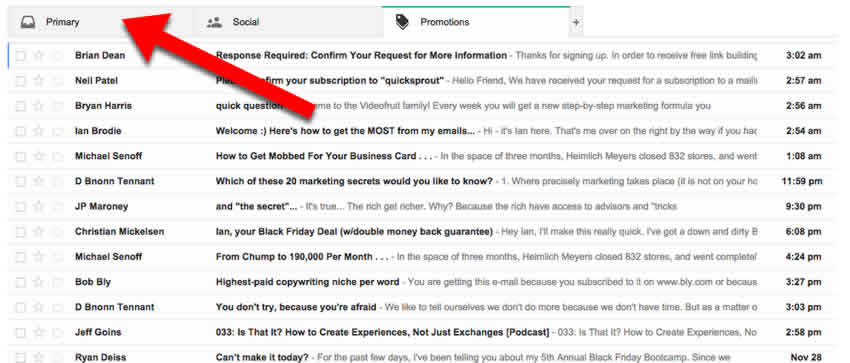
- You should now start receving my emails into your primary inbox :)
For Gmail and other email service providers (Hotmail, Yahoo, AOL, etc.) please also add my email address (ian@ianbrodie.com) as a contact in your address book. You can find more detailed instructions here.
Thanks!
– Ian
 Ian Brodie on January 7th, 2015.