Why Most Lead Magnets Don't Work
If you’ve been marketing online for any length of time you’ll no doubt have been told that your email list is your best source of paying customers.
And that the very best way to get people onto your email list is with a great lead magnet.
Both those things are true, of course.
But if you've slaved away building your own lead magnet and launched it into the world you've probably found that results very rarely match the hype.
Typically what happens is that you get very few signups. And even fewer of those actually turn into paying customers or clients.
The reason?
Primarily it's because you've built the wrong type of lead magnet.
Let me explain...
What we’re normally taught about lead magnets is that their role is to convert website visitors into email signups so you can then send regular emails to build credibility and trust and nurture your relationship until they’re ready to buy.
In fact pretty much every training course or guide to lead magnets focuses only on this role: converting traffic to subscribers.
The problem is that's rarely the biggest issue for most people. Hardly anyone is in a situation where they've got floods of visitors to their site but they just can't get them to sign up.
For almost everyone, getting enough traffic to their site or landing page is a far bigger issue. And once people have signed up, turning them into paying clients is a huge challenge.
Those issues are brushed to one side in most training. It's just assumed you'll be able to get traffic to your site and that once people have signed up it'll be easy to turn them into clients.
But neither of those is true.
So while converting your visitors to subscribers is vital, if that's all your lead magnet is focused on then it's almost guaranteed to fail.
Instead, you need to build a lead magnet that's designed from the start to not only get signups, but also to drive traffic and sales.
We'll talk in a second about how you do it, but first let's explore what would happen if you could do it. If your lead magnet could generate traffic and build the credibility and trust needed to get sales.
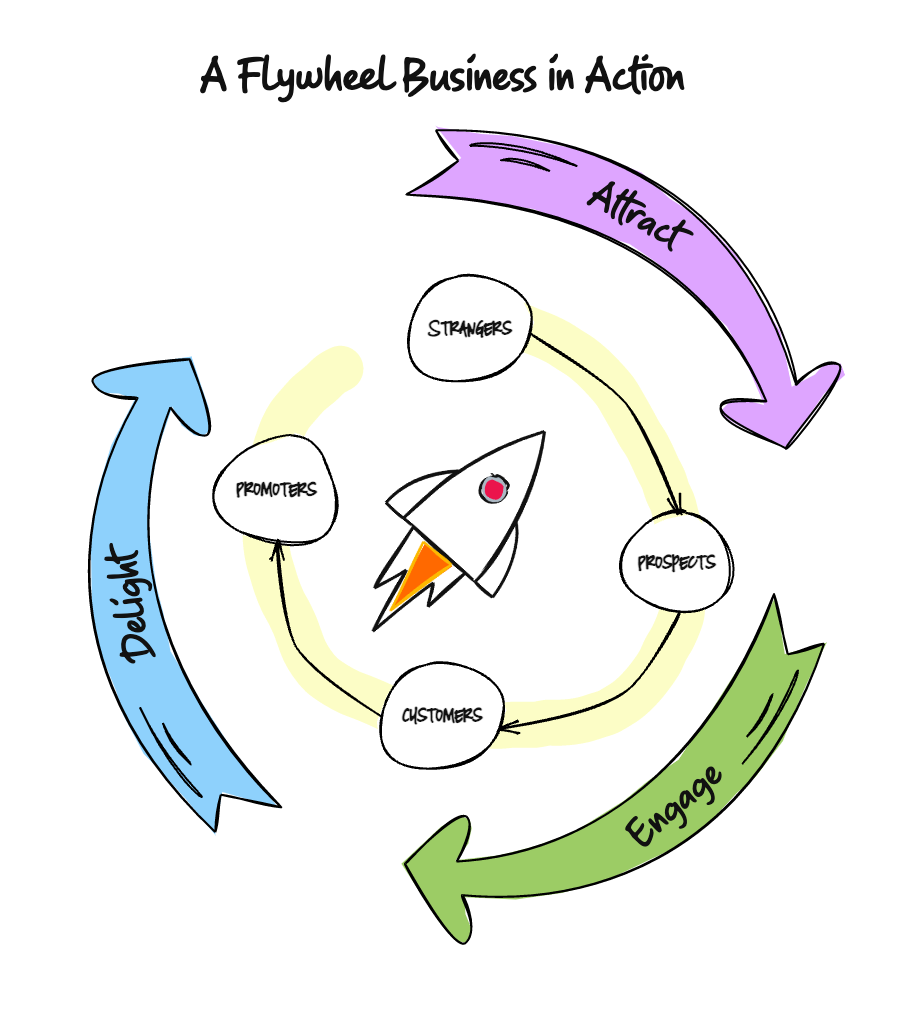
What you’d have is a business where progress and results were partially, if not completely, self-sustaining. A Flywheel Business.
Bear with me if you’ve heard this analogy before, but it’s worth repeating. A Flywheel Business is one where once you’ve begun to get moving, the business continues to generate most of the progress itself - rather than needing you to be constantly putting in effort.
It’s like a large, heavy flywheel. It takes a lot of effort to get it to turn initially. But once you’ve got it going the weight of the wheel generates its own momentum. It spins faster and faster without you needing to put in any more effort per turn.
Jim Collins popularised the flywheel analogy in his book Good to Great. Hubspot further adapted the model to look at how delighting customers through your products and services can drive growth through recommendations and referrals.
Here we’re extending the idea further. Instead of waiting until customers buy and experience your product, we’re using your lead magnet to delight them and drive recommendations and referrals. In other words, your lead magnet creates an Instant Impact.
That means:
You get more referrals and recommendations - because now prospects are recommending you, not just a smaller number of paying customers. And it’s much easier for them to refer a valuable free lead magnet than a paying service.
You get referrals and recommendations much faster - because they can refer you as soon as they sign up to your email list.
More of your referrals will convert into subscribers because instead of being introduced to your paid services, they’re being offered your valuable free lead magnet - much easier to sign up for and then your lead magnet and follow ups can work their magic.
Your new subscribers will pay more attention to your emails because of the impact your lead magnet has had already.
More of those subscribers will convert into paying customers, and they’ll do it faster - because of the credibility and trust you’ve built through your lead magnet.
So if you’re still living in the old world where a lead magnet is just a freebie you use to incentivise website or other visitors to join your email list, then you’re missing out on so much.
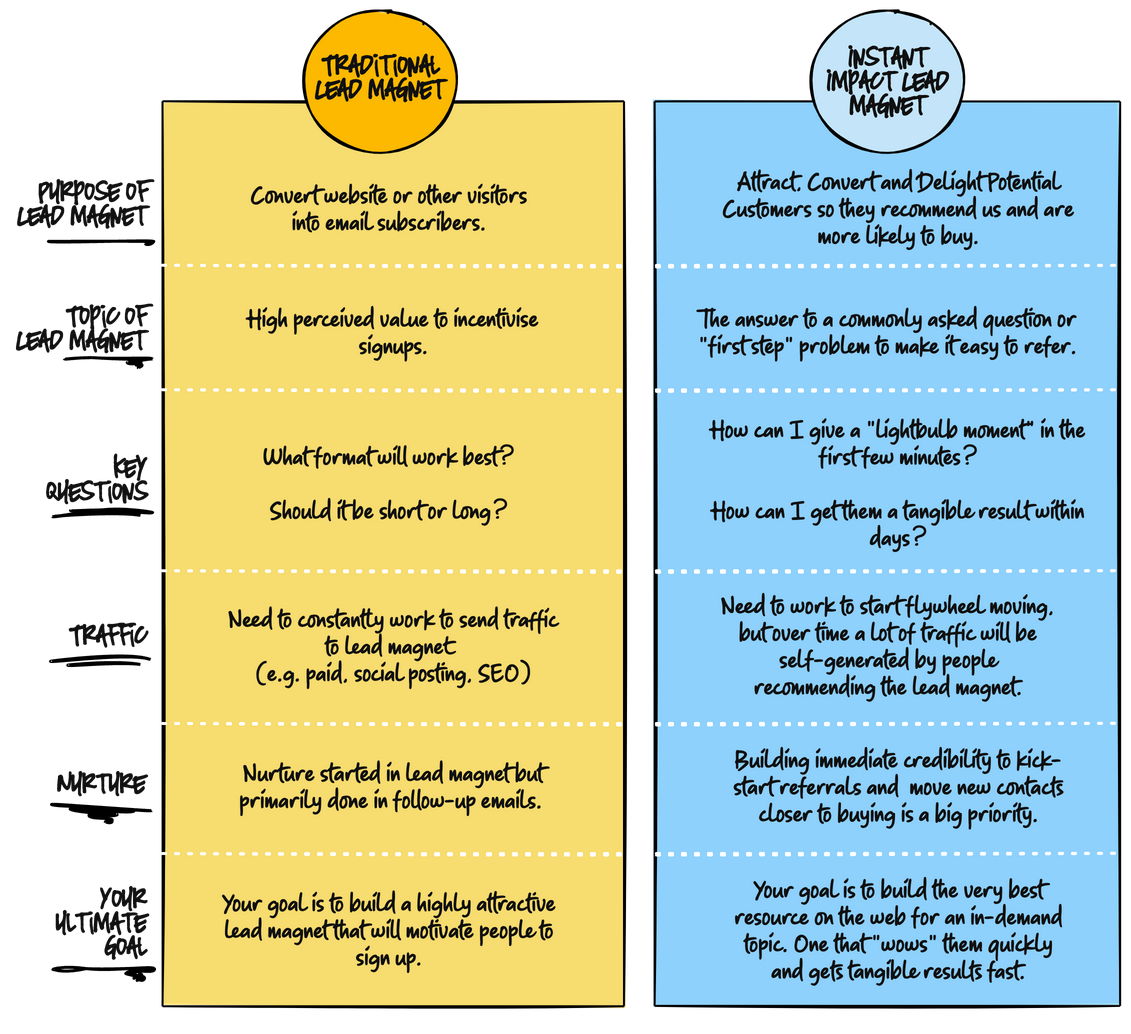
Here's a comparison of traditional lead magnets with this new type of Instant Impact Lead Magnet.
What your Lead Magnet needs to do to create Instant Impact
So enough with why you should build a new type of lead magnet. You probably want to know how to build one that will attract, convert and delight your potential customers. Here’s what you need to do…
Firstly, your lead magnet needs to provide a unique solution to an urgent “roadblock” problem that your ideal clients often ask about.
Let’s break that down:
It has to solve an urgent problem for your ideal clients otherwise there’s no motivation for them to sign up.
It should be a “roadblock” problem - in other words a smaller problem that often stops them on the way to the bigger goal that your paid products or services help them with.
For example, if you want to get more sales, getting enough meetings with potential clients might be a roadblock on the way. If you want to succeed with email marketing then getting subscribers might be a significant roadblock for you. If you want to build a successful team then choosing the right team members might be the key roadblock.
In each of these cases, your goal is for them to hire you or buy your products to help them with their bigger goal. Your free lead magnet gets them started and over their first roadblock. That will give them confidence that you’re the right person to help them and that with your support they’ll be able to achieve their bigger goal.
It should be a problem that your ideal clients often ask about. You can prompt and incentivise your subscribers to recommend your lead magnet. But by far the best type of referral is where they recommend it as an answer to a question someone asks because it means the person they’re recommending you to is actively looking for help.
For example, if someone asks “what’s the best type of lead magnet?” or “how do I get more email subscribers?” I’d hope that after reading this report you’d tell them they need an Instant Impact Lead Magnet and point them to getinstantimpact.com to find out more :)
So the more people who ask a question that your lead magnet is the obvious answer to, the more recommendations and the more new subscribers and eventually customers you’re going to get.
It needs to be a unique solution. If your lead magnet just tells people things they already know, there’s no reason for them to get excited about it, to recommend it to others or to think you’d be capable of helping them where others have failed.
The reality is that most of us work in areas where there are lots of competitors and where our clients have often tried to make improvements before. For them to have confidence in you, you need to show them things that they’ve not tried (and failed with) before.
And something new and unique is inherently more interesting, exciting and attention-drawing that something familiar. There’s a special cachet in sharing something different which your friends and colleagues won’t have seen before - which motivates people to share more.
The second thing your lead magnet needs is to deliver an immediate “lightbulb moment”.
A lightbulb moment is where your clients get a flash of insight due to the information and ideas you share in your lead magnet. It’s a beautiful moment where they “get it” and realise the implications of what you’re teaching them. When they suddenly think “OMG, you’re right - I’ve been thinking about this the wrong way” or “this could really work…I need to do something about it”.
If you’ve had those flashes of inspiration yourself you’ll know how powerful they can be. They create instant energy and spur action. And for you, that means three things:
They’ll be inspired to keep consuming your lead magnet. How many free reports or videos have you signed up for then given up on after a few minutes because they don’t seem to have anything new in them for you? If you can trigger a lightbulb moment in the first few pages of a report or minutes of a video you’ll keep their attention to the end.
They’ll be motivated to take action on what you recommend. Before making any significant changes in our businesses or lives we need to be confident that those changes will work. The inspiration of a new idea that feels right can give you the confidence to take action.
They’ll recommend your lead magnet even before they’ve had tangible results from it. The positive feelings they get from the lightbulb moment combined with the reflected glory they’ll get from recommending something that gives others that moment means you can get referred almost as soon as they’ve downloaded your lead magnet.
The third thing your lead magnet needs is to deliver a tangible result fast. If an immediate lightbulb moment drives action and initial recommendations, it’s tangible results that drive longer term recommendations.
Put simply, there’s nothing that gets people to recommend you more than getting great results from working with you.
That doesn’t mean they need to get the final end result or achieve their long term goal before they’ll recommend you. Just that they’ve got a tangible and meaningful result. And the faster they’ve got it and the more unexpected it was, the better. So you want to focus your lead magnet on a customer problem that can be solved fast.
For example, I used to have a lead magnet called the “21 word email” which was a simple template people could tweak and send out to certain contacts to resurrect their relationship with them. That email could be tailored and sent out within an hour of reading the lead magnet and in many cases the people who sent it reported they had meetings agreed within 48 hours.
With this lead magnet my goal is for you to have created your own Instant Impact Lead Magnet within a few days. Not everyone will, of course. But it’s perfectly feasible to do so if you set aside a few hours for a couple of days. Having that lead magnet done and dusted will give you a great sense of achievement and it will make you much more likely to recommend this report.
In summary, your lead magnet needs to have Instant Impact.
Picking the right topic for your Lead Magnet
The place to start is to figure out the topic your lead magnet is going to be about. Or more specifically, the problem it's going to solve (or goal it's going to achieve) for your ideal client.
Inevitably, this will be an iterative process, but a good place to start is to be clear on what you want this to lead up to. What do you want people to buy as a result of going through your lead magnet and follow up emails?
This doesn't have to be finalised or detailed - you jut have to have a rough idea as it simply tells you what area your lead magnet needs to be in.
For example, if you want this process to lead up to someone hiring you to work with them 1-1 on their leadership, then the lead magnet will need to deal with a leadership problem they're likely to have. If you want to sell a course on getting clients through LinkedIn, the lead magnet will need to be LinkedIn related.
Once you have this broad scope you can begin to narrow down to a very specific problem. Remember, you want your lead magnet to solve a "roadblock" problem that's standing in the way of your ideal client achieving their goal. And you want it to deliver results fast. So it needs to be a tightly defined problem where you can see the results.
The easiest way to start this narrowing down is to think about the kind of questions you get asked by clients and potential clients most often - especially those at or near the start of their journey.
If your goal is to sell them something on succeeding with LinkedIn, maybe getting a decent profile is what they worry about first. Maybe your potential clients who want to make a big transformation in their business are frozen because they don't know what the big picture plan looks like. Or maybe they can't get going with email marketing because they don't know how to build a list.
Make a list of these questions and add to it through a little research. If there are active forums, Facebook groups or even subreddits in your field, see what the most common questions asked there are. Check Quora to see what related questions people are asking there.
If you have some initial ideas you can see whether people are search for similar things using answerthepublic.com or alsoasked.com.
This will give you a sense of whether the question is being asked more widely. And if you have access to keyword research tools you can also get a rough quantification of how often. If you have a website with blog posts or articles, check which one gets the most traffic, and check Google Search Console to see which searches generate the most visits to your site.
Remember, the easiest way for you to get more subscribers is if current subscribers recommend your lead magnet. And the easiest way for people to recommend your lead magnet is if it's the obvious answer to a question that someone asks them.
By now you should have a short list of potential problems or roadblocks that your lead magnet could help with. At this point it's worth injecting a dollop of realism and asking yourself:
"Is this something that could be solved by a short report or video and that people could get results from fast? Or am I trying to boil the ocean here?"
For example, it seems perfectly feasible to give some powerful suggestions on LinkedIn profiles in a short report. Or to share an overall blueprint for a transformation program with key success factors.
On the other hand email listbuilding is a huge topic that very much depends on your individual situation. In that case you'd want to narrow down the topic to one aspect that's more realistic to cover - like creating a lead magnet that can turbo-charge any listbuilding efforts ;)
Finally, you want your lead magnet to offer a unique solution that your new subscribers won't have seen before. It's this novelty that creates excitement and interest in your lead magnet - and makes it more likely that yours will be the resource recommended.
So look at the list of ideas you've generated so far and see which ones you either already have unique solutions for, or whether with a little tweaking your could create something unique.
Your unique solution could be a different methodology you use to get results, a different way of looking at the problem, a way of simplifying things.
Sometimes you're already clear on what's unique about your way of doing things. But sometimes it can be easy to assume "every does things that way, don't they?".
What you'll find is that your unique solution will be the thing that surprises your clients the most when you do it for them. Or the area you most disagree with and get a bit hot under the collar when you see what your competitors are doing. Often it's an area where you had your own "lightbulb moment" when you discovered it, or it's based on new ideas from research or from outside your field.
For example, my unique way of looking at lead magnets is to challenge the idea they their only purpose is to get your existing traffic to convert into subscribers and instead to look at how to use them to drive traffic and build credibility and trust as well. It's something that struck me when looking at how books become evergreen bestsellers and at how "growth loops" work for technology businesses.
The most important factors in your choice of lead magnet are that it solves an urgent problem that lots of your potential clients ask about and that you can deliver results fast with it. But if you then have a choice of topics, choose the one where your solution is the most unique.
The importance of early lightbulb moments
Have you ever started reading a report or watching a video and given up after the first few minutes because it felt like there was going to be nothing new in it? Or that it took ages to get to the point?
And if you can't even make it through someone's lead magnet, the chances of you paying attention to their nurture emails and then trusting them enough to buy from them are very slim - no matter how great their follow-up is.
So your lead magnet needs to grab readers (or viewers) early. And the best way to do that is with an early "lightbulb moment". Sharing a new idea or insight or challenging the status quo.
Focusing your lead magnet in an area where you have unique ideas and insights was part of the selection process we used to decide on your topic. You now need to make sure you get across these insights as soon as you can in your lead magnet.
So cut the long-winded introductions, your bio and life story or the tale of how you came up with the idea and get to the value fast.
Did you notice how in this lead magnet I opened with the bold headline "Why (almost) everything you’ve been told about Lead Magnets is wrong"? And then the next few paragraphs described the big idea of Instant Impact.
You only have a few pages in a report or a few minutes on a video to make a big first impression. If you waste that with self-important waffle you'll lose most of your audience. Instead you need to hook your readers and viewers by starting right in the action the same way a TV show will open with a moment of suspense or surprise before the opening credits roll.
If you want, once you have them hooked, you can go back to your origin story or include your credibility-boosting bio at the end. But at the start you need to share something that makes them curious to find out more and makes them feel they've got value already.
Fast, tangible results drive recommendations and willingness to buy
If you want people to recommend your lead magnet on a regular basis, and you want to build the credibility and trust needed for them to be ready to buy from you, then you really need to deliver tangible results - fast.
It doesn't matter how much enthusiasm you build initially with a great topic and an early lightbulb moment - it all dissipates over time if your lead magnet readers and viewers can't take your ideas and get results with them.
Again here, your choice of topic is key. Becoming a world class leader or doubling the sales of your small business are going to take significant time and effort. So while they're great long term goals to help your clients with, they're not the best topics for lead magnets.
Instead, pick topics that take your clients in the right direction towards their long term goals, but give them measurable results quickly.
In my case, the long term goals of my subscribers might be to build a big email list and to get significant sales from that list. But better goals for a lead magnet would be to get your first 100 subscribers, or run a successful flash sale to your email list, or to create a powerful lead magnet.
If you coach clients on their leadership then obviously some things will require big changes in their mindset, skills and behaviours to implement. But there will always be quick steps they can take that will have an immediate impact: questions they can ask to get good feedback, simple ways they can free up time to focus more on their team, little ways they can recognise people's contribution.
Or if you work with large organisations on big transformation programs a measurable result that they would value could be to show them how to develop an overall roadmap for the transformation.
As long as people can see that they're definitely making progress towards their goals they'll be happy. Especially if they've struggled for a long time and are finally able to have a breakthrough - even a small one.
And the reality is that unless we can see tangible progress towards our long term goals, we'll abandon our efforts to get there pretty quickly.
So you should focus your lead magnet in an area where quick progress is possible and then help your new subscribers to make that progress by giving them concrete actions they can take in your lead magnet and in your initial follow up emails.
How to build your Instant Impact Lead Magnet
So let's get going creating your Instant Impact Lead Magnet. We'll start by dispelling a few myths that end up keeping budding lead magnet builders going round and round in circles trying to decide what to do:
Should a lead magnet be a written report? Or a video? Or an interactive software tool? Or...
It really doesn't matter. What matters is that it focuses on the right topic, delivers an early lightbulb moment and fast, tangible results. The format is much less important.
I'm going to suggest that you start by writing your lead magnet in text format simply because for most of us it's easier and faster. And if you need to change something then it's much easier to do updates to text than to video.
That said, if you love making videos and you're good at it, then go for it. If you're a software expert or a spreadsheet whizz - go for that. Whatever gets a great lead magnet out quickly and easily for you. Using the format that allows you to get it done and start putting it to work is far more important than whatever the theoretically best format is.
And you can always change format over time. What starts out as a written report to get it out quickly can become a video once you've had feedback and refined the content.
Should a lead magnet be short and easy to consume, or long and comprehensive?
Again, it really doesn't matter. They key thing is that people get tremendous value from your lead magnet and take action. If they can get that from an ultra-short lead magnet that's great. If it takes longer to get across what they need, that's great too.
What you want to avoid is fluff and filler. Don't make a big lead magnet just for the sake of making it look big and impressive. Make sure it's "value dense".
When it comes to creating your lead magnet you only really need 5 sections:
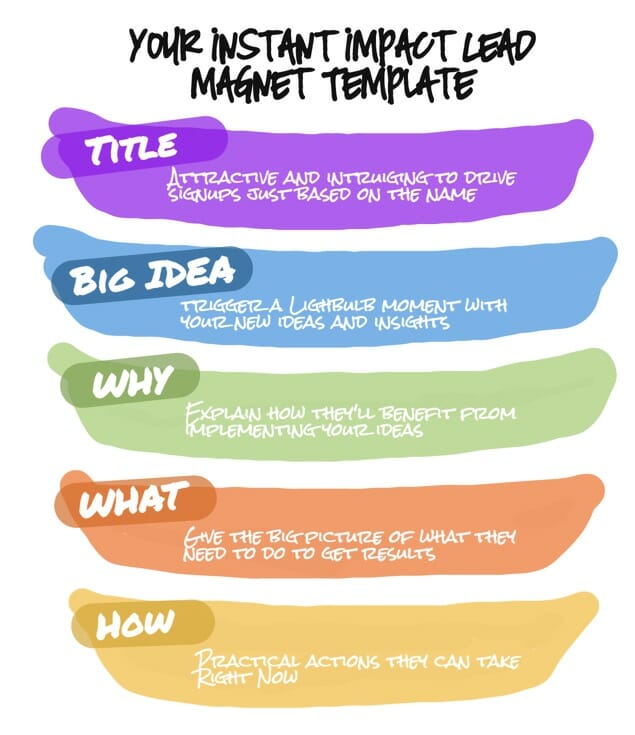
The first is your Title. Often the title of your lead magnet is the only thing people see before deciding to investigate further. So it needs to be both attractive and intriguing.
My favourite template for this is The [topic/benefit] [attractive format]. For example the Pain Free Marketing Blueprint, the Effortless Leadership Manifesto, the Marketing Automation Bible.
[topic/benefit] tells you what you'll get and [attractive format] tells you something about the way it'll be delivered. For example a Blueprint or Roadmap implies a clear step-by-step guide. A Template or Swipe File implies you'll be able to quickly adapt and use it.
Your Big Idea section presents your new idea and ideally contrasts it with old ways of thinking about the topic - triggering the lightbulb moment that keeps your audience tuned in.
In the Why section you explain the benefits of implementing what they'll learn in your lead magnet (or they problems they'll encounter if they don't). This gives them further motivation to take action.
The What section gives them a big picture view of the top few things they'll need to do to start implementing and getting results. By presenting this simplified, manageable view first you'll give your audience the confidence to get going.
In the How section you give them the practical steps they need to start making progress and start getting those first results right away. And you give them an action to take that furthers your relationship with them in some way.
That action could be to get more in-depth information from you for those that are ready. For example watching a video or doing a webinar. Or it could simply be a request to share your lead magnet to start the flywheel process.
My advice for creating your lead magnet fast is to sketch out the main points that are going to go into each section, then just start writing. Get all your ideas out on paper first before attempting to edit and improve. And keep focused on the essentials. Only include what your ideal client really needs to know - not everything about the topic that proves how smart you are.
If you have an email list already or a following on social media you can do what I did with this lead magnet and start sharing it straight away as a work in progress.
The benefits of "building in public" are that you get useful feedback and validation of your ideas straight away. And you build momentum so that when you release the final version you have an audience that feels ownership of it and already wants to share and recommend it.
There's no need to "gate" it initially or demand a signup. You want as many smart eyes on it as possible to get feedback. After you've refined it you can turn it into a PDF or video which they get after signing up. Or you can leave it ungated and ask for an email signup at the end in return for more details or support in your initial email sequence.
Get Started NOW
I've found that the number one predictor of whether someone will successfully create their powerful lead magnet or not is simply whether they get started straight away.
It's going to sound a little harsh, but the reality is that if you say to yourself "those ideas sound great...I'll get on to it next week" the reality is that you won't. Other priorities will take over, you'll begin to forget how enthusiastic you were and how much you believed it would help you, and you'll put it off to the next week...then the next...then the next.
On the other hand if you set aside just 15 minutes right now to re-read the section on picking your topic and then to brainstorm ideas, seeing those ideas will motivate you to take the next step of outlining your lead magnet. And that will give you the motivation to flesh out each section. And so on.
Keep up that process and you can easily have your Instant Impact Lead Magnet created within a couple of days.
Does having a brilliant lead magnet that attracts potential subscribers, converts them to email signups and then builds credibility and trust with them fast sound like something that could help your business?
I hope so.
And you can have it within days if you start now.
Let's get going!

 Ian Brodie on April 29th, 2023.