Ian Brodie

Ian Brodie


Navigation
Searchtime
Featured

Outlining Your Online Course

Posted on February 2nd, 2021. Outlining Your Online Course

How To Create An Online Course: The Ultimate Guide

Outlining Your Online Course


CONTENTS


Your Course Outline is the centrepiece of a lean approach to course development.
To minimise the risk involved in developing a course and to ensure it really meets the needs of your audience you're going to pre-sell it.
In other words you're going to offer it for sale (usually in pilot form) before you've built it.
And to do that you need two things:
  • You need a way of giving enough details about the course to potential buyers so they know if the course is right for them
  • You need to be confident you can actually build the course so that you don't sell it and then let your buyers down
Your course outline gives you both of these.
A good outline tells potential buyers what they'll get from the course: the outcome and the benefits of that outcome, along with enough about the contents that they'll know it's the right course for them.
And a good outline also gives you enough details of the content to know whether you'll be able to create the course and about how long it'll take you. (And obviously you can update the outline to make sure it's achievable for you if initially it's too challenging).
With your outline you're balancing two factors:

The steps logically needed to deliver the primary outcome of the course

The key things your potential buyers want to see in the course

Logically, you want to strip down your course (at least in the first version) to focus only on the key steps absolutely necessary to deliver the outcome of the course. But in practice, your buyers will also have a number of other things they want from the course which might not be directly outcome related. You have to make sure you're delivering on the these too to maximise demand for the course.

Your Outline “Sells” the Course

Before you have testimonials or other proof that your course works, potential customers will look at the course outline to give them confidence that your course will give them what they want.
They typically look for 3 things:
  • Does it look like this course can genuinely help me achieve the outcome I’m looking for (ie do the steps in the course seem like they make sense based on what I know already)?
  • Does it look like the course will be a good fit for me personally and what I need?
  • Does it look like the course is different and that I’ll learn something new from other courses I’ve done before?
Your course outline should tell them this, and on its own it should be enough to fill up a pilot with paying members without needing to do a ton of marketing.
In practice, when you run the course it might not go exactly like the outline said in the exact same order - but it must include all the elements you promised.
The chances are you already have a good idea what the logical steps are to deliver the primary outcome you defined for the course. But even if you're confident you understand what your potential buyers want from the course you should always confirm this by doing research.
Even if it just confirms what you already think about what needs to go into the course it will tell you the language your potential customers use and how to position your course to maximise sales.

Using Research to Build Insight into Buyer Wants and Needs

There are three types of research you can do to build your insight into what your buyers really want.

Desk Research is where you build up your background knowledge of your topic area and feed your ideas by:

  • Finding previous published research into your market (e.g. their problems and challenges)
  • Benchmarking competitor offerings to see what their courses cover
  • Reading reviews of books or courses on related topics to identify the key areas of need and potential gaps in the market
  • Observing conversations in relevant online forums or on social media

Small Scale Personal Research is where you:

  • Hold casual conversations with people who are representative (or who have insight into) your target audience
  • Ask them qualitative questions to understand their major problems and goals and whether your ideas for the course would get a good reception
  • Use the insights from this step to feed wider survey research
Ideally you'll hold these conversations in-person or over the phone. But you can also get a lot of insight from asking them in a Facebook Group or Online Forum.
The advantage here is that group members can build on each others answers and you can begin public conversations with them about the topic. The disadvantage is that being in public they may be less candid and honest with their answers.

Broader Survey-Based Research is where you:

  • Survey a larger list of potential customers to make sure the initial impressions you got are backed up in the broad base of your potential customers
  • Ask quantitative questions to confirm demand for the course and identify the main priorities to be covered (e.g. allow them to pick their main priorities based on answers you initially got from your small scale personal research)
  • Ask qualitative questions get more feedback on what should go into the course

Small Scale Personal Research 

Small Scale personal Research allows you to quickly "cut to the chase" and validate your course topic.
You're going to “interview” a small number of people who are representative of your target audience to get their initial feedback.
“Interviews” could be face to face over coffee, over the phone or video call, or by email or on social media. Though the more in-person they are the better the feedback you'll usually get.
You’re looking to understand whether this course topic will sell, and to refine what you should include in the course. If the feedback is positive you’ll use what they say to feed into the next step of doing a broader survey.
You’re probably already doing a degree of this informally already - that’s where your ideas for the course came from. But this step ensures you have a fuller, more up to date, and more in-depth picture.

Choose Your Interviewees Carefully

You’re going to talk to a small number of people - so they must be representative of your target audience (or know them well and be able to answer on their behalf).
In a broader survey of hundreds of people, one or two outliers won’t affect the results. But if you’re only interviewing 5 or 6 people, getting input from one person who doesn’t properly represent your audience can really skew your results.
Also remember you don’t need everyone to respond enthusiastically to your ideas. Not all (in fact only a small percentage) of your audience will ever become buyers. So if only half of your interviewees think your ideas for the course is a good one, don't worry. On the other hand, if no one responds enthusiastically, that would be a warning sign.

Decide on What Format to Use for Your Interviews

The ideal approach is to do short, informal 1-1 interviews with 5-10 people— either face to face or more likely on a video or phone call. Choose this option if you know people in your target audience personally and you think they’d be willing to answer your questions. 

You can also mail out to an email list or ask on social media for volunteers to be interviewed - but you need a bigger list/profile to get enough people saying yes.

It's usually best not to offer an incentive for taking part in the research - it attracts people who might not be representative of the buyers in your target audience.

You can also ask questions in a Facebook Group or other forum. You won’t get such in-depth answers, but it’s good for confirmation if you already have relatively clear ideas and the interaction and visibility can grow momentum and interest in the course.

How to Set Up and Run an Interview

For people you already know well, just call or email, tell them you’re thinking of developing an online course about your topic and ask if you could grab 15-20 minutes over coffee or on the phone to get their feedback and insights.

If you have an email list or run a Facebook Group or other forum (or you’re well known in one) send out a message similar to the above but asking for volunteers to contact you.

Keep the number of questions short. Encourage the interviewee to speak even if they don’t answer every question.

You want at least one question that relates to how important they think this is as a problem/issue/goal for them (or people like them). For example:

"I'm thinking of creating  an online course that helps startup businesses land their first corporate client. Is that the kind of thing businesses like yours would find valuable and be keen to buy?"

This gives you an initial validation of the market for your course. 

You also  want at least one question where you ask them what their biggest challenge or issue or barrier is in the area of your course - this helps you prioritise the content of the course. For example:

"When it comes to trying to win corporate clients, what's the biggest challenge or barrier you've faced?"

I also like to add a more general question about the course such as:

“If I was to make a course about landing your first corporate client - what would be the number one thing you’d like to see in it to make it the most valuable and useful to you?”

Sometimes they will tell you the content they want to see - but often the more general wording will trigger  other ideas about the course - for example whether they want live sessions, the ability to get feedback, worked examples, a mobile version of the course, etc.

Broader Survey-Based Research

Based on the insights from your initial small scale research you’re going to launch a survey to get wider input.

With a survey you can ask closed questions (yes/no, scale from 1-5, choose one etc) which will allow you to analyse the answers more statistically and confirm whether the initial impressions you got from your small scale research are true more broadly.

You can also ask qualitative questions too, but usually not many on a survey. Aim for people to be able to complete your survey in 5 minutes or less.

Even if you haven't done any small scale research and have relied on your existing knowledge of your market it's always valuable to do a survey:

  • It will give you confidence you’re on the right track
  • It will give you a lot of input and the confidence to progress fast
  • It helps your marketing by generating interest and awareness in the upcoming course and by building a waiting list for the pilot

Even if you don't have a big mailing list you can still run a survey:

  • You can put the survey invite on your social media profiles or in a group you run
  • You can ask permission and post it in relevant groups or forums run by other people
  • You can message it directly via LinkedIn or Facebook messenger - or send personal email to your contacts
  • You can ask a friend or contact to send it to their email list or contacts if it would be valuable to them too

You don’t need hundreds of responses to a survey. But aim for at least 50 to give you confidence you're on the right track.

Build on the Answers You Got in Your Small Scale Research

Focus your survey questions on areas that came out as important in the small scale research and use the most common answers you got as the options on survey questions  (e.g. “what’s the biggest challenge you face…”) to allow easy counting of votes.

Typical questions to ask include:

  • A question that gives insight into whether this is a priority issue. For example "On a scale of 1 (low) to 5 (high), how big a problem is winning corporate clients to your business?" or "On a scale of 1 (low) to 5 (high), how valuable would a course that showed you how to land your first corporate client be to your business?"
  • A question that identifies the biggest problem/goal so you can focus the course round that if possible
  • A qualitative (free format) question that allows your most motivated audience members to tell you what they want from the course. Leave this quite open to allow them to interpret for themselves. For example "If I was to create an online course about landing your first corporate client, what would be the #1 thing you'd like to see in it that would be the most valuable for you?
  • 1-2 additional questions for key areas of uncertainty you need to resolved (e.g. if you want to know whether they want video or written lessons)

Pay special attention to really long answers to qualitative questions as it means the person who wrote it is particularly passionate about this topic (ie more likely to be a buyer).

Close by asking them to enter their email address if they want to be notified about the pilot and get a special discount. That will allow you to pre-build an audience for your pilot.

A Google Forms Survey

You can use any simple survey tool to do this - Survey Monkey, Survey Gizmo or just a free tool like Google Forms.

Interpreting the Results of Your Research

Often the results of your research are obvious, but it makes sense to review them systematically so you avoid reinforcing your predispositions and biases.

The first thing to do is to read all the answers:

  • Re-read your interview notes from your small scale personal research
  • Then look at the summaries (usually pie charts) of quantitative questions on your broader survey research
  • Finally, skim-read all the qualitative comments/answers from your survey

Once you've read all the answers, “sleep on it”.  Let the information sink into your brain so your subconscious plays around with it and starts generating ideas. Come back a day later for more formal analysis.

Interpreting Small Scale Personal Research

The essence of analysing your small scale personal research is simply to read the interviews and highlight interesting and notable points.

Read through the answers a question at a time - that way you’ll be able to pick out common themes for each question

My own personal preference is to print out the interviews and highlight key points in each one. Then transfer the highlights to post-it notes which I then move around to organise in groups.

Look for “quotable quotes” in the answers and use the same language in your marketing.

Interpreting Broader Survey Research

For quantitative questions, try a variety of different graphs and analyses to see which gives the clearest picture of importance and the main issue/challenge

For the main issue you sometimes get one standout issue that you can then focus the whole course on. More usually you’ll get 2-4 and you’ll need to make sure the course covers all of them - and that you highlight these issues in your marketing.

For qualitative questions, read through all the answers to get a sense of the main points coming through. Highlight interesting quotes and common themes and make note of the language and powerful quotes so you can reuse t in your marketing.

Make note of any recurring themes and count how many times each theme is mentioned to get a numerical representation. Or use affinity mapping to group similar ideas coming from the surveys.

Finally, review your notes from both the small scale and survey research and summarise the main themes to identify which questions, issues and ideas need to go into your initial pilot, which would be valuable to include when you update the course (for example for a full launch) and which can be left for a later day.

Creating Your Course Outline

You're now ready to draft your outline.

Start by breaking down the primary outcome(s) of your course into steps or components. 

Aim for 3-6 main sections or steps initially. This should be all you need for a pilot version of the course and you can add to it later. A bigger course in future might have subsections within each section, but for your first pilot course keep it simple.

For example, for a course on how to  “Learn the Banjo in 7 Days” the main steps might be: get the right banjo, learn to pick and play, learn basic chord positions, how to practice, learn some simple tunes.

Usually the steps or components are obvious based on your experience in the topic:

  • If your course was on how to analyse an industry using Porter’s 5 Forces model you’d probably have a module on each of the 5 forces plus one to bring it all together.
  • If your course was on baking bread, you’d probably have a module on each of the sequential steps in the process: mixing the dough, autolysing, rising, proving and baking

If you’re struggling to break down your course, try using the “backward chaining” technique:

  • Start with the final outcome of the course in mind
  • Think “what’s the very last thing you need to do to achieve the outcome”? - e.g. for baking bread it might be “take the bread out of the oven”
  • Then think “what’s the step I need to do just before that” - e.g for baking bread it might be “put the bread in the oven at 240°C for 40 minutes”
  • Then repeat the previous step until you reach the first step of the process: - e.g “leave the bread to prove” « “shape the bread and put into proving baskets” « “leave the bread to rise” etc
  • Once you have all the steps, simplify and combine to get to your 3-6 steps

If you have a proprietary model or framework you use, that can be a great way of breaking the course down. For example:

  •  Steven Covey’s “7 Habits of Highly Effective People”
  • Charlie Green, Rob Galford and David Maister's Trust Equation of T= (C x R x I) / SO
  • My own  Authority Breakthrough 3 Circles model (Build Your Distinctive Point of View, Reach Your Target Market, Deepen Your Authority)

In these cases you'll have a module with lessons to explain each element of the model or framework. Basing your course around a proprietary model makes the course uniquely yours and gives your potential buyers confidence that this approach is different to things they’ve tried before.

Finally, review your outline based on all the notes you've taken so far and check:

  • Will the steps/components you’ve come up with delivered the primary outcomes of the course? 
  • Do they cover all the areas you identified that the pilot course must have from the perspective of a buyer? 
  • Is it obvious from the steps/components that the course really will deliver the promised outcome? (ie does it make logical sense)
  • Is there some element of uniqueness or difference visible in the outline  - e.g. the steps are very different to how other courses do things? 

Update or add to the course outline to make sure all four of these areas are covered - then move on to the next step of choosing the technology platform for your course.

Choosing the Best Technology Platform for Your Online Course

Choosing the Best Platform for Your Online Course

Review and select the best technology to use to run your course during your pilot and beyond:

  • The 5 technology pillars of online courses
  • Technology choices for your pilot
  • The 3 options for building and running your course long term
  • Technology choices for your course launch and continuing operation

Learn more about  Choosing the Best Platform

Featured

More Clients Memorandum

3 questions that will boost your marketing every week

Posted on January 31st, 2021.

I've taken to asking myself 3 simple questions at the end of every week that are having a very positive effect on my marketing.

I'm like most people in that I tend to do what I'm comfortable with rather than what's best for me – unless I'm pushed.

And these 3 questions have proven to be a great way of giving myself the little push I need each week to make sure I refocus onto my most important marketing tasks.

They really are very simple:

1. What did you do this week to generate more leads?

If you're in a small-number/high-value business that might be asking for referrals. In a business like mine, it might be something like making a guest appearance on a podcast or publishing an article.

2. What did you do this week to nurture relationships with your best contacts?

Maybe that's a phone call or sending a short note to your best contacts. In my business, it's more likely to be an email newsletter or sharing content with my contacts on Linkedin.

3. What did you do this week to convert some of your nurtured relationships into paying clients?

That may be offering to chat with someone on the phone, making a formal proposal, or for me: running a live webinar or making an offer in a short video.

Simple questions, right?

But the first time I was prompted to ask a variation of them by a friend, I really didn't have good answers.

Most of what I'd been doing had been useful stuff – but much of it tangential to the most important tasks in marketing: generating leads, nurturing relationships, converting into paying clients.

And when I was hitting one of the “big 3” it was almost always focused on the area I'm most comfortable with: nurturing relationships.

Vitally important to be sure. But unless you're generating leads on a regular basis you'll be nurturing a shrinking set of relationships.

And unless you're converting those relationships into paying clients somehow, you'll have a shrinking bank account too.

This week try asking yourself these simple questions – especially the ones that relate to the areas you're the least comfortable with.

You may be surprised at your answers and at how much it gets you to refocus for the upcoming week. 

Featured

Identifying the Best Audience for Your Online Course

Posted on January 30th, 2021. Identifying the Best Audience for Your Online Course

How To Create An Online Course: The Ultimate Guide

Identifying the Best Audience for Your Online Course


CONTENTS


Finding an audience who are hungry for the outcome your course delivers make it much easier to market and sell that course.
And having that audience in mind from the start makes it easier to focus the course, to use relevant examples and to talk to the right people to sanity check your ideas.

Decide on Which Type of Buyer to Focus On

Your first step is to decide which type of buyer to focus on: individual consumers or business buyers. And for businesses, whether to focus on large corporates or small businesses.
Each has different advantages and disadvantages:

Individual Consumers

  • Typical for Entertainment Based courses or some Professional Development done by individuals investing in their own careers

  • Buyer is also the person who takes the course

  • Buyer can usually make a quick decision and pay directly (e.g. credit card)

  • Usually only one course bought at a time

  • Price point relatively low

Corporates

  • Typical for Professional Development Courses and some outcome based courses

  • Buyer usually doesn’t take the course - often HR or Procurement person or a committee

  • Buying process is usually long and multi-step with many admin criteria (e.g. system compatibility, training standards, etc)

  • Usually many “seats” bought at a time

  • Price point usually high (but Corporates are often good at negotiating this down)

Small Businesses

  • Typical for Outcome Based Courses

  • Buyer is typically the business owner and may take the course themselves or delegate to someone in their organisation

  • Buyer can usually make a quick decision and pay directly (e.g. credit card)

  • Usually only one course bought at a time

  • Price point can be high due to clear ROI

If you already have strong relationships with corporate clients, start there:
your marketing will focus on contacting a small number of potential clients personally.
Ideally, you can sell an online course as an add-on to current or previous work with a corporate client. At minimum, you can harness your existing goodwill and relationships to start conversations to talk about online courses.
If you don’t have pre-existing relationships with corporates then no matter how lucrative the corporate market looks, it’s going to be tough going. Especially in the current situation where you can't meet potential clients face to face to build relationships with them.
If you already work with smaller businesses or are starting from scratch, they should be your main target. In this case your marketing is going to focus on reaching a large number of potential customers via email marketing, your website, social media, adverts, etc.

Brainstorm Specific Buyers to Target

Your next step is to brainstorm specific buyers to target. Remember, you’re aiming for your course to deliver a specific result or outcome for this audience.
And you also need to be able to reach this audience in order to be able to market to them.
Think broadly in terms of audience - it could be people in a specific industry, with a specific job title, a specific demographic, people with specific interests, etc.
Use the following questions to trigger ideas for your audience:
  • Who (type or characteristics of people) is most likely to value the topic you’ve selected for your course (for who is it a really big problem or goal)?

  • Who is likely to have the money to pay to deal with this problem or goal?

  • Who is this topic the newest for (e.g. a new technique that's been used in one sector but not for this type of client yet)?

  • Who seems to be active in buying courses?

  • Who have you worked with the most on this topic or related issues?

  • Who do you have the best testimonials or references from in this area?

  • Who do you enjoy working with the most? (caveat: this is less important than for face-to-face work as you won't have to spend much time with them)

Evaluate Your Potential Buyers

Your next step is to evaluate the audiences of potential buyers you brainstormed to see which ones are viable.
Unlike selecting topics, you don’t need to narrow down to just one audience. Depending on how you do our marketing you can target more than one audience or target different audiences at different times. So when you evaluate your audiences you're going to create a ranking rather than just selecting one.
There are two key criteria to look at:
  • The Potential Value of the Audience to You. Obviously, the bigger and more profitable to audience of potential buyers the better.

  • Their Likelihood of Buying.  The potential value of the audience will only be realised if they actually buy - so you need to evaluate how likely that it.

Evaluate your potential audiences against each of these criteria on a scale of 1 (low) to 5 (high). Use the following guidelines to help:
Potential Value (to You)
  • Does the outcome of your course solve a big strategic problem (or goal) with high financial value for this audience?

  • Are there a large number of them who would value the course?

  • Will the value be clear to them?

  • Do they have the money to pay for a high value course?

Likelihood of Buying
  • Does the outcome of your course solve a big strategic problem (or goal) with high financial value for this audience? (note: this is the same question as for Potential Value - it's important for both)

  • Is this an immediate, urgent need for them?

  • Can you reach them with your marketing (do you already have a relationship or can you easily connect with them)?

  • Have you already built credibility and trust with them?

Do your evaluation and rank the different potential audiences. Keep the top audiences in mind as you develop the content of the course and especially when you create examples and case studies. You want them to resonate with these top audiences.
When you pilot and launch the course, you'll do it primarily for the top ranking audience (unless you can also reach other audiences with little extra effort and without diluting your marketing).
Then when the course is launched you can decide whether to expand within that initial audience or to add further audiences. If the latter, you'll use the ranked list of audiences to decide which to move on to next.
For now, move on to the next step of creating an outline for your course.

Outlining Your Online Course

Outlining Your Online Course

Create a course outline to motivate buyers and guide the creation of your course:

  • Doing small scale personal research 

  • Broader research with a survey

  • Interpreting your research

  • Creating Your Course Outline

Learn more about  Outlining Your Online Course

Featured

How to Choose the Right Topic for Your Profitable Online Course

Posted on January 28th, 2021. Choosing the Right Topic for Your Profitable Online Course

How To Create An Online Course: The Ultimate Guide

How to Choose the Right Topic for Your Profitable Online Course

How to Choose the Right Topic for Your Profitable Online Course

CONTENTS


Imagine you're a busy business owner.
Under stress, working all the time, only a few spare hours in the week.
You've figured out the best way to grow your business is to win more contracts with corporate clients. But you're not sure how. So you're looking for a training course.
Which one would you choose:

Corporate Sales Training

- OR -

Land Your First Corporate Client in 30 Days

Or imagine you're a keen golfer and you want to beat your buddies. Which course are you most likely to buy:

The Complete Guide to Golf

- OR -

Knock 5 Shots of Your Golf Game

In each case it's the latter.
Most people (especially busy people which frankly is almost all of us these days)  don't buy courses for the joy of learning a subject. We buy because they'll help us get an outcome we're looking for in our business or life.
We want to achieve that outcome with as little fuss as possible.
So the key to an attractive course that will have buyers knocking on your door is to ensure your course delivers a Specific, Tangible Outcome in an Important or Urgent  Area for your potential buyers. And then to make that outcome clear in the way you describe the course.
You can get a 2x, 5x or even 10x increase in course sales for essentially the same content simply by focusing it on the right outcome and area.
And we're going to find a great topic for you in three steps.

Brainstorm Ideas using Topic Triggers

Strengthen Your ideas

Evaluate and Select the Best Idea

Tips for Finding a Great Course Topic

  • Remember, you’re aiming for your course to deliver a specific result or outcome for customers in an area that's a priority for them.

  • For your first course, go for a valuable but simple or small outcome you can create a course for quickly. Don't try to create your magnum opus on your first attempt at a course.

  • Don't get stuck trying to come up with the "perfect" topic. We're going to iterate and validate your initial idea with potential buyers. 

Using Topic Triggers to Brainstorm Great Ideas for Your Course

Rather than staring at a blank sheet of paper trying to come up with great ideas for your course that will be attractive to potential buyers, you can get going fast and start with proven ideas by using these Topic Triggers.
Ask yourself each question and make notes on the topic ideas that come to mind. You won't necessarily be able to answer each one, but in total you should get a really solid list of potential topics you can then work on.
  • What are the top problems you regularly solve for clients?

  • What issues do clients ask you about the most?

  • What are the first tangible steps your clients need to take on the path to achieving their goals?

  • What is a valuable quick win your clients could achieve?

  • What next step would clients be excited about achieving?

  • What’s the one thing you’ve seen that clients find as their biggest barrier to success?

  • What is typically the best thing your clients can do in terms of ROI?

  • What problems do you have the most experience solving?

  • What problems have you already developed clear methodologies or models for?

  • What problems do you think you deal with differently and better to your competitors?

  • What problems do you most enjoy solving for clients?

  • What problem or issue is creating the most “buzz” in your client communities right now?

  • What solutions do you deliver that are the newest and most intriguing to clients?

  • [If you work in corporates] Is there a specific problem that a big client faces that they could commission you to create a course for?

Strengthen Your Initial Ideas

You're now going to look at your initial ideas to see if you can  strengthen their appeal.
If you 've got a long list of ideas, select the top 4-6 for further refining. Just go with the ones based on gut feel you think would be the most likely to succeed and the ones you’d be the most interested in pursuing. You can always come back to the others later.
Then look at each potential topic and see how you can make them:
  • More obviously valuable (e.g. focused the idea on a higher value area, call out the value in the name of the topic etc.)

  • More tangible and specific (e.g. name specific results, a specific timeframe for achieving those results, specific people this works for, etc.)

  • More different, more new, more memorable (e.g. a unique approach, an alliterative name) 

For example, if your original idea is to do a course on presentation skills, you can strengthen it in a number of ways:
More obviously valuable:
  • Board level presentations

  • Sales presentations

More specific and tangible:
  • Ace your next board presentation in 48 hours

  • How to pitch to corporates

More different, more new, more memorable:
  • Hollywood presentation skills

  • The Perfect Pitch Formula

Evaluate Your Ideas

You're now going to evaluate the ideas you've brainstormed and then strengthened to select a "candidate" idea for your course to take through to validation.
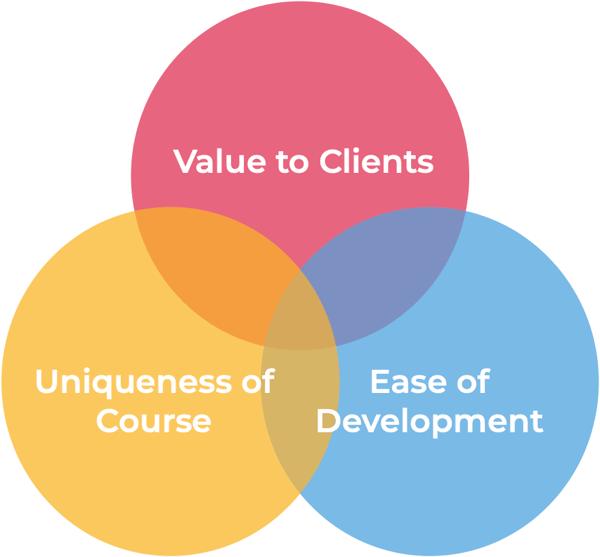
For this, you're going to use three criteria:
  • The Value of the Idea to Potential Clients. Obviously, the more valuable the idea, the more demand there's going to be for the course.

  • The Uniqueness of the Course. A valuable course is a pre-requisite, but if many similar courses are available your sales and price will be lower.

  • The Ease of Developing the CourseSo many great courses never make it to market because the difficulty of developing them leads their creators to give up before they're done.

Evaluate Your Topic Ideas
Evaluate your leading topics against each of these criteria on a scale of 1 (low) to 5 (high).  Use the following guidelines to help:
Value to Clients:
  • Does this solve a big strategic problem (or goal) with high financial value to many clients?

  • Is this currently an urgent priority for many clients?

  • Is this a problem or goal that’s highly visible to them and they’re already aware of?

Uniqueness of Course:
  • Are there only a few or no other courses available for this specific topic (or audience)?

  • Does this topic build on a unique skill, experience or story you have?

  • Have you created a specific methodology, tool, model or framework for this topic that you’ll teach in the course?

Ease of Development:
  • Can this course deliver results from a small number of lessons?

  • Do you already have ideas, content and materials you can reuse for the course?

  • Is this a topic you are enthusiastic about teaching?

If all the topics score below 10 in total, go back to generating more topic ideas.
If you have one or more topics that score above 10, any of them could be a successful topic for a course. Normally you would pick the highest scoring topic unless you had a strong personal preference for one. In the event of a tie, go with the topic with the greatest client value.
For your first course try to go with a topic that scores highly on Ease of Development - ideally 4 or 5. Once you're more experienced at developing courses you can work on more challenging ones.
Take your topic forward to the next module on finding your best audience.

Identifying the Best Audience for Your Online Course

Identifying the Best Audience for Your Online Course

Identify and evaluate the best potential audiences for your course to use as you develop and launch it:

  • Deciding which type of buyer to focus on

  • Brainstorming potential buyer audiences

  • Evaluating the best audiences for you

Featured

More Clients Memorandum

A simple schedule for effective marketing

Posted on January 27th, 2021.

I often get asked about how much time you should dedicate to marketing, and how to schedule it during the week.

In part, the answer is “do what suits you”. But while true, that's not very helpful really. And there are some guidelines that can steer you in the right direction.

Timewise I'd aim to spend 20% of my time – roughly a day a week – on marketing and business development type activities.

You'll need more if you're starting up or you've got a bit of a client slump at the time. Perhaps a couple of days or more a week.

And if you've got a steady source of new business that's unlikely to disappear overnight you can survive with a bit less. Perhaps half a day per week.

But don't get complacent. Unemployment queues are filled with consultants who were sure their clients were going to stick with them for another year at least.

In terms of scheduling that time I have two rules:

1. Schedule a biggish block of uninterrupted time where you can work on tasks that need focus and attention. Strategising. Writing. Making videos. 

It's almost impossible to make progress on tasks like these if you're grabbing 20 minutes here and there.

Schedule the time for when you're at your freshest so you can do your best thinking. Monday morning is a good default.

2. Try to do some marketing every day. 

It doesn't have to be much. Reconnect with some old clients on Tuesdays. Write a short Linkedin post on Wednesdays. Send something useful to a priority prospect on Thursdays.

Doing something on your marketing every day is a very healthy habit.

It keeps marketing and clients front of mind and means you'll find it much easier and quicker to pick up marketing tasks when you start them rather than having to get warmed up.

And having this regular focus on marketing means it's much more likely that good marketing ideas will pop into your brain in-between times.

It really is as simple as that. A chunk of time on Mondays. A bit of time every other day.

And as I said in my last email – write down in advance what you're going to do each day so you can get straight into it without having to spend half your allotted time thinking of what to do.

Not rocket science. But very, very effective.

And like the magic of compound interest, these small investments in marketing add up to something big over time.

– Ian

PS another tip, not quite 100% marketing-focused: set aside time each week for reading. Not “reading” Facebook or Linkedin. But proper reading – ideally books. 

Doesn't matter so much what. But reading for an hour a couple of times a week makes you more focused. And it helps relax you too.

Featured

More Clients Memorandum

Never start from a blank sheet of paper

Posted on January 24th, 2021.

There's something weird about trying to think and do at the same time.

Brainstorm a list of articles to write? Easy.

Write an article on a topic you've previously listed, or one someone else has given you? Maybe not easy, but doable.

Brainstorm an article topic and then write it in the same session? Absolutely im-bloody-possible it seems.

At least for me and a lot of people I've spoken to.

Somehow separating the thinking (of topics) from the doing (writing the article) makes it all work much smoother.

Perhaps it's the mindset you need to be in for each phase. Or perhaps the process of choosing which one to do rather than being given just one topic allows you to over-think and procrastinate.

The exact same is true when it comes to nurture marketing.

Brainstorm a list of nurture activities you could do on a regular basis?

Sure: you could get back in touch with old clients to ask them how things have progressed since your work together. You could send a link to an article to contacts you met in the last week or so. You could give your views on industry news to ex colleagues. etc etc – the topics just flow.

Execute a pre-defined nurture activity?

Of course: ask me to get back in touch with an old client and I just bring up a list of them, see who I haven't spoken to in a while who I might have something useful to say to, then I ping off a message. Job done.

Brainstorm a nurture activity to do and then do it straight away?

For some reason I get stuck. I can't make up my mind which one. I procrastinate.

That's why when you set up a Golden Hour for key activities like nurture marketing you should always list out in advance what you're going to do in that hour.

Never go into your Golden Hour with a blank sheet of paper.

You don't need all the details. You just need a solid list of activities you can work your way through without having to think about what to do next.

The list of activities depends on your priorities, but for a Monday morning Golden Hour it could be something like:

  • Message 3 ex-clients to see how things are going
  • Pick one contact you met in the last 2 weeks, search for an article you think they might find useful and send it
  • Try to schedule a 1-1 call with a potential client where your nurture activities have progressed well

Those activities are something you can easily do in much less than an hour, yet they'll help you take big steps with nurturing your relationships and getting people closer to being ready to buy.

Of course, you might not do the same activities every week. All you need to do is check out your Golden Hour activity list a few days in advance and update it if needed.

Then when you get into your Golden Hour you can focus on execution, not umming and ahhing about what to do,

Featured

Content Hubs Webinar Recording

Posted on January 22nd, 2021.

Your Content Hubs Webinar Replay

Many thanks for joining us on the webinar!

You can watch the webinar below, and download the slides. I've also provided links to the example content hubs I showed in the webinar.

If you have any questions, do message me by email or click the Contact Me link above.

Example Content Hubs:

If you'd like to find out more about Momentum Club, click here for details.

Featured

More Clients Memorandum

Do you have a “golden hour”?

Posted on January 20th, 2021.

In photography, the “golden hour” is the time just after sunrise or just before sunset when the sun is low in the sky and so its light is warmer, softer and casts more interesting shadows.

In other words, it's a great time to get your best photography work done.

When it comes to marketing or business in general, I believe it's important to make your own “golden hour” at least once a week where you can focus on your most important work.

For me, that means planning the week's activities. Something I do first thing on a Monday morning.

(Though admittedly, “first thing” for me tends to mean 10am or 11am.)

It also means setting aside protected time when I can work on creating new content for my website and new training for Momentum Club members.

Those are the things I've identified as the highest value activities for me.  So it's vital I set aside dedicated golden hour time for them rather than try to squeeze them in between more immediate but less important issues.

It's easy to prioritise and schedule client work.

You're getting paid for it. You have deadlines. You have someone who will say something if it doesn't get done.

And most of us have a big sense of duty to our clients.

We tend not to have that same sense of duty or urgency for our own activities that have a longer-term impact on our business.

Especially ones we might not enjoy so much or be that good at initially.

But in the long run, activities like nurturing client relationships outside of projects and creating content to build our credibility will have a huge impact on the success of our business.

And, I'd argue, on our well-being too.

Relationships that last beyond the current transaction are what keep human beings happy. And creating a body of work to be proud of gives us a real sense of worth and achievement.

So make sure you plan in at least a few “golden hours” every week to work on these vital activities.

Don't leave it to chance. Don't try to squeeze it in when you have time.

Prioritise it.

Featured

More Clients Memorandum

The #1 reason nurture marketing fails

Posted on January 17th, 2021.

If you sell high-value services, then the most important part of your marketing by far is the way you nurture relationships with current, ex- and potential clients.

It's not as glamorous as generating new leads – but it's where the real money is.

But…

Most of us are really inconsistent at nurturing relationships.

And inconsistency is the #1 reason nurture marketing fails.

It's not that we don't know what to do. Nurturing relationships isn't rocket science. And there are plenty of sources of great ideas for nurturing like my in-depth guide to follow-up here.

The problem is keeping it up regularly.

Sometimes we get overwhelmed with client work.

And while that's understandable every now and then, if client work is consistently getting in the way of your marketing then you've got a problem.

Maybe you're not valuing your work highly enough so you have to bill 5 full days to hit your revenue goals – leaving no room for marketing.

Maybe you're over-promising or over over-delivering or committing to get things done faster than your client actually needs.

Or maybe you're using client-work as an excuse to push aside the marketing you're not so keen on doing. If you find yourself doing a lot of admin work too, that might well be the case.

Sometimes it's a matter of how we organise ourselves. We don't plan our nurture activities. And we don’t set regular times for them to turn them into a habit.

It's worth checking on yourself every now and then and thinking “how much time did I spend on proactively nurturing my best relationships this week?”

If it's less than an hour you might need to look at why that is.

Maybe you need to rejig your services and pricing so you have more time.

Maybe you need to plan your time better to fit nurture activities in.

And maybe you need to think about why you're avoiding nurture marketing and looking for ways of doing it you don't find so difficult.

Whatever it is, nurture should be a priority.

Featured

More Clients Memorandum

How a “perfect 10” can make your life a lot easier…

Posted on January 13th, 2021.

Last email I talked about concentrating your forces to win high-value clients.

In other words, going for fewer opportunities but investing more time on each one. Because coming first in three out of six opportunities you go for is infinitely better than coming second in twenty out of twenty.

I've found the best way to do this for most people is to create what I call a “Perfect 10” list. A shortlist of a handful of absolutely ideal clients for you that you'll proactively focus your efforts on winning.

It doesn't have to be 10. It might be 5 or it might be 20 depending on your resources.

But it's not 50 or 100 or 200.

With a small number of very high-value potential clients on your list you can afford to tailor your marketing for each one:

  • Study them and their business to know what's a priority specifically for them
  • Create a tailored lead magnet that hits all the right hot buttons for them
  • Use the marketing strategies that are the most likely to connect with them
  • Use “high touch” approaches like referrals and presentations that have a big impact
  • Follow-up personally and consistently in ways that add value to them

One of the biggest mistakes I see people making is using “mass market” marketing strategies to try to win high-value clients.

Or conversely, to use “high touch” marketing to try to win mass-market clients.

I've summarised the different approaches that work well for different types of client, including the Perfect 10 in a quick “Client Value Pyramid” map you can download here:

>>> The Client Value Pyramid <<<

I think you might find it helpful.