Ian Brodie

Ian Brodie


Navigation
Searchtime
Featured

More Clients Memorandum

You CAN do this

Posted on May 21st, 2017.

A lot of my advice on marketing is about sharing your expertise with potential clients to position yourself as an authority. 

Sometimes I hear from people saying that they're worried that they're not “expert enough” or that no one will be interested in what they have to say since they haven't written a best-selling book, run a major corporation or lectured at Harvard. 

If that's something you worry about too, this little story might set your mind at ease.

Back in the 2000s, one of my big hobbies was playing poker. I still have about 50 books packed away in our attic filled with poker theory, tutorials and biographies.

It was difficult for me to find a regular game back then since poker wasn't all that popular in Europe. But when I was down in London for a few days I'd try to grab a game at the Grosvenor Vic and later the Gutshot Cardroom.

When poker took off online I began to get quite interested. Even considered it as a career change from consulting for a while as I was a pretty decent player back then. 

In addition to all the books from well-known experts I read, I followed a few people online through their blogs.

And here's the thing: the poker bloggers I followed and listened to weren't WSOP champions or leading theorists with a string of books to their name.

They were just regular guys who were trying to make it as poker players and were chronicling their exploits in their blogs.

Some of them eventually started producing ebooks and online courses you could buy too and began to make a side income from them.

But what's interesting to me looking back is that I chose to follow the fortunes of people who were just a few steps ahead of me, not those who were already at the top.

Partially, that was because the guys still on their journey were more willing to share what they were doing, warts ‘n all.

But mainly it was because I felt a closer connection to them. They were who I could be with some work. Doing what they were doing didn't seem like some distant, unattainable goal.

So I followed them, fascinated.

When I started my own business, all hobbies went out of the window of course. But looking back I realise now that in some ways I'm doing what those early poker bloggers were doing. And you can too. 

I do well, but I'm not a multi-millionaire consultant. And although my book has sold pretty well, it was my existing following that made the success of the book, not the other way round.

I think many people like hearing my ideas, not because I'm some genius who's at the very top of the pile. But because my success seems within reach. I'm perhaps a step or two ahead in a few areas, but nothing that seems impossibly difficult.

You can be that “one or two steps ahead” leader too.

Don't pretend you're an international superstar if you're not. You don't need to. People are more than willing to follow and pay rapt attention to those just a few steps ahead who share what they know honestly and entertainingly.

You can EASILY do that.

Featured

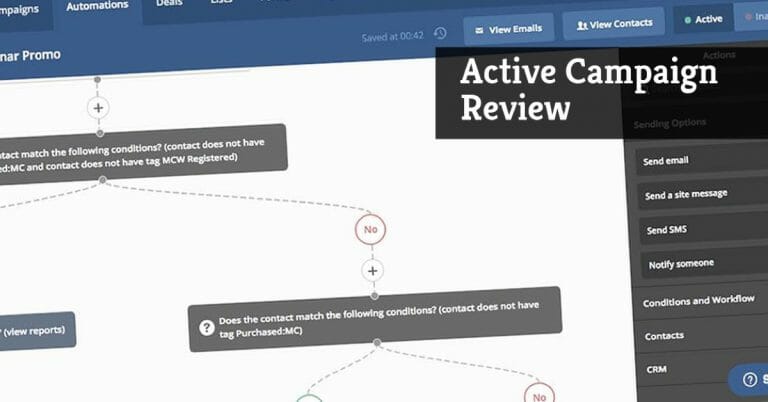
ActiveCampaign Review: Why I No-Longer Recommend this Former Favourite

Posted on May 20th, 2017. ActiveCampaign Review

As the author of one of the best-selling books on Email Marketing in history (Email Persuasion), I often get asked, “which system do you recommend for email marketing?”.

And my first answer always used to be “ActiveCampaign”. But no longer.

Here’s why I now recommend you should avoid ActiveCampaign:

As background, I was a pretty early adopter of ActiveCampaign and used and recommended it for close to a decade. I was even consulted by the venture capitalists who provided a key round of funding for them.

But there are two key reasons why I recommend small businesses and solo professionals in particular should steer clear of ActiveCampaign.

Before I get into it, you may be looking for an email service. Some you can try out for size are Kit and Brevo (see at the very end)

1. ActiveCampaign Can’t Be Trusted

After using and recommending ActiveCampaign for a few years I became an affiliate. That means when someone bought it through my link I would get paid a commission for every payment they made.

I also created ActiveCampaign specific email templates and training to help users.

It was never a huge earner for me, but over the years I must have brought in multiple 6 figures of income for ActiveCampaign. 

Then in 2022 something changed. ActiveCampaign contacted their affiliates to tell them that they would be changing the way commission was paid so that you would only earn a commission if you brought in new buyers in the previous period.

What that meant was that no matter how many customers you’d brought them in the past, you wouldn’t get paid any commission for those customers unless you brought in new and different ones each period. Even though Active Campaign was still earning money month after month from those original customers they wouldn’t be paying you any commission for them.

Now to a certain degree that’s fair enough as a policy moving forward. It’s a way of incentivising affiliates to stay active. And new affiliates can decide whether to sign up under those terms or not.

The problem is that they applied the policy retroactively. In essence tearing up the agreements they made with affiliates in the past to pay lifetime commissions and saying “actually, no we won’t.”

Assuming this was just an oversight I wrote to them asking them to clarify and explaining that you can’t just go back on an agreement like this. Affiliates who had brought them literally millions over the years and had been a driving force in growing their business had done so on the understanding that they would be paid lifetime commissions. Some of them had worked their socks off in the past to bring in customers for ActiveCampaign and just because they weren’t so active now doesn’t mean it’s OK to suddenly say “sorry, I know we promised lifetime commissions in the past and you put in all that work to help us on that understanding…but tough”.

But when ActiveCampaign wrote back to me it became clear this was no oversight – it was a deliberate and calculated “business decision” (their words). They had figured out that they would make more money this way and really didn’t care that they were breaking the agreements they’d set up with affiliates over the years.

I simply don’t want to do business with a company that thinks it’s OK to break its promises because it can make more money by doing so.

And if it’s happy breaking promises to the affiliates who help build it as a company, what other promises will it be happy to break?

I don’t want to find out.

2. ActiveCampaign is Moving Away from Small and Solo Businesses

When I started recommending ActiveCampaign it was a brilliant solution for my clients: small and solo professional businesses.

It had similar powerful features to much more expensive systems aimed at bigger businesses, but it was much cheaper and without all the bloat and unnecessary features that smaller businesses don’t need. And it didn’t try to be “all things to all people” – it did marketing automation well, and didn’t waste time and effort trying to add landing pages, live chat and other features most small businesses already have tools for.

That’s all changed now too.

After the affiliate issue I moved to a different email provider. But in Kathy’s business we stuck with ActiveCampaign because it’s so tightly integrated into how the business runs and we have a lot of complex automations that would have taken many weeks to recreate in another system.

In the last 2 years ActiveCampaign have raised the price of our subscription by 75%.

That’s right, not 7.5%, a massive 75%. Our costs have almost doubled in two years.

Have we got better service as a result? No – we’ve seen more bugs and worse response times. One bug we raised took nearly a year to get “resolved” – with the resolution being “well, we’ve changed the system since then so we don’t think it’ll happen again”.

What ActiveCampaign have done is add all sorts of fluff and features that small businesses really don’t need (like a “predictive sending” feature that decided the best time to send to Kathy’s UK customer base was midnight on Friday).

It’s very clear that they’re moving away from the small businesses who helped get them off the ground to what they see as a more lucrative market with larger businesses. And they’re doing it by raising prices so much that only bigger companies or those who are so locked in they can’t move will stay.

I can only see this trend continuing. So if you’re a small business I’d steer well clear – “great features for a value price” is out of the window.

In many ways I’m really sad that a platform I used and recommended for almost a decade is now one I active advise people to steer clear of, but the deliberate decisions they’ve made in their business have made it impossible to recommend them.

So, what email software do I recommend? 

Well you may be here to look at options for software similar to ActiveCampaign then.

1. Kit – is similar to ActiveCampaign in that it does advanced email automation without additional shopping cart and other features of the more expensive systems. I know many people who moved to Kit when ActiveCampaign started bumping their prices up. They’ve had excellent experiences since, and in some cases Kit actually did the migration for them, recreating emails and automations as well as transferring contacts.

And it is good for consultants / creators because you can have your newsletter promoted by other creators through their recommendation network. If you find you don’t get on with ActiveCampaign usability-wise, you could give them a look, in their free trial.

2. Another email automation system is Brevo, this was suggested by my friend Jordie van Rijn who also wrote a bit about the reasons behind why people choose ActiveCcampaign alternatives.

Brevo has been around for many years. The nice part about that is that it is very affordable, with a free version and then $8 starting price. And you can even do pay-as-you-go. Also nice is that it has the option to add a CRM and keep all your contacts in there.
Brevo is worth a trial. It is a bit cheaper than Kit, but you would have to add the recommendation network separately if you like that.

Featured

More Clients Memorandum

Too fast!

Posted on May 14th, 2017.

Last Sunday my email was about how your number one competitor is most often the status quo: your potential clients deciding not to do anything.

And I made the point that you're often better off focusing on helping those clients see that something needs to change rather than proving you're an expert (if they don't think they need to change it doesn't matter how expert you are, they don't think they need that expertise).

How do you do that?

The answer is to sloooow down.

A big mistake I've made myself  many times is to get too excited when I'm talking to potential clients. 

We start well by talking about problems they might have or goals they're trying to achieve. But what I used to do was that when I heard something I thought I could help with I immediately jumped to talking about what the solution could be.

I felt like I was adding value and proving my expertise by giving them lots of ideas on how they could solve their problems.

The problem for me was that they usually didn't hire me when I did that. 

I'm sure you've figured out why already. I was moving way too fast.

It obviously wasn't a surprise to the people I was talking to that they had a problem. And since they weren't living on a different planet, they were usually aware that there were solutions to that problem even if they didn't know the details.  

The reason they hadn't already implemented a solution was that to them, the pain of changing seemed greater than the pain they were experiencing from the problem itself (at least in terms of a gut feeling). So they stuck with what they already had.

By jumping straight to talking about solutions I was giving them details of something they weren't yet convinced they needed. Worse: the more details I gave them the more difficult and painful the solution seemed to be – so I was actually putting them off.

What I should have done instead was spend much more time exploring the impact of the problem. Asking about what effect it had. Using my experience to suggest possible side effects and contingent issues they hadn't realised were happening.

When I started doing that, my results took a big uptick. I was still adding value when I later suggested solutions. But this time I was suggesting solutions to people who now realised they needed them.

Of course, sometimes when you explore the impact of a problem it turns out it's not worth solving after all. In that case, it's your duty to recommend that they stay with the status quo.

But usually, that's not the case. Usually, they mistakenly stay with the status quo because you haven't properly helped them see the true impact of the problem they have.

Don't let that happen to you.

Featured

More Clients Memorandum

You’re more interesting than you think

Posted on May 11th, 2017.

I had an enlightening discussion last night.

I was chatting to a group of speakers, consultants and trainers and we were talking about using stories from your life in your talks.

The enlightening thing was that to a person, we all basically said: “well, I don't really have any interesting stories from my life…but I bet you have some amazing stories to tell”.

In other words, we all looked at our own experiences, and because we'd lived them (and re-lived them many times in our memories) they all seemed a bit dull to us. But to everyone else we mentioned them to, they were really interesting. 

And vice versa, of course. The stories about themselves that everyone else thought were incredibly dull were interesting and new to us. 

The same goes for your content too.

I can't tell you the number of people who tell me that they don't think anyone would find their area of expertise interesting enough to get regular emails about. Yet, of course, they themselves are incredibly interested in the emails they get from other people about topics those other people fear are deathly dull.

Familiarity might not breed contempt, but it certainly causes you to find your own stories and content a lot less interesting than other people do.

So if you're worried that others might not be interested in what you have to say, remember that they're probably thinking the same about their own content.

Try out your stories. Share your ideas and insights. Watch whether people perk up and listen.

If your stories are relevant to them and your content is about problems or issues they have, they'll be interested, I promise you.

It just takes a little bit of courage to start.

Featured

Thrivecart Review: Updated for 2020

Posted on May 9th, 2017. Thrivecart Review

Your shopping cart is one of the most important – yet often overlooked – components of your business. And that’s true whether you’re a solo consultant, a small business, or a fully fledged online marketer. Small changes to your cart to give it a higher converting design and make it an easier experience for your clients can have a huge impact on your sales.

In this review I’m going to look at the most important features you need in ANY shopping cart, and then how Thrivecart stacks up against those criteria.

Most of us, of course, start off with something simple like a PayPal button. But after a while you realise that you could increase sales and make your life a lot easier by investing in a proper shopping cart.

In my time I’ve used a huge variety of carts: from dedicated carts like 1shoppingcart, Ultracart and Samcart through to the carts built in to tools like Infusionsoft, Ontraport and Membermouse. For the last 9 months I’ve been using Thrivecart – a new cart that’s in the last stages of its pilot program. And I’m going to tell you up front that Thrivecart is by far the best cart I’ve used.

Read on for my in-depth Thrivecart Review

Featured

Get Clients Online

The Tools I Use To Run My Online Business

Posted on May 2nd, 2017. The Tools I Use

Probably the question I get the most emails on is some variant of “what's the best X?”.

What's the best email marketing system? What's the best landing page builder? What's the best shopping cart?

And, of course, there's no one right answer for everyone. What suits a full-time online marketer with a team behind them isn't the same as what suits a small solo business with limited time to do their marketing in. And personal preferences play a role too.

But what I can tell you about are the tools I personally use. These are the ones that I've tested and I feel are the best to help me run my online business without being too complex or too time-consuming. They might well be a good fit for you too.

Click here for details of the tools I use to run my online business »

Featured

More Clients Memorandum

You don’t have to do this

Posted on April 30th, 2017.

Here's a problem I often here from my subscribers and clients:

“I just can't find the time for all these different marketing tactics. How can I keep up?”

And the answer, really, is that you can't.

No one – especially us small businesses – can do everything. And you don't need to.

There's a story I heard a while back from James Clear about advice Warren Buffet gave to his pilot who was discussing career goals with him.

Buffet got him to write down his top 25 goals, then circle the absolute top 5.

The pilot told him “great, I'll really prioritise these 5.”

Then Buffet asked him “what about the other 20?”

The pilot replied, “well, these are important too, I'll try to fit them in when I can.”

But Buffet violently disagreed.

“You've got it wrong. Everything you didn't circle just became your Avoid-At-All-Cost list. No matter what, these things get no attention from you until you've succeeded with your top 5.”

The point is that every minute you spend on one of those 20 is a minute you're not spending on your top 5.

It's the same with marketing.

There are literally hundreds of different things you could be doing. And there are people out there telling you that you should be engaging on Twitter, advertising on Facebook, connecting on Linkedin, doing live talks, webinars, video, SEOing your site, ad infinitum. 

And all of these things can work. The problem is that every minute you spend on them is a minute you're not spending on your “top 5”.

You don't need to do everything. You can't do everything. You can't even do more than about 5 things – so don't try. It will just distract you.

Whatever your top 5 is, stick to it. Maybe test out one new thing at a time and switch that in to your top 5 if it works really well.

But don't listen to all the folks telling you about the latest, greatest techniques they're succeeding with.

Usually they're biased: they want to sell you some training on how to do it. And often they're an unusual case. it worked for them but it won't work for you.

But even if it will work for you, the question is “will it work so extraordinarily well that it's worth stopping one of the other things you're doing?”

Usually not.

Stick to your Top 5, get great at them, and reap the rewards.

Featured

More Clients Memorandum

How to lose a sale

Posted on April 23rd, 2017.

I needed to get some new photos done in a hurry recently for an external publication I was going to appear in.

I was heading in to Manchester later in the week, so made an enquiry with a photographer there.  I picked a high end one who worked with a lot of actors as I wanted some good headshots with “character”.

When I got an email reply to my enquiry about availability I noticed that the photographer was actually based way outside the city centre and I wasn't going to be able to fit in a visit.

The photographer was really good, so I decided I would just get a few quick ones done on the day with an alternative, and then go for a full shoot with him later on. So I emailed the photographer to tell him my plans.

My email must have hit something of a raw nerve as I got a snarky email back about how I was using the wrong criteria, how it would hurt my website and let down my image not to use him. How he was one of the last few classically trained photographers.

But apparently I should “fill my boots” if I could find someone as good as him.

I was quite taken aback. And naturally I decided on the spot that I wouldn't be using him for my full shoot after all.

I couldn't fathom what had prompted him to write such a snarky email that had lost him a certain sale.

Then I realised. I often do the same thing myself.

We all like to see ourselves as the lords of our own domain really. And when our expertise is challenged or ignored, even indirectly, we react.

I saw the fact that I was going to use someone else for the quick shoot for the magazine as a simple necessity due to a shortage of time. He saw it as a slight on his capabilities and proof that I didn't know what I was doing.

And I must admit, when someone ignores my advice or disagrees with it (especially in an area where I think I really know what I'm doing) I tend to see it as a bit of a slight too. 

It's usually not. There are a whole bunch of reasons why people might not choose to follow your advice that have nothing to do with you.

Take a deep breath. Don't immediately email back if you feel yourself reacting.

Treat people well, even if you disagree with them, and they may well come back to you. Lose your cool and send a snarky email and they're gone for life.

It's something I'm going to be more aware of in future.

Featured

More Clients Memorandum

Good news for those who give a damn

Posted on April 19th, 2017.

Yesterday's email had quite a tough message I guess.

It said, in essence, that if you want to get productive meetings with high potential clients, you've got to put some work in to create something valuable they'd be interested in discussing.

Some people work hard in the wrong way. They kill themselves playing a numbers game hammering the phones or sending out a zillion emails to people they don't know, trying to get a meeting.

And it does (sort of) work if you don't have anything better.

Make enough calls and eventually, you'll find some people willing to have a meeting with you. And some of them may indeed be good potential clients.

And you can use modern robo-calling technology to only connect you when someone picks up – so you don't waste quite as much time as you used to.

But it's the wrong kind of hard work (and frankly, I dislike the ethics of disturbing tons of people and wasting their time just so you can get through to a small number who might say yes. Very selfish.).

A much better form of hard work is hard thinking to create something valuable that many more people will want to meet you to discuss. Insightful case studies, a contrarian point of view, a benchmarking report.

You only have to do that hard thinking once and you can reap the benefits time and time again.

But instead, most people choose to do the “easy” hard work of networking, calling, chatting on social media.

There's a famous quote often attributed to Lincoln (but almost certainly not his) that says “Give me six hours to chop down a tree, and I will spend four hours sharpening the axe.”

Rather than chopping away with a blunt axe, sharpen your axe by investing in creating something valuable that people will want to talk to you to discuss. Or download from your website. Or attend a webinar on.

Not the same old stuff they can hear from everyone else. But something sharp and new.

Give a damn about the content you create and the clients you serve by doing that hard thinking.

The good news…no…the great news is that so few others are willing to do it that you'll stand out like a beacon.

Featured

More Clients Memorandum

You get the meetings you deserve

Posted on April 18th, 2017.

A lot of people struggle to get real meetings with potential clients.

By “real” I don't mean the “let's grab a coffee to talk about how we can help each other” or “lets do a 1-1” meetings beloved of networking organisations. The ones where both parties are hoping the other one will buy from them or refer them but that usually end up with nothing.

I mean meetings with potential clients where there's a strong chance they could become a paying client at some time in the future.

If you want more meetings with potential clients you need a good answer to the tough question: “why on earth would someone want to meet with you?”

“To find out how I could help them” isn't a good answer. Nor is “to understand more about them and their needs”.

Neither of those adds any value to the potential client.

Sure, you'll get some meetings that way. Some with tire-kickers. Some with people who already have a strong relationship with another supplier who just want to check the market. And a few genuine potential clients too.

But not nearly enough to build a thriving business.

Instead, craft something you could discuss with potential clients that would be useful, insightful and new for them. 

A review of the top trends for this year in their industry or your area of expertise.  

Benchmarking you've done on what their leading competitors are doing.

Case studies of businesses who've made the kind of major improvements they're looking to make.

Notice a common thread?

Apart from the fact that these are all incredibly valuable to a potential client, they also require you to do some work.

You can't just arrange a meeting and wing it with your super-smart questioning skills and off-the-cuff expertise.

You have to study current trends. Do the benchmarking. Prepare the case studies.

But if you put in that work, you'll get far more potential clients saying yes to meetings with you. And those meetings will do far more to build your relationship and establish your authority than meetings to “find out what they're looking for”.

If you put in the work you'll get the meetings you deserve.

And if you don't…well, you'll get the meetings you deserve.