Ian Brodie

Ian Brodie


Navigation
CategoryMindset
Featured

Mindset

An Irrational Fear of Worms…

Posted on April 28th, 2010.

Irrational Fear of WormsI've just been watching some of the free videos Dov Gordon is giving away as part of the product launch of his upcoming Alchemist Entrepreneur course (** Update – the course has now closed for new members, but you can still get access Dov's free “Plenty of Clients” manual which originally sold for $97 by clicking here **).

I've found the second video Dov released (“How to Win Your Customer's Hearts by Reading Their Minds.”) to be particularly appropriate for those in the professions – in fact, the first case study he gives is of an accountancy firm.

The focus of the video is on the mindset and tools you can use to “mindread” your customers – and so present yourself in a much more compelling way. There are some great points in it – particularly around getting beyond the rational surface justifications for things to the underlying emotional drivers.

One of the simple methods Dov discusses to help you better get inside the heads of your potential customers is a simple series of questions to ask your existing ones. But in the example he gives, he has a client who is very reluctant to ask those questions.

“I don't want to open up a can of worms” the client says.

Now that phrase rings a bell.

Over the years I've met so many people who don't want to open that proverbial can of worms. Be it asking clients for feedback, or asking a colleague what seems to be bothering them.

But guess what? That can is already open.

The worms are already out. They're slithering all over the floor. The only reason you can't see them is because you've got your eyes closed.

Closing your eyes doesn't help anything. If a client isn't satisfied, it's best to find out now rather than when they leave you. If a colleague has an issue with you, best to find out early on and fix it rather than later when it's gone too far.

Being open to client feedback, in particular, is very scary – but it's critical to develop the deep understanding of them you'll need to secure them as clients for life and win more like them. As Dov says, they need to feel you “get it”. And you can't “get it” if you don't know what “it” is.

Let's be honest: worms can't really do you much harm. And neither can finding out what your clients really think. So make sure you open that can of worms soon.

——–
If you're interested in getting access to Dov's free “Plenty of Clients” manual, click on this link. You'll need to sign up to get free access.

Just like with Amazon, I'll get a small commission if you eventually buy one of his programmes.

Featured

Mindset

Getting the Right Mindset for Selling (and it's not what you think)

Posted on April 16th, 2010.

A lot's often talked about getting the right mindset for selling. The focus is most often on having a positive outlook, a winning mentality, or even a “don't take no for an answer” attitude.

But I've found that when you're selling consulting services (as I do) or other high value professional services (as my clients do) then there's a different, more important mindset.

I call it a “matchmaking” mindset.

The thing you must have in the front of your mind when you go into a sales meeting is that's it's your job (together with the client) to find out if there's a good fit between you and them, and the service they need.

What I mean by that, is that it's not your job to assume you're the right person, then persuade them to hire you. It's your job to find out whether you're the right person (and also whether they and the work are right for you – it's mutual qualification).

You see, if you go into a sales meeting thinking it's your job to get a sale, it affects the way you interact with the client.

Some people get too pushy. They try to manipulate and convince the client to hire them. Others get too subservient – desperate for the sale they accept things they should push back on.

In both cases, the client picks up on your mindset. They know you're trying to sell to them. So they put up barriers. They don't really trust you. They second guess what you say because they believe (correctly) that your primary goal is to get a sale.

In contrast, if you have a matchmaking mindset, if you believe your goal is to figure out if there's a good fit – and you're comfortable that there might not be and you'd walk away in that case – then they pick up on that too.

They work with you in mutual exploration. Psychologically you're sitting on the same site of the table. It's the same relationship you'd have with them if they'd already hired you and you were working together.

That's a good place to be – because it also allows you to showcase to them what it would be like to work with you. If they feel good during the sales meeting they'll assume they'd feel good when they worked with you.

Mike Schultz calls it “Selling as you serve” in his excellent Selling Consulting Services free report.

So often in my career I've asked clients why they hired me over the other consultants pitching for the business. And so often, their answer (often drawn out of them with the aid of a beer) is that it just felt right. They were more comfortable with me.

And I put a lot of that down to the fact that I developed this matchmaking mindset. It was OK if they said no once we'd explored whether was a fit. I didn't put them under pressure. When I made a case for hiring me they knew it was because I genuinely believed it from the diagnosis we'd done – not because my primary objective was to get a sale.

And paradoxically, that meant I got more sales than the guys who focused on getting the sale.

——–

PS: Charter membership for the Selling Consulting Services online training program closed on the 16th April. It will re-open later in the year.

You can pre-register for when the program re-opens by clicking here.

Featured

Mindset

The Top 10 Ways to Screw Up a Client Relationship

Posted on April 15th, 2010.

I don't often do top 10 lists, but most of this one came to me in a dream (which is a pretty sad admission in itself) and it kind of amused me.

In reverse order:

10. Bad mouthing a client. We all have clients that we dearly love, but who drive us wild. There's a terrible temptation to moan and bitch about them to colleagues, business partners and friends. Don't. Delivered with affection by you, you might get away with it. Repeated second hand you certainly won't.

9. Courting a competitor. It doesn't often happen (but it happened once to me). Sometimes clients can get upset if we approach or start working with one of their competitors – especially if it's a particularly direct or aggressive competitor. Even though you know you won't be sharing anything confidential and you're probably working in a different area, it can raise big concerns. Best to avoid it, or check with your current client first.

8. Being too salesy. Clients don't like being sold to all the time – especially not when they're paying you to be there. Developing client relationships and winning extension work, expansion work and referrals which currently being employed by them is subtle art you have to learn.

7. Making a mistake. We all make mistakes. Clients are usually very forgiving of small mistakes – but sometimes not. Make quality control a priority. Far more serious than making a mistake though, is:

6. Covering up a mistake. You might be able to cover up a mistake and get away with it, or fix it before the client notices. It's surprising how often they find out though. And if they do, they now know that you prioritise your interests above theirs. It's difficult to come back from that.

5. Overpromising. Even if you do a brilliant job, if you've promised the earth and you only give them the moon, they'll be disappointed. And they'll know not to trust your word in future.

4. Surprises. Clients hate being surprised. Even more so if they find out about it from their colleagues, their customers or their bosses rather than you. Make sure you warn them in advance of potential risks, and you keep them regularly informed. Even surprisingly good news can be embarrasing if you're the last to hear about it.

3. Taking key decisions without involving them. Even if clients have hired you because you're the expert not them, it can be a big loss of face for them if you take key decisions without consulting with them and reviewing the options. Agree very early in your engagement how you will take decisions and who will be involved. And stick to it.

2. Not being open. Touch feely stuff this – but important. Any close relationship will go through high points and low points. There'll be moments when the relationship is tested. As your relationship develops, it needs to move beyond the factual and rational into the emotional. But many professionals feel uncomfortable sharing their feelings. If a workshop or meeting or event didn't go as well as planned, instead of being open about their disappointment and how they feel, they put on their “game face”. They hide their feelings and call it professionalism. They never develop really strong relationships with clients because they never let them in.

1. Indifference. This doesn't sound like a big crime – but it's #1 because it's the cause of more broken relationships than anything else. When you've stopped working for a client (or even when you still are but you're really focused on delivery) it's so easy to stop communicating. All those great corridor chats they found so valuable suddenly go away. You don't seem to care any more. The truth is that you still love them, but you're just so darn busy. But to them, it feels like you don't care – and that the only reason you had a relationship with them was because they were paying you at the time.

That's my top 10 – comments on some of the things you've seen that screw up client relationships would be much appreciated – just drop them in the box below.

Featured

Mindset

Is it better to be Truthful, or Interesting?

Posted on February 13th, 2010.

I've just had a rather heated argument with someone on a Linkedin discussion group that's had the side benefit for me of clarifying what I feel is the “right” way for professionals to promote their businesses.

I'll summarise the background briefly:

The person in question posts regular articles on a Linkedin group I'm a member of. His posts are pretty much “best practice” from a copywriting perspective. The headlines are always controversial and intriguing – they always make you want to read the article. And the articles are well written, opinionated and again, controversial.

Essentially, he's differentiating himself through his writing. He's not bland – he has clear points of view that I'm sure attract a lot of readers.

Last week, however, he posted on a subject I know something about. The business value of Twitter.

In a post entitled “Twitter is for Twits” he opined on how Twitter was a complete waste of time for businesses.

This is where it became intriguing for me. His headline was effective – it got people to read the article. The article was well written and got across a clear point of view.

The trouble was, I know a lot about using Twitter to get new clients. Both from my own experience and from others who I've talked to in depth about how they've used twitter to win new business. And my experience was very different.

His position massively oversimplified reality. In my experience, Twitter can work well for some people, in some circumstances, and used in certain ways. It's not a simple black or white, good or bad situation. Just like any other business development or lead generation channel, it requires careful thought to figure out if it will work in your circumstances, and to figure out how best to use it.

I wasn't the first person to answer the post – someone else posted a really thoughtful reply full of examples of how twitter could bring value. I posted my experience. I explained that I had 50,000 followers so I had some experience in the matter – and I went on to describe both how I had won (at least) a couple of clients via twitter and how others had done so with rather fewer followers but using a strategy of building deep relationships with a small number of people.

A few days later I received a Linkedin direct message from the person saying he was going to make a second post effectively using me as an example of how twitter was a waste of time because I had only won two clients despite having 50,000 followers.

I replied saying that that would be misinterpreting the facts. I use twitter for 10-15 minutes per day – and not every day. Getting two clients (and probably more, as I can't track all the clients who initially found me via twitter) and a bunch of other side benefits for 10-15 minutes per day in my spare time when there's not much else I can do for business development is actually a pretty good ROI in my point of view. Especially since I'm really, really expensive so those clients are very high value.

I also explained that whether twitter would be a valuable investment for people was not a simple question and required thorough analysis, not a blanket answer. And that I typically advised clients not to try to build large followings, but to use twitter to help build deeper relationships with a small number of potential clients.

Today I noticed he had gone ahead and made a new post on the Linkedin group exactly as he'd said. He'd completely ignored all the information and explanation I'd sent him.

Instead he made up a spurious calculation of how many people I must have touched with tweets over a year and claimed that only getting two clients from that “captive audience” viewing my tweets was an awful ROI.

Now measuring success with twitter in terms of new clients per tweet is like measuring success in advertising in terms of new customers per reader of the publication you've advertised in. Never mind that the one customer you got spent $1m and the advertising was free. Apparently it must have been a bad ROI because number of new customers per reader was low!

What he did was in many ways good copywriting. He continued to have compelling headlines and interesting, controversial and well-written material in his post.

But it was bad, bad advice. Worse, he deliberately gave that bad advice despite knowing better.

I can forgive him the initial post. We all sometimes write on a subject we're not experts on but which we feel passionate about. And sometimes we're wrong.

But I gave him detailed information which he then ignored when writing the second post.

Knowingly writing misleading information just to make an impact is wrong.

It may attract more viewers. It may build your reputation. it may make you more popular with people who share similar viewpoints.

But it's wrong.

People reading it will make bad decisions as a result that will cost them significant time and money – or worse.

And that brings me to my point.

As someone who writes a lot, I'll admit to trying to construct intriguing or controversial headlines to get more clicks to my site or readers to my articles. I've even constructed headlines to try to help my ranking in google.

But as professionals our primary duty is to our clients. We must give them the very best advice we can – not just say what best promotes ourselves.

Now sure, I may not be right all the time. And my passion may get the better of me and cause me to write or say something when I'm not in full possession of the facts.

But it is our absolute duty as professionals not to twist or ignore information to best serve our own interests.

So it's most definitely best to be truthful.

Interesting gets more readers and more traffic. But truthful is the right thing to do.

And it allows me to sleep at night.

And I like to think that in the long term, it wins loyalty and trust.

Featured

Mindset

The Business Development Drumbeat

Posted on December 9th, 2009.

The Business Development DrumbeatBack in the days when I was managing major business transformation projects, almost the first thing I did on every engagement was to instil a regular project management “drumbeat”.

Not that I particularly viewed myself as a Roman galley slave master. But the metaphor was clear. By establishing a regular cycle of project management reviews we ensured that the whole programme progressed forward in-sync.

Now of course, most consultants hate “bureaucracy”. They like to be self-managing and independent. But in practice, the regular drumbeat reviews always picked up things each team wasn't doing, or areas where they could integrate or work better with other teams. And they simply kept the pace moving. Knowing the reviews were coming up, each team leader managed the progress of their area better.

Not surprisingly, the same process works incredibly well for business development too.

Now whether you do them as part of a big team or you do them just for yourself, you need to take time out on a regular basis to look at your pipeline and identify actions you can take to improve its position.

A typical agenda for a business development drumbeat review might be:

  1. Review progress executing your Lead Generation tactics:
    • Reviewing progress vs your marketing action plans – i.e. are you successfully carrying out the activities
    • Reviewing the outcome of the tactics – e.g. how many short term leads (usually sales meetings) did you generate? How many long term leads (contacts passed into lead nurturing) did you generate?
    • Reviewing the progress of your Lead Nurturing activities – e.g. How many contacts did you make with your A/B/C clients and prospects vs plan?. How many prospects do you have in each phase of your nurture funnel (if you use one) and how is this progressing? What was the feedback from the contacts with A priority prospects and clients? How many nurtured leads converted into sales opportunities (i.e. a sales focused meeting for a live piece of work)?
  2. Reviewing the progress of your sales activities
    • What does each stage of your sales process/pipeline look like vs target and how is this progressing over time?
    • What was the outcome of your key sales meetings this period: lost sale, “treading water”, progress or sale?
    • What business did you close this period?
  3. Agreeing the critical activities your business needs to focus on in the
    next period

    • Are there shortfalls in the early stage pipeline?
    • Do you need to focus on Lead Generation?
    • Are some potential sales “stuck” and need senior effort to help progress?
    • What support is needed for each professional or business developer to help them progress and close their key opportunities in the upcoming period?
    • Are there any consistently weak areas in the process that need addressing?
    • Are any individuals consistently under-performing? Do they need coaching, support or reassignment?
    • Do we need more or different resources focused on lead generation or sales?

A simple review like this typically takes between 90 minutes to 2 hours and it's best done weekly (certainly for the first few iterations) or fortnightly.

At first it'll feel uncomfortable and bureaucratic. But persevere – the results will be well worth it.

Featured

Mindset

Make Business Development a Habit

Posted on October 27th, 2009.

Busy, Busy, BusyA couple of weeks ago I got a phone call from a friend which got me thinking about this particular topic.

The friend in question is David Lomas, who runs M3 Publishing – but more importantly, is the kind of guy who always has a dozen projects on the boil and has a huge network of connections.

David called me as he was driving home one Friday evening “just to keep in touch”. We spent the next 20 minutes or so just shooting the breeze, exchanging stories and brainstorming a little about a couple of projects we are working on.

Here's the point: 95% of people – when driving home on a Friday – would be listening to music, thinking about their weekend, or grumbling about the traffic.

But in David's case, the thing that came most naturally to him was to phone up his contacts to see how they were getting on.

The rest of us either wouldn't bother, or we'd be thinking “I don't want to intrude”, “I don't have a good reason to call” or “Why would he want to speak to me on a Friday afternoon?”.

We talk ourselves out of keeping in touch. Perhaps because we fear that 1 in 10 call where the person really doesn't want to hear from us. Or perhaps we just don't enjoy these part social, part business calls.

Now maybe David and others for whom business development seems to come naturally go through the same self-chatter like this. Or maybe they don't. But either way – it doesn't stand in their way. When they have a few spare moments they don't turn inward – they reach out to contacts and clients to stay in touch.

Another example: Steve Head.

Steve is one of the UK's top professional speakers. He's got that rare ability to entertain, inform and inspire.

Steve has an unusual business development approach – one I've not seen anyone else use: he keeps in touch with clients via text messages.

When I saw him at the Professional Speakers Association in Manchester, he talked about how he checked his phone after an evening away from home before a client seminar and was astounded to see that he'd sent 125 texts to clients the previous evening.

When I quizzed Steve about it he highlighted that every one of those 125 messages was personal and sincere. In other words, it's his way of keeping in touch with people he cares about – who also happen to be his clients. It's absolutely not a cold, calculated “what can I get in return” business development methodology. Nor is David's habit of phoning up his contacts.

Nonetheless, the habit shared by Steve and David is a healthy one from a business development perspective. By keeping in touch, they keep top of mind with clients. And because they both really care about their clients: every interaction they have deepens their relationships.

So do you have a business development habit? A way you keep in touch and deepen client relationships on “autopilot” without having to think, plan and prepare every time.

In reality – most of us don't do this naturally.

Personally, given a few moments spare, my first thought is to read a book or article – to expand my knowledge. I don't instantly think of getting in touch with current & prospective clients.

In order to get good at business development I've had to create habits which “force” me to do the right things. For example, keeping a list of my priority client and prospective client relationships and reviewing it weekly to brainstorm what I can do to help them this week.

It's not like I find keeping in touch with clients painful or difficult. It's simply that, unlike David or Steve, given a few spare moments, it's not my first thought.

And that's the thing. The world of the professional isn't filled with empty hours where we can start from scratch, plan how to keep in touch with clients, and carefully execute the plan. We're busy. Really, really busy.

We don't get hours spare at our desks. We get a few minutes here and there. Or we get an hour driving home or on the train.

If we have to think, plan and prepare our keep-in-touch activities, the reality is that they just won't happen.

So for people like me who aren't naturals at business development – we need to have already done our homework by the time our free moments arrive. If we're going to call people up (or even text them) we need to have thought through already who we're going to call and what we're going to say. Because if we leave it to our free moments, by the time we've figured out what to do the moment will be gone.

Most importantly, we need to get ourselves into the habit of staying in touch. Initially we have to force ourselves to do it with reminders and rituals. Over time, we'll come to do it automatically without having to force ourselves. We may even come to enjoy it.

And then we'll be indistinguishable from those natural business developers we all get so envious about.

Featured

Mindset

The Importance of Authenticity

Posted on October 21st, 2009.

Pointing to the TruthA few months ago I had a bit of a heated email argument with a fairly well-known marketing guru whose newsletter I subscribed to.

I won't mention names as the point of this post isn't about criticising others – it's about something I believe to be vital to succeed in business development: authenticity.

The argument started when I received an email from the guru sent from a hospital waiting room in a few moments he had spare waiting for his wife to give birth. His email said he had to be quick (for obvious reasons) but wanted to make an offer on one of his new products.

Nothing wrong with that, per se. In fact I believe it's good thing to share insights into your personal life with your community. It deepens your relationships – rather like the way you'd share personal information, ideas and hopes with a close business partner or one of your best clients. Your very best business relationships go beyond purely business.

The problem was that I received the same email 3 times over a 3 month period.

I emailed the guy, and he said he'd had a problem with his email system. OK, fair enough. No one has perfect grasp of their technology. I'm prepared to believe it was a genuine mistake that multiple copies were sent out.

But then I noticed that the emails were actually all a little different. They had slightly different headlines.

In other words, he'd been split testing the headlines.

Now split testing headlines is a good marketing practice in normal circumstances. But when your email is supposed to be something you rattled out quickly when in a hospital waiting room it actually leaves a rather nasty taste in the mouth.

Far from being the spur of the moment message it purported to be, this was a calculated marketing tactic. And it left me feeling manipulated.

Here's the deal: had this been a normal marketing email then, of course I'd have been perfectly cool with headlines or anything else being tested, optimised or whatever. Why shouldn't the marketer try to maximise the response they get?

But this was an email that purported to be a spur of the moment outpouring. His email personalised things – brought me into his world. It made me feel closer, as if I was sharing his experience.

For me then to discover that the email had been a calculated construction left me feeling used.

And that's the thing. The most powerful marketing & sales approaches are the ones that bring us closer to our clients, that deepen our relationships.

But they must be genuine.

Deepening a relationship can't be one-sided. You can't pretend to open up to someone, but really put a tight filter on what you say. You can't encourage a client to be frank and honest with you if you're not going to be frank and honest with them.

If you do try to manipulate, you'll be found out. It may not be as obvious as a split-test headline on a supposedly personal message: but people will discover your manipulation.

If you can't be genuine – then stick to more impersonal forms of business development: advertising, factual messages, value propositions.

But if you want to build deep. long lasting relationships with clients, you must, must be authentic.

Featured

Mindset

Are you Dr House or Dr Kildare?

Posted on September 4th, 2009.

I love House.

I think we all like to empathise with the outsider, the maverick, the tormented genius.

And in our professional lives, many of us secretly long to be able to play that role – at least sometimes. To be able to just use our huge brains to solve clients' problems without having to deal with the complex, messy emotional issues. To not have to deal with feelings & relationships. To just get on and do our job. “If only we didn't have to deal with clients…”

Often we label this emotional side of the job as “politics” – when in reality it's just dealing with people.

Of course, Gregory House doesn't put up with all that. He avoids seeing patients – because they all lie about their symptoms anyway. He uses cold, hard facts to make his diagnosis.

And he always gets it right.

It's a very seductive image. Dangerously so – because the real world just doesn't work like that.

For accountants, consultants, lawyers and other professionals; how we interact and deal with people has a huge impact on our success – that's hardly new news.

When we're selling our services, we#ve always known that at least to some degree, clients decide emotionally and justify rationally.

But often we castigate them for that – how foolish of them not to pick the “right person for the job” just because they didn't get on with them, or they didn't have great interpersonal skills.

But the idea that somehow the highly technically competent person with no social skills is the right person and has been unlucky in not being hired is just pure fantasy.

In reality, it takes great social skills to truly succeed in performing professional roles: Dr Kildare's bedside manner not Dr House's.

In the world of consultants and others who focus on organisational improvement there's a phrase that's as true today as when I first heard it nearly 20 years ago.

A B grade plan with an A grade implementation is infinitely better than an A grade plan with a B grade implementation.

Organisations only change and improve to the degree which their people change and improve. The greatest ideas and plans in the world are no good if you don't have the people skills to get them implemented.

So in fact, the “foolish client” who based a lot of their hriring decision on which consultant they got on well with and they felt would “connect” with their people actually made a highly rational decision. They hired the person most likely to successfully implement change in their organisation. The technocrat with poor people skills would have had great ideas and produced a great report – but that report would be left on the shelf unimplemented.

Or take an architect. If they can't connect with their clients, they can't find out what they're really looking for. They won't be able to get behind “I'll know it when I see it” to a deep understanding of what would really delight their client.

Even lawyers and accountant need their clients to open up to them, to share with them what they're really looking for. They need to understand how they really feel and to get real feedback on their performance in order to do a great job.

In the real world, it's Dr Kildare not Dr House who gets the best result.

The learning for business development?

Often, the skills you need to attract and win new clients are actually the skills that will make you a great professional. Don't view them as two different worlds.

Featured

Mindset

Building a Portfolio of Business Development Approaches

Posted on July 6th, 2009.

Different PeopleA common problem many professional firms face is overly relying on only one approach to business development. They focus all their efforts on word-of-mouth & referrals, or on networking, or on responding to tenders/RFPs. Typically, the basket they keep all their eggs in is the one they are the most comfortable with: it's worked for them before, they have the skills to do it, and it doesn't push them outside their comfort zone.
This works fine when times are good and there's plenty of work for everyone. But in tougher times, if that one source dries up, they are left stranded.

I advise my clients to run a portfolio of different approaches. I usually get them to focus on four very different areas:

  1. Current Clients: investing in “superpleasing” their highest potential current clients to secure their business, win expansion and extension projects, and get referrals to new clients. Typically this area uses the approaches of Client Relationship Management and Key Account Management.
  2. High Probability Potential Clients: targeting 3-5 named companies which meet their core targeting criteria (size, industry/sector, geography, leadership, cultural fit, etc.) and where they have a good chance of winning business (e.g. an ex-client, previous/current contact,  a good opportunity for a referral in). Typically, personal approaches are used: direct contact where there is a pre-established relationship, referrals where there aren't.
  3. Ideal Potential Clients: targeting 3-5 named companies who meet all targeting criteria and would be the absolute perfect clients – but where there are no immediate entry routes to establish a relationship.  Typically, longer-term relationship building approaches need to be used: for example searching for and courting potential referrers, running a targeted mail campaign sending selected articles and research, offering to run a free seminar for a client organisation.
  4. “Bluebirds”: these are clients who are won unexpectedly rather than being directly targeted. How can you win these sort of clients? By having a channel or approach aimed at getting visible to a broad set of potential clients. For example: public speaking at events with a high preponderance of target clients, running a seminar at a large client industry event, optimising your website for keywords frequently used by target clients. The key here is to use approaches which give access to a broad set of potential clients (rather than the more focused approaches discussed earlier which narrow down to a few specific clients – but with a higher probability of success with each one).

Focusing first on current clients is common sense, and should be a core part of any business development strategy. After that, adopting a portfolio strategy like this balances out the short-term potential of the High Probability Potential Clients with the long-term higher gain of the Ideal Potential Clients – while still keeping the possibilities open for serendipitous new business through the use of a “bluebird” channel.

Larger firms with more business development time & resources available can adapt this strategy by increasing the number of Current, High Probability and Ideal Potential Clients targeted – and adding an extra “bluebird” channel.

My advice for most firms though is to always add resources in that order. For many professionals, the “bluebird” channels (e.g. web, speaking, articles) are seductive ones as they offer the hope of attractive new clients without the challenge of personally engaging in the process. Resist the urge to focus too much effort on these channels – the big payoffs are usually in the more targeted, personal approaches.

Image from FreeFoto.com

Featured

Mindset

Creating a Marketing Habit in 21 Days

Posted on June 15th, 2009.

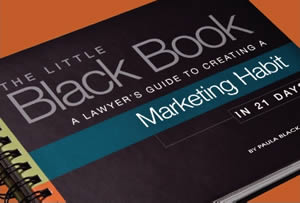
Creating a Marketing Habit in 21 DaysPaula Black has just published The Little Black Book: A Lawyer’s Guide To Creating A Marketing Habit in 21 Days.

Having got my hands on a pre-release copy, I can say that not only is the book beautifully produced (the sort you'll want to keep flipping open and dipping in to) but it's filled with the sort of practical hints that can really help ingrain a marketing mindset.

And as I've repeatedly written, the key differentiator between successful Rainmakers and “also rans” is that Rainmakers have a repeatable business development system. Sometimes it's unconscious – they just get on and “do their thing” when needed. But a great many highly successful business developers have developed their skills and their “system” consciously. This book is a great way to do that for yourself. It's not a book of heavy theory or completely new ideas. Just practical tips and advice – the “blocking & tackling” we all need to do become effective marketers.

The first part of the book is a day-by-day activity guide to ingrain client-focused marketing habits into your psyche. The second is a guide to developing a marketing plan, focused on your current and former clients, marketing within your firm, and marketing by joining organisations. the final part is a series of marketing “pearls of wisdom” from successful lawyers.

48 Hour Deal: 34 Free Gifts for Purchasers of the Book

For the next 48 hours, Paula is running a special deal where anyone who buys her book via the Law Marketing Portal can claim “The Smart Layer's Toolkit” – 34 ebooks, free subscriptions, podcasts and other gifts.

Among the contributers to this are:

  • Larry Bodine on “Thinking Like a Rainmaker”
  • Josh Fruchter on “The Top Ten Law Firm Website SEO Best Practices”
  • Julie Fleming on “The Reluctant Rainmaker: A Guide for Lawyers Who Hate Selling”
  • Patrick J McKenna on “Getting Unbeatable Testimonials”
  • Paramjit Mahli on “How To Grow Your Law Practice on a Shoestring Budget…Media Relations”
  • David Barret on “Social Media for Lawyers”
  • and a contribution from myself: “Building Your Client Base Through Referrals”

Go to Paula's Law Marketing site to order and get the free gifts.