Ian Brodie

Ian Brodie


Navigation
CategoryMarketing
Featured

Marketing

Vertical Differentiation

Posted on April 19th, 2010.

You can't turn a corner these days without bumping into a marketing consultant banging on about the importance of a Unique Selling Proposition (USP) and differentiation.

I've written on the topic before – and in my view, for most service businesses it's actually far more important to focus on creating compelling client value than it is to worry about being unique or differentiating yourself.

However, it's a topic I keep coming back to and thinking about. For while clients buy based on the value you can bring, they may well initially notice you, and remember you based on your uniqueness or differentiation.

So there's a challenge here: being different helps you get noticed and get remembered. But if you're different in a way that doesn't add value to a client then you won't get hired.

Now you can try to find ways of being unique and different that are also valuable to clients – but it's difficult. Competition being what it is, if something is valuable to clients, other people will notice and create and provide that service too. Unless you're very, very smart or a great reader of early trends – the chances are if you spot something that no other professional in your field is doing – it's because clients don't value it.

But there is another way to think about differentiation.

Too often, when we think about differentiating ourselves we think of what I call “horizontal differentiation”. We want to be viewed as doing something different to our competitors. As not occupying the same space in our niche.

But think of some of the most successful professional service firms. Do they really do something different to their competitors?

Is McKinsey the only firm that does Strategy? No.

Do Skadden, Arps, Slate, Meagher & Flom* or other top law firms really do law differently? No.

Do AECOM design different buildings from the rest of the profession? Again, no.

What sets these firms apart is not that they are differentiated horizontally. They don't really do anything different to the other firms in their niche.

They do things better.

They're “vertically differentiated”. Clients perceive them to be in the same horizontal space as their competitors – but above them.

That's the perfect positioning for a professional service firm. Delivering the same services as their competitors (because they're the services clients need). But delivering them better.

How do you differentiate vertically?

Well to some degree, the perception of superiority comes from delivering great results.

But all professional firms have a truckload of testimonials and happy clients. It's difficult to differentiate on that.

What allows these firms to stand head and shoulders above their competitors is perceived authority.

Being a consultant, McKinsey is the firm I know best (in my career, I've had to come in after McKinsey projects and pick up the pieces on more than one occasion – yet their reputation is immaculate).

I've asked McKinsey clients about why they perceive them as being better than their competitors. And I consistently get two answers.

It's the quality and depth of their thought leadership – and the insights their partners share when they meet with them.

Clearly these two are related. Face to face insights come from personal experience – but also from the thought leadership the firm produces. Thought leadership is usually grounded in the personal experience of the team.

But perceived authority isn't the exclusive domain of global giants. At a local level, there are consultants, accountants, lawyers, many professionals who are viewed as authorities in their field.

They're the ones who “really know their stuff”. Who get invited to speak at events, and who are the first to get the call when there's a tricky or out-of-the-ordinary issue.

They get the best work, and they charge the highest prices.

So next time you're thinking about differentiation: think about up rather than sideways.

____

* I could have named a different law firm – but blimey, I love that name!

Featured

Marketing

Are You Exploiting This Key Strategy To Get More Clients?

Posted on March 23rd, 2010.

Campaign PlanWe've all heard multiple versions of the “it takes 6 touches before a customer will buy from you” saying. But how true is it?

In my experience it's very true.

But it's also very misleading.

You see, it kind of gives the impression that all you need to do to win a client is communicate with them in some way 6 times.

But if you got the same advertising flyer from someone 6 times would it make you more likely to buy? Or if you met the same person at a networking event 6 times, but your conversation never got beyond what they did?

To make an real impact on a client, rather than 6 (or more) random, unplanned or ad-hoc communications, you need a planned sequence of communications with each one furthering your relationship with them.

You need a campaign.

You can only really run campaigns for your highest potential clients. They require detailed thought, planning and preparation. You must think through what your clients need to know and feel about you before they'll feel comfortable hiring you (or initially meeting with you if that's the goal of your campaign). They you need to deliver a series of communications which focus on addressing each of these “know and feels”.

A classic example would be a direct mail campaign.

Imagine you have a prospect list which includes ten really high value potential clients. Winning work with any of those ten could start a relationship which could set you up for life.

Unfortunately, you don't know any of them. You've searched, but you can't find anyone you know who could refer you in to them. So you're considering writing or calling them directly.

Rather than a one-off letter which has a small chance of being read and acted upon (even with great copywriting) you should instead create a tailored campaign for each of the key clients.

Create a sequence of letters – each demonstrating something you need them to know before they'll be comfortable meeting with you. And each adding value.

For example, in your first letter you could send them a recent whitepaper you've written highlighting your expertise in an area you believe they need to focus on.

The next could include some case studies – each one providing useful information while showing you've done this before and are a safe pair of hands.

The next could be a link to an online video where you talk about how to make results from improvements in the area actually stick. Here they'll get a sense of your personality and a feeling for whether they'll be able to work with you.

The next could be some research you've done, a selection of related articles, etc.

Each letter includes something of high value to the potential client. But each item of value also doubles as a proof point that you're an expert in your field, that you get results, that you'd be great to work with – whatever it is you want them to know.

Now using a campaign like this is relatively high cost. Not exorbitant, and you should have a lot of material you can reuse for it. But it does require thought and planning.

But for your very high potential clients, the ideal ones you really want to work with, it's well worth it. If you were on the receiving end of such a campaign, would you be more likely to respond to it than a series of random sales-oriented letters or cold calls? I'm sure you would – and so will your clients.

Featured

Marketing

Are Traditional Websites Dead?

Posted on March 4th, 2010.

Are Traditional Websites Dead?I recently recorded a podcast interview with Raintoday.com entitled “Is the Traditional Website Dead?” (You can listen to it free here).

The focus was specifically on websites for professional service firms – and reflected my experience with the success of my own site over the last 9 months. Despite being a rather small outfit (and determined to stay that way) – my site attracts more traffic than the sites of some of the top 30 consulting firms globally.

Why is this?

The primary reason, in my view, is that my site focuses almost completely on content. If you come to the home page, what you see is the latest of my articles or videos – and not a pitch for my services.

This helps me in two ways.

Firstly, it means I have lots of content indexed by google, with lots of keywords that potential clients may be searching on. And it's much easier for related sites in my field to link to a resource site like mine or specific articles on it than it would be to link to a corporate website that focused on pitching it's services. Sure, I do a lot of Search Engine Optimisation work and have a little bit of “secret sauce” I sprinkle around, but none of this would work without having a content rich site.

Secondly, once visitors arrive at my site, they're much more likely to stay than with a traditional site.

If you think about most professional services, the reality is that our clients don't need our services all the time. No one redoes their strategy every week, takes over a company every month, gets divorced every fortnight or changes their accountant daily. They use our services intermittently.

And if you think about the buying cycle for our services, our clients rarely wake up with a sudden need for our services that they weren't aware of before. The problems or opportunities that trigger the need for them to hire us usually start off small. They're a minor irritation or perhaps a glint of an idea.

Then, over time, the irritation gets bigger or the idea begins to firm up. They start looking around to find out more and to see what can be done. Years ago, they'd speak to colleagues and friends – maybe even dip into a book. Today, of course, they search the web.

So the first time a potential client visits my site (or any professional service firm's site) the chances are that they're not in buying mode. They're looking for useful information. And if they don't see useful information on the first page they come to, they're going to click away pretty quick.

Even if you have a blog or articles page just one click away from your home page, it's too far. You're not going to catch the attention of most visitors.

The BBC's website is always a good place to look for best practices. What do they have on their home page? Lots and lots of content. In the BBC's case it's primarily clickable headlines linking through to news, sports, business, entertainment or other stories. But the main point is that it has useful information rather than just a list of the BBC's services. You're encouraged to dig further and engage with the site.

So it should be with professional services websites. 90% of the time, your visitors will be early in their buying cycle. You need them to engage with you, get value from your site – and in the process discover that you know what you're talking about and you could be someone they could work with.

What's needed for this is not a traditional website with clever copy showcasing your services. it's a content-rich website that puts value for the visitor front and centre of its approach. Faced with this sort of website, your potential client is much more likely to engage with you and to keep coming back for more value.

Then when their initial irritation turns into an unbearable pain they need a solution to – you'll be the first on their list to contact. You may not win every time, but you'll be in pole position.

Featured

Marketing

Meet: Lawyers – great idea

Posted on November 13th, 2009.

Over on my (small but very friendly) Rainmaker Network Linkedin group we've been discussing using Linkedin for business development in professional services.

One idea I'd not heard before came from Julian Johnstone. He's set up a group called Meet: Lawyers where lawyers who are travelling can set up “meetings for coffee” with other lawyers in the cities they're visiting.

One of the best sources of referrals for many professionals is other professionals in the same field. This might either be in complementary or non-competing specialisms (a lawyer in a corporate practice referring to a divorce lawyer in a family law practice for example) or even from direct competitors (a divorce lawyer recommending a “competitor” as they clearly can't represent both sides in a case).

Sometimes professionals are asked to recommend people in other locations – and small firms are at a disadvantage here as they often don't have good contacts outside the town they practice in.

The Meet: Lawyers idea really helps with this. And for a lawyer alone in a different city, provides a bit of social contact too (hey, someone's got to feel sorry for lawyers).

Check out Julian's group here

Featured

Marketing

Is the Free Initial Consultation Dead?

Posted on October 7th, 2009. Is the free initial consultation dead

Yes, in my view.

At least in the way it's normally done.

For many years, consultants, coaches, trainers – and even accountants and lawyers – have been offering “free initial consultations” as a way of encouraging clients to engage with them.

The logic, of course, is that once they work with them for an hour or so, their fears about whether the professional knew their stuff and whether they'd be able to get on with them would be laid to rest.

Some of the more marketing savvy professionals learnt how to focus the initial consultation on identifying the client's most urgent problems and plotting an outline action plan rather than simply giving away an hour's free work. In that way the client was taken on a journey where they realised just how big their issues were and were more inclined to buy as a result.

But in my experience, potential clients are becoming less and less likely to take up the offer of free initial consultations.

The change is coming from two angles:

  • Firstly, they've experienced some professionals using the initial consultation as a blatant opportunity to sell to them. They now view initial consultations as risky – with a high chance they'll be subjected to a sales pitch and receive little value from the session.
  • Secondly, they've discovered that they can achieve many of the things they got from an initial consultation in other ways (for free too) without having to engage with a professional. Meeting a consultant, lawyer or other professional can be a daunting prospect. So if they believe they can get similar value from a free e-book or video or seminar recording – then they'll often prefer to take that option. And they can take this option at their own convenience – without having to travel or wait until the professional is available.

My advice:

Most professionals benefit greatly from having some form of free give-away which gets a client to begin to engage with them. It can demonstrate their expertise, give clues as to what they're like to work with, and generally reduce the client's perceived risk.

But the day when free initial consultations worked well for this are gone. If all you have as a freebie is a free consultation you need to think again, and create something else you can offer as an easier to bite option.

It could be that after sampling your free report or teleseminar, the potential client is ready for a free consultation (or they may be ready to buy straight away). But it's unlikely that today's time-pressed cynical executives will jump at the chance of a free consultation if nothing has come before it to demonstrate your capabilities and personality.

Featured

Marketing

Win New Clients with Talks and Seminars

Posted on October 1st, 2009.

Talks and SeminarsThe key to marketing professional services is to demonstrate rather than claim.

And if you're marketing yourself and your skills then one of the strongest ways to do this is through talks and seminars.

Clients hire professionals who understand their problems, have the expertise to solve them, and who they feel they could work with productively. Few other marketing approaches give the professional such an opportunity to demonstrate their understanding of client problems and their expertise, and give a feel for what they would be like to work with.

Talks and seminars are in the top tier of effective marketing approaches.

I remember the first time I saw a consultant give a talk on marketing at a networking event many years ago. The talk was pretty bland. Nothing special or new. But the consultant had a queue of people wanting to talk to them at the end. It didn't take me long to figure out that this could be a great way of engaging with new clients.

So how do you go about getting speaking engagements & seminars?

It's something I asked myself as I was planning my marketing priorities for 2009. I wanted to grow my practice locally (historically, the vast majority of my work has been international, or London based and I wanted to cut down on travel somewhat). Talks and seminars seemed an obvious route to go down.

I followed a simple three point plan which can work for many other professionals too. I'm focusing here on speaking for free in order to market your services, rather than paid speaking engagements.

Step 1: Get Good

An absolute prerequisite to marketing your professional firm through talks & seminars is that you must be very good at presenting your material.

That means both good content, and a good presentation style.

It sounds obvious: but so many professionals overlook it. The number of mediocre and sometimes very bad presentations I've been to in the last year is simply staggering. A bad presentation does more harm than good. Yet so many people fail to prepare, fail to practice, fail to get feedback – and so fail to get any new clients.

In my case, I'm a fairly experienced presenter, having done sessions at events from local seminars to global conferences. And I've been professionally trained in presentation techniques. But I still felt I needed to make sure I made a great impact, so I decided to make an investment in my capabilities in this area.

Early on, I focused on being able to really “ace” just one talk (on getting more referrals). So I developed it, practiced it, got feedback on it, and did it at multiple events in a variety of formats.

I also joined a local Toastmasters group to work on my presentations skills, and hooked up with my local Professional Speakers Association (in the US, this is the National Speakers Association) to learn from watching really polished performers in action. I also took coaching on developing compelling presentations. And, of course, I read a ton of high quality material on the subject.

Even if you're an experienced speaker or seminar presenter, you can almost always improve. And at bare minimum, you need to make sure that the presentations and seminars you do showcase you at the top of your game. Make sure you prepare them well (please, no endless stream of bullet-point PowerPoint slides), you practice and rehearse, and that you get honest feedback from experienced presenters.

I thoroughly recommend joining Toastmasters. If you don't know it already, it's not about becoming one of those guys who loudly announces the guests at functions – it's about becoming a great speaker. The most valuable element of Toastmasters is that you get to practice in a safe environment and get constructive feedback. And because you go back regularly rather than it being a one-off training course, you learn via the optimal method for skills training: one thing at a time not a whole bunch of new ideas heaped on you.

Step 2: Get a Plan

I'd wanted to get more involved in speaking & seminars right from when I set up my own practice. But for a year it just didn't happen.

The reason: wanting and wishing aren't the same as planning and doing.

But once I'd set myself a target of 12 presentations/seminars to audiences with at least 10 or more potential clients I was spurred into to action. I broke down the target into months and planned the activities I needed to do to hit that target. I brainstormed potential events & venues, thought through the topics I would focus on that would be likely to lead to potential clients engaging with me, and identified the resources I would need to achieve my goal.

Once I had my plan in place, I became more aware of possibilities for offering my services as a presenter. And by reviewing the plan and progress initially weekly and then monthly, I kept the pressure on myself to hit the target.

And it worked. I've already beaten my target 9 months in.

Simple stuff. But I hadn't done it the year before, because I hadn't taken the simple step of setting a target and making a plan.

Step 3: Get Booked

For me, there were three key steps which got me the opportunities to speak I needed.

The first step was to clarify with laser focus just what sort of events and audiences I needed to speak in front of.  Obviously I wanted to get in front of potential clients and referrers. But the key was being able to articulate this clearly so that I could identify potential events and forums myself, and that I could explain it to others so that they knew what I was looking for.

Here, it helps to be focused. If you specialise in working with a particular sector or client type, or working on a specific set of issues or functional area then there are often professional associations or groups similarly specialised. And they're pretty much always on the lookout for good speakers with interesting topics.

If you're less specialised there are theoretically more potential groups to speak to: networking events, chambers of commerce, etc. But there are also more people offering to speak at those events.

The second step was to have done my preparation. I knew the topic I wanted to speak about, and it was one of great interest to my potential audience. I prepared a clear summary of the topic so that when I spoke to potential event hosts,  they could see I had something of value ready. It's infinitely more credible than the tactic many people use of “I'd like to speak at your event. Any subject really, just tell me what you want me to talk about.”

And having a lot of publicly available material available on my blog helped. Potential hosts could quickly see I knew what I was talking about.

The third step was to go for an easy win and then leverage it. I managed to get a recommendation from someone who knew me well to an event host they knew well too. It was enough to get started and I made sure I did an excellent job at that first talk. From then on being able to say “I've just presented on abc to the xyz group…” gave me much more credibility in getting booked for other events.

Once I had a handful of talks under my belt, I was able to expand the range of subjects  I covered too.

Now it's Your Turn

My plan worked, and it worked quickly. And I managed it as a sole practitioner without admin support. As a professional in a bigger practice you should certainly be able to harness the skills of your marketing/business development team to help you both with the material and in getting events booked.

You may even be able to host some events yourself. However, I do advise that unless you already have a big, responsive contact list it's much easier to get a good attendance by presenting or running a seminar at a well established event or forum.

Remember: the key to making it happen was to set a target and build a plan. Everything flowed from there.

Set your own target. Build your own plan. And it will flow for you too.

Featured

Marketing

Beyond Customer Service

Posted on September 24th, 2009.

I popped in to the post-office today to post a few parcels off with some “goodies” in them for friends.

At the counter next to me an old lady was showing one of the assistants an old newspaper with a really old photograph showing a scene from about 80 years or so ago. She was telling the assistant about how there were only two people left alive who remembered that event and how she wanted to post a copy to her son to show him.

The assistant listened to her, asked her questions about the scene, and expressed interest about various aspects of the story. They were still going when I left.

You could tell from the discussion that the old lady really appreciated someone just listening and paying attention to her. Amid all the impersonality of modern life, here was someone who was making her feel human and valuable again.

Does this kind of customer service have a payoff? An ROI? Will it increase loyalty or sales?

Quite frankly I don't know. And I don't need to know.

Life isn't all about calculating whether you'll get a payback from everything you do. We all owe a duty of care to our fellow human beings – especially the elderly. To try to calculate whether those actions will have a payoff is crass in the extreme. Just do them.

Apologies for going a bit off-topic. There's no great sales or marketing learning in this story. No insights for professional services. But maybe something for us to thing about as human beings.

Featured

Marketing

Book Review: Professional Services Marketing

Posted on August 5th, 2009.

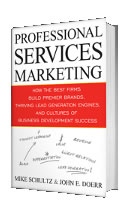
Professional Services Marketing BookOne question I get asked quite often is “Can you recommend a good book on marketing professional services?”.

And to be honest, my normal answer is “not really”.

For sole practitioners and small consulting firms, Robert Middleton's Action Plan Marketing material is an excellent resource. For larger firms there's very little on marketing that I find helpful, so I usually point them to the relevant chapters in more general works like Maister's Managing the Professional Service Firm, Harding's Rainmaking or Denvir & Walker's Growing Your Client Base.

Well, now I have something to recommend.

Professional Services Marketing
is Mike Schultz & John Doerr's new book focused on helping professional firms build strong brands, create a “lead generation engine” and develop effective business development cultures.

Here's the difference with Professional Services Marketing – it's based on what really works in professional services.

As well as running their own professional service firm, Schultz and Doerr advise leading law, accountancy and consulting firms. And as the founders of Raintoday.com, they have access to the most recent research on lead generation methods, client buying criteria, fee rates, etc.

The impact of that experience and research comes through loud and clear in the book. What you won't find here are unsubstantiated theories or concepts from product marketing crudely adapted to a services environment. Instead, it's based on practical, real-world-tested ideas.

Example: In Chapter 6 – Don't Worry About Your Competition, they debunk a number of myths hung-over from product marketing. “You must be a first mover” – nonsense. “You must be #1 or #2 in your market” – pish. “You must have a USP” – yeah right. I come across these myths frequently (and unfortunately, I hear them repeated by too many trainers and consultants who should know better). Schulz & Doerr demonstrate here and throughout the book that they're not afraid to break with conventional wisdom and to “tell it like it is”. Using research and experience they show how these ideas are not only wrong for professional service firms, but that by following them they can damage your business.

OK – so here's what the book actually covers:

  • Marketing Planning
  • The Key Levers of Lead Generation
  • Options for Fees & Pricing
  • Competition
  • Culture
  • Branding
  • Uniqueness (and why it's a mistahe to think you need to be unique)
  • Thought Leadership
  • Marketing Communications
  • Lead Nurturing
  • Targeting
  • Selling
  • Networking
  • “Hustle”

No book is perfect, of course. The chapter on selling has some excellent ideas (particularly about the importance of surfacing client aspirations as well as problems) – but isn't enough on it's own to turn a stumbling accountant or brash lawyer into a competent salesperson. I'd have liked to have seen pointers to more detailed resources in this area like Let's Get Real or SPIN Selling.

But overall – how highly do I rate the book? Put it this way: I got a free electronic version of the pre-release version of the book – but I've stumped up my own cash to add a hard copy version to my library for reference.

You can buy it at amazon.com or for us Brits, at amazon.co.uk.

If you do buy it in the next few hours, you'll be eligible for a number of free bonuses, including a Raintoday webinar and articles from Larry Bodine, Ardath Albee, Brian Carroll, Jill Konrath, Vickie Sullivan and others. Once you've bought the book, go to professionalservicesmarketingbook.com/bonus-materials to get access to them.

Featured

Marketing

10 Linkedin Tips for Professionals

Posted on August 1st, 2009. Linkedin Tips For Professionals

Linkedin Tips For Building Your Professional Presence And Getting More Clients

My latest tips on building a Client Winning Profile for Linkedin are now on a free, short video – click here to watch it.

Linkedin is the “social network for business” and now has over 200 million users.

And many Linkedin users, myself included, have found new clients through it, and enhanced relationships with existing clients. But many others have found it to suck up a ton of time for very little gain. So here are 10 quick tips for getting the most from Linkedin.

1. Make your profile client focused

The first thing you do when you join Linkedin is to create a profile. And since Linkedin has slots for your previous job roles, qualifications, etc. there’s an almost overwhelming temptation to make your profile look like your CV.

Resist that temptation.

When you first meet potential clients you don’t rattle off a huge list of companies you’ve worked for and the responsibilities you’ve had – that would bore the pants off them. So don't do the same on Linkedin.

Most effective introductions focus on who you help, and what problems you help them solve or results you help them achieve. Then if asked more, you say a bit more about what you do – perhaps giving a little backstory as to why you are uniquely qualified to help, or an example of the work you do.

Linkedin is for making connections – and for the majority of professionals that means clients and business partners, not recruiters.

You need to design your profile to have the impact you want on those connections. Treat it like your introduction at a networking meeting.

Think about the impression you want to make on your potential clients. What will get them interested enough to read your profile? Probably something telling them you work with people just like them and deal with the sort of challenges they have.

What will make them read on? Probably some interesting examples that spell out and “prove” the results they could get by working with you.

What would make them contact you? Well, at minimum a call to action with details of how – a website, phone number or email address.

Whatever you do, don't just stick your CV details in there.

2. Get connecting – but…

Linkedin works on connections. The most powerful use of Linkedin is to find new clients and business partners through the search function or directly via your contacts' connections. The more direct connections you have, the more opportunities you have to connect. I still see people who’ve made all the effort to set up their Linkedin profile – but who have so few connections that they don’t get any benefit.

The Linkedin toolbar for Outlook provides an easy way of inviting the your Outlook contacts and people you email regularly to connect with you.

However, there’s a catch…

3…Choose your connection strategy carefully

There are two very different strategies to connecting on Linkedin: “Open Networking” and “Trusted Partner Networking”.

In business networking generally, the value you get from your network is a product of the size of your network, and your ability to “convert” connections into productive business (work, a referral, etc.). You can grow the value of your network by getting more connections, or deepening the strength of each connection (getting to know people better, helping them out, etc.)

On Linkedin, one strategy for getting value is to be an “Open Networker” or LION (LinkedIn Open Networker). Open Networkers focus on growing the size of their network by initiating and accepting connection requests from as many people as possible. Open Networkers typically have many thousands of connections. This means that when they search for useful relationships (potential clients or business partners), for example looking for contacts in specific companies, or geographies or with specific interests or job titles – they are much more likely to find them (exponentially more likely because of the way Linkedin connections work).

The downside of this strategy is that with thousands of connections they don’t know many of them particularly well, if at all. They’re essentially using Linkedin as a giant Rolodex or telephone directory rather than as a way of making deeper connections. That’s neither good nor bad – it just means that if they find someone they want to connect with through one of these “shallow” connections, they’re unlikely to get a strong referral to them – they'll still have to initiate a relatively cold contact.

The other strategy is to have fewer but deeper connections – a “Trusted Partner” strategy. Here you only connect to people you already know and trust. Most likely from face-to-face interaction, but possibly from online interaction too.

With this strategy you have less chance of finding someone via a search because you have less connections. But if you do find someone, it'll be through someone who knows and trusts you – and they'll be able to give a strong referral to you and put you in touch with the person you’re interested in connecting with.

The downside to the “Trusted Partner” strategy is that it’s a bit like going to a face to face networking event and only speaking to the people you already know. You deepen your relationship with them – but you don’t build any new relationships.

Personally, I take a “middle way” and I recommend you do the same.

I don’t actively go out and connect with huge numbers of people. But if someone wants to connect with me, and their profile looks interesting – then I’m very happy to connect with them, even if I don’t know them. If they do turn out to be a “spammer” (I’ve only had this happen once with over 1,000 connections) then I can always disconnect.

This way, my network expands significantly. I meet new people who may turn out to be helpful to me, and I may be helpful to them.

I always try to take the time when people connect with me to send them a message to start a conversation rather than just accept the connection but never speak to them. That way we find out more about each other and it may lead to interesting and valuable discussions. At minimum, it means that if I want to ask a favour later, we'll actually have interacted before.

4. Use Search to find potential clients and business partners

This is perhaps the most important of my Linkedin Tips.

Many people get going on Linkedin but fail to use it to help their business. Absolutely the most effective way I've found to gain business value from Linkedin is to find potential clients and business partners. One of the things I do in my consulting practice is to help clients get more referrals for their business. And one of the key things I teach them is to be very specific in who they ask to be referred to.

Linkedin allows the ultimate in specificity. You can search for exactly who you want to be referred to – by company, by geography, by name, by job title, etc. And you can search across your entire network at once. Or you can look at the contact list of an individual to see if there’s anyone you’d like to be connected to.

Almost everyone I've taught to do this has been staggered by just how many people their contacts know that they'd love an introduction to. Yet before using Linkedin they had no idea that they were connected.

Once you’ve identified people you’d like to be introduced or referred to, rather than try to connect them directly, give your mutual connection a call and ask them if they can connect you. That’s much more polite than going directly, and it’s much more likely to be successful.

5. Give recommendations and endorsements to get them

Recommendations are very helpful to have on your profile. They’re a clear indication of the quality of your work and the relationships you form.

But begging for a recommendation isn’t a great strategy.

If you want to get recommendations, use Linkedin to give them to people you’ve worked with and who have done a great job for you. Linkedin will show them the recommendation to approve, then ask them if they want to reciprocate. They probably will.

Similarly with the new Endorsement feature, if you endorse someone, they'll be notified and you're likely to get a reciprocal endorsement in return. if you get an impressive number of endorsements you can move them up in your profile to just under your summary. So the first thing people see after finding about about you is that lots of people think you're great.

6. Have a helpful Professional Headline

Another one of my most impactful Linkedin Tips. When people find you in searches on Linkedin, the initial thing they see is a little box with your name, photo, and your “professional headline”.What most people have in their headline is their job title. “Owner at XYZ Company” or “Principal consultant at ABC Ltd”. By default, unless you change it manually, Linkedin takes the headline from your last job title.

Unfortunately, this doesn’t give people a clue as to whether you might be able to help them, or might be interesting to connect to.

You should treat your headline like your introduction when networking. Focus on what you can do to help people.

My headline, for example is “Straight talking advice for Consultants and Coaches to help them Attract Clients and Win More Business”. It’s much more useful in telling people what I actually do than using an “official” job title like Managing Director. That will get more people to click through to my profile and maybe begin to interact with me.

You can edit your Headline via the Edit My Profile option.

7. Join Linkedin Groups to connect and interact (but be careful)

Linkedin groups are essentially discussion forums for specific interest groups. They allow you to find out the latest news, and to join in debates on topics of interest. You can join groups both of interest to you professionally, and the groups where your potential clients “hang out”.

Some people have reported great success in meeting potential clients and building their credibility by being helpful and answering questions on Linkedin Groups. But be careful. My own experience is that far more people end up wasting hours of time in fairly idle chatter, or in trying to sound clever but with very little impact.

Before you join a group, click on the link to check out the group statistics and look at the activity stats. What you want to see is a lot more comments than discussions started every week. Lots of comments means members are actively engaging with each other. Lots of discussions with few comments means people are just posting their stuff and no one is reading or engaging with it.

8. Use Status Updates to subtly remind your contacts of what you do

Linkedin status updates are a nice way of helping to stay top of mind with contacts. If you were to call or email all your contacts any time you did something small but interesting, it would quickly become seen as pushy or spammy. But updating your status is an non-intrusive way of getting a gentle reminder out.

Depending on their settings, your contacts will get a regular email with a summary of the status updates of their contacts. And they will see the updates on their Linkedin homepage. Mostly it will just be “so and so updated their profile” type messages. So if your status update has something interesting in it (“Ian has just run a seminar on consultative selling skills”) it will remind them of the sort of thing you do and may even trigger them into action.

Recently, for example, I put up a status update saying I’d run a training course on Marketing for Consultants for the Institute of Business Consulting. That prompted one of my old colleagues to get back in touch and we came to an arrangement about sharing training material.

You can also share your latest blog post and other useful resources. Be careful through: Linkedin isn't Twitter and your connections won't appreciate you making dozens of updates a day as it will mean they can't won't anything from their other contacts.

9. Watch others’ status updates to initiate contact

Keep an eye on status updates from others – it can be a good opportunity to get back in touch – especially if they’ve changed jobs or have set out on a new venture. Even small status changes can help give you something to start a conversation – the sort of smalltalk needed to keep dialogues and relationships going in between more meaty topics.

These days many CRM systems like Salesforce and Highrise offer “Social CRM” features. They make it easy to find your contacts on Linkedin (and Facebook and Twitter) and track their activity on their profile page on the CRM.

10. Keep your use of Linkedin in balance

This is less a tip about using Linkedin, and more a tip about not using Linkedin.

Do bear in mind that Linkedin is just a tool. And it's one that's very easy to spend too much time on. Endlessly tweaking your profile to make it just that little bit more perfect isn't going to bring you any new business. Nor is chatting away on a discussion group to buddies you already know.

Be judicious in your use of Linkedin. Get a good profile. Make sure you're connected to people you know would recommend you, then harness that network to get introductions to potential clients. In a couple of upcoming articles I'll show you who to do that in the most effective way.

But make sure you're not sucked in to spending hours a week playing around with it.

More Linkedin Tips:

How To Optimize The New Linkedin Profile >>
The Number One Linkedin Mistake And How To Fix it (Free Video) >>
The Real Secrets of Linkedin >>

Featured

Marketing

Reconnecting With Old Clients: A Step-By-Step Guide

Posted on July 14th, 2009. Reconnecting With Old Clients

Reconnecting with old clients can be your very best source of new business and referrals.

You've probably even got a pretty good “little black book” of names – people who already know, like and trust you. People who could be good sources of referrals or even new work with their companies.

But there's a problem.

You're hesitating. You haven't been in touch for over a year. You don't want to seem like you're “begging” for work. You don't want to risk them seeing you as “too salesy”.

And wouldn't they be knocking on your door if they needed your help or had a referral for you?


Click here to read what you should do »