Ian Brodie

Ian Brodie


Navigation
AuthorIan Brodie
Ian Brodie

Ian Brodie

https://www.ianbrodie.com

Ian Brodie is the best-selling author of Email Persuasion and the creator of Unsnooze Your Inbox - *the* guide to crafting engaging emails and newsletters that captivate your audience, build authority and generate more sales.

Featured

More Clients TV

Boost Your Credibility With A Powerful Origin Story

Posted on March 14th, 2016. Boost Your Credibility With A Powerful Origin Story

Ever read a comic book or watched a superhero film?

One thing you'll have noticed in every one is that the hero always has an “origin story” – the way they got their superpowers.

A powerful origin story makes the hero more credible and believable. Spiderman can climb walls and shoot webs because he was bitten by a radioactive spider. Superman can fly because he comes from a planet with a red sun. Batman is driven to fight crime because his parents were gunned down in front of him as a child.

As an expert in your field, you have “superpowers” too. Clients hire you because you can do things that others can't. And just like with a hero, having a clear origin story of how you acquired your powers can make you more credible and believable.

In this week's video I share a number of effective models that you can build your origin story from depending on your own specific experiences.
 
Click here to watch the video »

Featured

More Clients Memorandum

A great way to develop new products

Posted on March 13th, 2016.

Here's something I've been doing for the last few years that I've found is the best way for me to develop new products.

It's something I thought was relatively unique to me because most of my business comes through my Momentum Club membership program. But I realised recently that almost any business can adopt the same approach. Pay attention and you should be able to tweak it to fit your situation.

What I do is pretty simple. Whenever I'm thinking of producing a new product I make a free version of it for my existing membership site members first. I've done this with my Facebook Advertising course, my Client Winning Websites course, my Lead Magnet Masterclass course and my Content Marketing Mastery course.

I go through a few phases. Firstly I confirm via email and our private Facebook group whether the course I'm planning would be useful.

If it is, I then draw up a timeline with the main components I'm going to include and start working on those modules bit by bit, usually over 4 or 5 weeks.

I drip-feed those modules out to my Momentum Club members whenever they're available. And recently I've started doing short Facebook Live broadcasts with Q&A for members only.

Based on the feedback I get I update the modules or add new components. At the end of the 4-5 week period, I have a course that I know delivers what my best customers are looking for that I can now promote to new customers.

This method works brilliantly for me because there's no downside. Normally when you produce a course, if you don't get many sales then you've wasted a lot of time and effort.

In my case, even if I don't get any new sales, I've created new content and given it free to my existing customers in Momentum Club. I've built goodwill and created yet another reason to join and stay in the club.

Of course, I'm quite likely to get new sales because the development of the course has been steered by my very best customers. But even if I didn't, I'll still feel like it was a great investment of my time.

And there's no pressure when I'm developing the course. Because it's a free gift to existing members, if I get ill for a week and the timetable slips or there's some other delay, there's no anger or pressure to deliver. It's all goodwill all the way and viewed as a bonus.

The end result is a course that's much better than it would have been had I tried to develop it on my own. And happy customers even before I sell a single copy.

Even if you don't run a membership program like me, you can do something similar in your business as long as you've got some existing customers.

As soon as you have an idea for a new product or service, test it out with those existing customers.

Email them or call them first and get their feedback. That in itself is a good way of keeping in touch and broadening their awareness of what you do.

Then invite them to participate in a pilot version of the new product or service.

That might be a one-off workshop or training course run across your client base. It might be a day's consulting for one of your best clients in this new area to test out your new methodology or approaches.

There are many ways you can do it. The key is to make it really valuable for your clients and to get feedback from them to help you shape the new product or service.

Don't try to sell the service itself to them – this isn't a sales pitch in disguise. But quite naturally, if you have a couple of their staff on a brilliant new course for example, word of mouth will generate demand and pull in more people for further paid versions of the course.

Worst case, you'll have generated a ton of goodwill with your existing and ex-clients and reminded them of the other things you do. Best case, you'll have shaped up a great new product or service, generated demand for it, and got a bunch of testimonials you can use to promote it.

Now doing all that will take time and effort. But it's going to be a lot less effort and a lot more effective than starting from scratch and then having to market your new product cold to people who don't know anything about it.

As I say, I have a natural outlet for this with my membership program. But with a bit of thought, you can do this in pretty much any business.

The upside is a great new product. The minimum you'll get is happy customers.

Featured

More Clients TV

How To Build Authority Using Video

Posted on March 9th, 2016. How To Build Authority Using Video

A special 5 Minute marketing Tip for you this week, and another in my series of tips on how to build authority in your field.

This video is an interview with Steve Washer. Steve's both a personal friend, and a real expert in building authority using video.

In the video I ask him what the best ways are of using video to build authority, and how to get started if you've not done video before or are in the early stages with it.

If video is on your agenda, this is well worth watching.
 
Click here to watch the video »

Featured

More Clients Memorandum

Could you do what Bruce Henderson did?

Posted on March 6th, 2016.

A bit of a history lesson today, but bear with me because I believe it's directly relevant to you and how you can win more clients.  

Back in 1963, the Boston Safe Deposit & Trust Company asked Bruce D Henderson to set up a management consulting division for them.

The “division” was initially Henderson, a back room in their offices, and a phone.

And Henderson faced the challenge many of us face today. He had strong incumbent competitors (McKinsey had been going for 45 years by that time) and he lacked the contact network and well-placed alumni that consulting firms of the day used to bring in new clients.

But what he did have was ideas. Great ideas about how businesses could improve and grow.

He knew if he could get those ideas into the hands of senior executives in large organisations, he stood a chance of winning them as clients.

So in 1964 he started mailing essays he called “Perspectives” direct to senior executives. 

He didn't wait to write a book. He didn't try to get articles into prestigious publications, or to ask for introductions, or to get on radio or TV.

He sent his essays directly to them.

And they weren't just any essays. Henderson described them as a “punch between the eyes”. Deliberately provocative. Focused on big, important topics. In Henderson's words:

“Statements that senior executives would find believable are not supported. Only provocative material is argued. The subject matter is chosen to be deliberately provocative, significant in implication, and relevant to the policy decisions of corporate competition.”

Henderson steered away from content that his potential clients already know or could hear from his competitors. He focused on his own distinctive point of view.

Within 10 years the Boston Consulting Group, as they came to be known, had become the leading strategy consulting firm in the US.

All started through Henderson's approach of getting his best ideas directly into the hands of his idea clients.

Could you do something similar?

Do you have great ideas that would help your clients and are different from what your competitors are saying?

Our ability to “go direct” has never been greater. With paid advertising on Google, Facebook or Linkedin we can get our message to exactly the right people based on demographics, geography, income levels, what they're interested in, what they're searching for, they job they do, their level of seniority, which industry they work in, and a whole bunch more.

Writing a book and hoping it's a success is great and can absolutely boost your authority. Appearing on TV or radio or podcasts can do similar. As can writing guest articles or appearing on social media.

But for a surefire strategy for getting your ideal clients to take notice, nothing beats going direct.

Featured

More Clients TV

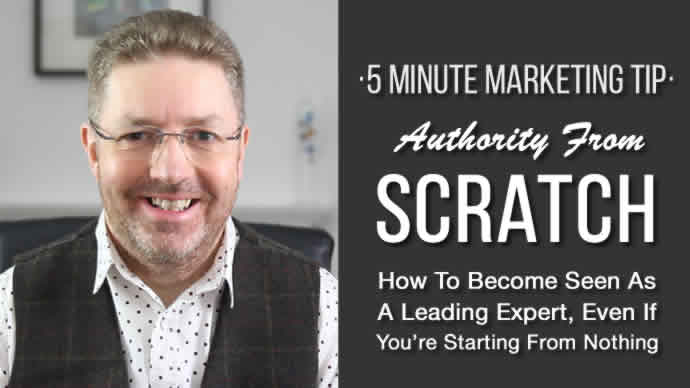
Authority From Scratch: How To Become Seen As A Leading Expert, Even If You’re Starting From Nothing

Posted on March 1st, 2016.

 
World's longest title. Bold claim :)

In March I'm going to be focusing my 5 Minute Marketing videos, blog posts and emails on Authority Marketing: Strategies for becoming seen as a leading expert in your field.

In today's video I give my tips and experience on a really tough but highly relevant question: “How do you become seen as an authority if you're starting from scratch, without a best-selling book, popular blog or top-ranked podcast?”.

I give my view on what I would do to build Authority From Scratch in today's video…
 
Click here to watch the video »

Featured

More Clients Memorandum

Surprise!

Posted on February 28th, 2016.

Last week I talked about how you can position yourself as being different by “picking a fight” with someone or something you disagree with.

Another method is to highlight something you do that surprises your clients (in a good way).

I'm sure there are techniques or methods you use to get results with clients that they find surprising or didn't expect would work so well.

These are often the best ones to focus on when you share tips and insights in blog posts, videos or other content. Chances are that if your current clients find them surprising, so will your potential clients.

And if they're surprising, it means they're not hearing the exact same thing from your competitors. It means you'll be sharing a unique message that will differentiate you from the mass of sameness out there in the market.

10 minutes with pen and paper should give you a starting point for this. And make sure you're listening out for when your clients are surprised by how successful something you do is. That'll give you more to add to the list. 

Whenever you create content, prioritise the surprising over the obvious. Not only does it help differentiate you, it's an awful lot more interesting for your audience too! 

Featured

More Clients TV

How Value Trumps Relationships (When it comes to Winning New Clients)

Posted on February 22nd, 2016. Value Trumps Relatonsips

We all know that relationships are vital when clients come to choose a supplier to work with. That's why it makes sense to make building relationships a core part of your marketing.

But if you're trying to win a new client who already has an existing supplier they may have been working with for years, then unless that supplier messes up or is basically “asleep at the wheel”, you'll find it incredibly difficult to “out-relationship” them.

Instead, you're better off focusing on trying to “out-value” them. I explain why and how in this 5 minute marketing tip video…
 
Click here to watch the video »

Featured

More Clients Memorandum

Pick a fight

Posted on February 21st, 2016.

Do you disagree vehemently with an idea, practice or person in your field? Or as my kids would put it, do you “have a beef” with them?

If there's nothing you strongly disagree with, then maybe you're not that different to everyone else in your field? 

We all like to think we're different. But sometimes we see minor shades of difference as big, whereas our clients ignore those minor shades and see us as largely the same.

That's why thinking about who or what we disagree with can help us to see where we're really different.

Personally, I think it's a better idea to disagree with an idea or a practice than with an individual. And if you do particularly disagree with an individual it's often better to talk about the practices they espouse that you disagree with rather than them personally.

And make sure you're not just disagreeing with something that every else disagrees with! 

In my field, for example, it's become a bit of a cliché to say you'll teach people how to get more clients without pushy, aggressive selling. I don't see any courses for sale or any trainers who promise to teach people “how to get clients using pushy, aggressive selling”. So what are we really fighting against here?

If you want to get noticed by starting a fight, pick one with the big, popular kid; not the little weedy one no one likes anyway.

My current “beef” is with the new trend of marketing that's complex and takes a ton of time. You'll see it under the guise of “funnels” and “product launches” and “marketing automation”.

There's nothing wrong with what's being taught per se, provided you're a full-time marketer or have a big team to support you.

But for the majority of us who have something like a day a week to spend on our marketing, it's not helpful to try to implement something so complex that we never get anywhere with it.

Especially as we can do so much with simple principles and techniques that are much easier to implement. 

So what do you have a beef with? What do you stand for and against?

Featured

More Clients TV

How To Avoid The “Hollywood Blockbuster Trap”

Posted on February 16th, 2016. Hollywood Blockbuster Trap

There's a trap that very many business owners fall into when they launch new services and products that I like to call the “Hollywood Blockbuster Trap”.

It's a problem that the big Hollywood studios have because of the nature of their products, but it's a problem we small business owners shouldn't have. Despite that, huge numbers of businesses run into difficulties because they try to launch products like a Hollywood studio would, with disastrous impact.

I reveal what you should be doing instead in this week's video…
 
Click here to watch the video »

Featured

More Clients Memorandum

Are you in a satisfied or sceptical market?

Posted on February 14th, 2016.

Most of us operate in fairly mature markets.

Perhaps our specific services or products are relatively new, but the end-results we get for clients are typically end-results that have been promised to clients for aeons: more sales, lower costs, higher productivity, better leadership, etc.

In a mature market it's especially important to be different somehow as there will be lots of competitors promising the same end-results as you. 

If the only thing you tell your potential clients is the same “I can get you X” message as your competitors then they'll pick the one who promises X at the lowest cost.

But how to best differentiate? I've found that there are two different types of mature market, each with different opportunities.

In a Satisfied Market, the majority of products and services on the market do what they say and deliver the core benefit clients are looking for.

Toothpaste is a good example of this. Pretty much every modern toothpaste on the market cleans your teeth and reduces cavities. 

So given that customers are largely satisfied with the ability of toothpaste to clean their teeth, you need to focus on additional benefits and on niches that value those additional benefits.

That's why today we see so many variations of toothpaste. Toothpaste for whiter teeth, for fresher breath, toothpaste for kids, toothpaste for people with sensitive teeth.

In the car market, every car will get you from A to B. So the focus is on other benefits, often emotional ones. Safety, prestige, economy, environmental impact, image.

Are you in a largely satisfied market where clients believe that most service providers do a good job and meet their core needs? If so, you need to focus on the additional benefits your services can bring and find a niche that really values them.

The second type of mature market is a Skeptical Market.

In a skeptical market, clients have bought products and services before yet haven't got the results they've been looking for. This might not be due to any failure of the products or service provider – just that what they're looking for is tough to achieve. 

Anti-wrinkle cream is a good example. I'm sure they work to some degree, but fighting ageing is a tough battle. Similarly, in many service markets it's often tough to help clients get the improvements they're looking for. Improving leadership, teamwork, presentation skills, time management, sales, costs – all of these have multiple contributing factors and sometimes despite the best efforts of service providers, clients just don't get the results they were hoping for.

That means that when clients are looking for help in the future, they're often highly skeptical of the claims of potential suppliers.

Rather than the problem in a Satisfied Market of clients choosing competitors because they believe everyone can do a good job, in a Skeptical Market clients often choose no-one – because they don't believe anyone can help.

So your main challenge in a Skeptical Market is to get clients to believe that you can actually deliver. That's often done with testimonials and examples. But often you also have to show clients that your “method” is different to everyone elses and that's whey you can get results when everyone else has failed.

In the world of anti-wrinkle cream you'll notice that adverts tend to focus on the new ingredients the creams have. Whether it's “Q10” or “Trylagen PCB” or “Palmitoyl Oligopeptide” – the purpose of focusing on new ingredients is to give potential buyers a reason to believe that this cream might work when others have failed.

Are you in a skeptical market where many clients have struggled before to get the results that you're promising them? If so, you need to focus your marketing on proving you can succeed where others have failed.