Ian Brodie is the best-selling author of Email Persuasion and the creator of Unsnooze Your Inbox - *the* guide to crafting engaging emails and newsletters that captivate your audience, build authority and generate more sales.
A few weeks ago I was asked to contribute my thoughts to an article on B2B (business-to-business) email marketing.
I thought I'd check out what others were saying on the topic and came across this humdinger from one of the world's biggest CRM companies on what they think is the difference between B2C (business-to-consumer) customers and B2B customers…
My assumption, based on their advice, is that they're either living on a different planet or perhaps have just never actually met a business-to-business customer in the flesh.
This idea that somehow people check in their emotions at the door when they enter the workplace is as pervasive as it is muddle-headed.
Of course, business-to-business buying decisions tend to be bigger. But if anything, that means there are more emotions involved, particularly fear.
I'm sure you've seen many, many cases where the “logical” and “financially best” solution lost out to an alternative that was seen by buyers as being less personally risky.
And business-to-business purchases tend to involve multiple people. meaning that politics and personal rivalries rise to the fore too.
So of course, logic and finance are important for business-to-business decision-making. But don't let anyone, even huge companies who should know better, tell you that emotions aren't vital too.
When you're marketing to businesses, you're not marketing to the business itself. You're marketing to human beings who work in that business.
And just because they work for a business doesn’t mean they leave their humanity, their emotions or their sense of humour at the door. Far too much business-to-business marketing is bland and corporate and devoid of personality and interest. As a result, the human beings on the receiving end just ignore it.
As a small or solo business you have the tremendous advantage that you can afford to be different, to take a few risks to actually be funny or angry or joyful in your marketing.
Stuff a big company either wouldn't dare to do or would water down through endless committees.
You can talk to potential clients like they're real emotional human beings, not logic and finance-driven robots.
That's a huge advantage you have over bland corporates and the people who believe the nonsense about corporate buyers being all rational and emotionless.
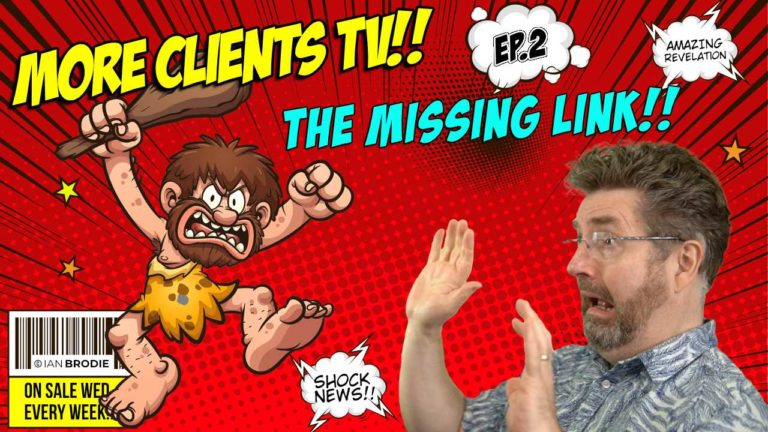
Over the years. I've created or advised on the creation of literally hundreds of marketing plans. Right from small one-person businesses through to billion-dollar corporations.
And almost all of them – even the really big companies – have all had one missing vital component that puts their success at serious risk.
In this Episode of More Clients TV I reveal what that missing link is, how to fix it, and what I've found is the best approach to implement that fix.
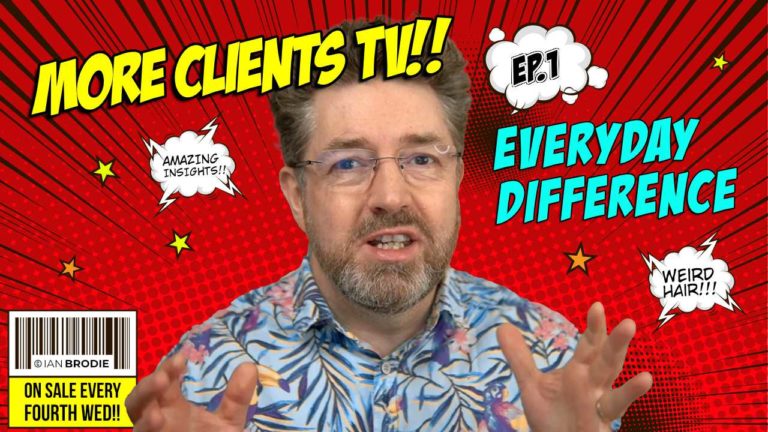
If you want to stand out and be remembered, you need to be doing something different.
Typically when we think about differentiation we think about “big difference” – our value proposition, niche and service offers. But often that “big difference” doesn't actually make any difference to our day to day lives.
We disappear off to a retreat, brainstorm our difference, update our website, then move on and keep doing the same old things we did before.
Usually what makes the biggest impact on clients and potential clients isn't what we say about how we're different. It's what we do differently.
It's the little stuff we do every day they notice. This episode of More Clients TV explains how.
I discovered this week that Ogilvy are doing online courses.
One of the world's most prestigious (and expensive) advertising agencies are doing courses on behavioural economics and social media for £90 a pop.
Will it ruin sales of marketing courses for those of us who are a tad less well-known?
Or will it bring lots of new buyers into the market and grow it for all of us?
I suspect the latter. But there's no real way of knowing for sure.
What is certain though is that things will change. And keep on changing.
And some things will always stay the same.
People will always buy things they want and need from people they know and trust who've demonstrated they can deliver.
Your real battle isn't with Ogilvy or McKinsey or that annoying leadership coach who your clients keep talking about.
Your real battle is to make sure you deeply understand what your clients are hungry for, that you're building credibility and trust with them all the time, and that you offer them something that feeds their hunger and does them good.
Competition kind of becomes irrelevant if you do that.
I bought a bucket hat this week in the colours of my team, Newcastle United, from back in the 1970s when Supermac was marauding up the pitch for us and smashing in the goals.
Probably my earliest football memories are of our cup run in 74. And although we didn't win, I still get a warm glow thinking of that time (and I can still sing “Howay the Lads” – our cup single by the Barrie Brothers).
I think one of the attractions of nostalgia like this is that we remember when things were simpler.
Our lives seem so complicated these days. So much pressure, so much to do. And nothing seems easy.
It's little wonder we get a warm feeling thinking back to a time when the weight of the world wasn't on our shoulders and everything seemed so straightforward.
Given the pleasure that simplicity gives us, it's strange then that in our marketing we seem to end up making things much more complicated than we need. Both for ourselves and especially for our clients.
We seem to get so tied up trying to be clever or persuasive or influential that we end up just confusing our clients.
I can't tell you the number of times I've seen people offering products and services where I can't figure out what on earth they're supposed to do or why I would be interested.
Or where I would need a PhD to figure out how I'd benefit from them.
One of my golden rules for marketing is to make things as clear and simple as possible.
All these clever tricks of persuasion people tell you about run a very poor second to simply being clear about what you're offering and what people will get from it.
Don't make people guess or jump through hoops to figure out what buying your products or services will mean for them and their business. Spell it out in simple terms.
It may not be clever. But my word, it's effective.
We've got a lot going on chez Brodie at the moment, so when I dragged myself reluctantly out of bed this morning and slurped down my extra strong coffee, I jumped straight to work.
A couple of hours later after recording and uploading a Course that Sells bonus video I realised I'd forgotten to write and send today's email.
Doh.
Back when I was running consulting teams pretty much the only “leadership” thing I was good at was getting buy-in from clients and involving them early so that everyone was on the same page and we didn't have to persuade them about recommendations later – they'd been intimately involved in working on them themselves.
It meant my teams got off to slower starts than my peers who rushed off to get the job done. But we finished faster and got much better results.
A decade or so ago when I started writing more, I discovered that a few minutes spent outlining what I was going to write saved me a ton of wasted time and effort later – and resulted in much better articles and emails.
And today I've been reminded that a few minutes “wasted” first thing in the morning to review your priorities makes sure you're doing the right things in the right order.
Aside: it was about two years into my first job when I realised I could no longer carry my to-do list around in my head and it made sense to write it down. Nowadays I struggle to remember where I've put it :)
So the desperately dull but much-overlooked secret to consistent and effective marketing is to think first and think consistently.
Make a quarterly plan for big projects. Plan your week. Review your priorities first thing in the morning.
It's easy to push out marketing in favour of client work (or frankly, anything you find easier).
It's rarely a good idea.
Keep putting off your marketing and you eventually won't have any client work to get in the way.
Just a few minutes spent each quarter, each week and each morning will keep you on track.
And unlike me, you won't have to apologise for failing to send out your email :)
The “always be closing” school of thought in sales is much derided these days.
The world has realised that for most significant sales you need to build credibility and trust before someone will be ready to buy. Or at minimum, if you push too hard before the time is right you'll lose someone who could become a great client later.
But the opposite approach of feeling you need to spend weeks or months nurturing a relationship before you ever offer anything for sale is equally wrong too.
The reality is somewhere in the middle.
For any given product or service, the majority of people won't be ready to buy straight away.
But some will. And they're incredibly valuable to you.
So are the larger number of people who might buy later.
So your challenge is to make sure the people who're ready to buy straight away (or after a week or a few weeks) do. But in the process you don't repel the people who aren't ready yet. And ideally, you strengthen your relationship with them
There are a bunch of ways to do this, but the simplest is to give something of value first, then offer the next (paid) step.
In essence, you're saying “here's something great. By the way, would you also like this amazing thing that complements it and helps you get results faster?”
(It's the opposite of those awful timeshare sales people who offer you a carriage clock but won't give it to you until after you've sat through their 3 hour presentation. Here you give them the goodies first, then ask if they'd be interested in your paid thing. Not the other way round).
If people sign up for your free report, you can tell them it'll be in their inbox shortly and ask if they'd like your video training course that gets them going and gets results fast.
Nobody (or hardly anybody) is going to object to that.
If you do a free video with 5 tips on something, at the end you can tell them about your paid product where you do everything for them to get them the results they're looking for.
Nobody (or hardly anybody) is going to object to that.
As long as you give value first and you offer something relevant without being super pushy about it, you'll get sales from people who are ready now, and you won't lose the people who aren't ready yet.
Kathy and I watched the last episode in the current series of Murdoch Mysteries last night.
We don't watch a lot of TV but I realised that we've seen a full 14 series of a show about a turn of the century Canadian detective and his colleagues.
That's a lot of attention we've given it. Sustained over time.
I know there are a lot of people, when it comes to content or email marketing, who worry about whether they have enough interesting things to say to sustain the interest of their audience over time.
Or who get stuck when they're trying to write an email or make a video because they worry it just won't be valuable enough or interesting enough.
What we've found with Murdoch Mysteries and all the series we've watched over long periods, like Elementary or Fringe or the CSI shows is that variety really is the spice of life.
Some of the shows have complex plots. Sometimes there's tension as the characters are put in grave danger. Sometimes they address important issues.
It's the equivalent of your best, most in-depth content and ideas.
But I don't think we'd have kept going for 14 series had everything been deep, complex, tense and dark.
There needs to be lighter periods to relax the tension. More whimsical episodes. Simple, action oriented episodes.
You need to be able to breathe before being gripped by the tension again.
It's the same with your content.
Filling every email or blog post or video with in-depth, super insightful content is not only a huge task – it also overwhelms people.
People tend to tune you out for one of two reasons.
Either when what you send them stops being relevant, valuable or interesting.
Or when it's just too much for them. And that's not just the volume you send them – it's the mental capacity it needs for them to process it.
It's vital that you build credibility and share your best ideas.
But you should also learn from the best in entertainment and have both shadow and light. It's not just OK to have lighter, easier to consume, more casual content. It's necessary.
Be like Murdoch (or insert your obsession of choice here).
I've been hearing an advert a lot on the radio recently for the UK census which is due in today.
In it a mum is encouraging her student daughter to complete the census because “it will inform decision-making about your future”.
“Inform decision-making” is the kind of language bureaucrats and advertising executives use. It's not something that would emerge from the mouths of ordinary mums and student daughters in a million years.
It's incredibly easy to get trapped in your own bubble and assume everyone thinks and talks like you. But it's lethal when it comes to marketing.
I've made that mistake many times. I spend so much time reading articles and watching videos aimed at marketing experts it's easy for me to fall into the trap of thinking everyone is motivated by the same things and reacts to the same type of messages.
But it's just not like that in the real world.
Last week we launched my wife Kathy's annual summit for early years practitioners and educators. They're a very different audience and a great reminder of how you need to get inside the head of your clients and talk to them in ways that are natural for them, not you.
The first email we sent out announcing the summit was a bit “rah rah” with emojis in the subject line.
It did OK.
But the second email we sent out to people who hadn't signed up after the first did way better. The subject line?
“your invitation”
Not only did we get more people signing up (and buying the recordings), we got a whole bunch of replies from people saying how much they'd enjoyed the previous year's summit and thanking Kathy for inviting them this year.
We wrote to them in their language and they responded.
It wasn't massively different to the first email. Just a change in tone really.
But it made a big difference.
I think whenever you've spent a lot of time inside your bubble with people who think and talk like you, you need to remind yourself of what your actual clients are like before marketing to them.
Read the emails they've sent you or what they post on social media. Recall conversations you've had. Remember what it was like when you were in their situation.
Those small changes could make a big difference for you too.
If you're thinking of creating an online course then this is my best (and simplest) tip:
Create an “outcome-based” course.
An outcome-based course is one that's designed to enable course members to achieve a specific, tangible outcome – rather than one that's designed to teach as much as possible about a topic.
Because they're focused on tangible outcomes, it's easier for potential customers to figure out their return on investment from taking an outcome-based course.
Which makes it easier to buy.
And they're also easier to create because they need less content.
Most of us fall into the trap of thinking that more content in a course means more value for members. But the truth is that in most cases, people are looking to your course to help them achieve a goal with the minimum possible fuss.
There are exceptions of course, but the majority of people don't take a course to learn a topic because they're inherently interested in it. And they're unlikely to be as in love with the topic as people like us who've dedicated their lives to studying and mastering it.
Mostly they just want to learn the minimum possible to get the job done.
They want to learn Facebook Ads so they can get more customers. They want to improve their management skills so their team performs better and they get better results.
So in practice, adding more and more information can actually make a course less valuable to members – because it means they have more work to do without necessarily getting a better outcome.
With an outcome-based course you can strip back the content to focus only on the steps absolutely needed to achieve the outcome. Remove all the “nice to have” stuff you put in because you think it's interesting or you want people to feel they got a lot for their money.
What they get for their money should be the result, not the material that gets them there.
Focusing your course obsessively on a tangible outcome means a clear return for buyers with less time wasted getting there.
Which makes it much easier to sell.
You can find out more about how to design and build outcome-based courses in my-in-depth guide to online courses here:

 Ian Brodie on May 9th, 2021.