Ian Brodie

Ian Brodie


Navigation
Searchtime
Featured

Mindset

Building a Portfolio of Business Development Approaches

Posted on July 6th, 2009.

Different PeopleA common problem many professional firms face is overly relying on only one approach to business development. They focus all their efforts on word-of-mouth & referrals, or on networking, or on responding to tenders/RFPs. Typically, the basket they keep all their eggs in is the one they are the most comfortable with: it's worked for them before, they have the skills to do it, and it doesn't push them outside their comfort zone.

This works fine when times are good and there's plenty of work for everyone. But in tougher times, if that one source dries up, they are left stranded.

I advise my clients to run a portfolio of different approaches. I usually get them to focus on four very different areas:

  1. Current Clients: investing in “superpleasing” their highest potential current clients to secure their business, win expansion and extension projects, and get referrals to new clients. Typically this area uses the approaches of Client Relationship Management and Key Account Management.
  2. High Probability Potential Clients: targeting 3-5 named companies which meet their core targeting criteria (size, industry/sector, geography, leadership, cultural fit, etc.) and where they have a good chance of winning business (e.g. an ex-client, previous/current contact,  a good opportunity for a referral in). Typically, personal approaches are used: direct contact where there is a pre-established relationship, referrals where there aren't.
  3. Ideal Potential Clients: targeting 3-5 named companies who meet all targeting criteria and would be the absolute perfect clients – but where there are no immediate entry routes to establish a relationship.  Typically, longer-term relationship building approaches need to be used: for example searching for and courting potential referrers, running a targeted mail campaign sending selected articles and research, offering to run a free seminar for a client organisation.
  4. “Bluebirds”: these are clients who are won unexpectedly rather than being directly targeted. How can you win these sort of clients? By having a channel or approach aimed at getting visible to a broad set of potential clients. For example: public speaking at events with a high preponderance of target clients, running a seminar at a large client industry event, optimising your website for keywords frequently used by target clients. The key here is to use approaches which give access to a broad set of potential clients (rather than the more focused approaches discussed earlier which narrow down to a few specific clients – but with a higher probability of success with each one).

Focusing first on current clients is common sense, and should be a core part of any business development strategy. After that, adopting a portfolio strategy like this balances out the short-term potential of the High Probability Potential Clients with the long-term higher gain of the Ideal Potential Clients – while still keeping the possibilities open for serendipitous new business through the use of a “bluebird” channel.

Larger firms with more business development time & resources available can adapt this strategy by increasing the number of Current, High Probability and Ideal Potential Clients targeted – and adding an extra “bluebird” channel.

My advice for most firms though is to always add resources in that order. For many professionals, the “bluebird” channels (e.g. web, speaking, articles) are seductive ones as they offer the hope of attractive new clients without the challenge of personally engaging in the process. Resist the urge to focus too much effort on these channels – the big payoffs are usually in the more targeted, personal approaches.

Image from FreeFoto.com

Featured

News

What to Do When You Need Sales Fast : Issue 1 of the Outside In Newsletter

Posted on June 26th, 2009.

Back in 2009 I did a monthly email newsletter wih hints and tips on marketing and business development for professional service firms.

The first month's feature was and still is highly topical: What To Do When You Need Sales Fast.

In the current economic climate, many professional firms are facing the challenge of bringing in new business in a very short space of time – for example, to replace the lost revenue of a major client who has stopped buying, or to “fill the gap” when engagements are delayed. In some cases it's a “do or die” situation – they need to chalk up new sales in a month or two or face layoffs or worse.

Unfortunately, for professional service firms, accelerating sales is not simply a matter of running a campaign or pushing the partners and business developers harder. The lead time for a sale is usually much more dependent on the client's timetable than the professional's – and pushing too hard, too fast can very often backfire.

However, there are ways of generating sales in short timeframes – if you have a strong understanding of the key sales drivers. Not all the strategies will work for every profession or for every client – but each is worthy of strong consideration.

Firstly, you must focus on clients who already trust you and believe in your capabilities.

Secondly, you must package and position your services to make them easy to buy.

Finally, you must reduce “friction” in the buying process.

To read the full article you can read the archived copy of Outside In Newsletter Issue 1 here.

Featured

Marketing

How to Get More Referrals Using Offers

Posted on June 20th, 2009.

Referral OfferOne of the biggest challenges I find clients have when trying to get more referrals is that their referrers (the people they've asked to introduce them to someone) struggle to make the introduction sound attractive to the potential client.

For example, let's say you're an employment lawyer and you've asked an accountant to introduce you to small manufacturing businesses in your area. Or perhaps you've been smart and used Linkedin to name some specific people and organisations you know he knows.

How is he going to make that introduction sound attractive to the potential client? Chances are they don't have a specific need for your services at this point in time. And even if they did, the accountant might not know that. So although a recommendation and offer of an introduction from a trusted partner like an accountant is more likely to succeeed than a cold call – it still might not seem attractive.

And it may also be embarrassing or uncomfortable to the accountant too. It may feel a little too much like he's simply selling for you with no real benefit for his client.

Now of course, you're going to try to inspire your referral partner by demonstrating what a great resource to his clients you're going to be. And of course, you're going to be “courting” that referral partner to keep yourself top of mind for when the time comes to give recommendations.

But still, 1-on-1 with his client he's going to have to pop the question. So maybe he'll wait until the client's in a good mood. Or maybe until a related topic comes up. Or maybe….

But what if the accountant had something to offer the client on your behalf? Something that was valuable to them without relying on them having an immediate need.

It could be a report you've prepared on the key facts manufacturers need to know about employment law. Perhaps an invitation to a monthly seminar and Q&A session your firm runs on new legislation which impacts small firms. Perhaps some kind of related checklist or spreadsheet tool.

Then there's no embarrassment or difficulty.

The accountant will feel they're adding direct and immediate value to their client. They're not just suggesting a meeting with you which might lead to value for the client. They're giving it straight away.

And the client will feel much more disposed to meet with you and much more confident that you're going to be a useful resource.

The whole situation has changed from the referral partner doing you a favour – to them doing themselves and their client a favour.

So not only will the accountant be recommending you when the time is right and when the client's in a good mood. Since your offer adds value to his clients, he'll be recommending you whenever he can to get “brownie points” with them. He'll be actively looking for opportunities to make recommendations and raise the status of his relationship.

So what resources do you have that your referral partners can offer?

If you don't have any, start working on them now.

PS For more details on this strategy, check out Steve Gordon's excellent book Unstoppable Referrals.

Featured

Marketing

The Referral Formula

Posted on June 17th, 2009.

ReferralsThis is the second in a series of posts on how Professional Firms can get more referrals. Read the first in the series – Referrals: You've Got to Have A System

To some degree, succeeding with referrals is something of a numbers game. More referrals equals more business. However, for busy professionals who need to balance business development with billable hours, it's rarely wise to sacrifice quality for quantity. Better to go for a smaller number of high probability referrals and devote enough time to convert them to sales.

So what makes a high quality referral?

Referrals work because of transferred trust. Obviously I am going to put more credence in a recommendation from a colleague or business partner I know and trust and who I know has experience in the area than from a casual acquaintance or someone I bumped into at a networking event (although it's surprising how much credence we do give to those more distant referrals). The higher the level of credibility of the referrer, the higher the quality of the referral.

In addition, the level of endorsement we get in a referral can be crucial. This is why referrals from clients can be so valuable. Referrals from clients are more credible because they have actually experienced our work. And if we have performed exceptionally well the referral will be much more complimentary than a referral from business partners who know us but have never worked with us ever could ever be.

Finally, a high quality referral is a targeted referral. We are far more likely to get a sale from a prospect who we know needs our services right now and has the budget to pay for them than from a random, unqualified “name and number”. This is one of the frequently overlooked strengths of referrals. In many professional service businesses, client needs are often difficult to detect from the professionals perspective. Businesses considering a takeover don't like to make their intentions public by announcing they're looking for M&A advisors. Couples with marital problems try to show a united face in front of strangers. Companies planning to make major layoffs and needing HR and employment law advice rarely want the news to leak out until after they've had that advice. As a result consultants, lawyers and other professionals rarely see these opportunities on their radar screens until it's too late. However, an insider or current advisor in frequent contact is often alerted to these opportunities well in advance. That's why accountants, who are in frequent contact with their client businesses, are such sought-after partners by lawyers and other professionals. They can give highly targeted referrals to clients with pressing needs.

Putting all that together gives us what I call the “Referral Formula” – a simple guide to the key areas professionals should work on to maximise the value they get from referrals:

Referral = Number of x Potential of x Credibility of x Strength of
 Value     Referrals     Prospect        Referrer      Endorsement

Future posts will go into more details on specific aspects of generating more referrals

Featured

Mindset

Creating a Marketing Habit in 21 Days

Posted on June 15th, 2009.

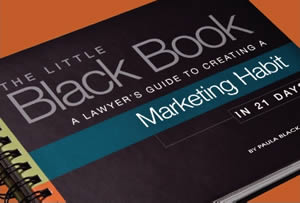
Creating a Marketing Habit in 21 DaysPaula Black has just published The Little Black Book: A Lawyer’s Guide To Creating A Marketing Habit in 21 Days.

Having got my hands on a pre-release copy, I can say that not only is the book beautifully produced (the sort you'll want to keep flipping open and dipping in to) but it's filled with the sort of practical hints that can really help ingrain a marketing mindset.

And as I've repeatedly written, the key differentiator between successful Rainmakers and “also rans” is that Rainmakers have a repeatable business development system. Sometimes it's unconscious – they just get on and “do their thing” when needed. But a great many highly successful business developers have developed their skills and their “system” consciously. This book is a great way to do that for yourself. It's not a book of heavy theory or completely new ideas. Just practical tips and advice – the “blocking & tackling” we all need to do become effective marketers.

The first part of the book is a day-by-day activity guide to ingrain client-focused marketing habits into your psyche. The second is a guide to developing a marketing plan, focused on your current and former clients, marketing within your firm, and marketing by joining organisations. the final part is a series of marketing “pearls of wisdom” from successful lawyers.

48 Hour Deal: 34 Free Gifts for Purchasers of the Book

For the next 48 hours, Paula is running a special deal where anyone who buys her book via the Law Marketing Portal can claim “The Smart Layer's Toolkit” – 34 ebooks, free subscriptions, podcasts and other gifts.

Among the contributers to this are:

  • Larry Bodine on “Thinking Like a Rainmaker”
  • Josh Fruchter on “The Top Ten Law Firm Website SEO Best Practices”
  • Julie Fleming on “The Reluctant Rainmaker: A Guide for Lawyers Who Hate Selling”
  • Patrick J McKenna on “Getting Unbeatable Testimonials”
  • Paramjit Mahli on “How To Grow Your Law Practice on a Shoestring Budget…Media Relations”
  • David Barret on “Social Media for Lawyers”
  • and a contribution from myself: “Building Your Client Base Through Referrals”

Go to Paula's Law Marketing site to order and get the free gifts.

Featured

Strategy

Referrals: You’ve got to have a System

Posted on June 13th, 2009.

Referral PartnershipsWe all know that referrals can be the most powerful and profitable source of new clients. Yet most of us find that we’re simply not generating enough referrals of a high enough quality to reach our practice growth objectives.

What's the problem here? Are we mistaken in our assumption that referrals are such an effective business development method? Or is it an execution issue – we're simply not going about it in the right way?

For most professionals it's a bit of both.

While all the evidence highlights that our clients rely on referrals as their most trusted source of information on new suppliers; we've got to remember that not all referrals are created equal.

Unfortunately, some referrals can be little better than random cold calls. You get the name and number of someone who may or may not need our services, may or may not be able to afford them, and may or may not see the referrer as a credible and trusted source.

So it's our ability as professionals to work with our clients and partners to deliver the quality – not just the quantity – of referrals that will make all the difference to our success with them.

Do Referrals Work?

“Referrals from Colleagues” and “Referrals from Other Service Providers” were identified as the #1 and #2 method used by buyers of professional services to identify and learn more about providers in the 2009 RainToday.com Benchmarking Study “How Clients Buy”.

Because of the complex and intangible nature of professional services, buyers look for help to assess two critical criteria for selection:

  • “Can the provider do the job?”, and
  • “Can I work with them?”

They take clues from their personal interactions with the providers (at seminars, presentations and sales meetings) and from the experiences of people they know and trust.

And despite the increasing prevalence of online “relationships”, the people they turn to for recommendations are their colleagues and other service providers they have worked closely with. In other words: people whose judgement they respect.

For infrequent or “distress” purchases which are bought because of an immediate or unexpected need (for example, many legal and consulting services) the reliance on trusted third parties is even bigger.

Buyers won't invest in building a relationship up front with a provider of services they don't know they'll ever need. So instead, they rely heavily on the opinions of those they trust with experience themselves.

So do referrals work? The answer is a resounding “Yes” – if done correctly.

You've Got to Have a System

In his classic work Creating Rainmakers, Ford Harding highlights that although successful business developers are very diverse in terms of background, personality, style and approach – they all share one common factor: <u>they all have a “system” for generating business</u>.

That system may be hugely different between Rainmakers, with one relying on networking, another on cold calling, another on writing and speaking.

But all of the successful Rainmakers had developed a method which <u>worked for them</u> which they could employ repeatedly and effectively without having to think from scratch of what to do.

When needed, they were able to “switch on” their system and carry out the steps which would bring them more business.

In contrast, less effective business developers either tried to “wing it”, or had to spend so much time reinventing a system – gathering contact details, developing a script, identifying networking meetings, or writing an article – that the opportunity was lost.

It's the same with referrals. Although we all know how powerful referrals can be, how many of us take a systematic approach to generating them?

Not many in my experience.

Professional firms wouldn't dream of investing marketing budgets and non-billable time into advertising, speaking campaigns, seminars, website development or thought leadership without a thorough analysis and plan for how that investment would pay off.

Good marketing plans identify target clients for each approach, refine the firm's positioning and specify the messaging to be used.

They identify clear objectives for each area and the sequence of activities and critical success factors necessary to achieve those objectives. They carefully allocate non-billable hours and budget to each activity to try to maximise the overall returns.

Yet when it comes to referrals – potentially the most powerful approach of all – most firms simply leave it to chance.

At best, they encourage and remind partners to “ask for referrals”. But no thought is put into which clients to ask, how to ask, what to ask for, how to “earn” a referral, etc. At worst referrals are simply not mentioned at all.

These firms are hoping that their good work will result in positive word of mouth and spontaneous referrals. Sadly, research by TARP in the US has highlighted that referrals simply don't happen spontaneously.

When it comes to dissatisfaction:

  • An unhappy customer will share their bad experience with an average of 12 other people (in my case, when it comes to bad customer service at John Lewis, I share it with thousands via this blog)
  • Each of those 12 people will in turn mention it to 6 others.

Unfortunately, when it comes to a satisfied customer:

  • A happy customer will share their experience with just a few friends;
  • Those friends will not remember much and will not share that information with anyone at all.

Essentially, without further proactive work from the service provider, positive “word of mouth” ends with a few friends and colleagues of the satisfied customer.

So professionals and their firms who want to get more from referrals need to get serious in their approach.

They need to develop and implement a plan to proactively address all the key elements which influence both the number and the quality of referrals received.

Featured

Mindset

Why You Should Enter Your Contacts in Your CRM System Yourself

Posted on May 10th, 2009.

Typing into my Contact Management systemAs businesses grow, they very sensibly begin to delegate or outsource “administrative” tasks. One such task is often the inputting of contact details from business cards into the contact management or CRM system. The task is typically delegated to junior staff, or nowadays a virtual assistant or service such as Shoeboxed.

As a sole practitioner I need to outsource as many administrative tasks as possible to preserve my time to focus on marketing, sales and client work. But inputting contact details is one task I keep myself.

The task isn't hugely onerous – but it does take time. I'm prepared to invest that time for three reasons:

  1. I always recall useful details of my interaction with the contact that I can enter in my system – but that I didn't capture at the time in a way an assistant would be able to transcribe. Like many people I write useful notes on the back of people's business cards. But, of course, I never capture everything. Typing in the contacts details often triggers useful memories which I can then put in the system.
  2. It embeds the contact's details in my mind and makes it easier for me to remember them in future – particularly if I spot something interesting for them, or think of something I can do to help them. As I've discussed before, I review my contact list monthly (weekly for high priority contacts) to try to see if there's anything I can do to further my relationships. By embedding the contacts details in my mind, a lot of this activity happens automatically during the month anyway.
  3. It triggers me to think about immediate follow-up. If there's something useful I can do for them within a few days of the event we met at, I will become much more memorable to them and be remembered with gratitude rather than just as a contact. A few minutes invested in thinking about what they said, the needs or interests they expressed and about the resources I might have access to that could help them always pays dividends.

Now, of course, you could get an assistant to type the raw details in, and then review yourself and do the tasks I've just talked about. But that has really never worked for me. I need the physical prompt of being forced to type the details to make me get round to thinking about the contact and potential follow-up.

So for me, this admin time is time very well spent indeed.

Featured

Marketing

Sales Excellence Podcast – Episode 4 : Lead Nurturing

Posted on April 30th, 2009.

In most businesses, between 70-80% of your leads are long term. They're potential clients who pass all your qualifying criteria – but they're just not ready to buy right now.

Ideally, you want to begin to build a relationship with these potential clients so that when the time is right to buy, you're in the front of their mind.

Unfortunately, most firms tend to drop leads the moment they find out they're not going to close in the short term. This is a huge mistake. Almost all these potential clients will buy from someone in the next 24 months. The role of Lead Nurturing is to make sure that someone is you.

Featured

News

Pain at John Lewis – a lesson in awful customer service

Posted on April 22nd, 2009.

One of the prerogatives of being a fairly well read blogger – especially of a sales related blog – is that every now and then you get to rant about a bad customer service experience you've had.

This is my time.

And it's a doozy.


I've just spent the best part of an hour being grilled by the security staff at John Lewis in what I would describe as a deliberately (policy driven) accusatory manner. I've been a very valuable customer for them over the years and they've just lost me for life.

I went to John Lewis today to buy some stuff – a solar charger for my iphone and a new wallet. For those outside the UK, John Lewis is a well known national chain of department stores – they usually have pretty good items at good prices – and they have a good reputation for customer service. They're fairly unique in that they are owned by the 69,000 employees (or partners as they call them) and were voted Britain's favourite retailer in 2009. Well, they're certainly not my favourite now.

After I'd bought the solar charger I started looking at wallets. The reason I wanted a new one was that although my current one works well in a jacket pocket – it's just too big to slip into the pocket on a pair of jeans or trousers if I'm not wearing a jacket. I wanted a nice looking one – but the main criteria was that it was small.


In order to find the right wallet I spent quite a bit of time at the stand testing them out. There were some very small ones – just big enough for a few credit cards, and some slightly bigger ones which allowed more stuff to fit in them. I took my existing credit cards and tried them in the new wallets, putting the wallets into and out of my jacket and trouser pockets to test. At one point I went to the counter to buy the very small one – then had second thoughts and tested it with some extra cards I have in my wallet and found it a very tight fit for them. So I went back to the slightly larger ones – some nice Ted Baker branded leather wallets. I “umm'd and ahh'd” for a bit over the choice of a black leather one matching most of the other stuff I carry, or a cooler brown leather one. In the end I went for the plain black leather one.

I tried to check out the prices of the wallets – but struggled to find any price tags (I later found out the tags are usually inside the wallets – I was looking on the boxes). The wallet I wanted was next to two empty boxes – one with a price in it and one without (to be honest with all the swapping and moving I have no idea which box it was originally in) – but both were Ted Baker boxes.

I put the wallet in the box with the price tag and took it to the counter. When I got served, I specifically asked the assistant to double check the price of the wallet as I wasn't sure I had the correct box and I wanted to make sure I was paying the correct price.


He disappeared for a few minutes and then came back and confirmed the price on the box was correct – a relatively cheap £35.

So I bought it, and after fiddling with my iphone for a bit, left the store ready to head home.

Outside the door I was confronted by three big security guards. One asked me to show him what was in my pockets, which I did (I actually had the new wallet in my hands at the time and was busy transferring my credit cards into it as I walked). After confirming that, of course, I didn't have an extra wallet anywhere, they said they still wanted to take me to the security area so I was escorted back through the store into the private room they have.


When there I told them I wanted to record the conversation we were about to have on the voice recorder app on my iphone (it would have made a fun podcast!) – they disappeared for 10 minutes and came back saying that they had been told by group security that in would be “inappropriate” to record it on a mobile phone (!?!).

They then took my name and address – and then told me that they suspected me of something called “ticket swapping”. Apparently this is where someone swaps the price tag on a high priced item for a lower priced tag.


I explained how I had been selecting my wallet and trying out sizes and that I understood it may have looked strange. I then explained how there had only been one box with a price on so I had picked that but had deliberately asked the sales assistant to confirm the correct price so that I didn't under or over pay. I checked with them that they'd spoken to the sales assistant and confirmed this had happened.

“OK I thought, that's that cleared up. They're only doing their jobs – but now they understand what happened I'll get an apology and it'll all be over with”.

But no.

I did get an apology of sorts. The main security guard offered his apology saying “there's been confusion and mistakes on both sides. On this occasion we're prepared to let you leave right now.”

I did a double take. What did they mean “mistakes on both sides” and “on this occasion” – what “occasion” is this? Me buying for and paying for goods and taking extra steps to make sure I paid the right price.

So I checked with him: “Are you agreeing that you were mistaken and that I made sure I paid the correct price? Or do you still think I was up to something?”


He stated that in his view “A ticket swap was attempted – but I (the guard) intercepted this and made sure the right price was paid”.

I couldn't believe it. I checked again. “Look, I specifically asked the assistant to check the price and make sure it was right. There's no way I could have been trying anything. Think about it – I deliberately made sure I was paying the right price.”

But he wouldn't back down.

“Are you still accusing me of trying to do this ‘ticket swap' thing?”

“Yes”.

Unbelieveable. I go out of my way to make sure a mistake isn't made – and I get accused of trying to steal something.

Well, that was it for me.

As it happens, I am absolutely scrupulous about honesty. If I get undercharged for things or get an accidental refund I will point it out and pay the right amount. The flip side of that is I am absolutely relentless if someone accuses me of dishonesty.

Despite his apologies he was not going to admit he was wrong. He was still accusing me of theft.

Obviously I called for the manager – I was furious.

To his credit, the manager listened to my story and apologised. He said all the right words – but it still hurt.


I wouldn't leave until the security guard backed down and admitted I was clearly innocent. Maybe it's just me but I couldn't leave there knowing that someone – for whatever foolhardy reason – thought I was guilty of something. It just seemed so obviously wrong to me.

After they backed down I went downstairs with them just to make sure – for my own sanity – that I hadn't been undercharged. I didn't want to walk out of that store thinking “perhaps an accident did happen and I've paid less than this is worth”. And of course, the assistant confirmed I'd paid exactly the right amount. Of course I had – I'd asked him to double check originally.

The guard walked out of the store with me. (Eventually) he was apologetic. But even then I couldn't help thinking – “Is he just saying this because it's ‘good customer service'?” “Does he really believe he was right all along?”.

I'm still thinking that now – and I hate it. I can't bear to think that out there someone thinks I've been dishonest and “got away with it”.


I'm not naming the individual security guard. I really don't think it was specifically him. Clearly guards are trained to be suspicious – to distrust. They need to do so to do their job. My issue is with the procedures they followed.

The problem was that the whole procedure seemed designed on the assumption I was guilty. So even when
it became startlingly clear that I had in fact gone out of my way to be honest – the guard just couldn't accept it. The words he'd been trained to use – apologising without admitting a mistake; then admitting a “partial mistake” but still claiming that I was guilty. Then trying to close the issue (by “letting me go this time”) without resolving the mental turmoil that any genuine customer would have been going through.

And what if I hadn't gone the extra mile and asked the assistant to double check the price? What if I'd just done the perfectly reasonable act of picking the nearest box to the wallet and taking that to the checkout? Would they ever have backed down? I'd probably still be there now. I'd never have got any mental resolution to the issue of being under suspicion. And my God, it was so painful to be treated with such suspicion – that was a real revelation for me.

A simple step for them would also have been to check my name against their customer records (they had plenty of time while they were “checking with legal”). While having spent thousands with them over recent years isn't a guarantee of my honesty – it would have told them what they had at risk, and that maybe they should proceed carefully and try to ensure that the process was as painless as possible for me.


And their procedures let them down with follow-up. When they thought I was guilty they wrote all my details down. When it became clear I wasn't, they gave me back the sheet to prove they were keeping no records of the incident. But they have also kept no records in order to redeem themselves. They have no idea who I am or how to contact me. Now they can't follow-up to apologise or do anything. Their much heralded John Lewis Customer Service has no chance of working.

So what have I learned from this?

Well, firstly it's reminded me that blogging is a pretty cathartic experience. I feel rather better for having written about this. Perhaps I should have written this as a letter of complaint rather than airing their dirty laundry in public. But – bah! I'm a blogger Goddammit.

Secondly, it's really driven home like a nail just how important customer experience is in selling.

I've spent literally thousands of pounds in that John Lewis store over the years. From prams for the kids when they were born, to toys, tons of electronics, some artwork and home furnishings, right through to some lamps last week. They're a good store with good products and excellent value – I know that rationally. They have good principles – I've seen them, and I know people who work there and they're lovely people. But right now I cannot imagine myself ever shopping there again. This incident has cost them many thousands of pounds (not counting the bad PR from all the people I inevitably rant to – and the people who read this).


We all talk and advise our clients about the importance of good service and making amends when something goes wrong. We all know it rationally. But you never know it fully until you experience it yourself. I'm still fuming over an hour later. My pain will be rekindled later when my wife gets home and I tell her about it. As I said, I can't imagine ever shopping there again.

Now let's put this in perspective: I haven't lost a loved one, been detained illegally for years, or been beaten for being somewhere in the vicinity of a protest march. I've just had a bad experience. But it shows how something as rationally small as this can have such a huge emotional impact on customers.

Finally, it's highlighted the importance of making sure you have a way of making amends properly. They let me walk out of that store with no way of contacting me again. Now sure, I might not have wanted to give them my details – but they didn't ask. As it happens, even requesting my details so they could follow up, perhaps do a “post mortem”, would have made me feel better. What I really want is for them to review their policies so that innocent customers aren't made to feel like criminals like I was. But I'll never know if that's happening and they have no way of telling me if it is.

Well, rant over. Thanks for staying with me. Hopefully we learnt a little along the way about how to treat customers and how to make sure you have an avenue for making amends.

Ian


Featured

Selling

Sales Velocity: The Hidden Lever

Posted on April 21st, 2009.

It seems to be a trend at the moment amongst sales gurus to highlight that “there are only three ways to increase sales”: More leads, higher conversion of leads to sales, and more revenue per sale for example.

Leaving aside the fact that pointing this out is hardly a revelation – and that the real value comes not from naming the three levers, but from actually figuring out the best way of “pulling” them for a specific business; in fact there is another, often overlooked lever: velocity.

Sales velocity is the cycle time of the sale from initial lead to closing. Complete that cycle faster, and you free up time to work on another sale. Double the velocity of each sale – and you can sell twice as much.

Of course, it's not that simple: of all the sales levers, velocity is often the most difficult to improve. Push too hard too fast and your potential client will push back. There's often an optimum pacing for each sale and to go faster than that optimum can in often lose you the sale completely.

Veteran salespeople are used to naive sales managers pushing them to try to accelerate a close to hit this month's or this quarter's targets. But there's a huge risk that pushing to hit an internal target can damage your chances of making the sale. And it's one of the easiest negotiating weapons for purchasing professionals: if you know when your salesperson's quarter-end is you can often get a huge discount by timing your purchase right so that the salesperson gets desperate as the end of their reporting period looms.

But putting that aside – velocity can often be a valuable area of focus for improvement for salespeople – simply because most salespeople rarely consider it.

The best way of looking at the sales velocity lever is not to think about speeding up – but instead to think about avoiding delays and removing roadblocks.

Roadblocks can take many forms: you don't identify underlying client concerns early enough and as a result they hesitate to make a decision; you forget to follow-up on time or wait for your client to take the initiative; you're not aware of the timing of financial approval committee meetings in your client's company and as a result your client misses the deadline for submission and has to wait a quarter.

One of your key jobs as a salesperson is to know what these roadblocks are likely to be and to make sure they don't happen. Work to surface concerns early on and address them, never be late with follow-up, understand the client's decision-making process (see my post Avoiding the Treacle Effect for more details of this one).

Your first step though is to understand the impact of velocity: simply put, halving the cycle time of a sale can have as much impact as doubling your conversion rate or number of leads. Having that message in the front of your mind, should help you pay attention to this hidden lever and suddely you'll spot opportunities to avoid delays and remove roadblocks.

Happy driving!

Ian