Ian Brodie

Ian Brodie


Navigation
AuthorIan Brodie
Ian Brodie

Ian Brodie

https://www.ianbrodie.com

Ian Brodie is the best-selling author of Email Persuasion and the creator of Unsnooze Your Inbox - *the* guide to crafting engaging emails and newsletters that captivate your audience, build authority and generate more sales.

Featured

More Clients Memorandum

Beliefs is another name for objections

Posted on September 5th, 2021.

Our last few emails have been about this idea that your content needs to establish certain beliefs in the minds of your audience to get them ready to buy.

Great in theory. But how do you know what these beliefs are you have to establish?

Some of them are obvious of course.

People need to believe they have a big, urgent problem before they'll be ready to buy. And they need to believe you have a solution that will work for them.

But many of the crucial ones are unique to you, the services you sell and the type of clients you work with. How do you know what those one are?

The best place to start is objections.

The questions people ask and the reasons they give why they're not ready to buy.

Nine times out of ten objections are just questions your potential clients have that you haven't answered to their satisfaction yet.

If you're talking to them face to face you answer those objections when then ask them.

If they ask if you've worked with others in their industry you tell them.

If they say they're concerned about the disruption and time out your consulting project might cause you tell them about how a well organised project actually saves time and motivates rather than disrupts.

If they raise concerns about the cost you discuss the value they're going to get.

When you're selling face to face, people tell you their objections so you can answer them.

But if you're marketing through content, they don't. You don't know which objections your individual audience members might have. So your content has to answer all the most common questions.

That's one of the big reasons sales pages are so big. They have to answer all the potential questions a buyer might have.

The advantage of marketing with content is you can deal with these objections over time with your different emails, blog posts or videos.

It doesn't feel like you're bashing them over the head with your answers or fighting them.

Done well, you're answering their questions just as they're beginning to think of them. It all feels natural and unforced.

And bit by bit, they're getting more ready to buy.

So the next step in planning your content is to list all the major objections or questions your clients typically have so that you can build the answers into your content.

Featured

More Clients Memorandum

Look outwards for ideas

Posted on September 2nd, 2021.

For me, the best way to become more productive at creating content is to get good ideas faster.

For most of us it's much more likely that we get stuck staring at a blank screen than it is for us to get a great idea but get bogged down halfway through writing it.

That's why when I run writing challenges for clients and supply the topics they almost always coast through it and get their writing done pronto.

But ask someone to come up with an idea and write about it on the spot and they go all deer-in-headlights.

The problem is usually that when we try to come up with ideas for content we reach inside. And that's been exacerbated in recent years by this pernicious idea that the only good content is some kind of hero's journey story that sees you overcoming your fears, slaying demons and triumphing against all obstacles.

My experience is a bit different.

Yes, some of my best content has been stories from my past. But the majority of it has come from graft. From research. From looking outwards not inwards.

I've written a lot and very successfully about how to get atttention. That didn't come from my own rags-to-riches experience. It came from me reading everything I could get my hands on about the art and science of getting attention. And then trying out some of those ideas in the real world.

The same goes with value-based marketing, building authority, nurturing relationships.

All based on researching a topic. Reading around the edges. Keeping my eyes open for interesting examples. Weaving in my own experiences. Experimenting and trying things out.

Our own experiences makes us unique. But they're the spice that makes things interesting, not necessarily the meat and two veg.

I don't have a rags-to-riches story to tell. My life story won't reduce you to tears or have you whipping out your credit card when I whisper the line “if I can do it, so can you”.

But I do have lots of valuable and interesting content – because I've looked outwards, not just inside for ideas.

And that's definitely something you can do too.

Featured

More Clients Memorandum

The surprising secret of consistency

Posted on September 2nd, 2021.

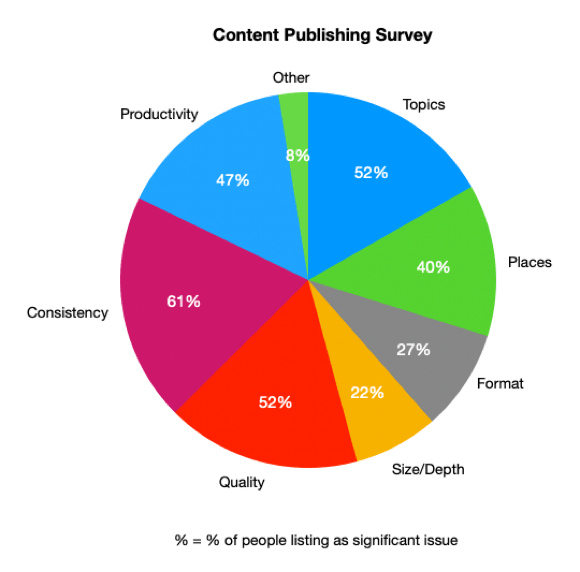
Being able to create content regularly and consistently came out #1 on my recent survey of challenges with content publishing.

And my experience is that the secret of consistency is [drum roll please]…

Success.

Wait. Shouldn't that be the other way around? Shouldn't the secret of success be consistency?

It should. Consistency does lead to success.

But success leads to consistency too. And it's an important link.

I was going to fill today's email with lots of tips for freeing up and scheduling your time and getting in the right mindset to create content consistently.

But when I thought about it I realised that none of the clever tips and tricks to help you write more consistently are really going to work if you don't truly believe that creating content will lead to the results you're looking for.

If I have to do something but I'm not sure it's going to work I'll dab at it. Do a bit here and there. But give up and move on to something else after a few attempts.

I think most of us are like that. 

And being a bit of a skeptic (#understatement) I tend not to take things on faith. You won't find me writing hundreds of words a day just because some marketing expert told me it'll work.

But I do write hundreds of words a day. Sometimes thousands.

Not because someone has told me it will work. But because it has worked. For me. Again and again.

So I realised that the best way to help you create content consistently was to show you ways to get results fast with your content.

Because once you've had success for yourself with content, you'll find ways to be consistent. 

Now those successes might not be big wins like people hiring you (yet). But I know from experience that you need to see solid progress towards your goals to keep going.

So we're going to look at getting results from your content first, before we look at tips on getting consistent. And there's a good chance that once you're seeing results, you won't need any tips on getting consistent – you'll sort it out for yourself.

Tip#1 is easy: use more calls to action.

Most of us – me included – don't have enough calls to action in our content.

We hope our readers or viewers will be so impressed with our content they'll rush to our website or drop us an email and ask us to work for them.

99.99% of the time they don't. 

But with a bit of prompting, many of them will.

Maybe not to hire you – but to take an easy next step like answering a question. Do that a few more times, interact with them, and they're well on the way.

I'll talk more about interaction next email. But for now, just make sure you have a call to action in your next piece of content.

It could just be a PS at the end.

Or you could do like Drayton Bird did when I interviewed him for a podcast years ago and put your call to action at the start. Because, of course, even in the best content, more people read the start than make it all the way through to the end :)

Featured

More Clients Memorandum

Sequencing your content for more impact

Posted on September 1st, 2021.

Last email I seeded the idea that for big important content, you ideally want to create a sequence of content where you've thought through the beliefs you want to establish in order to warm up your potential clients and get them ready to buy.

A bit of a mouthful, but I'm sure you get the idea.

So your first step is to plot out what those beliefs are and the order you want to touch on them. 

It starts with understanding where your potential client is when you first begin to communicate with them.

If they've signed up for some kind of lead magnet and are on your email list you can be reasonably confident they have a problem or goal that your lead magnet talks about.

So they're at least aware they have a problem. Your content can start by expanding on the impact of the problem and giving useful ideas to help them solve it.

If you're posting content on a blog or somewhere like Linkedin then you can't count on that.

It's why a lot of content that people think is really valuable actually falls flat. Because it starts talking about solutions before the audience even thinks they have a problem.

If you're posting content to a cold audience you need to start with the symptoms of the problem they might have and help them diagnose whether they have it.

This doesn't have to be long and drawn out, but it's crucial that you do it.

In Michael Hammer's classic Harvard Business Review article from 1990 that introduced Reengineering to the world he begins not by talking about his big new idea, but about the problems it addresses.

How big they are, why they exist, and how traditional methods of solving them just aren't working.

It's well worth a read of the article just to see how he builds the case for change (and therefore the case for hiring his consulting firm).

It's all about the sequencing.

No matter how great your ideas, hints ant tips are; if someone doesn't think they have a problem they're not going to be interested.

Or if they think the problem is small.

Or they think they can fix it just by working a bit harder or making small changes to what they're doing.

So you have to talk about problems first. Then their impact. Then how other approaches won't fix them.

Only then will people be open to your great new ideas.

Featured

More Clients Memorandum

When to wheel out the big guns

Posted on August 29th, 2021.

There are typically two reactions when I start to talk about the content framework I shared in our last email where you think through the details of what it takes for potential clients to be ready to buy.

One is “wow – that's brilliant – I can see how that will work perfectly” (and I did indeed get a few emails back saying similar).

The other is “wow – that sounds like so much work – you can't possibly do that whenever you create content can you?” (you guys were too polite to send me emails saying that, but it's the kind of thing I would have been thinking).

Both responses are right.

By thinking through the specific beliefs you need to establish for your potential clients to be ready to buy you significantly increase your chances of it happening.

But it is a lot of work.

It's not something you'd do for every email or article at all.

If you're writing a quick ad hoc piece of content you may have the ideas in the back of your head to make sure you touch on some of the points. But you don't formally work through them.

Or if the goal for your content is less about getting people ready to buy and more about getting your content shared (a typical SEO goal) then you tend to be writing more to hit “share triggers” than you are to hit “buying hot buttons”.

Or if your goal is simply to send something useful to keep your relationship bubbling along without a specific sales goal then you tend not to get so formal with content frameworks.

I don't have anything to sell related to these current emails for example. There's no “content publishing masterclass” on offer or a “call me and we can talk about how I can help with this”. So I've focused on how the content can be helpful rather than thinking about getting anyone ready to buy.

But there are specific times when it really pays off to use the framework.

When people first join your email list for example.

That's a process that lots of people will go through. And the reason they're joining your email list is usually to get some kind of useful information to help them with a problem or goal.

So thinking through what it will take to get them ready to buy and then sequencing your initial autoresponder emails to hit those buttons will have a big ROI.

Whenever you launch a new product. Or you're building a webinar. Or any time you're investing time and money to sell something…

…you'll get much better results if rather than thinking “how can I persuade them to buy?” as a one-off, you think “how can I get them ready to buy over time?”

Persuading cold prospects to buy something big in one event takes world class marketing skills.

But warming people up over time so they're ready to buy is much easier.

And it has a bigger effect. Because even if they don't buy then, they're much closer to being ready to buy next time, or the time after that.

So pick your moments.

Next time we'll jump into how.

Featured

More Clients Memorandum

You can’t succeed with content without this

Posted on August 25th, 2021.

It's a beautiful day here in Sunny Handforth. Bright sky. Blue tits tweeting in our trees. I'm full of foolish optimism that Newcastle will beat Burnley in the EFL Cup tonight. 

Just the right time to talk about “big stuff”.

Because when it comes to publishing content, if you want to succeed you have to start with the big stuff: being clear on your goals.

If you're not sure where you're heading with your content it's almost impossible to produce quality, engaging content consistently.

And even if you could, what would be the point if it didn't help you achieve your goals?

When it comes to goals for your content, everyone is somewhat unique. But in truth, we're all rather similar too.

For the vast majority of us, our big goal will be something to do with getting more and better sales through our content. 

More customers. Higher paying, better quality customers. More repeat sales from existing customers. Higher margin sales.

In other words our long term goals all have something to do with people parting with their hard earned cash.

And that's not going to happen on its own. Your content has to persuade them to do that.

One of the original definitions of content marketing was that it was about “sharing valuable information with potential customers so that ultimately they reward us with their business”.

Unfortunately the world rarely works like that.

You can't just throw useful information at people and expect that when it comes time for them to buy they abandon all their normal buying criteria and emotional responses and instead buy from you to “reward you” for sending them that useful information.

I don't buy like that, and I doubt you do too.

Providing useful and engaging information definitely helps.

When someone does that it makes me feel a bit more positive towards them. It probably raises their perception in my mind as an expert and useful resource. And it certainly makes me much more likely to pay attention to communications from them.

But on its own it's nowhere near enough to get me to buy.

So if your goal is to get people to buy, you need to understand a bit more about what it is that actually makes them buy. And then the content you publish needs to touch on those areas.

Luckily it's not rocket science. Most people tend to buy consulting, coaching and training services under a set of specific circumstances:

  • They have a problem or goal they want to achieve that they feel is worth investing time and money in solving
  • They believe that it's actually possible to solve that problem (or achieve that goal)
  • They feel that what they're doing right now isn't working to solve the problem – and small changes won't get them there
  • They believe that you understand them and are on their side
  • They believe you have the expertise and/or an approach to solving the problem that will work for them – and is different to the things they've tried (and failed with) in the past
  • They believe your approach is either the only option, or the best value option for them
  • They believe now is the right time to address this problem

You could probably write those a bit more succinctly. And you could probably make a list more specific to your situation.

But the point is that all these factors are beliefs, feelings and perceptions. And they're all things you can influence with your content.

  • You can highlight problems your potential clients didn't know they had (with a self-diagnostic for example).
  • You can show them the true size of a problem or opportunity to make it clear it's a problem worth solving.
  • You can share case studies of people who've successfully solved similar problems along with how they did it so they come to believe it's possible for them to solve it too – if they do something different.
  • You can share your story of how you faced similar problems, or demonstrate real insight into how the problem affects them so they know you're on their side.
  • You can explain your unique methodology and approaches and how they work better than what they've tried before.

That's what I mean by being clear on your goals.

Not just a high level goal of getting more sales.

But goals for what beliefs and perceptions you want to instil in your audience so they become ready to buy from you.

It just takes a little bit of time to brainstorm them and write them down. And you don't have to get them anywhere near perfect.

Then you can remind yourself of them when you sit down to create a big piece of content and think “which of my big goals is this going to help with?”.

And you'll naturally have them in the back of your mind when you do something more ad-hoc too.

So that even without using any fancy marketing techniques your content will almost automatically become more persuasive and effective.

And with that as the context, our next email will start to look at the specific challenges with content you identified.

Featured

More Clients Memorandum

Content Survey Results

Posted on August 22nd, 2021.

Huge, huge thanks to everyone who took part in my survey to find out your biggest challenges and issues when it comes to regularly publishing content for marketing purposes.

Five big topics came out as major concerns:

  • Being able to publish consistently and regularly
  • Knowing the best topics to create content about
  • Being able to create interesting and engaging content
  • Being productive when creating content
  • Knowing where best to publish your content

In addition to the “biggest issue” you also gave me dozens upon dozens of specific questions to look at which is going to be really helpful.

So over the next few weeks my emails will focus on the big topics and those specific questions – and hopefully they'll help you get better results from your content.

To start off I have a quick tip for you today that could help you with that biggest issue of publishing consistently and regularly. And it'll also set the context for the advice I'm about to give you in my next emails.

Because one of the biggest problems I think we all face that causes us to hesitate, procrastinate and just not get our content out anywhere near regularly enough is too much good advice.

I'm sure you've been told that when it comes to your content it needs to be hugely valuable to your audience. And engaging and interesting. And it needs to lead them step by step to being ready to buy. And you need to establish your credibility and build trust. And and and…

All of it is good advice.

But if you try to do it all for every piece of content it can be incredibly overwhelming.

And because doing things “right” feels like such hard work, you end up not publishing anything.

In an ideal world you'd have the time and bandwidth to plan all your content strategically. To create series that engage, entertain and give value, while leading potential clients through every step needed to get them ready to buy.

I do that for some of my content. But by no means all or even the majority.

With most content my goal is just to do something decent.

A little bit of value. A little bit funny. Something interesting.

As long as it's good enough that you leave with a positive impression it doesn't have to be earth-shattering. And it doesn't have to meet all or even a fraction of all those best practices.

Every now and then you'll want to take a step back and plan something more strategic that does hit more of those best practices.

But trying to do that with every piece of content will hold you back.

The impact of good content is like compound interest. A little bit every week accumulates and grows.

Every time you overthink and put off publishing because you've got something good, but not good enough is a time that someone else is squeezing in to your clients' limited share of mind.

And squeezing you out.

So with all the tips and idea I'm going to share over the next few weeks don't try to do all of them at once. And don't give up if you can't tick every best practice off with every piece of content.

Just implement what you can every week and make sure you get something decent out of the door.

Because decent content that gets published is infinitely better than world-class content that doesn't.

Featured

More Clients Memorandum

Beat bad psychology with good habits

Posted on August 15th, 2021.

I'm sure it's no surprise to you to hear that the people most likely to buy from you in the future are the people who've bought from you in the past (or came close to buying).

That's why you'll hear so much advice telling you to get back in touch with your ex-clients, your old contacts or your “nearly bought” prospects. And then to keep in touch with them.

The problem is, it's hard. Really hard in my experience.

The reason most of us aren't in regular contact with old contacts and clients isn't because we don't know how valuable it is. It's because we find it difficult.

Few of us have the front to just call or email people we haven't spoken to for ages and ask what's up. 

We feel like we need a proper reason to get in touch otherwise it'll be a bit embarrassing and feel self-serving.

And coming up with a “proper reason” every time is really hard work.

So we don't do it.

We tell ourselves they'll call us if they need us. And of course they don't. They have their own worries and concerns and we slip to the back of their minds.

Then they hire someone to do something they'd actually have preferred us to do if they'd have remembered. 

The best way of staying in touch on a regular basis is not to need a reason. It's to pre-establish it as something that people expect.

And although it feels a bit old fashioned these days, it's what an email newsletter does brilliantly.

Once you sign up to get regular tips from me, I show up in your inbox every week.

I don't need to think of a “proper reason” every time. I just press send.

Of course, it's not the same quality of interaction as calling someone and chatting about old times and asking about what they're up to.

But it's infinitely better than doing nothing, which is what actually happens otherwise.

And it's usually enough to keep top of mind and to build credibility and trust too.

Publishing on Linkedin or Youtube or wherever your audience is works in a similar way too. You keep top of mind and build credibility with people who might need your help.

Establishing a regular habit of publishing isn't trivial. But it's way, way easier than coming up with a good reason for getting back in touch person by person.

(And there's no reason you can't do the personal thing on top too. In fact the newsletter can give you something to talk about).

If I had to give one piece of advice these days about building a sustainable business as an expert I'd say “make publishing a habit”.

And in the next few weeks I'm going to focus my tips on how to do that. Starting with a little bit of a survey to see what you'd like to know the most or what you're struggling with.

Featured

More Clients Memorandum

You attract the clients your marketing deserves

Posted on August 11th, 2021.

It would be nice to always attract the clients you want.

But in reality, you attract the clients your marketing resonates with.

On Sunday my email was about stupid marketing mistakes I've made. I got a lot of messages back from people talking about similar mistakes they'd made, or just to say how nice it was to hear the honest truth.

I know that some people's marketing seems to be an edited highlight reel of success after success. Others go the other way and want to talk to you about their traumatic childhood and rollercoaster ride of a life all the time.

I'm kind of somewhere in the middle. I like to hear the real stories of what happens in marketing and business because I find that useful and relatable. But I don't need motivating by someone's “rags-to-riches, if I can do it so can you” life story.

So I market in the the way I like to be marketed to.

I happen to talk about my family every now and then. And football. And daily life. But if you don't want to, that's fine. It means your marketing will resonate more with people who aren't interested in that side of things either – so it's probably a good fit.

In theory you should market in the way your target clients like to be marketed to. But I feel that marketing in a way that you wouldn't respond to yourself is very difficult.

So I've decided that there are enough people a bit like me that I'll make them my target clients so I can market in a way I'm 100% comfortable with:)

That way the marketing I do is marketing that resonates with people I like.

And on the darker side, if you copy the marketing style of an internet guru who talks about nothing but getting huge riches with little effort, you'll probably attract the same sort of clients as they do: people who want to get huge riches for little effort.

Because that's who that style of marketing resonates with.

I guess what I'm trying to say is there are many different ways to do good marketing, so pick one that's true to you.

Just because someone says a particular way of marketing is “best practice” or you can just copy it and get results doesn't mean it's going to work well for you.

Within the broad church of good marketing there's lots of room for you to do things your own way.

Featured

More Clients Memorandum

Stupid marketing mistakes I’ve made

Posted on August 8th, 2021.

I've lost track of the number of stupid mistakes I've made with marketing. 

Whether it's running paid ads to the wrong page and wondering why no one was signing up. Or scheduling emails for the wrong day or sending them out with broken links.

The thing with most mistakes though is that you soon find out about them and you can fix them.

Some mistakes are rather more insidious though. They fool you into believe you've succeeded when in fact you've failed.

Something that gets me time and time again is overcomplicating things.

I've done all the “leading edge” stuff like websites that adapt to different visitors, email sequences that change depending on interests or the pace of the reader, webinars and videos that track how far you get in order to make different offers of next steps.

And it's not like any of these things failed per se.

All of them are decent enough ideas.

And I felt like I'd achieved something when I finally built and debugged all the clever technical whizzes and bangs.

The problem is that these complex tactics take an absolute ton of time and effort to implement and get working. And their impact is usually minor.

A couple of percentage points of improved conversions. A few more people watching videos.

If you're doing things at a large scale with 10s or 100s of thousands of contacts then those few percentage points of improvement are worth having.

But for a small client and contact base the investment in setting it up just never pays back. 

You're much better off doing something “unscalable” like sending a short personal video to your to best clients and contacts. Or upgrading the emails your new subscribers get. Or following up that extra one or two time with people who expressed interest but didn't buy.

It's easy to get tied up in the sugar rush of new tech or fancy new techniques. But you've got to ask yourself whether you're doing it because it's trendy and interesting – or whether it's genuinely going to make a big difference.

Usually the answer is no.