Ian Brodie

Ian Brodie


Navigation
Archive Archive for May, 2008
Featured

Selling

What Makes a Good Salesperson? Answering the Impossible Question

Posted on May 26th, 2008.

There comes a time in every consultant's life when for some unknown reason they feel the need to document their thoughts on the defining characteristics of successful sales people. Well, now it's my time.

Of course, this is a very risky proposition. Inevitably, we all see the world through our own biases and prejudices. No individual's personal view on the characteristics of great salespeople (or great anything) can ever really compare with a more rigorous, scientific study. But often, it's the insights from the experience of individuals that informs and triggers the studies and eventually leads to firmer, more evidence-based conclusions.

I've been lucky enough to work with hundreds of salespeople from over 20 different countries – so at least my own personal, biased thoughts are based on a reasonably large and diverse sample.

So here goes – my top 3 and a bit characteristics of world-class salespeople. Bear in mind that my viewpoint and experience is biased towards people who sell high value professional services:

1. Passion
It's a characteristic that's been highlighted many times before, and something I talked about in In Praise of Passion. My experience has been that the fundamental characteristic all great salespeople share is an absolute belief and passion in the product or service they are selling. That passion infects customers and makes a major difference in the trust they place in the salesperson.

It's sometimes joked that if you can fake sincerity you've got it made. But I've found that almost no one can fake real passion for what they sell. Somehow, some way, customers just pick up on it.

What do you do if you're not passionate about your products? Either get passionate (talking to customer about how they benefit from your product is a good start), get another product you can be passionate about, or get out of sales.

2. Likeability
Before anyone will buy anything from you, they need to trust that it's going to do what you say it will. Sometimes the product or the evidence speaks for itself – but more usually, it's the salesperson who will need to be trusted.

Now it is possible to trust someone without liking them. But in the world of sales, someone who isn't likeable never gets the opportunity to prove their trustworthiness. It's a basic pre-requisite to building relationships.

3. Resilience
As I pointed out in Rejection – Sometimes It Really is Personal, being turned down is just part of the job of a salesperson. Successful salespeople can’t afford to need everyone to like them – they need a thick skin and an ability to learn and move on quickly from failure.

And the final bit – Willingness and Energy to Learn
The pace of change and the need to continually adapt and improve approaches has never been as great as it is today. The salesperson who commits to continuous learning, and applies themself wholeheartedly will soon catch up and outpace more talented rivals who rest on their laurels.

So that's my little shortlist. Passion, likelability, resilience and continuous learning.

Onward!

Ian

Featured

Strategy

Lightbox – 21 Word Home Page

Posted on May 19th, 2008. Banner Blindness

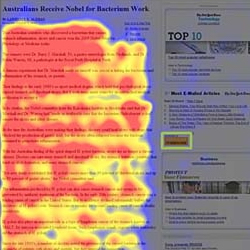
Banner BlindnessIn 1998 researchers Jan Benway and David Lane coined the phrase “banner blindness” for the newly observed phenomenon that web users tended to ignore the colourful, animated banner adverts that had previously been thought to be more likely to be seen.
Over a relatively short period of time, web users had discovered that ad banners tended not to contain information of much value to them – and learned to ignore them and focus their attention on text areas and hyperlinks which were much more likely to contain useful content.

Hence “banner blindness” – web users have essentially trained themselves to ignore banner ads (or perhaps it could be argued that a proliferation of useless banner ads have done the training).

And the same thing happens, albeit more slowly, in the arena of real world sales.

When I first started selling consulting it was fairly easy to arrange meetings with executives. The prospect of a meeting with consultants who might bring interesting and useful ideas to their business was intriguing and unusual enough in its own right to secure a meeting.

Of course, over time, executives' time got tighter, and they discovered that not all consultants brought useful and interesting ideas.

Many claimed to be trying to understand the executive's challenges and needs – but just turned up and tried to shill their products instead. So soon, executives got their gatekeepers to turn down the meeting requests.

Next, we found that by quoting the types of improvement or savings we could make for their business, executives would be more willing to see us. Until, of course, they discovered that almost anyone could call and claim to be able to make 17% cost savings, 26% revenue increases or a 34.875% ROI – without any real knowledge or capability to do so other than in the simplest of situations.

So again, executives got their gatekeepers to turn down the meeting requests.

Today, the most reliable way of securing a meeting is to offer value in the meeting itself – to go through a relevant pre-developed report, white paper, or case studies for example. It's more difficult to claim to be able to do that if you haven't invested the time and brainpower to develop the necessary material.

Hopefully it will be some time before this approach and its value gets diluted (by outsourcing the development of low-quality reports to interns for example).

But the message is clear. In marketing you need to be continually upgrading your approaches – adding more and more value to your client interactions – from initial meetings right up to and after the sale.

If you don't, real world banner blindness will ensure you won't even be noticed.

Onward!

Ian

Featured

Strategy

Selling Without Slides

Posted on May 11th, 2008.

It's a scenario played out in millions of sales meetings every year.

The eager consultant (or lawyer, accountant or salesperson) has finally managed to get a meeting with one of his A list target customers. The customer meets him at reception, takes him to a meeting room and opens with “tell me a little about your company”.

“I'm glad you asked” says our hero as he brings out his pack of slides (or perhaps a glossy brochure, or even worse, his computer) and proceeds to give a thoroughly professional presentation – which unfortunately, does nothing to further the client relationship.

After a brief discussion afterwards the client offers to “call you when we need something in your area”, and the two never speak again.

Of course, it's hardly news that initial meetings with clients need to be about establishing relationships and trying to identify the client's critical needs. The problem is that far too many of us rely on the use of slides or a pre-prepared presentation as a crutch – without realising that the presence of the visual aid can often be a barrier to establishing the relationship we're looking for.

The first problem is that the potential client is no longer having a face-to-face dialogue with you – they're looking at your slides or brochure – or worse still, they're looking at a screen and you're not even physically close to them.

Secondly, if you present material, the meeting changes from dialogue to presentation. From a peer-level discussion to a “master-servant”, “I'm trying to impress you” dynamic.

Finally, the most likely outcome of a presentation is that they begin to ask questions about the presentation. That's what happens when we listen to presentations – they trigger questions and we ask them.

But, of course, at this point it's really you who needs to be questioning them. Trying to find out what they're looking for, what their challenges and problems are.

A far more effective approach is to be able to briefly describe your company in a few sentences, then turn to asking the client about their company, their challenges and what they are hoping to achieve. You can establish your and your company's credibility far more with intelligent questioning and a few “that's interesting, we worked with a client who had what looked like a similar issue recently, they…” follow-ups.

If you need to illustrate points, try a “pencil selling” approach. Have a few blank sheets of paper situated between you and the client and sketch out what you want to show them. It's far more effective and demonstrates your knowledge of the subject rather than just your ability to show slides which could have been prepared by someone else.

Better yet, you can hand the pencil to the client and get them to share in the process – adding in their thoughts and taking co-ownership of the solution or plan you are creating together.

And without the distraction of slides, brochures, or even worse, a computer to look at; you can begin to establish real human to human rapport. This may be the most crucial aspect of all as a potential client is highly unlikely to begin to open up and tell you about any significant problems they have until you establish a base level of trust and credibility with them. And that's so hard to do when you are presenting preprepared material.

So why do we rely on slides and brochures so much?

Very often it's because we have neither the confidence, nor have we done the homework needed to allow us to work without our visual aids. We can't remember all the key points we want to get across, the major benefits to the customer, and our great testimonials. We put all our preparation time into creating the presentation – rather than in thinking about how we should present it.

Ironically, we need to know our presentation and our slides absolutely off-pat – so that we can then do without them and begin to build a real dialogue with our potential client and stand a much better chance of turning that potential client into a real client.

Onward!

Ian