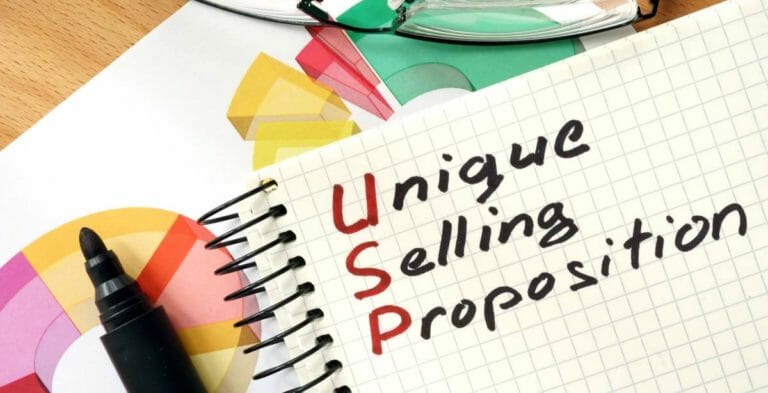
If you've been the recipient of any marketing advice over the last decade or so you'll no doubt have been told that you can't possibly succeed without defining your “Unique Selling Proposition”.
The concept was pioneered by advertising legend Rosser Reeves in the 1940s. Reeves' belief was that each advert should have a USP which:
- Highlighted a specific and real benefit to the consumer of buying the product
- Was one the competition could not or did not have
- Was so strong it could “move the masses” to buy your product
There's a lot to like about this concept. It can be a powerful and succinct way of communicating with your clients – but unfortunately, since Reeves' day it's been mangled and misapplied repeatedly.
Note the order in which Reeves describes his points – start with benefits, then uniqueness.
Unfortunately, the very phrase “Unique Selling Proposition” tends to lead people to start off thinking internally about what's unique about them rather than thinking externally about the value or benefit they bring to clients.
If you start by focusing on what's different about you, you frequently end up with a proposition that just doesn't resonate with clients. There probably aren't many lawyers who wear clown suits – but I wouldn't recommend it as a USP.
For that reason, I sometimes prefer the phrase Value Proposition to USP. It forces you to think first about the value you bring – and then second about how it's different to what others do.
Being able to articulate the value your services bring is particularly important when that value is intangible.
If you help clients with leadership or team building or anything where there’s not an immediate dollar value associated with the results you get for them, then you need to find a way of making that value more tangible and visible. Because at the end of the day no matter how enthusiastic your client is to work with you, when they have to go and get the budget and compete against all the other people looking to spend that same pot of money, they need a really strong business case for why they should be spending it with you.
The first step in developing a powerful value proposition is to review your insights from your ideal client persona to identify their biggest problems, challenges, goals and aspirations that you can help them with. Choose the ones with the greatest financial and strategic impact.
If you end up with a long list, narrow it down to the ones where what you deliver is the most different to what your competitors offer. If needed you can do a simple rating of the value of each area and how different it is on a scale of 1-5 and select the highest scoring ones to explore further.
As you do this, remember that in order to win clients, you don't have to be completely unique and the only person in the world doing something. You just have to be unique in the eyes of your potential client.
In other words you have to be different to the other potential suppliers they're considering, not everyone else in the world. If you're a coach who works with small businesses based in Manchester, it really doesn't matter that another coach in New York does something similar to you. What matters is that you're different and add more value than the other coaches your client is considering in Manchester.
Next, you need to articulate your value in a way that's instantly clear to potential clients.
A good way to do this is to try to put your value into a series of value proposition templates:
- I help [target clients] get [desired outcome] (or I help [target clients] [solve unwanted problem])
- I help [target clients] get [functional value] which results in [bottom line/emotional value]
- I help [target clients] get [desired outcome] without [undesired side effect]
- I help [target clients] get [desired outcome] even if [typical objection]
- I help [target clients] get [desired outcome] with [additional benefit]
- I help [target clients] get [desired outcome] in [specific timeframe]
- I help [target clients] get [desired outcome] using [unique approach]
- The only [unique difference/outcome] designed specifically for [target clients]
The first template is one you'd use in a relatively new or immature market where clients know they have a problem they want to get rid of or an outcome they want to achieve, but there aren't a lot of alternative solutions for them available in the marketplace.
In that case, just telling them you can solve their problem is enough. If you have an issue that's causing a lot of pain but you've never heard anyone offer a solution before it's a huge relief when someone says they can help with your specific problem and you tend not to need a lot more persuading.
More usually though, there will already be people offering to help them with that problem. So you need to offer a solution they see as a better fit for them.
That might be a solution without some of the undesired side effects that normally go with it (e.g. “more sales without becoming a pushy salesperson”) or a solution that addresses some of the common objections your ideal clients have (e.g. “build your own website even if you can barely use Microsoft Word”).
Or it might be they get additional benefits from your particular service, or you get them those benefits in a specific timeframe or with a guarantee, etc.
Use the templates as starting points and triggers for your thinking – not a straightjacket. And get your ideas out on paper first before worrying about wordsmithing them. Once you've identified a value proposition statement that feels the most attractive to potential clients you can strengthen it by making it more specific, succinct and memorable.
In practice, you won't necessarily use the “I help…” format everywhere. It's just a good way of starting your thinking.
On your website home page, you'll probably want to word your value proposition more in terms of what your clients will get. For example “Rapid Sales Growth for Software Startups”.
In that case, you might use “I help software startups grow their sales quickly” in your Linkedin profile or on your About page. But on your home page, you want to make it more about them than you and use the “Rapid Sales Growth for Software Startups” version.
Follow this simple process and you should end up with a solid Value Proposition.
And if you want in-depth training and direct help to do this, Creating a Powerful Value Proposition, is one of the core modules in my Momentum Club Rapid Results Program. If you'd like to start getting better results from your marketing and business development then you can find out more by clicking the button below:
 Ian Brodie on April 28th, 2021.

 It's accepted wisdom in marketing and sales nowadays that every business needs a strong Unique Selling Point (USP).